
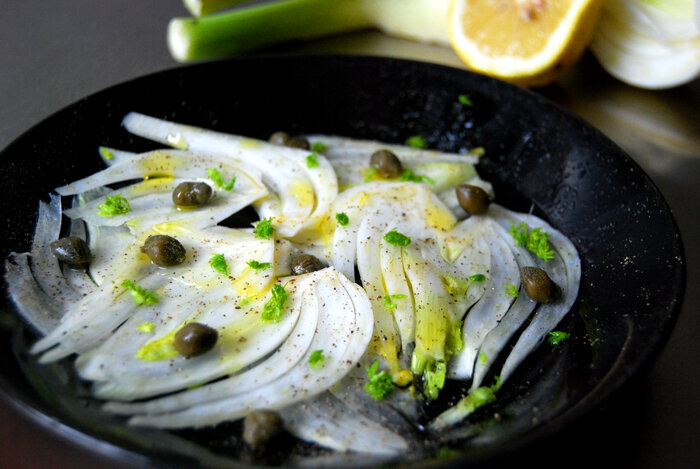
Fennel Carpaccio with Caper and Lemon
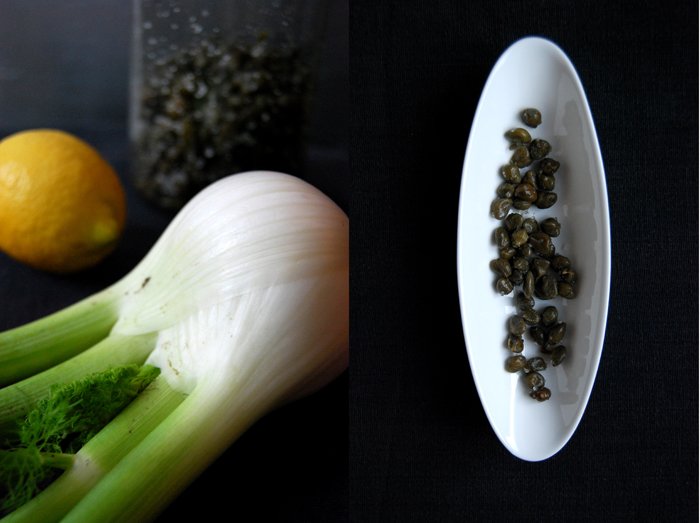
Two days left in 2013 - an easy and comfy lunch is in order to lean and look back on the past months. I feel like a quick carpaccio with fennel, caper and lemon, fresh and light, the right foundation for an honest review of an exciting and inspiring year - and the start of eat in my kitchen!
My mother told me about this vegetarian carpaccio which she enjoyed at a restaurant in Italy, so much that it became part of her - and my - recipe collection. Sometimes she is so excited by her food discoveries that she calls me immediately after she ate to tell me about her find. She knows that I love fennel and caper - a perfect match together with lemon and olive oil. I can get good quality fennel all year round therefore I cook with it quite often. As much as I love this carpaccio as a quick lunch because it's so easy to prepare, it makes a beautiful, light starter as well.
As a starter for 4, cut 1 fennel bulb in very thin slices and arrange them on plates. Add 6-10 capers on each plate, mine are salted so I have to rinse them first. Drizzle some olive oil and fresh lemon juice on top and season with salt and pepper. It only takes a couple minutes.


My Sunday Pizza Tradition

Another tradition of mine - I always bake pizza on Sundays, always. My friends joke about my unwavering dedication (I barely break this tradition) but to me pizza is the ultimate cosy mood food. Nothing beats an evening on my sofa with a nice big piece of pizza in my hands and a good movie. It's the perfect preparation for a smooth transition into a new week. So why change it. The only variation is what's on top which depends on the season, my appetite and spontaneous inspiration. So far, my Sunday tradition has never seemed boring.
For today, my pizza gets a topping with aubergine slices (grilled with garlic and oregano oil), Pecorino slices and one part with ricotta. A very concentrated tomato sauce with lots of oregano and slices of organic Mozzarella go with it, that's all it needs. I make the pizza dough with olive oil which makes it richer and very tasty. A very easy recipe, it takes its time to rise but it's worth it. Nothing beats homemade pizza dough! It makes such a big difference to the taste - and kneading the dough with your own hands is great stress relief!
For years I made my pizza base the same way. First I let it rise in a bowl and then, a second time, on a baking sheet before I put the topping on. This summer I got a great tip from a friend of mine from Switzerland. He told me to put the baking sheet for the pizza on the bottom of the oven while the oven is heating up. As soon as the baking sheet is hot you take it out of the oven and flip it over. You take the well risen pizza dough (which has been rolled out) and place it on the hot baking sheet. The dough will start to rise and bake straight away which makes an amazing crust - like pizza stone. Once the topping is on, bake it in the oven for a few minutes and you will get the crispiest pizza you can imagine!

Pizza with Aubergine and Pecorino
I start to prepare the dough 2 hours before I bake it to give it enough time to rise.
For 1 big pizza (size of 1 baking sheet) you need
For the dough
plain flour 350g / 12.5 ounces plus more for mixing
dry yeast 1 package (for 500g / 1 pound of flour)
water, lukewarm, 190ml
olive oil 3 tablespoons
salt 1 teaspoon
Combine the flour with the yeast and salt, add the olive oil and the lukewarm water, slowly, not all at once (you might not need all of it). Mix with your dough hooks for a few minutes. The dough shouldn't be moist and sticky at all, more on the dry side. Continue kneading and punching with your hands until you have an elastic dough ball, not too hard, not sticky. Put the dough back in the bowl, cover it with a tea towel and let it rise in the warm oven (35°C / 95°F) for 40 minutes. This works really well but make sure that your oven is set to top/ bottom heat and not to fan.
When the dough is well risen, roll it out on a very well floured (this is very important!) working surface. It should be a bit smaller than the size of your baking sheet. Cover with a tea towel and let it rise for another 10-15 minutes
For the tomato sauce
tinned tomatoes 400g / 14 ounces
oregano, dried or fresh, 1 tablespoon plus more for the topping
salt (1 teaspoon) and pepper
Mix the ingredients in a small sauce pan, chop the tomatoes and let everything cook down until very concentrated and thick. If you leave the sauce too liquid it will be soaked up by your pizza base.
For the topping
I prepared the grilled aubergine (eggplant) a day before. You can keep it in the fridge for days and use it for other recipes as well, or enjoy it as antipasti.
aubergine, cut in thick slices, 1
garlic, crushed, 1 clove
olive oil, to brush the aubergine and to drizzle on top of the pizza
salt and pepper
pecorino cheese, cut in thin slices, 100g / 3.5 ounces
mozzarella, cut in cubes, 125g / 4.5 ounces
ricotta, 100g / 3.5 ounces (I sprinkled just 1/4 of the pizza with ricotta)
Brush the aubergine slices with olive oil, sprinkle with oregano and garlic and season with salt and pepper. Grill in the oven until golden brown and soft and cut in long strips.
The pizza
Set your oven to 260°C / 500°F. My oven has a special pizza setting but you can use top / bottom heat as well. Put the baking sheet on the bottom of your oven to heat it.
Take the hot baking sheet out of the oven, flip it over and place it carefully on two stable wooden boards or mats as it will be very hot. Place your risen dough carefully but quickly (best done by two people) on the baking sheet, push it gently into place if necessary. Spread the tomato sauce on top and sprinkle with oregano, continue with the aubergine, Pecorino, mozzarella and ricotta. Put the baking sheet back into the oven, on the bottom again, and bake for a few minutes until the pizza is golden brown, bubbling and crisp!



Orange Cheesecake

The first time I had New York cheesecake is quite a while ago - it was love at first sight! When I was fourteen I traveled to New York and Canada with a friend of mine and her family. As soon as I took my first bite I was hooked and during the following three weeks of our holiday I don't believe I left out a single chance to get a piece of cheesecake, every day, at every restaurant we went to. I became a true cheesecake specialist!
Now, when I bake my own, I'm always reminded of that trip and the excitements of being a traveling teenager. Over the years I tried out many cheesecake recipes and developed my own favourite with orange zest and juice and cream cheese mixed with ricotta. It is still as rich and moist as the traditional version, the citrus flavour just adds a fresh, fruity specialness and gives it a lighter feeling.
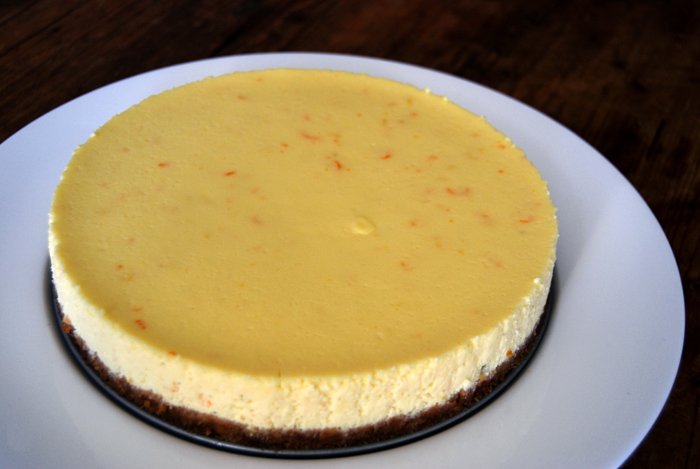
Orange Cheesecake
For a 20.5cm / 8" springform pan you need
digestive cookies, crushed very finely, 210g / 7.5 ounces
butter, melted, 70g / 2.5 ounces
cream cheese, at room temperature, 450g / 16 ounces
ricotta, at room temperature, 100g / 3.5 ounces
granulated sugar 100g / 3.5 ounces
vanilla sugar 1 teaspoon
organic eggs 3
cornstarch 1 teaspoon
zest of 1 orange
orange juice 1 tablespoon
zest of 1 large lemon
juice of 1 lemon (4 tablespoons)
a pinch of salt
Mix the crushed cookies with the melted butter until crumbly and combined and press into your springform pan. Put in the freezer for 15 minutes.
Set the oven to 165°C / 330°F and put a deep roasting tin in the oven on the lowest position. Boil water in a kettle.
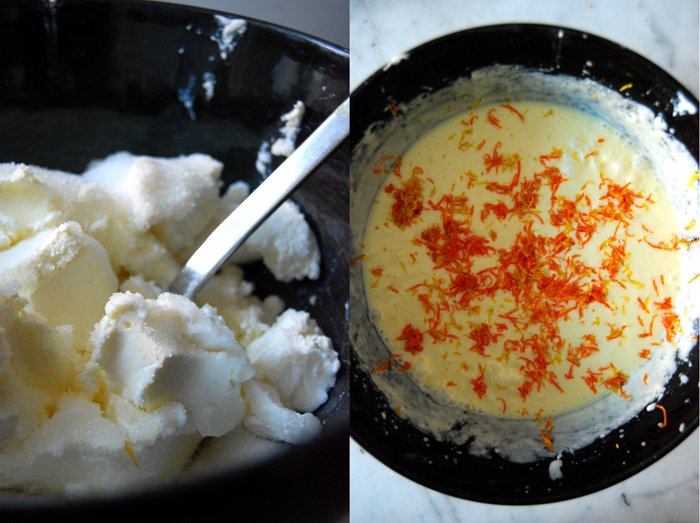
Mix the cream cheese, ricotta, sugar, vanilla sugar, salt and eggs and beat until smooth. Add the cornstarch, lemon and orange zest and juice and continue mixing.
Take the baking pan out of the freezer and wrap in aluminium foil twice so that the bottom and sides are well covered to protect the cheesecake from the water. Pour the cheesecake mixture on top of the hardened crumbs and place carefully into the tin in the oven. Fill the roasting tin with the boiling water from your kettle. The water should come half way up the wrapped springform pan. Bake for 50 minutes, switch off the oven and leave the cake in the oven to cool. After around an hour you can take your cheesecake out and chill in the fridge for a couple hours.

A Feast of Leftovers
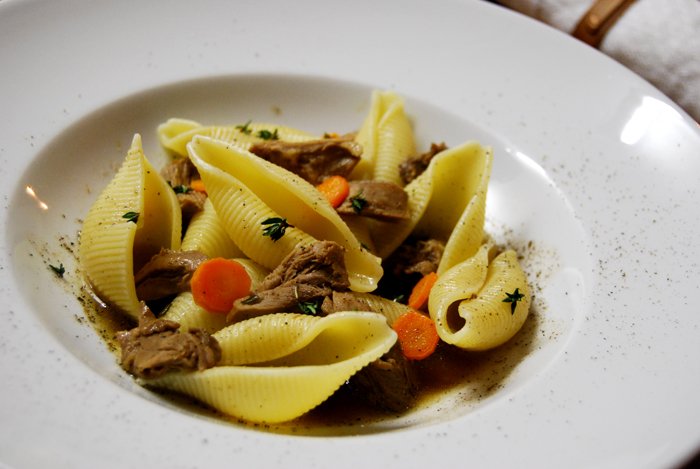
It is so satisfying to create meals with leftovers. Although it is exciting to cook a special meal for a special event, the next day when I see the food that is left I get inspired to combine it differently and create something new. When I enjoyed our Christmas duck and the tasty gravy on Christmas Eve I knew I would make a hearty, wintery pasta dish with the leftovers. This has become something of a tradition. Every year in the days after Christmas, when we need a break of our extensive meals, we eat the meat leftovers and gravy mixed with pasta.
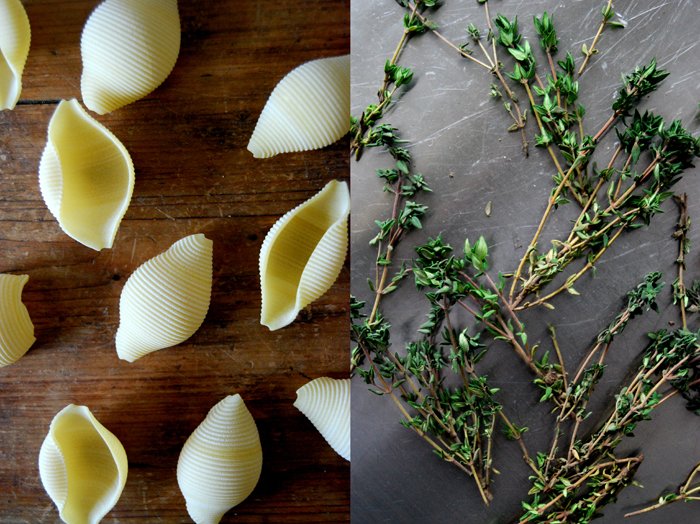
I have Delverde's Conchiglioni in the shelf - they look absolutely beautiful, like big shells, and they are perfect to catch the rich gravy and duck. I chop up the duck meat into bite sized pieces and warm it up in the sauce. To offset the richness of the gravy I fry two carrots (cut into thin slices) in some oil and a bit of sugar and add a few thyme leaves. I don't want the carrots to be too soft, it just takes a couple minutes and they still have some bite. When the pasta is ready - al dente - I place the pasta shells on big plates and add the sauce with the meat and the vegetables. You can sprinkle them with crushed pepper if you like it more spicy. It's nothing short of a feast, just lighter and quicker than the first.
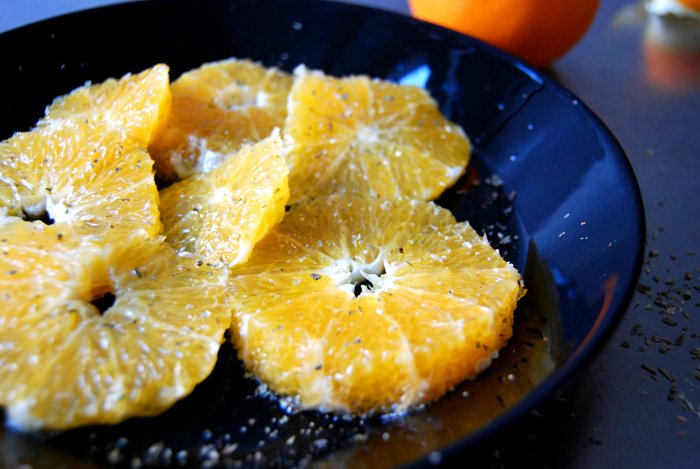
A Sicilian Salad with Oranges, Oregano and Olive Oil
My friends and family live all over the world. On the big festive days of the year, we spend quite a bit of time on Skype to share the special moments. We talk and laugh and - very often - show each other what we cook for our festive meals. Yesterday, my boyfriend's mother Jenny, presented a beautiful piece of ham that she had just pulled out of her oven. It looked so tempting! She also told me about the orange tree in her garden in Malta which is sagging with oranges and held a huge box of oranges for me to see. I knew what I would have for lunch today: my Sicilian salad with oranges, oregano and very good olive oil!
I know this combination sounds a bit extraordinary. It is another one of my Sicilian discoveries which I had for breakfast at a little farm in Noto two years ago. They used the oregano which grew on their farm and it was the best oregano I ever had in my life. It was unbelievably good! I never thought there could be such big differences in the taste of oregano.
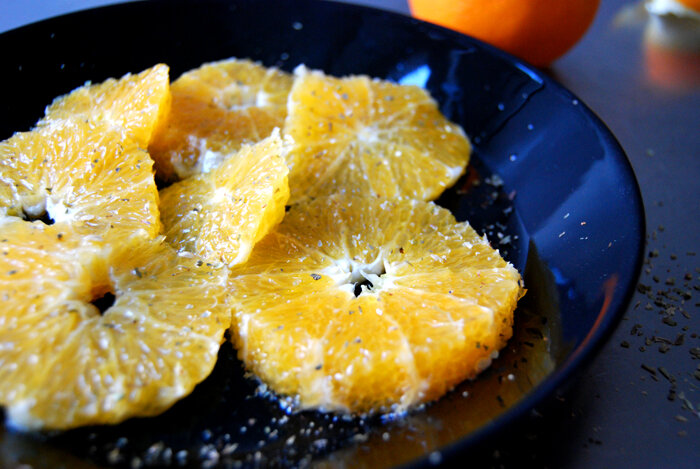
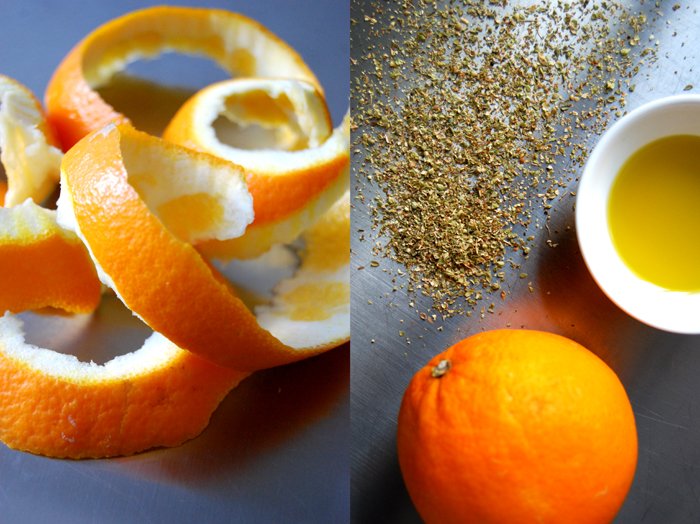
This salad makes a perfect snack after the last Christmas days of culinary richness - refreshing, light and comfortable. All you need to do is to peel two oranges (including the softer inner skin) and cut them in thick slices. Drizzle some good olive oil on top and sprinkle with dried or fresh oregano and a bit of salt.
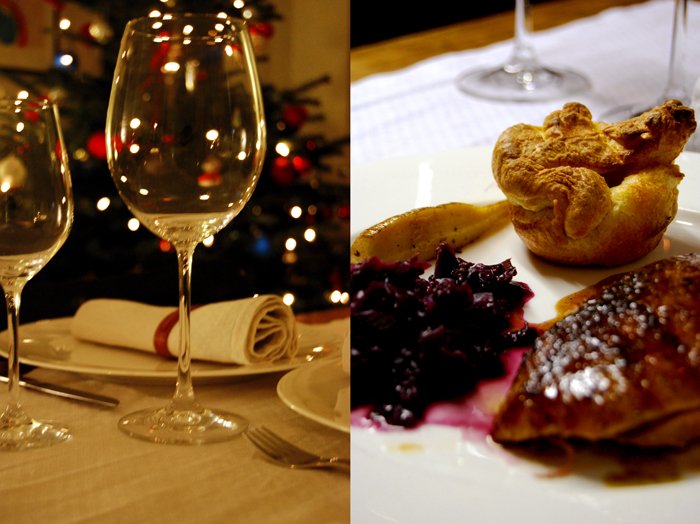
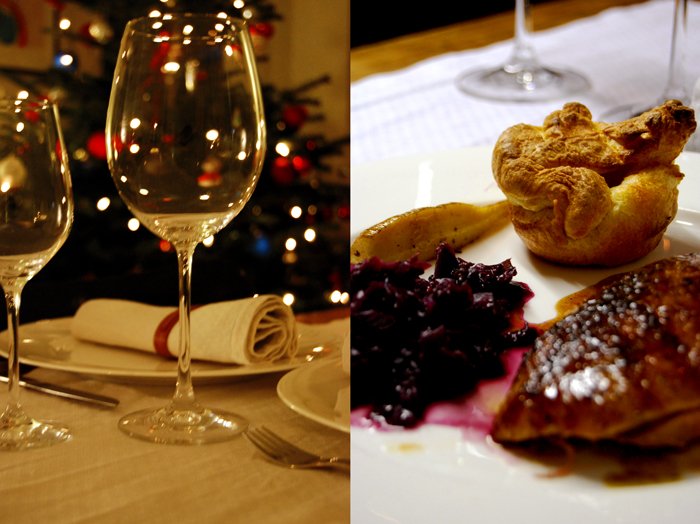
Slow Roast Duck and Yorkshire Pudding - our Christmas Dinner

Christmas is one of the special silent moments of the year, it feels like time stops for a few hours. The streets are empty and we share some precious time with the ones we love. It's a beautiful celebration of love and gratefulness - I wish you all a wonderful and joyful Christmas with the ones who are special to you!
At Christmas time, we share many traditions but each family also creates their own, especially regarding the festive meal. Some of my friends have sumptuous meals and cook for hours, some prefer it simple - like my aunt and uncle - they always celebrate Christmas night with Wiener sausages and potato salad. For me, it has to be duck - together with Yorkshire pudding on the side for the gravy and red cabbage, that's my tradition.
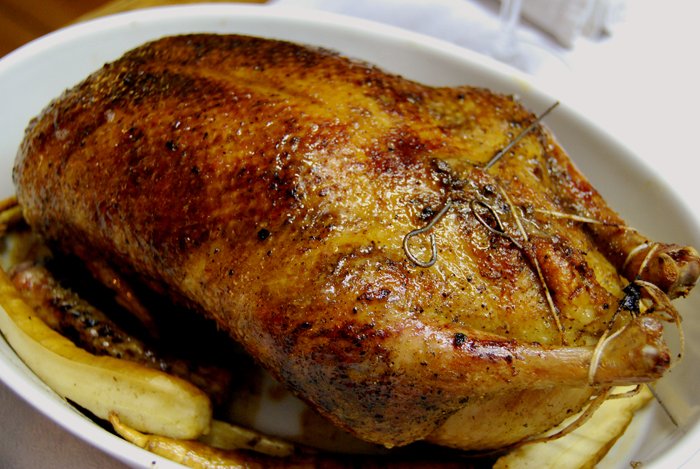
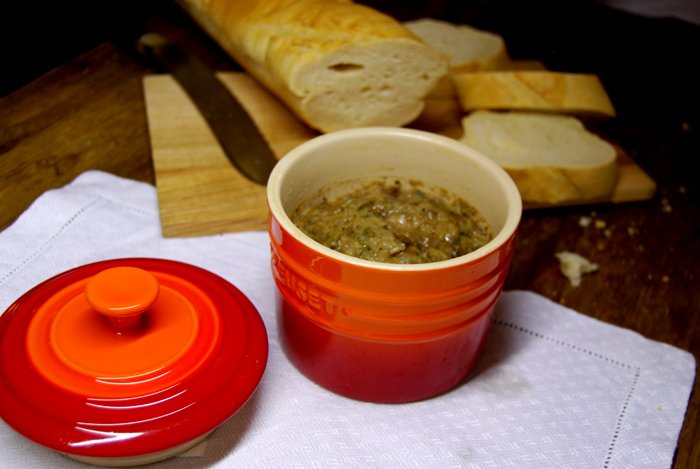
My duck takes its time and cooks very slowly. It stays in the oven for around 4 hours and cooks on very low temperature (85°C / 185°F) which guarantees the juiciest and most tender meat you can imagine. It never fails! I always make a rich filling with apples, mushrooms, minced meat, liver, bacon and lots of herbs. It's more like a terrine than a traditional filling - it could be a meal on its own. I prepare a bit more than I need for the duck and cook it in a little terrine dish in the oven (not as long as the duck, just for an 1 1/2 hours). It is similar to French Paté and I love it cold on bread the next day.

A duck that takes its time
For 4 people you need
whole duck, rinsed, dried, rubbed with salt and pepper, around 2kg / 4 pounds (with neck, liver and kidneys)
olive oil for frying
For the gravy
chicken, duck or goose broth 500ml
rind of 1/4 orange cut in strips
a sprig of fresh thyme
brandy for deglazing
balsamic vinegar
plum chutney or plum butter
salt and pepper
sugar for caramelizing
For the filling
minced beef 80g / 3 ounces
thin slices of white bacon, finely chopped, 2
organic chicken liver, finely chopped, 60g / 2.5 ounces
thin slices of ham, finely chopped, 2
mushrooms, finely chopped, 50g / 2 ounces
tart baking apple, peeled and finely chopped, 1
organic egg 1
dry breadcrumbs, soaked in cream or milk, 1/2 cup
a small onion, finely chopped
clove of garlic, crushed, 1
fresh parsley, chopped, 1 tablespoon
fresh thyme leaves of 1 medium sprig
lemon zest 1/2 teaspoon
bay leaf, ground in a mortar, 1
juniper, ground in a mortar, 1
nutmeg, grated
brandy for deglazing
butter for frying
salt and pepper
Heat some butter in a large pan and fry the bacon, mushrooms, apple, onion, garlic, juniper and bay leaf until golden and deglaze with brandy. Put in a large bowl and mix with all the other ingredients.
The duck and the gravy
Set your oven to 85°C / 185°F. Our oven has a Rotitherm roasting setting which works perfectly for poultry.
Heat a splash of oil in a large pan and fry the duck on all its sides until golden brown. Take the duck out, place on an oven dish and fill with your prepared filling. If you have some filling left put it in a terrine dish and cook in the oven together with the duck (covered with a lid, for 1 1/2 hours). Leave the duck in the oven for around 4 hours. Check with a skewer after 3 1/2 hours to see if the duck is done, when only clear juices come out, the duck is ready. Brush the top of the duck with gravy (see below) and put under the grill for 3-5 minutes until the skin is golden brown.
My gravy isn't thick as I prefer it natural without thickening agents. After you put the duck in the oven, fry the duck's neck, liver and kidneys in the pan you used for the duck and deglaze with brandy. Take the giblets out, pour the broth into the pan and let it simmer down together with the other ingredients for the gravy, until it reached its right concentration and taste. Take out the orange rind and thyme sprig and season with salt, pepper, vinegar and chutney. Caramelize 1-2 tablespoons of sugar until brown and add to your gravy. You can also add some dark chocolate, honey or a tiny bit of orange juice. Play around with it but always use very small amounts of whatever you add and taste in between.
For the red cabbage
Chop a small red cabbage into very thin strips. Rinse the cabbage and fry it - still wet - in some oil or lard in a large pan with a closed lid for 5 minutes (on medium heat). Add 2 glasses of red wine, a chopped apple, some grated ginger, a bay leaf, 6 cloves, 4 juniper berries, 2 tablespoons of honey and season to taste with salt and pepper. Cook for 1 - 1 1/2 hours.
For the Yorkshire pudding
Mix 200ml of milk together with 2 eggs, 200g / 7 ounces of plain flour and 1/2 teaspoon of salt. Fill a bit of oil in little oven dishes (like the ones you use for crème brulée) or in the cups of a muffin pan and place the oven dishes in the hot oven (250°C / 480°F) for a few minutes or until the oil is hot. Pour the batter carefully into the hot oil in the dishes and bake for 12 minutes or until well risen and golden brown. Don't open the oven door before the puddings are done as they will collapse.
Prepare your dinner table with all your festive food. Enjoy with loved ones!

Merry Christmas

I wish you a wonderful Christmas with your families and friends! Enjoy all the special moments of love and good food!
Merry Christmas!
Meike xx

Maltese Lemon Christmas Cookies
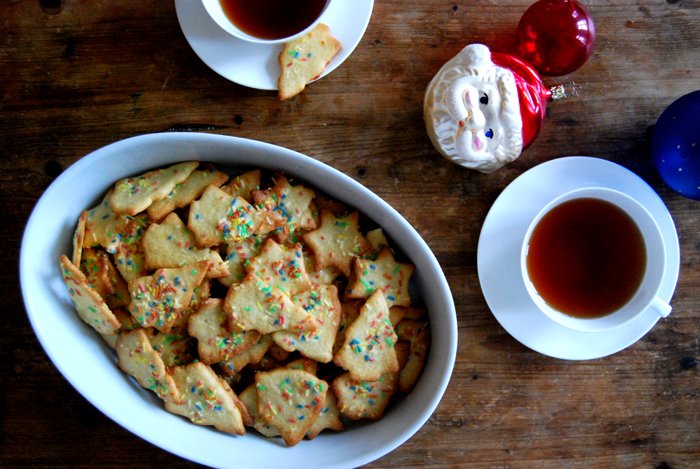
I got this recipe from Jenny, my boyfriend's mother, who makes these wonderful lemony cookies every year at Christmas time. She lives in Malta, in the Mediterranean, where everyone has their own citrus trees or knows someone who has enough citrus fruits to give away. Many Maltese recipes are made with lots of lemon juice or zest and I love it. I used to cook and bake more carefully with lemon and lime flavours but I became quite brave with it over the years. It doesn't have to be a shy add-on, it should stand out in many variations.
These flaky cookies are stuffed with lots of lemon zest, they fill the house with such a beautiful, warm and buttery citrus smell. It's absolutely lovely!

Maltese Lemon Christmas Cookies
Makes about 70 cookies
plain flour 160g / 1 1/4 cups
baking soda 1/2 teaspoon
cream of tartar 1/2 teaspoon
fine sea salt 1/8 teaspoon
butter, soft, 120g / 1/2 cup
granulated sugar 100g / 1/2 cup
vanilla pod 1/2, split and scraped
lemon zest, freshly grated, 1 1/2 teaspoons
organic egg 1
sugar sprinkles, for the topping
Combine the flour, baking soda, cream of tartar and salt in a large bowl.
In a second large bowl, cream the butter, sugar, vanilla and lemon zest with an electric mixer until fluffy. Add the egg and continue mixing until well combined. Add the dry flour mixture to the butter mixture and continue mixing with the dough hooks of an electric mixer until combined. Scrape the dough onto a piece of cling film, form a thick disc, wrap and freeze for 30-45 minutes or until the dough is hard.
Preheat the oven to 350°F (180°C) (preferably convection setting). Line 2 (or more) baking sheets with parchment paper.
Once the dough is hard, brake 1/4 off the dough and keep the remaining dough wrapped in cling film in the fridge. Lay a large piece of cling film on the kitchen counter and cover generously with flour, lay the dough on top, dust the dough with flour and cover with a second layer of cling film. Roll the dough out thinly with a rolling pin. The dough is quite buttery, if it sticks to the cling film, dust it with more flour. Dip the cookie cutters in flour and cut out cookies. Carefully transfer them to the lined baking sheets, spread them with a bit of space in between and decorate them generously with sprinkles. Continue with the remaining dough. Bake for 6-7 minutes (slightly longer if using conventional) or until golden. Let the cookies cool completely on a wire rack.
When the cookies are completely cool, store them in an airtight container for up to 1 week.


Cheese Spaetzle, a Swabian Feast
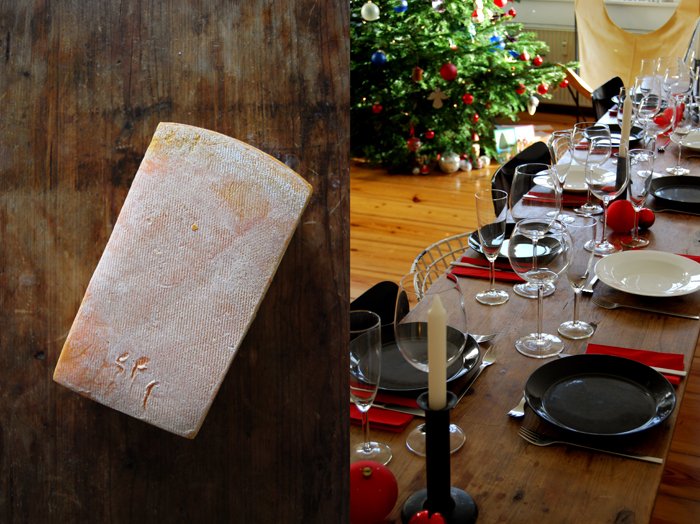
This meal is a feast, one of my all time favourite foods! It's luscious, rich and simply stunning. I am talking about Cheese Spätzle - originally from Swabia in the South of Germany. Spätzle are little noodles made of flour, durum wheat semolina and egg. They are thick, with bite. You press the Spätzle dough through a potato ricer into boiling water and then you layer the cooked Spätzle noodles with lots of good mountain cheese and fried onions - just addictive! Whenever our family comes together for a few days Spätzle is one of our dinners.
I make Spätzle with a ricer. Originally they are "cut" into pieces by placing the thick dough on a little chopping board, letting it run into boiling water and cutting pieces off. I must admit that I never tried this. I prefer to stick to my ricer.
Yesterday I had a big dinner for ten at mine and Cheese Spätzle were my first choice. They are so easy to prepare, hearty and perfect for the cold season and - to me - there is nothing more beautiful than placing a big bowl of food in the middle of my long wooden table. It was a true feast, savoured by us all!
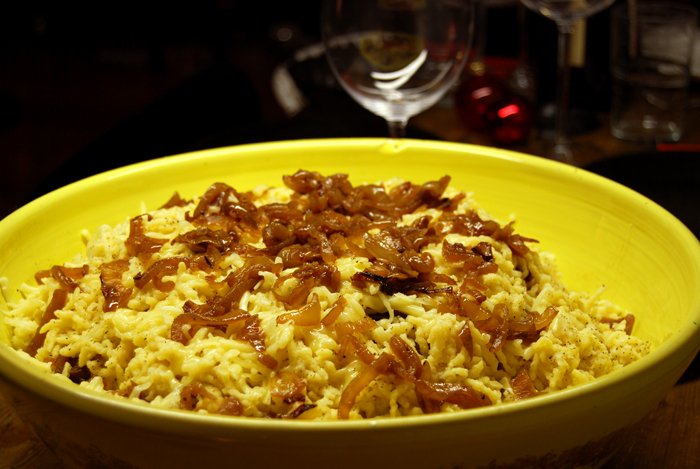
Cheese Spätzle
You need a potato ricer with large holes or a special Spätzle ricer.
I served the Cheese Spätzle with a wintery salad with beetroot on the side. As there were 10 of us yesterday I made the Spätzle dough with 27 eggs! Usually I calculate 5 eggs for 2 people.
For 2 people you need
plain flour (I use spelt flout type 630) 130g / 4.5 ounces plus more for mixing
durum wheat semolina 180g / 6.5 ounces plus more for mixing
organic eggs 5
salt 1 teaspoon
onions, medium sized, cut in thin slices, 5
olive oil for frying
aromatic cheese (like Appenzeller or Raclette), grated, 200g / 7 ounces
salt and pepper
Put the flour, semolina and the salt in a big bowl, add the eggs and mix with a wooden spoon until everything is combined. Whip the dough at bit harder until bubbles appear on its surface. Add more semolina if necessary until you have a smooth, thick dough that drips slowly off your spoon. Let the dough rest for 10 minutes.
Fill a large pot with salted water and bring to the boil.
Place an ovenproof dish (big enough for all the Spätzle) in the the oven and set to 100°C / 210°F.
Fry the onions in some oil on medium heat for at least 20 minutes or until soft and golden brown. Grate the cheese.
Fill your Spätzle or potato ricer with some of the Spätzle dough, press into the boiling water and cut off the dripping ends with a long knife. Let the Spätzle cook for 30 seconds, drain and place them in the warm dish from your oven. Season gently with salt and pepper as you will season every Spätzle layer. Sprinkle the top with some of the grated cheese and fried onions. You have to divide the onions and the cheese depending on how many batches of Spätzle you make. Place the bowl with the Spätzle in the warm oven again and continue with the next batch, always seasoning each layer and topping with cheese and onions.
Place the bowl with your Cheese Spätzle on the table - you can offer some freshly crushed pepper and more salt with it.
Enjoy your Spätzle feast!
A small but important note: Clean the cooking ware that was in touch with the Spätzle dough only with cold water. Don't use warm water as it will make the bits of dough as hard as concrete.

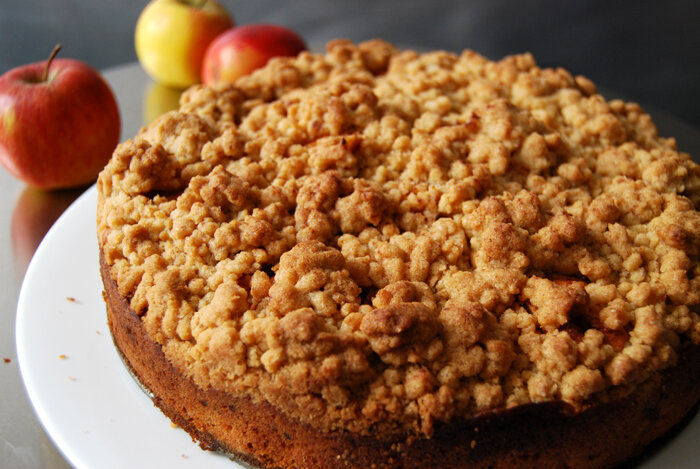
A Cinnamon and Apple Crumble
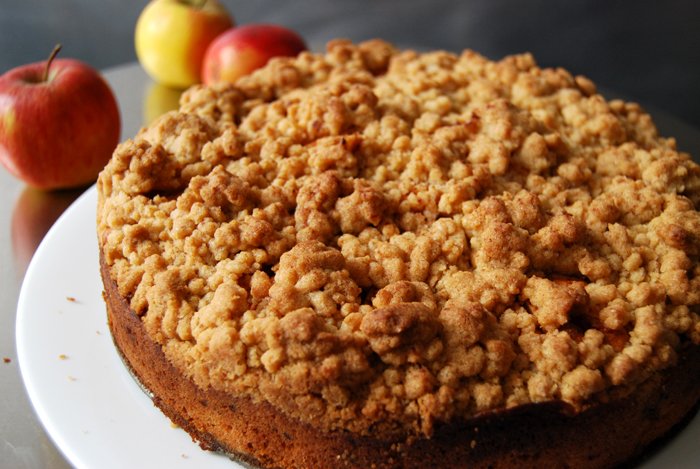
This cake is a friend to keep! Crunchy, buttery cinnamon crumbles, a light and juicy base and lots of fruit! Depending on the season I use either apples, plums or rhubarb. The aromatic cinnamon fits perfectly to the three of them and adds the right flavour. I love this crumble all year round and I must confess that I actually bake it at least once a month. Either for tea time or for dessert together with vanilla ice cream or cinnamon whipped cream. It's also easy to prepare which is great when you have guests for a dinner party and it tastes so good! My friends love it as well and are always impressed by the "perfect" crumbles - it's not science, it's just about the right mixture.
Today, it's apple time! The sweetness of the cake and the sourness of my Boscoop apples are very well balanced. 10 people will sit at my dinner table tonight and I want a dessert which allows me to stay with my guests rather than in the kitchen. I bake my apple crumble in the morning, whip my cinnamon cream at night and I know that this dessert will tease lots of happy smiles!
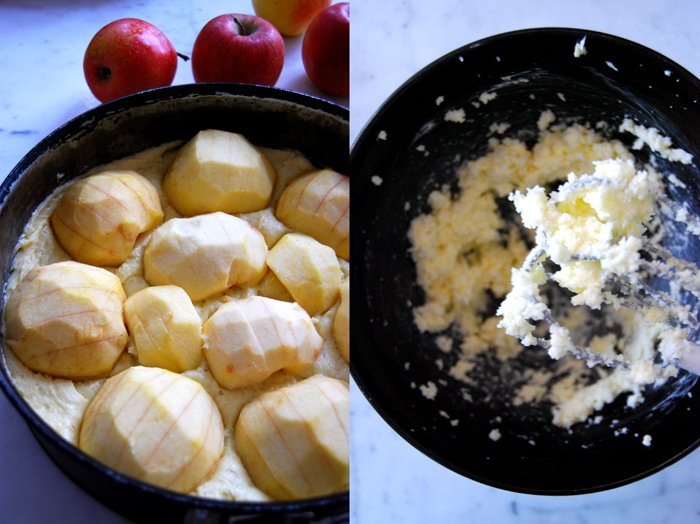
Apple Cinnamon Crumble Cake
You need a 26cm /10" springform pan, buttered. Prepare the dough for the base first, cut your apples afterwards and prepare the crumbles at the end.
Set the oven to 180°C / 355°F.
The fruit
sour baking apples (like Boscoop) 5, peeled, cut in half and carved lengthwise around 6 times
For the base
I use spelt flour type 630 for the base and the crumbles but you can use any other plain flour.
butter 125g / 4.5 ounces
organic eggs 3
granulated sugar 125g / 4.5 ounces
plain flour 250g / 9 ounces
baking powder 2 teaspoons
vanilla sugar 1 teaspoon
a pinch of salt
Beat the butter till fluffy. Add the sugar, continue mixing and add the eggs, one at a time. Add the flour mixed with the baking powder, salt and the vanilla sugar and continue mixing until combined. Fill into your buttered springform.
Place the apples close to each other on the dough base in the springform and push them down a bit.
For the crumble
plain flour 200g / 7 ounces (you might need some more if the crumbles are too sticky)
granulated sugar 125g / 4.5 ounces
vanilla sugar 1 teaspoon
ground cinnamon 2 teaspoons
butter, melted, 125g / 4.5 ounces (plus more if the crumbles are too fine)
The crumbles need good preparation as you have to make sure that the mixture is neither too moist nor too dry. Have some extra flour and melted butter near at hand so that you can add some immediately if necessary.
Combine the dry ingredients in a bowl. Pour the melted butter on top and mix quickly with the hooks of your mixer, this shouldn't take longer than 15-20 seconds. If the crumbles are too moist and sticky add a bit more flour (1-2 tablespoons). If they are too fine and don't form bigger crumbles add more melted butter. Stop immediately when the mixture starts to get crumbly and spread quickly on top of the apples. If you have bigger lumps of crumbles you might have to separate and spread them.
Bake in the oven for 50 minutes or until golden. Check with a skewer, it should come out clean, and let it cool.
Enjoy the crumble cake on its own or serve with vanilla ice cream or cinnamon whipped cream (200ml whipping cream, whipped with 1/4 teaspoon of cinnamon and 1 teaspoon of vanilla sugar).


Grown up Chocolate Cookies
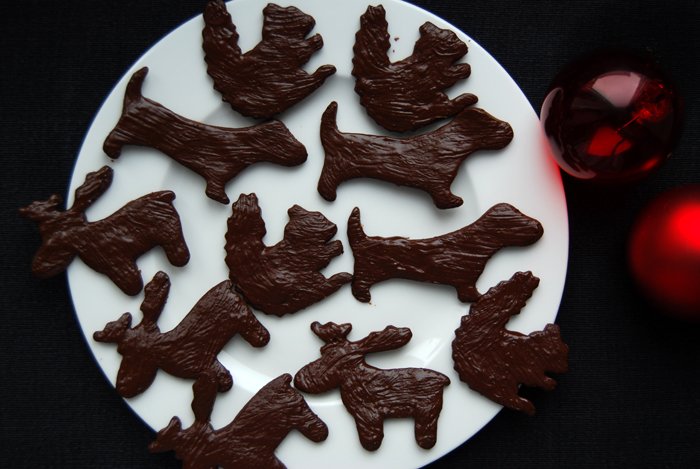
This is already the beginning of my last cookie baking weekend before Christmas! I can't believe it, time flew - as always during Christmas season. I baked and ate so many cookies this year! Whenever friends came over we sat under our Christmas tree, enjoyed the festive mood and emptied the cookie boxes. But I can definitely take another round before closing the 2013 cookie season, so let's start!
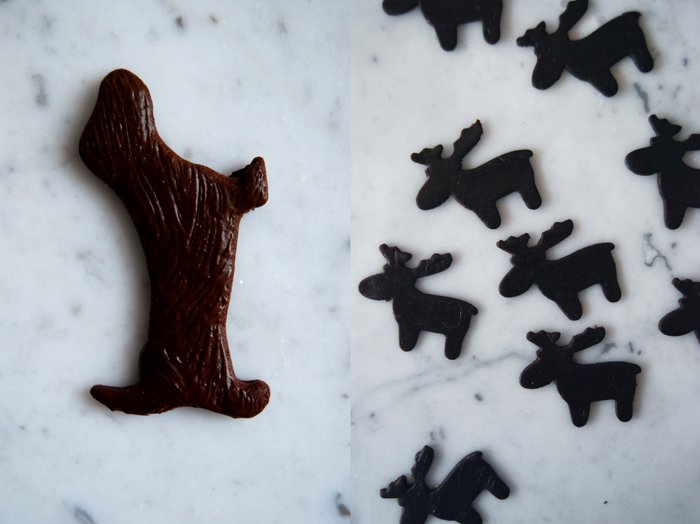
If you don't really have a sweet tooth these will be your cookies! Bittersweet chocolate and lots of spices: cinnamon, coriander, cloves, aniseed and allspice. The texture is light and crumbly with a thin layer of melted dark chocolate on top. They taste grown up - dark, bittersweet and rich in flavours. I thought some foresty animal shapes would do them good.
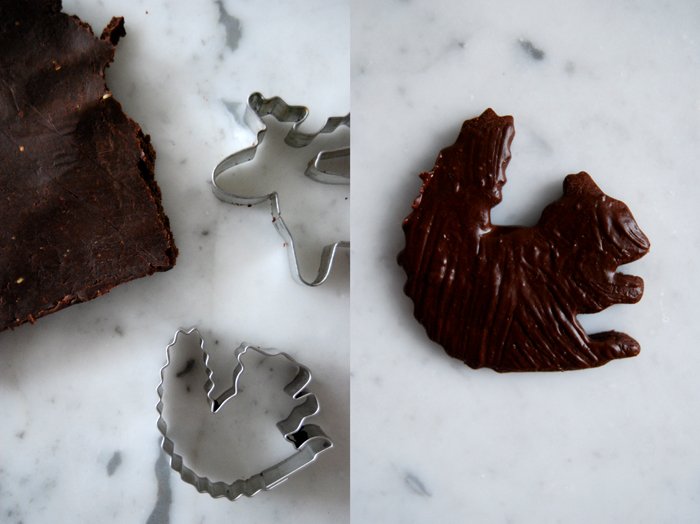
Chocolate Spice Cookies
For around 80 cookies you need
plain flour 250g / 9 ounces
cocoa powder 50g / 2 ounces
icing sugar, 90g / 3 ounces
baking powder 1/4 teaspoon
butter, soft, 130g / 4.5 ounces
organic egg 1
cinnamon, ground, 1/2 teaspoon
cloves, ground, 8
coriander seeds, ground, 1 heaping teaspoon
aniseed, ground, 1/4 teaspoon
allspice berries, ground, 2
a pinch of salt
bittersweet chocolate, melted, to brush the cookies, 100g / 3.5 ounces, mixed with cinnamon (1/4 teaspoon) and Chinese 5 Spice (1/4 teaspoon) or some of your cookie spice mixture
Combine the dry ingredients (except the sugar). In a separate bowl, beat the butter till fluffy, add the sugar and continue mixing till combined. Add the egg and mix for another 2-3 minutes. Put the dry mixture into the bowl with the butter mixture and continue mixing with the hook of your mixer until you have a crumbly mixture. Form a disc, wrap in cling film and put in the freezer for 45 minutes.
Preheat the oven to 160°C / 320°F and prepare a baking sheet with parchment paper.
Roll the dough out thinly (about 3mm) between cling film and cut out your cookies in whatever shape you like. Place your cookies on a baking sheet and bake them for 6 minutes. Let them cool and brush with the melted chocolate.

Trout al Cartoccio
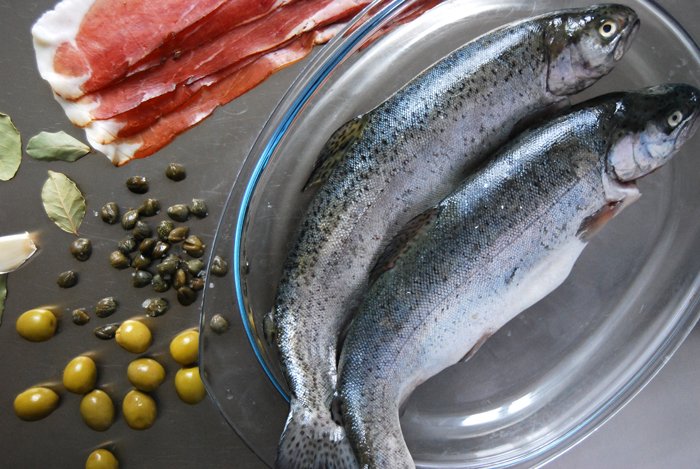
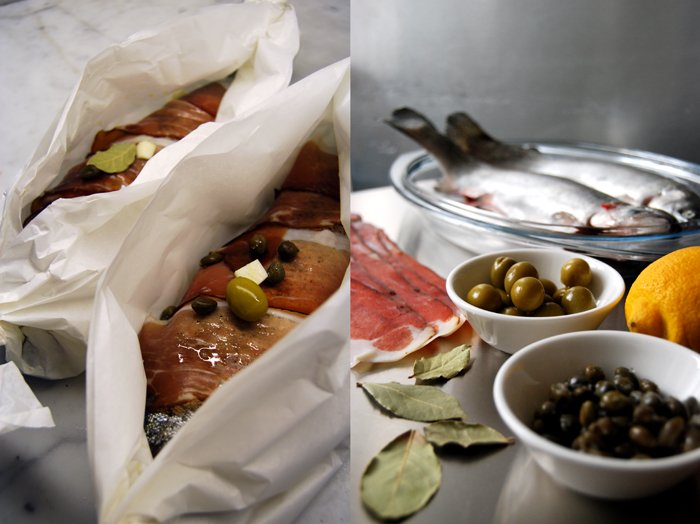
Today I found some beautiful, fresh trout and they reminded me of the region where I grew up. Of the forest and its little streams meandering between trees, passing by the trout ponds which are close to my mother's house. I decided to get two of them and cook them al cartoccio - in parchment paper - together with Tyrolean prosciutto, olives, capers, garlic and bay leaves.
Trout has a strong, earthy taste which makes it perfect to combine with other stand out flavours. The closed parchment paper package makes this union of tastes even more intense. As extreme as this combination may sound, it is a perfect match. The trout can take the smoky prosciutto, the bay leaf, the olives and capers without loosing any of its own qualities.
The best part is opening the hot paper package on your plate and smelling the different aromas. Dip some bread in the juices and enjoy with a glass of white wine!
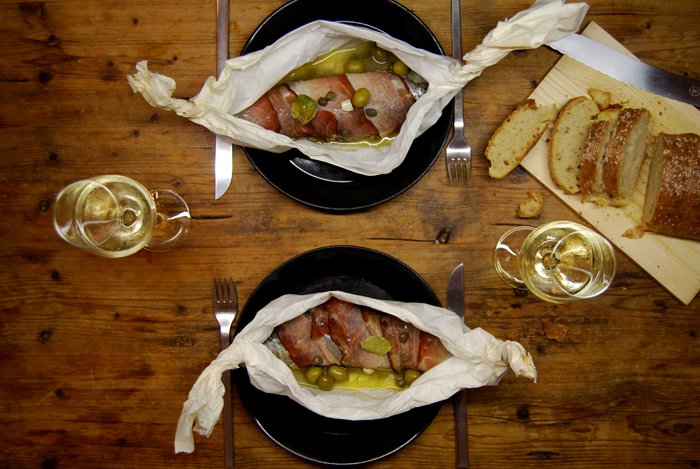
Trout al Cartoccio with Tyrolean Prosciutto, Olives and Capers
For 2 people you need
whole trout, cleaned, 2 (each around 300g / 10.5 ounces)
Tyrolean prosciutto, thin slices, 6 (or any other Italian prosciutto)
green olives 8
capers 2 tablespoons
garlic, quartered, 2
bay leaves 4
white wine 100ml
olive oil 4 tablespoons plus more to brush the parchment paper
salt and pepper
a small loaf of Ciabatta, for serving
parchment paper, to wrap the trout
Set your oven to 180°C / 355°F.
Rinse and dry the fish, season with salt and pepper (inside and out).
You need to prepare 2 parchment paper packages for 2 trout: for each package put 2 layers of parchment paper on top of each other, each around 20cm / 8" longer than the fish. Brush the top layer with oil.
Wrap each trout in 3 slices of prosciutto and place it in the middle of your oiled parchment paper. Put one bay leaf in the fish and one below. Fold up the sides of your package, twisting the ends without closing the top and fill with half of the olives, capers, garlic, olive oil and white wine. Close the top and fold twice. Repeat with the second trout.
Place both bags in a baking dish or pan and put in the oven for 10-12 minutes (depending on the size of the fish). You can tell the fish is done when its earthy smell starts to fill the air. Carefully open one of your packages, if you can lift the flesh off the bone with a fork it's done.

A Mountain Bun

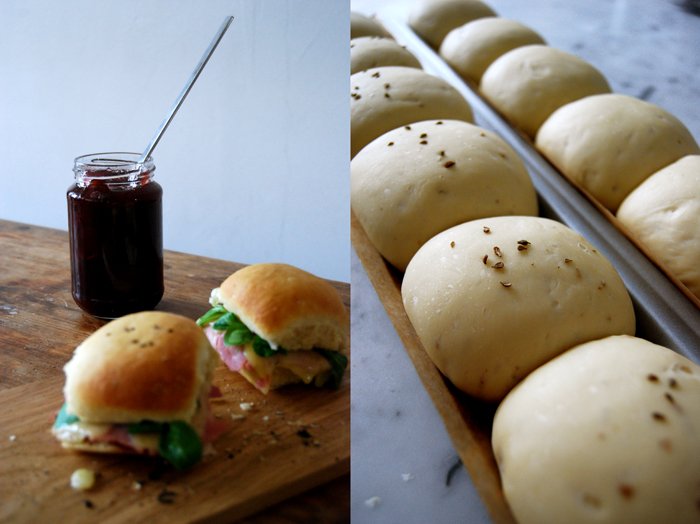
When I was a child we used to go to the Italian Dolomite Alps. Every year, in December, we stayed in a beautiful village in the Alta Badia region called Corvara. I loved being there as it looked like a wintery fairy tale (I always had a weak spot for places like this). Old wooden houses, trees packed with thick snow and the most amazing Tyrolean food - my childhood heaven. Yesterday I thought about how much I would love to be in the mountains again, in a wooden hut with an open fire and lots of snow outside. I would sit at a rustic old wooden table and eat rustic food.
Although I will not be visiting Corvara this winter, at least I have the wooden table and the hearty food. Therefore, my Wednesday Sandwich has to be a mountain sandwich - kind of - rich, with ham and cheese, homemade plum chutney and ground pepper. This morning, I baked my own buns with coriander and aniseed and I got some nice ham and cheese. I made a plum chutney with lots of spices a couple months ago which is great together with cold cuts and mountain cheese. You could also use any other chutney or even plum butter, you just need something that adds a bit of fruity sweetness to this sandwich.

A Mountain Bun
For 2 sandwiches you need
2 buns, or 4 thick slices of bread
slices of ham, 6
thin slices of aromatic mountain cheese, like Swiss Appenzeller
plum chutney
a few leaves of lettuce (I used field salad as I had some left)
crushed peppercorns
Set your oven to grill (highest temperature).
Cut the bun in half, spread the chutney thinly on one half and put a slice of ham on top. Cover with 3 slices of cheese and put in the oven until the cheese starts to melt. Take the bun out, sprinkle with pepper, add some lettuce and put the other half of your bun on top.
I know it's a bit of work, but baking your own bread or buns is definitely worth the effort and I'm sure you will agree after your first bite of the warm and fluffy buns. I prepared mine last night and let the dough rise overnight. Then you just have to put the buns into shape the next morning, let them rise for 40 minutes and bake them. If you want them plain just leave out the coriander and aniseed, they are still delicious!
For the Mountain Buns
This recipe makes 12 fabulous buns or milk rolls
plain four 550g / 1.1 pound
dry yeast 1 package (for 500g / 1 pound of flour)
milk, lukewarm, 300ml
butter, melted, 50g / 2 ounces
organic egg 1
sugar 1 teaspoon
salt 1 1/2 teaspoon
coriander, crushed, 1 teaspoon
aniseed, for the topping, 1 teaspoon
Combine the flour with the yeast, coriander, sugar and salt. Mix the milk with the melted butter and the egg. Mind the temperature as the mixture should be lukewarm. Pour the liquid mixture into the flour and start mixing with your dough hooks for around 10 minutes until you have an elastic dough ball. Put the dough on a floured working surface and continue kneading with your hands for a couple minutes.
When I prepare the dough in the evening I place it in a clean, buttered and covered bowl in the fridge and let it rise overnight. You will have to take it out of the fridge 30 minutes before you can continue with the next steps.
In case I want to bake my buns the same day, I put the dough in a clean and buttered bowl, cover it with a tea towel and let it rise in the 35°C / 95°F warm oven for 60 minutes. This works really well but make sure that your oven is set to top/ bottom heat and not to fan.
Set your oven to 220°C / 430°F and prepare a baking sheet with parchment paper.
When the dough is bigger and puffy punch it down and knead for 1-2 minutes. Cut into 12 pieces and roll them in your hands into a round shape. Place the buns on your baking sheet, sprinkle with anisseed and give them another 40 minutes in a warm place to rise again (covered with a tea towel).
Bake the buns for 6 minutes, take the temperature down to 200°C / 390°F and bake them for another 7-10 minutes or until golden brown. Let them cool for a couple minutes.

Spicy Pumpkin Soup with Bittersweet Chocolate
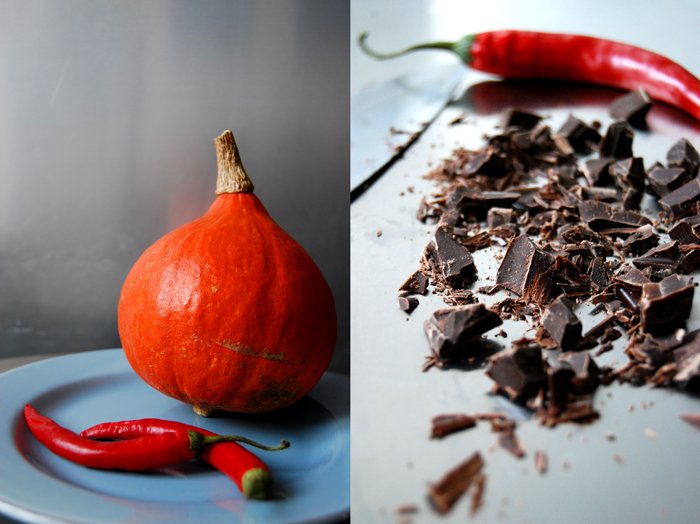
It's cold outside and I see a bright orange pumpkin right in front of me telling me what I need - a warming pumpkin soup. I have played around with many pumpkin variations in the past, with bacon, curry mixtures, roasted onions and I also love my puristic version with pumpkin seed oil and pumpkin seeds. Over the years my pumpkin soups became more spicy. I tend to feel cold all the time in Winter and nothing beats a hot and spicy soup to warm up your body from the inside.
Today I want my soup really hot and I also feel like adding some bittersweet chocolate on top (I love the combination of bitter, sweet and spicy!). I mix the soup in a blender which gives it a smooth and velvety texture. Together with the chili and bittersweet chocolate sprinkles on top, it makes quite a sensual meal!
This recipe has been featured on Food52 Halfway To Dinner!

Pumpkin Soup with Chili and Bittersweet Chocolate
For 4 people you need
For the soup
pumpkin (squash), without the seeds and fibres, cut into cubes, 600g / 1.5 pounds (I like to use Hokkaido squash with skin, or peeled butternut or Musquée de Provence)
medium sized potato, cut into cubes, 1
medium sized leek, sliced thinly, 1/3
medium sized carrots, cut into small cubes, 2
medium sized onion, chopped, 1
garlic, quartered, 1 clove
bay leaf 1
small dried chili peppers 2
a pinch of mace or nutmeg
salt and pepper
olive oil
water around 1l / 2 pints
For the topping
fresh red hot chili pepper, chopped finely, 1
bittersweet chocolate, grated, 4 heaped teaspoons plus more to taste
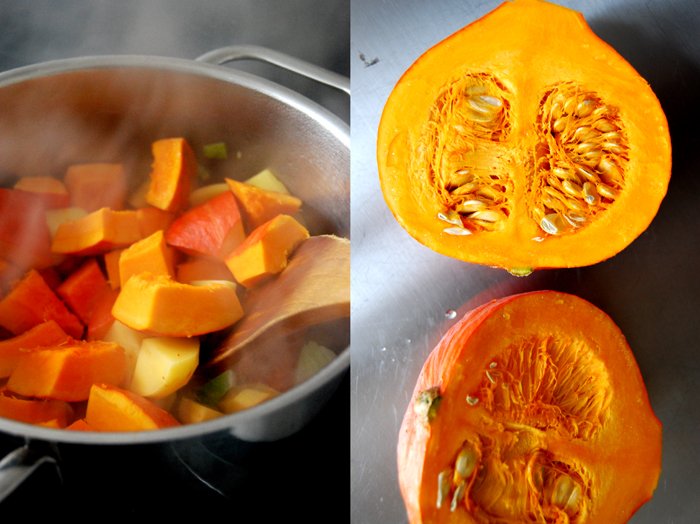
In a large pot, heat a splash of olive oil and cook the onion for a few minutes until golden and soft. Add the garlic, leek and carrots and cook for 2 minutes, stirring constantly. Add the pumpkin and potato, cook for 2 minutes and cover with water. Add the bay leaf and the dried chili peppers and season with mace (or nutmeg), salt and pepper. Bring to the boil and cook for about 30 minutes (without a lid) or until the pumpkin is soft.
Take the pot off the heat and remove the bay leaf and dried chili peppers. Purée the soup with a stick mixer or in a blender until smooth, season with salt and pepper to taste. Divide the soup between the plates and sprinkle with the fresh chili pepper and chocolate.
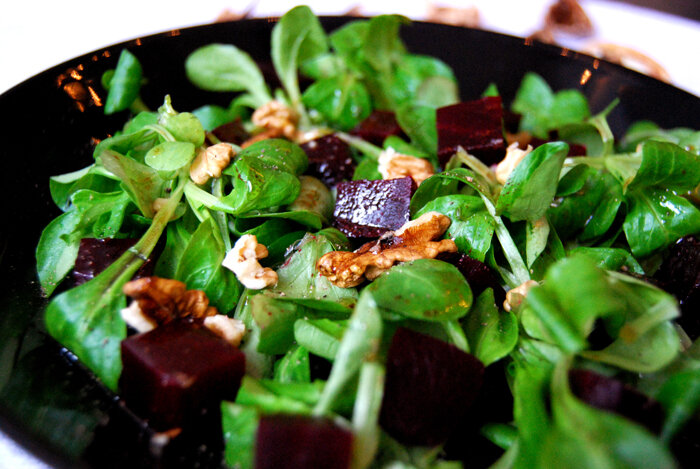
A Wintery Salad with Beetroot and Walnuts

I must confess that I literally lived in my cookie boxes the past weekend but - at least for today - I will take a sweet break (as much as I love them). My body needs something light and healthy, a salad. In winter I love to get boxes of organic field salad, its nutty taste is great to combine with roots, fruit and nuts. You just need to throw a handful of these little leaves in a bowl, add whatever you feel like and drizzle some olive oil and balsamico on top. It makes a great lunch or dinner even with some cheese and bread on the side. As this salad is so easy to prepare and looks and tastes so good, it is also a very nice starter for a wintery dinner party.
Sometimes I arrange this lettuce with mango or apple slices but my favourite combination is cooked beetroot and walnuts. I cooked a few beetroots a couple days ago and still have some left. I chop up one medium sized beet in little cubes and mix it with two handful of field salad. My dressing is simple but matches the beetroot perfectly: 3 tablespoons of olive oil mixed with 2 tablespoons of balsamico vinegar, seasoned with salt and pepper, that's all it needs. I pour the thick dressing on top of the salad and drizzle 5 chopped walnuts on top. Today there are two of us enjoying this tasty and healthy treat!
We eat beetroot quite often, I buy 3 or 4 of them every week and cook them with 2 bay leaves in salted water for 45 minutes (more or less depending on their size). This way they keep their strong and unique taste. I love them sliced thinly as a carpaccio or cut into cubes in wintery salads.
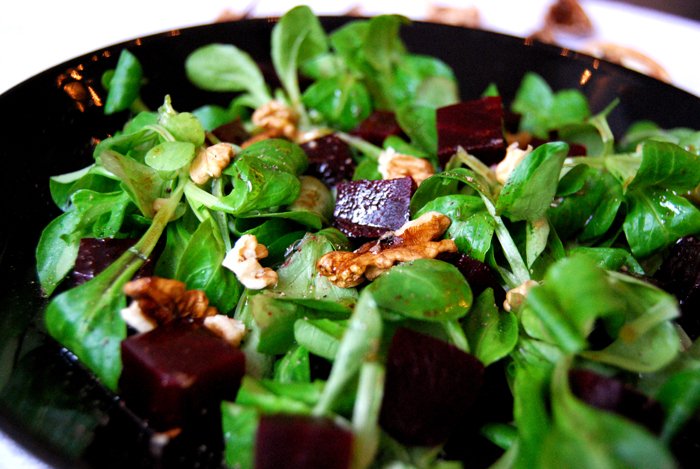

The Family Cookies
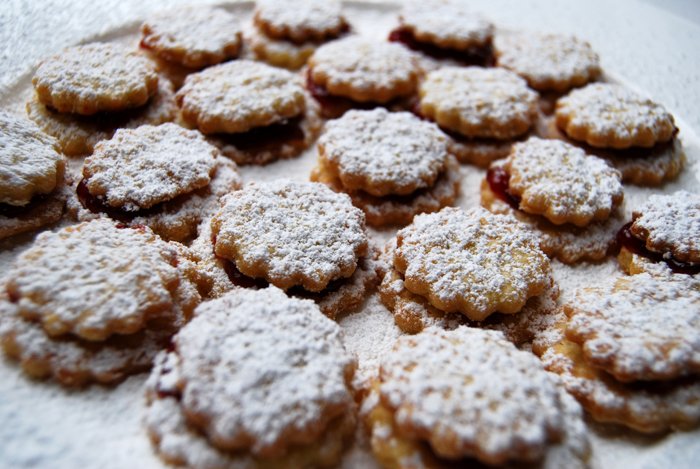
My mother started the tradition of these precious stacked Christmas cookies. They are little divas, very delicate, you have to be gentle with them as they are a bit fragile but they are worth all the effort - trust me! Apart from the fact that they look simply stunning, the buttery short crust of these cookies is one of the best I ever had. Just perfect, buttery but still light, flaky - they will melt in your mouth.
The dough isn't much work at all. It needs to sit for half an hour and then you can start cutting out your cookies, baking and assembling them, with redcurrant jam or jelly in between. Some sugar dusting on top and they are done. You should just handle them with care and appreciate that you have something very precious and delicate between your fingers.
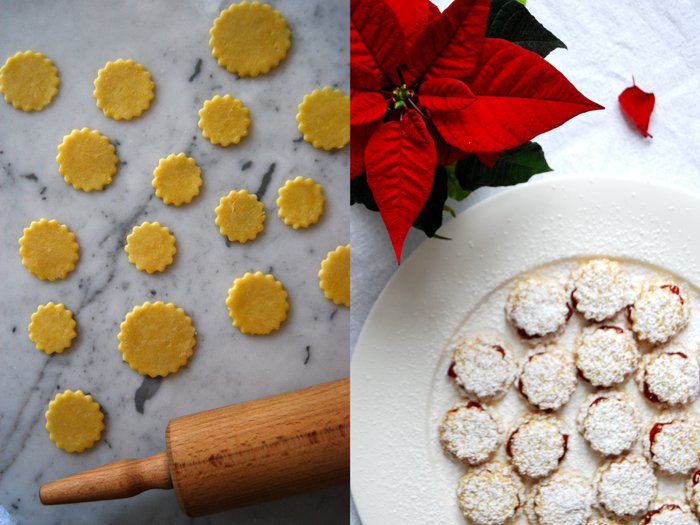
Linzer Cookies
For 60 sandwich cookies you need
plain flour 250g / 9 ounces
butter, cold 150g / 5 ounces
egg yolks 2
granulated sugar 2 tablespoons
a pinch of salt
cold water, 3 tablespoons
redcurrant jam or jelly
icing sugar, for dusting
You need round cookie cutters in 2 or 3 different sizes (mine are 3.5cm / 1 1/2" and 4.5cm / 1 3/4").
Combine the flour with the sugar and salt. Cut the butter with a knife into the flour until there are just little pieces of butter left. Continue with your fingers and quickly work the butter into the flour until combined. Add the egg yolks and the water, continue mixing with the hook of your mixer until you have a crumbly mixture. Form a disc, wrap in cling film and put in the freezer for 30 minutes.
Preheat the oven to 175°C / 350°F and prepare a baking sheet with parchment paper.
Roll the dough out thinly (about 2-3mm) between cling film and cut out your cookies with a floured cookie cutter. If you want to have 2 different sizes cut out an equal amount of cookies with each cookie cutter. Place your cookies on a baking sheet and bake them for 8 minutes or until golden but not dark. Let them cool for a minute or two. Place 1/4 teaspoon of jam on a bigger cookie and put a smaller one on top. Press a little bit but not too much as they might break. Let them cool completely and dust with icing sugar.
Enjoy their beauty and - when you're ready - pile them up carefully in a cookie box.

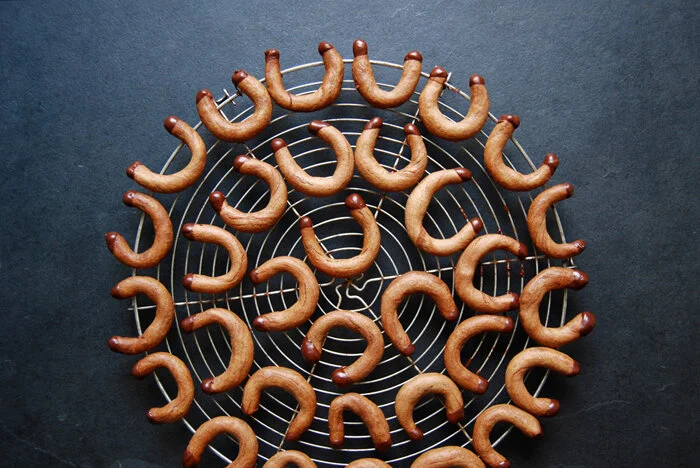
Gianduja and Chocolate Cookies

When I made these cookies the first time many Christmases ago I knew that a tradition was born. Every year, in December, I need a box of these crescent shaped cookies stuffed with Gianduja, which is also known as nougat in Germany and Austria and gives them their name: Nougat Kipferl. This nougat is made of chocolate and hazelnuts - different to the white nougat (or "Turkish honey") which is made of almonds and honey.
Another weekend, another Kipferl! These aren't as tender as the Vanilla Kipferl which I made last week, they are more dense, but still crumbly. I add lots of Gianduja to the dough because I want more than just a hint of this taste. The bittersweet chocolate on the Kipferl's feet isn't just for decoration - it takes away a bit of the sweetness. The amounts I use in my recipe aim for a bigger batch of 90 cookies as I enjoy this pleasure just once a year.

Gianduja and Chocolate Cookies - Nougat Kipferl
For 90 cookies you need
butter, soft, 100g / 3.5 ounces
Gianduja / nougat for baking, soft, 250g / 9 ounces
organic egg 1
plain flour 320g / 11 ounces
baking powder 3/4 teaspoon
vanilla sugar 1 tablespoon
a pinch of salt
bittersweet chocolate 70g / 2.5 ounces
Mix the butter together with the nougat, this works best with dough hooks. Add the egg and continue mixing. Add the flour, vanilla sugar, baking powder and the salt and mix to a dough ball. Form a thick disc, wrap in cling film and put in the freezer for 45 minutes.
Preheat the oven to 180°C / 355°F and prepare a baking sheet with parchment paper.
Melt the chocolate.
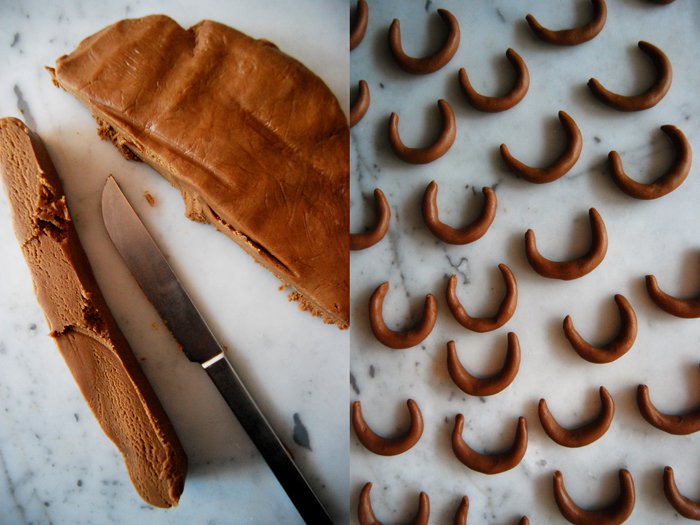
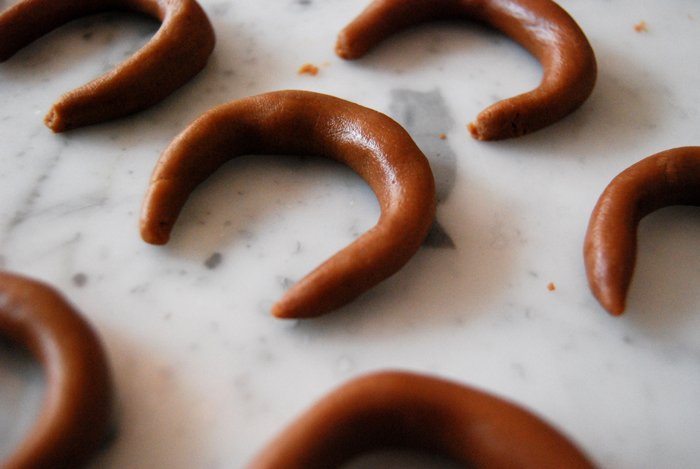
Take the dough out of the freezer. Cut thick slices off the disc and cut these slices in walnut sized pieces. Roll your cookies into the Kipferl shape between your hands. Mind that the ends don't get too thin as they would burn. Place your cookies on a baking sheet and bake for 8 minutes. Don't let them get too dark. Let them cool completely before you start dipping their two tips into the melted chocolate.

Spaghetti with Baked Ricotta, Salsiccia and Sage

I love simple pasta recipes which allow you to create a great dinner in just a few minutes - no matter if it is a romantic dinner for two or a dinner party for eight. This is definitely one of them! You just need baked ricotta, Salsiccia, sage (I'm lucky, my sage plant still has a few leaves) and spaghetti. You can use any other coarse-cut sausage but the strong herbs of the Italian sausage fir perfectly to the milky ricotta. The mixture of garlic, fennel, coriander and nutmeg which is used for Salsiccia adds a nice variety of flavours.
If you prefer a vegetarian version you can just melt some butter in a pan and fry a few sage leaves for 1-2 minutes (they should become crisp but not dark otherwise they will taste bitter). Together with spaghetti and sprinkled with slices of baked ricotta, this makes a delicious dinner as well!

Spaghetti with Baked Ricotta, Salsiccia and Sage
For 2 people you need
pasta, around 200g / 7 ounces
baked ricotta, around 100g / 3.5 ounces
Salsiccia, or any other spiced and coarse sausage, 2
a few fresh sage leaves
olive oil for frying
butter for frying, 20g / 3/4 ounce
white wine for deglazing
garlic, one clove, cut in half
pasta water
salt and pepper
Slice the baked ricotta thinly with a cheese slicer.
Rinse and dry the sage leaves and fry them in a small pan in hot butter for 1-2 minutes until crisp but still light in colour.
Cook the pasta and take out a cup of the pasta water after it has been cooking for a few minutes as we need some of this liquid for the sauce.Heat some oil in a pan, add the garlic, and fry the sausages until golden brown. Deglaze with a dash of white wine and add a good splash of your pasta water. Leave the liquid in the pan but take the sausages out and cut them in pieces. Put them back into the pan together with the spaghetti and add the sage leaves with their butter. Mix and season with salt and pepper.
Divide everything between two big plates and sprinkle with the slices of baked ricotta. Buon Appetito!

Couscous with Orange, Ginger and 6 Spices
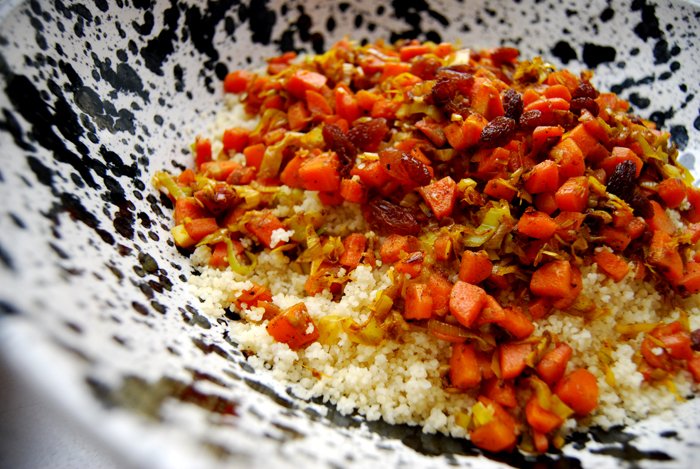
Two days ago I filmed a live session at a recording studio. As there were five of us and we had to work till late, I wanted to prepare something nice for us to eat, and to feed our energetic mood.
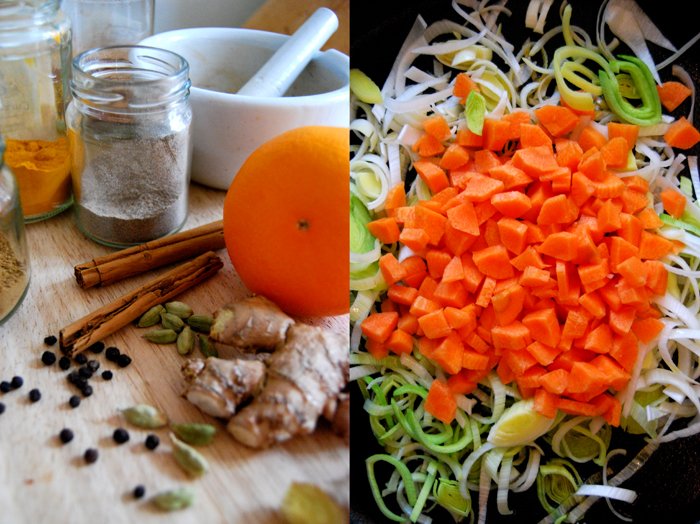
I didn't have much time to prepare, so a box of couscous caught my attention (5 minutes and it's done!). My mother had just sent it to me a couple days before because, I think, something that has to sit rather than cook for just a few minutes didn't quite satisfy her idea of cooking. I had half an hour to enhance it a bit so I decided to mix it with slices of leek and carrot and to add some strong exotic flavors - a homemade curry mixture with orange zest, ginger, turmeric, black pepper, cumin, cardamom, cayenne pepper and cinnamon. I mixed in some raisins to add some sweetness to the fruity spiciness of the curry mixture. Quick and easy - perfect food to wake you up (exactly what we needed at 11pm)!
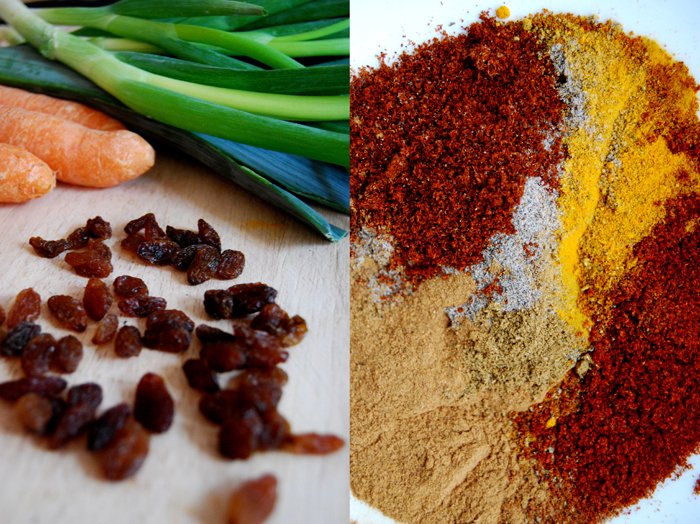
A Couscous with Orange, Ginger and 6 Spices
For 6 people you need
couscous 360g / 12.5 ounces
water 540ml (mixed with 1 teaspoon of salt)
1/2 a medium sized leek, thinly sliced
spring onion, thinly sliced, 2
carrots, cut in small cubes, 4
raisins, a handful
olive oil, 3 tablespoons plus more for frying
butter, 2 tablespoons
sour cream, 3 tablespoons
For the spice mixture
ginger, grated, 2 teaspoons
zest of an orange, 2 teaspoons
turmeric, ground, 1 teaspoon
black peppercorns, ground, 1 teaspoon
cinnamon, ground, 1 teaspoon
cardamom, ground, 1 teaspoon
cayenne pepper, ground, 1 teaspoon
cumin, ground, 1 teaspoon
Let the raisins soak in a cup of hot water.
Bring the salted water to the boil. Take the pot off the heat. Add 3 tablespoons of olive oil to the water, add the couscous and mix immediately, cover with a lid (but leave the pot off the heat). Let it sit for 5 minutes. Add the butter, mix and separate the grains with a fork.
Mix all your spices for the spice mixture (including the ginger and orange zest) and grind in a mortar. Warm some olive oil in a large pan and add the leek, spring onions and the carrots. Push the vegetables to the side after a couple minutes, pour some more oil in the middle of the pan and fry 3 teaspoons of your curry mixture for a minute on medium heat. Mix everything together and fry for another 1o minutes (keep in mind that the carrots shouldn't become too soft). Season with salt.
Mix the couscous and the fried vegetables in a big bowl, add the sour cream and more of your curry mixture until you find the right balance of spiciness (I added another 3 teaspoons of the spices at that point, so 6 teaspoons in all). When you are happy with the result, take the raisins out of the water and sprinkle on top of your couscous.

My Pastrami, Turnip and Winter Purslane Sandwich

It's Wednesday again, time for another sandwich!
At the moment I am really hooked on roots so my sandwich today can't do without them. My choice is a German turnip called "Teltower Rübchen". It tastes similar to horseradish, just a bit softer. I also have some winter purslane (sometimes known as miner's lettuce), its flavor is quite mild and sits well with the turnip. I must admit that I chose the winter purslane because it looks really cute. The centre piece of this sandwich is Pastrami but I wouldn't dare calling it a "Pastrami Sandwich" as, traditionally, this sandwich is literally piled up with slices of meat which is too much for me. This is lighter, on ciabatta bread, with a bit of olive oil, crushed pepper - delicious.
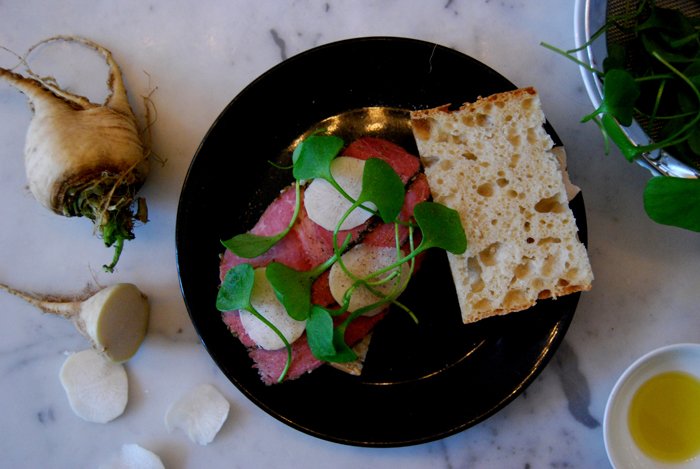
A Sandwich with Pastrami, Turnip and Winter Purslane
For 2 people you need
a small loaf of ciabatta
Pastrami, 6-8 slices
Teltower Rübchen, thinly sliced (or horseradish, grated)
winter purslane, a handful (or rucola/ rocket, a few leaves)
olive oil
crushed peppercorns
Cut your bread and slice it in half. Drizzle some olive oil on the inside, line with the pastrami and put either the turnip slices or a bit of grated horseradish on top. Garnish with a few leaves of winter purslane or rucola and enjoy a big bite!