meet in your kitchen | Isa's Beetroot Risotto with Chèvre and Mint
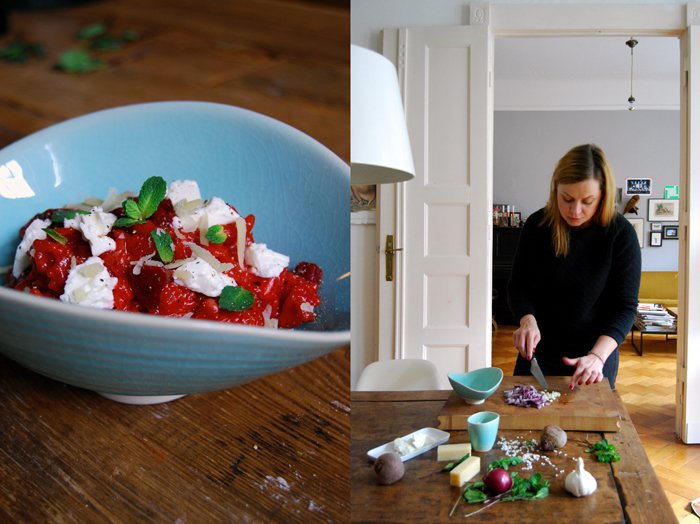
On to part II of Berlin's Hauptstadtmutti cooking session! The popular mother, fashion and lifestyle blog is run by Isa and Claudia, both such vibrant and inspiring ladies that I had to visit both of their culinary spaces. Two weeks ago, I learned how to make Claudia's Ukrainian Pelmeni dumplings (you can read about it here) and now it's time to cook in Isa's kitchen.
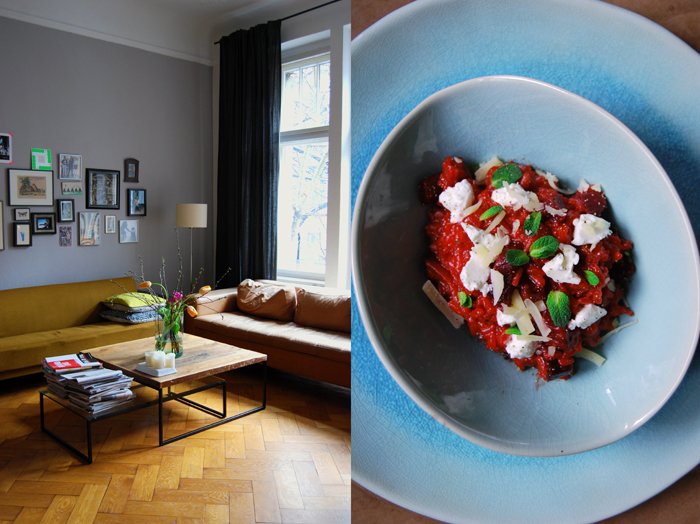
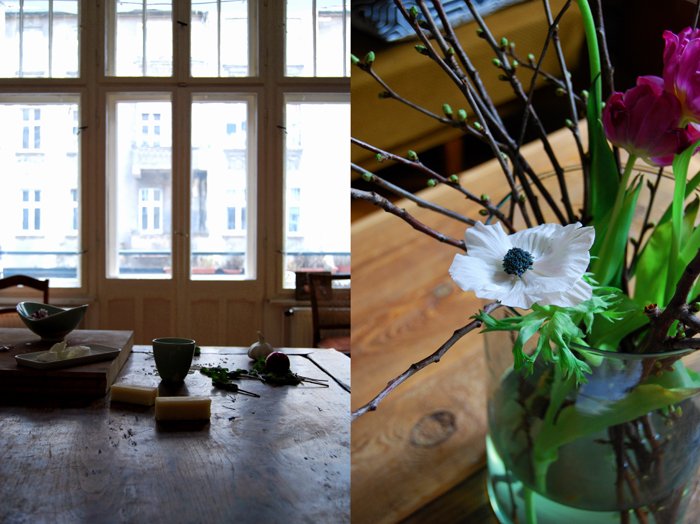
It was cold and snowy as I made my way to meet Isa, the city was wrapped in a wintery grey and, although it was already 10 in the morning, it was quite dark when I reached the old house where the young mother lives with her little family of four. The imposing building is one of the few on the street which hasn't been renovated, the facade crumbling between the majestic window frames which gives it quite a morbid charm, you can still see the beauty of the past. It looks a bit like an abandoned house in a fairy tale, it's more than impressive and it sparked my fantasy when I walked up the creaking steps to knock on Isa's wooden door. But then, when I entered her home, I was speechless, endless rooms and corridors, herringbone parquet floors, high ceilings lined with decorative stucco and large windows which let in the most dreamy light. Within seconds I fell in love with this elegant but cosy home!

Isa started Hauptstadtmutti in 2011 together with Claudia. In the first part of our cooking series I talked about their fascinating and complementary personalities which led to the two meet in your kitchen features. Both women share an international upbringing which confronted them with various cultures at a young age. Claudia grew up with an Eastern European background and Isa had quite an adventurous childhood, she lived in Baghdad in Iraq during the first 4 years of her life. Her father was a successful engineer who used to live in East Germany with his wife before his skills took him and his young family to the Middle East to design pump stations. Back in East Germany, he was also involved in the construction of the GDR's first nuclear power station. Despite this experience, or perhaps because of it, the whole family turned to a more alternative lifestyle in the following years. They became politically active, focussed on natural home grown food and raised awareness for healthy living.
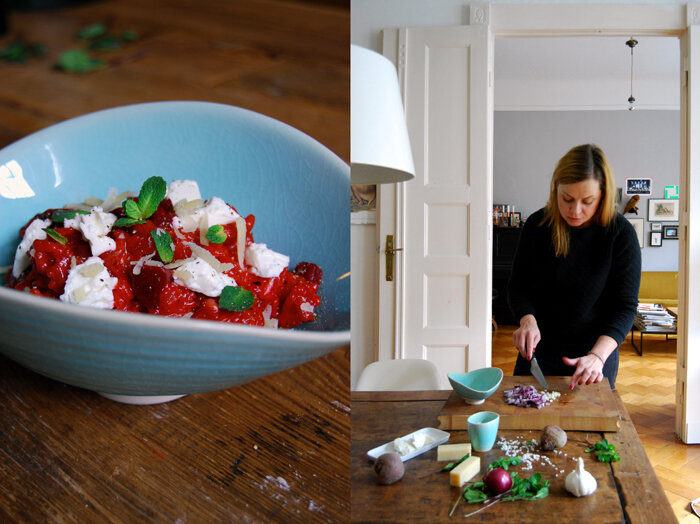
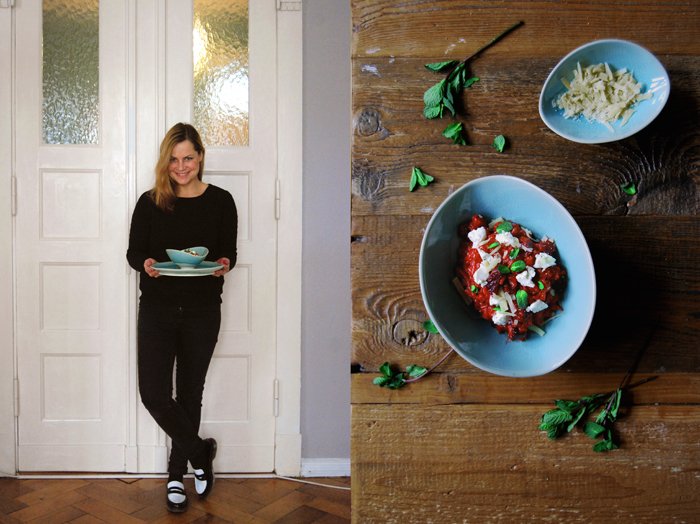
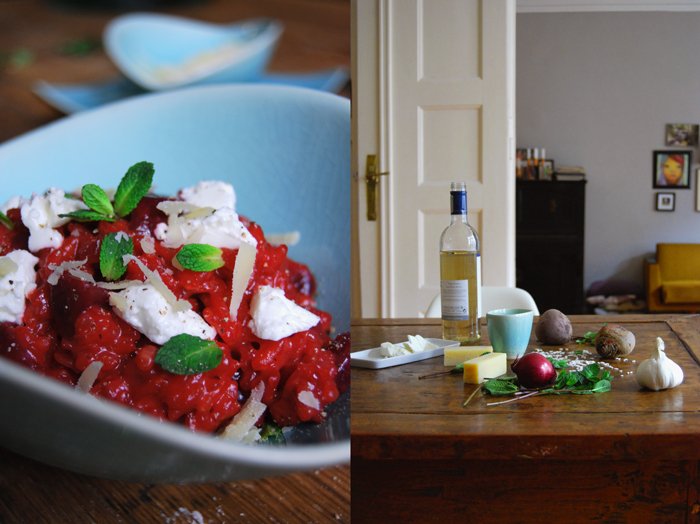
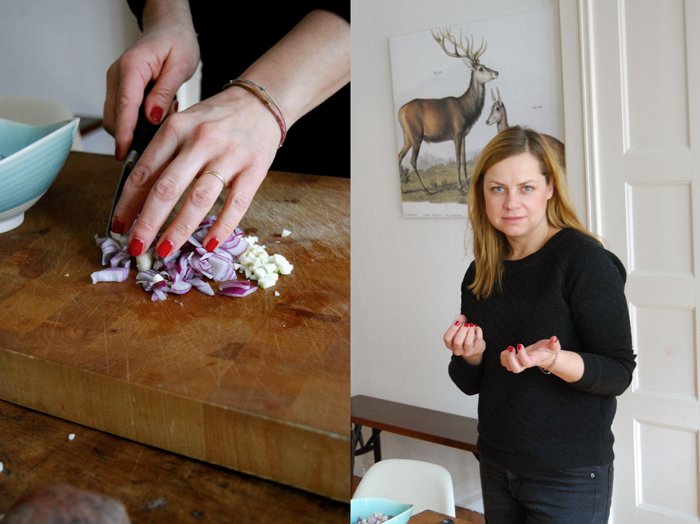
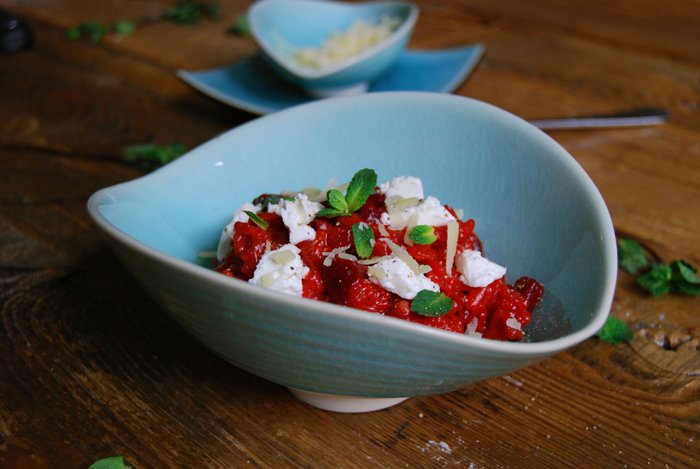
As a teenager, Isa joined yoga and meditation classes together with her father and mother. Today, her parents practice Tai Chi together with their friends in the family's grand garden which is part of an old farm established by Isa's grandfather. The family takes their well-being into their own hands, one generation after the other, and the next one is waiting in line. Isa passes her experiences on to her children and although they are still quite young they can already enjoy her delicious food. Isa's cooking truly pleases the taste buds, she creates culinary moments of bliss without regrets, her food is healthy, with organic ingredients, and full of flavour. She made a fantastic beetroot risotto for me, it was cooked to perfection, the rice corns and roots were al dente, just how I like it. She refined her composition with chèvre, parmesan and fresh mint - a great composition I can only recommend!
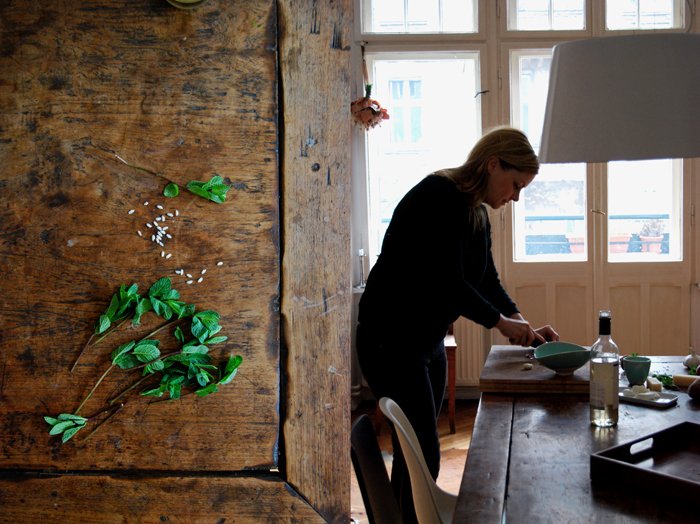
Beetroot Risotto with Chèvre and Mint
For 2-3 people you need
small beetroot 2
risotto rice (Arborio) 250g / 9 ounces
onions 2
clove of garlic 1
honey 1 tablespoon
a shot of white wine
vegetable broth 1/2-1 l / 1-2 pints
freshly grated Parmesan, a handful
butter 1 tablespoon
olive oil
salt and pepper
mint 4 small branches
fresh goat cheese (chèvre), for the topping
Peel the beetroot, garlic and onions and cut them into cubes. The larger the beetroot cubes, the more bite they'll have. Warm up the broth in a saucepan, it should be simmering.
In a large pan, heat some olive oil and cook the onions and garlic until glassy and soft. Add the beetroot and honey to the onion and let it caramelise slightly, add the rice and let it cook for a minute. Deglaze with a splash of white wine and add a ladle of broth. When the liquid has been absorbed add more broth, a little at a time stirring in between. When the rice is al dente, take the pan off the heat. Stir in the butter and Parmesan cheese and let them melt into the rice. Season with salt and pepper to taste and sprinkle with chèvre and mint to serve.

You spent the first three years of your life in Iraq due to your father's work as an engineer before your family moved back to East Germany. How did this experience influence your family and how did it effect your own personality?
Concerning that I should probably explain that my parents were neither in the communist party nor in the homeland security of former East Germany so it was quite a mission for them to get to live and work outside the country. But they made it because of their skills and raised my brother and I to believe that "You can get everywhere if you really want it". That really brought me to a lot of places and made me later want to live in other countries as well. We also have a very open minded attitude towards other cultures in our family.
Do you think traveling is important for children to get to know different cultures and mentalities? Can you give some tips for traveling with young children?
If they are very young I don't know. They will not really remember it. We did not travel too far away with our kids yet. Switzerland, France, Denmark. It is not that stressful for them but sometimes for us, the parents. Sometimes it is more fun to spend a week at the Baltic Sea than to travel for hours and hours. It is always good to have plenty of books with you, especially Wimmelbücher (picture books).
Your parents encouraged a great awareness for natural food and a healthy lifestyle by their own way of living. How did they influence your consumption, your cooking and the food you buy?
Oh yes, my mother was very into healthy food when we were young and still is. She cooks her own jams from the fruits of her garden and we always ate fruits and vegetables from the garden. She always uses fresh and natural ingredients. The older I get, and of course with children, I try to live as healthy as I can too. I usually buy local or organic fruits and vegetables.
You went to high school in the US for one year, what fascinated you about this new culture? What are your culinary memories?
Everybody was very very friendly and I just had a very great teenage time there. Culinary memories? Donuts, cheeseburger, tacos and ice cream (smiling)!
As an au pair in Paris, you also experienced the French cuisine for one year. What did you like about the food there?
It is very pure, many vegetables and beef and lots of seafood. I liked that very much and the oysters. I learned how to eat oysters. Delicious!
Did your cooking change since you became a mother? Do you have any tips to make cooking for and eating with young children easier?
I really changed into organic and local food. Eating with young children is easy. I always cooked the baby food by myself. This is totally easy and does not take a long time. What I learned is that young children want a variety and a change of food every day. They do not like to eat the same thing every day over and over. My tip is to always try to eat the same as your kids. They copy you and will (often) try more.
What was the first dish you cooked on your own, what is your first cooking memory?
The first dish was Spaghetti Bolognese. I learned this when I was 12 when my mother was away for an allergy cure and our father taught it to my brother and I.
As a fashion observer and blogger, which are your 3 most helpful fashion tips for young mothers?
1. Always carry a large scarf for nursing in public.
2. Get a new haircut. It makes you feel good.
3. Buy at least 3 shirts or dresses which make nursing comfortable.
Where do you find creative inspiration?
In Berlin, walking around the city and on the internet reading international blogs and magazines.
What are your favourite places to buy and enjoy food in Berlin?
I love to eat at Cordobar. Great food and the largest selection of wine. And I like to buy food at Mitte Meer.
What did you choose to share on eat in my kitchen?
Beetroot risotto.
If you could choose one person to cook a meal for you, who and what would it be?
Janine (a friend), roasted root vegetables.
You're going to have ten friends over for a spontaneous dinner, what will be on the table?
Risotto!
What was your childhood's culinary favourite and what is it now?
Spaghetti Bolognese and now it is fish, especially Sushi.
Do you prefer to cook on your own or together with others?
Together with others.
Which meals do you prefer, improvised or planned?
Planned.
Which meal would you never cook again?
Octopus.
Thank you Isa!

Spice Roast Chicken Legs with Butter Beans and Mint

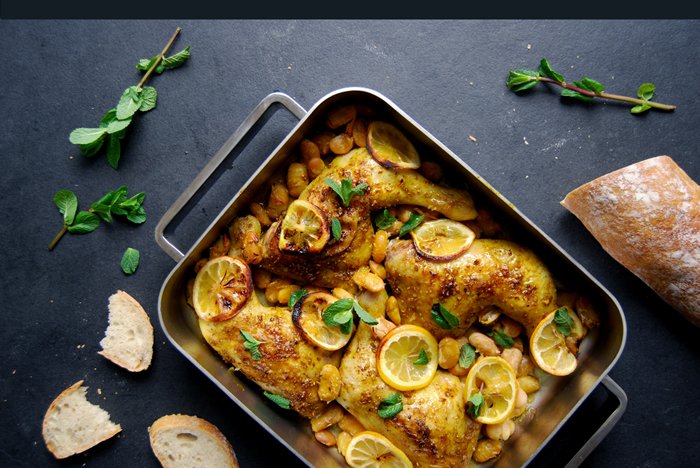
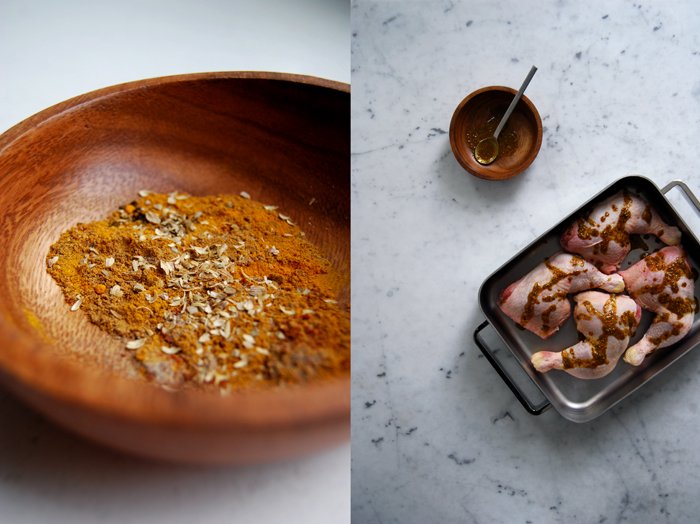
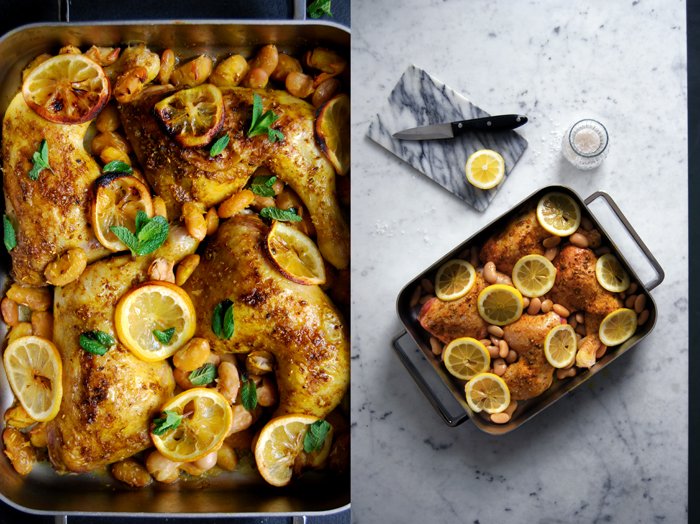
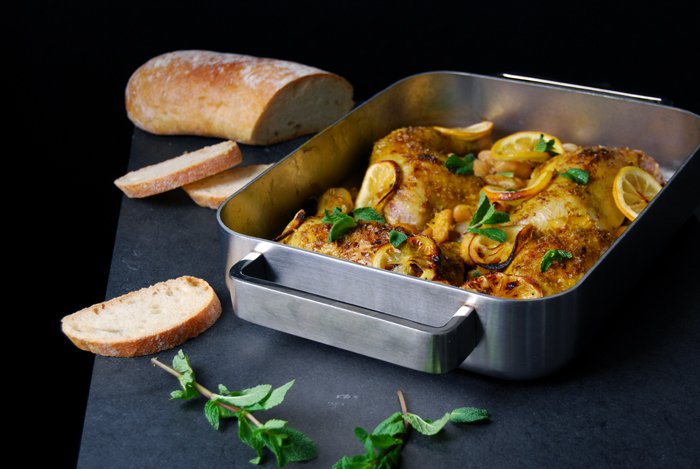
Five tasty C's: coriander seeds, cumin, curcuma longa (turmeric), cardamom and cayenne pepper! The list of spices for my roast chicken legs is long but each single one adds its strong character to the aromatic result. I mixed a generous amount of their fragrant qualities into a golden marinade made of olive oil and lemon juice to let them infuse the chicken's sizzling skin while cooking in the oven. The air in the kitchen smelled just wonderful and so did the meat when I put the tray onto the table. I also cooked some slices of lemon and butter beans in the spiced oil, the legumes skin burst and their velvety, soft inside mixed with the juices. It literally asked to be soaked with fresh ciabatta bread!
My mother often makes chicken legs in larger quantities when she has many people staying at her house, when my cousins visit to help her in the garden, or when her grandchildren visit and she isn't up for an extensive dinner. I completely understand why, this dish is the ultimate comfort food, it's easy to prepare (all you have to do is put the chicken legs on a tray and cook them in the oven) and you can easily customize the recipe. In late summer I cooked chicken legs with Moscato wine, grapes and thyme and in spring I glazed the skin with honey and roasted the meat with carrots and sage. You could also adjust my chicken with spiced peaches and work with the legs instead of the whole bird and enjoy the fruit's sweetness together with the tender poultry. There are so many options! Sometimes my mother just cooks it with olive oil, salt, pepper and garlic, plain and simple. Just the idea of sitting in her garden eating the chicken leg with my fingers makes my mouth water!
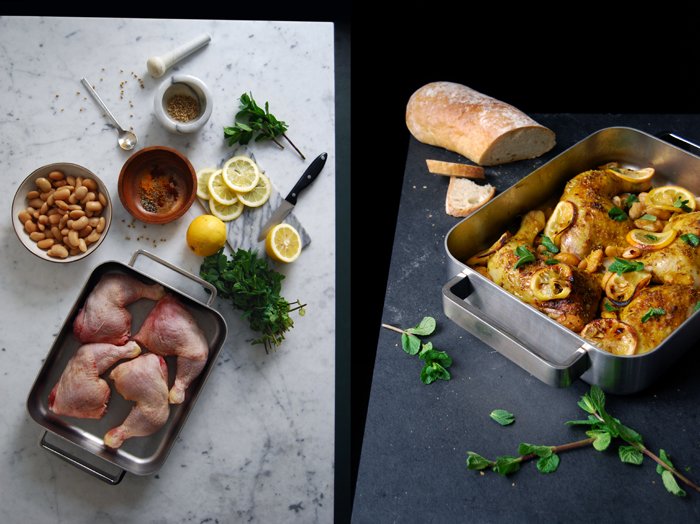
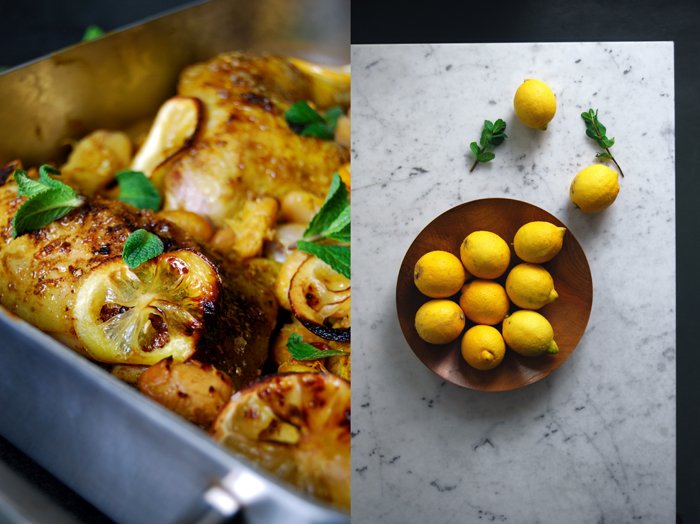
Spice Roast Chicken Legs with Butter Beans and Mint
For 2-4 people you need
chicken legs 4
canned butter beans, rinsed and drained, 250g / 9 ounces (double the amount for 4 people)
coriander seeds, crushed in a mortar, 1 teaspoon
ground cumin 1 teaspoon
ground turmeric 1/2 teaspoon
ground cardamom 1/4 teaspoon
cayenne pepper 1/4 teaspoon
black peppercorns, crushed in a mortar, 1/4 teaspoon
lemon, cut into thin slices, 1, plus 1 teaspoon of lemon juice
olive oil
coarse sea salt
fresh mint leaves, a small handful, to serve
Set the oven to 200°C / 390°F (I use the Rotitherm setting which works perfectly for poultry).
Whisk 3 tablespoons of olive oil with the lemon juice and spices. Arrange the chicken legs in a baking dish, rub them on all sides with the spiced oil and sprinkle the skin generously with sea salt. Mix the beans with a splash of olive oil and arrange them around the meat. Put the slices of lemon on top and cook in the oven for about 20 minutes or until golden brown. Pour some of the juices over the meat a couple times while it’s cooking. Check the meat with a skewer, only clear juices should come out when it's done. If you like, turn the grill on for a few minutes until the skin starts sizzling. Serve with fresh mint and ciabatta bread.

Poached Egg, Grilled Aubergine and Crisp Bacon Sandwich
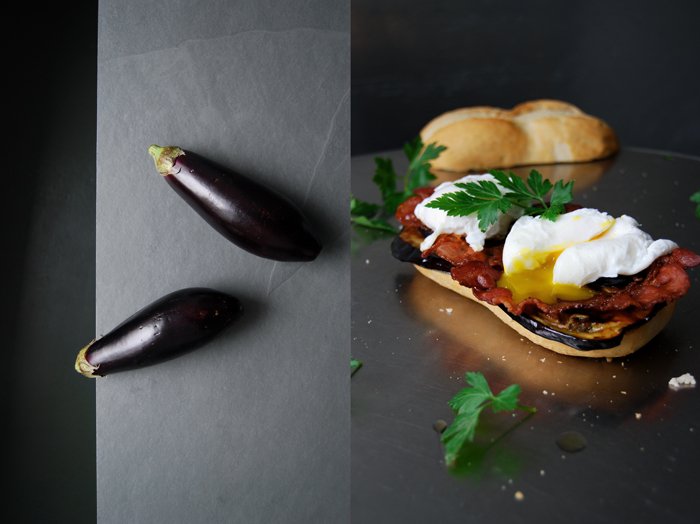
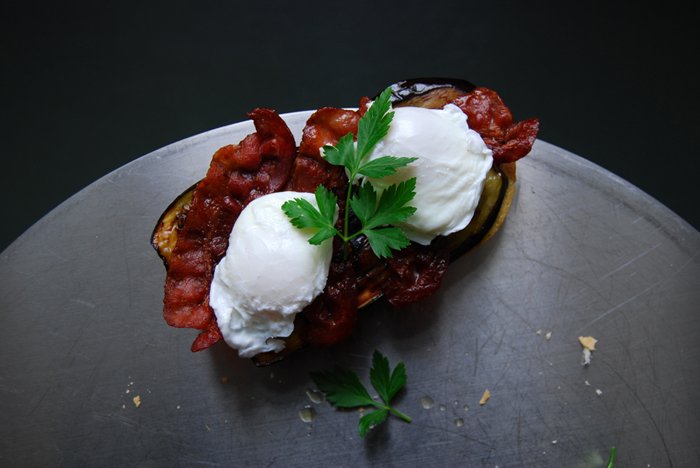
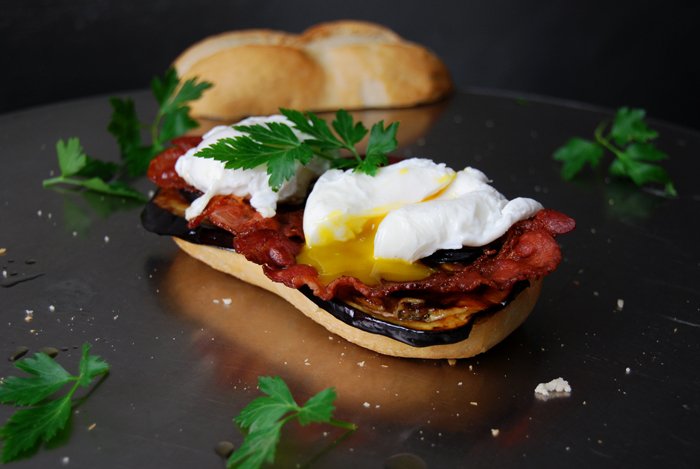
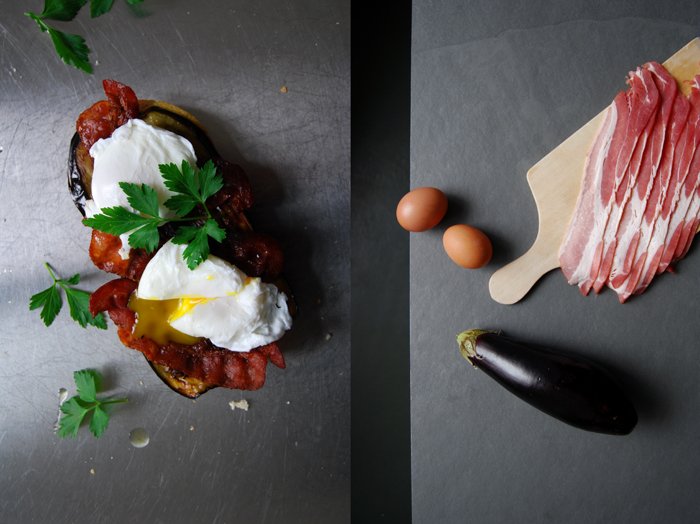
Excitement in the kitchen! I made my first poached egg and it worked out perfectly. After a quick introduction to the art of egg poaching on Food52 I felt ready to give this challenge a try. To my surprise, it was much easier than I had expected so I could take my time and focus on the other ingredients for this week's sandwich, grilled aubergine and crisp bacon.
My inspiration came from the great Sabih sandwich. I thought about it in the past couple days, how it combines all that lusciousness between two slices of bread, rich hummus, grilled aubergine and a boiled egg merged to true deliciousness. It could easily be too much but somehow this Middle Eastern sandwich classic does it just right. The egg and the eggplant are a great duo, they complement each other perfectly, so I used this idea but added a new flavour, salty bacon. I packed everything in between a large baguette bun and finished it off with some crunchy parsley leaves. I should warn you, this is more than a snack, it's a proper meal, but anything smaller wouldn't have worked, this sandwich has the same addictive quality as the scrumptious Sabih!
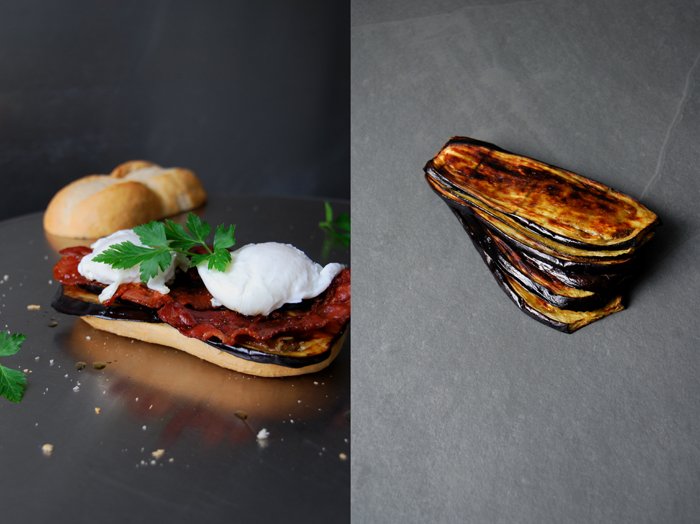
Poached Egg, Grilled Aubergine and Bacon Sandwich
For 2 large sandwiches you need
large, crunchy baguette buns, cut in half, 2
aubergine, cut into 1/2cm / 1/4" slices, 1
breakfast bacon 6 slices
eggs 2-4
olive oil
coarse sea salt and pepper
fresh parsley leaves, a small handful
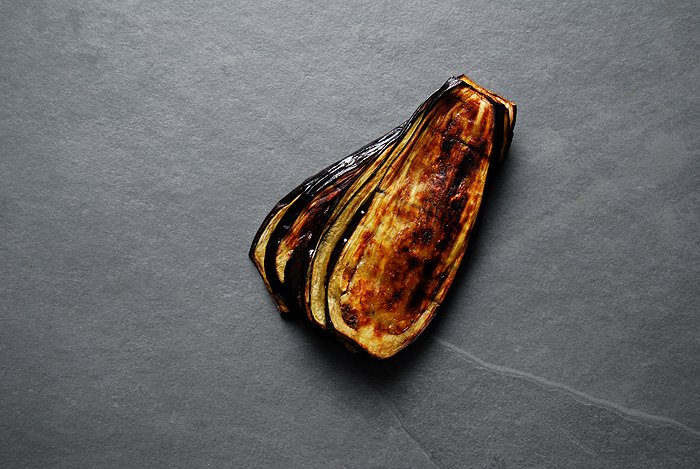
Brush the aubergine slices with olive oil on both sides, season with salt and pepper and put them under the grill for about 6-7 minutes on each side. Watch them as they should be golden, partly brown, but not burned. Take them out of the oven and put the slices on top of each other on a plate, that will keep them moist.
Heat a little olive oil in a pan and fry the bacon for a few minutes on each side on medium heat until golden brown and crisp. Lay them on kitchen paper to remove excess fat.
Put 2-3 slices of grilled aubergine on the bottom side of each bun and lay 2-3 slices of bacon on top.
In a saucepan, bring water to the boil, add some salt and turn down the temperature, it should be simmering, not bubbling! Crack an egg open and put it into a small bowl. Put a large spoon (the largest you have) on the surface of the simmering water and gently pour the egg onto the spoon. Hold the spoon with the egg in the water and put the egg back into place with a second tablespoon if it slips off the spoon (I had to do this a couple times). It needs around 3 minutes. When the egg is done, take the spoon out, let the excess water drip off and carefully scrape the poached egg onto the fried bacon with a second spoon. Sprinkle with parsley, close the bun and enjoy!
It's best to poach one egg at a time but if you are impatient, you can cook two at once. In that case, let the first egg float in the water after cooking it on the spoon for 1 1/2 minutes (mind that it doesn't stick to the bottom when you let it float). Poach the second egg on the spoon and take both eggs out after they have cooked for 3 minutes each.


Parsnip & Sweet Potato Soup with Pomegranate & Mascarpone
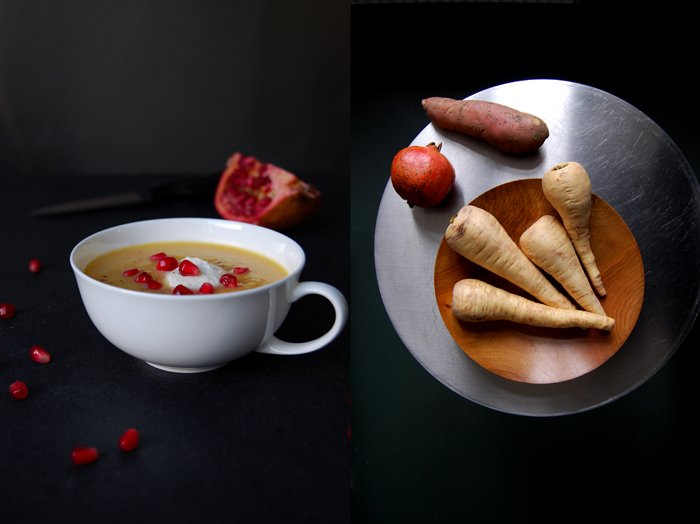
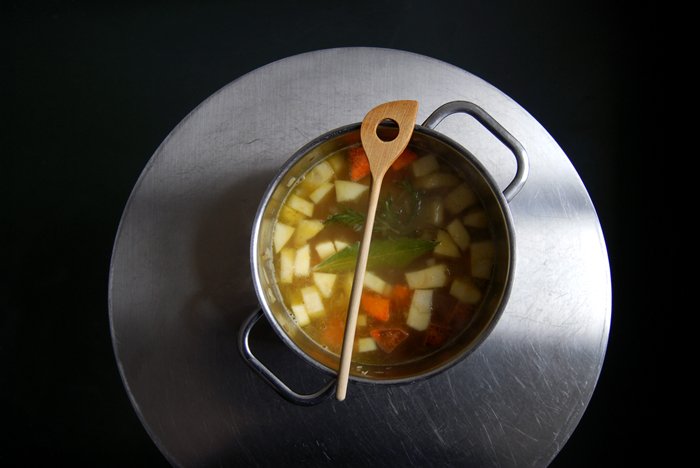
Roots and fruits are a great match for puréed soups, they merge to a deliciously warming treat full of fragrant flavours. They often balance each other out, like the strong parsnip which has such an overpowering impact that it's best in combination with other ingredients that underline its subtle sweetness.
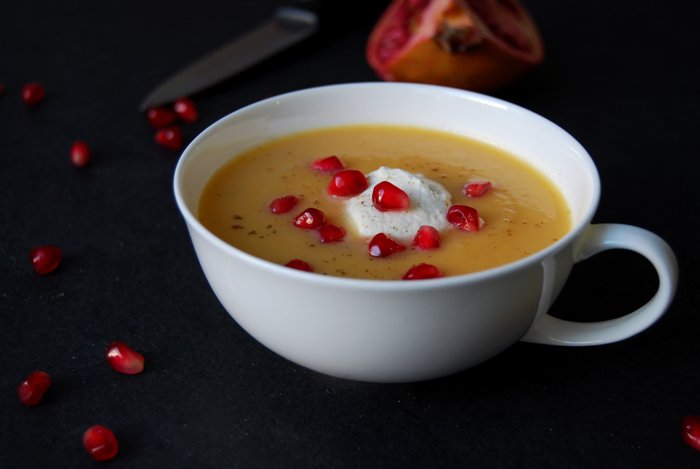
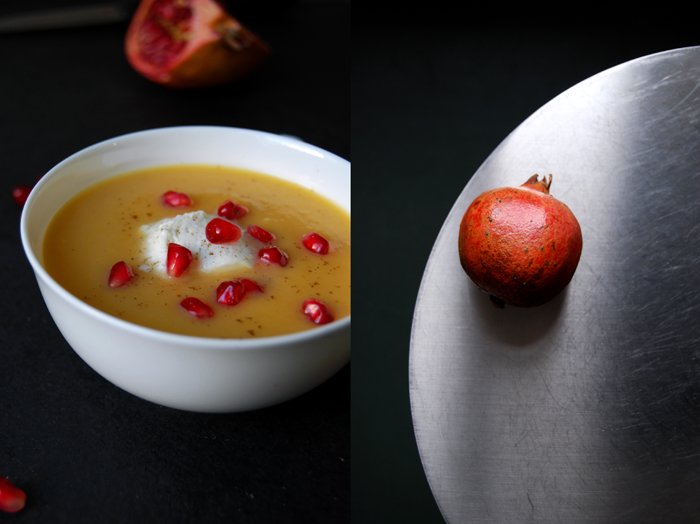
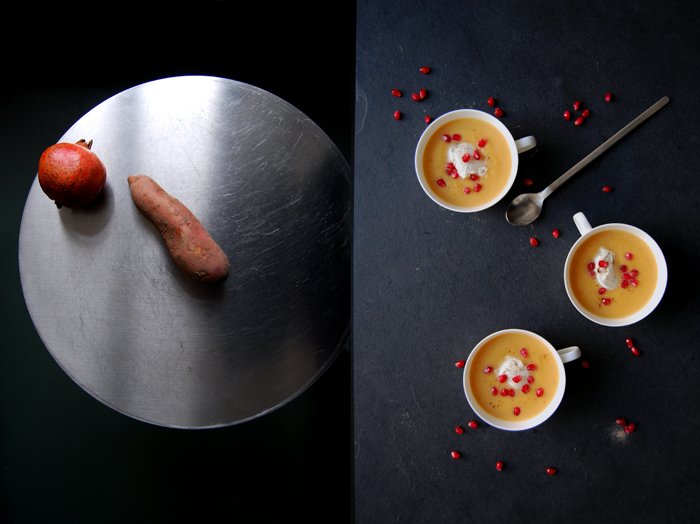
I went for robust sweet potatoes, a great team player, and juicy pomegranate seeds, their sourness is a wonderful addition to the earthy aroma. And, of course, their dramatic look is quite a stunner on the root's pale pink! When I cook these kind of soups I like to spare on heavy cream, I just stir in a little bit to support the natural creaminess which is already given through the puréed vegetables. It doesn't need much of the dairy product otherwise it will turn into a heavy meal and that's the opposite of what I'm after. I prefer to refine the roots with another kind of milkiness, a discovery I made in October for my parsnip and pear soup. I used whipped mascarpone cheese, just a small spoonful, but this time I mixed it with cardamom and a bit of orange juice, it literally melted into the root composition!
Parsnip & Sweet Potato Soup with Pomegranate & Cardamom Mascarpone
For 4 as a starter you need
parsnip, peeled and chopped, 300g / 10.5 ounces
sweet potato, peeled and chopped, 200g/ 7 ounces
medium onion, chopped, 1
vegetable broth 800ml / 2 pints
bay leaf 1
rosemary 1-2 small sprigs
olive oil
heavy cream 75ml / 2.5 ounces
salt and pepper
honey 1-2 teaspoons, to taste
ground cardamom
mascarpone 100g / 3.5 ounces, for the topping
freshly squeezed orange juice, to taste, for the topping
pomegranate, peeled, 1, for the topping
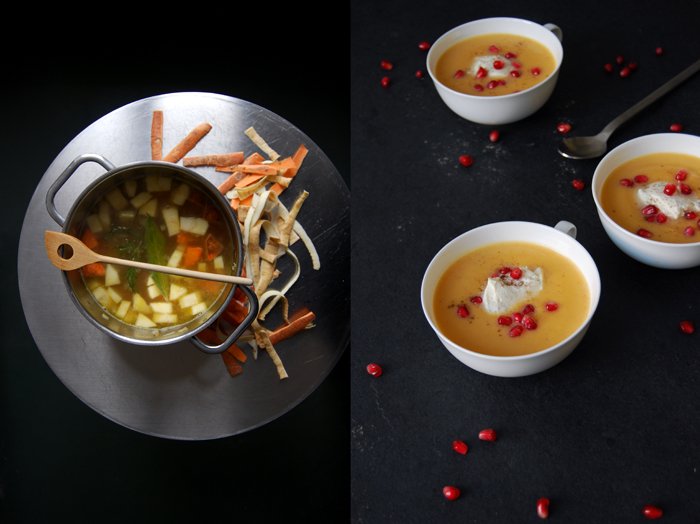
In a large pot, heat a splash of olive oil and cook the onion on medium heat until soft. Add the parsnip and sweet potato and cook for a minute. Pour in the broth and add the bay leaf and rosemary. Season with salt and pepper and cook for about 20 minutes or until the roots are soft. Take the rosemary out after 10 minutes and the bay leaf when the soup is done. Purée the soup in a blender or with a stick mixer, stir in the heavy cream, honey and a pinch of cardamom, season to taste.
Whisk the mascarpone with 1/4 teaspoon of cardamom and a splash of orange juice. Add a bit of heavy cream if it's too thick and season to taste.
Serve the warm soup with a dollop of mascarpone, pomegranate seeds and some cardamom sprinkled on top.

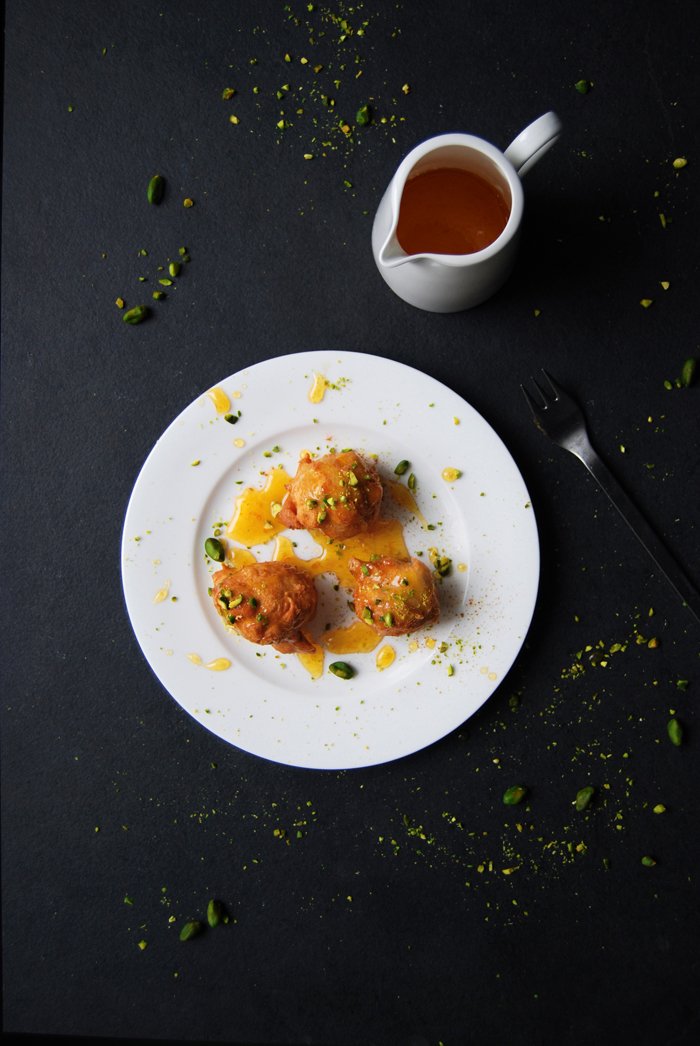
Loukoumades - Greek Doughnuts with Honey, Cinnamon and Pistachios

Every year at carnival, my family meets at my mother's house to make Berliner, a jam filled doughnut dusted with cinnamon sugar. It's a heavenly ball of sweet sponginess so tempting that all of us end up eating far more than we should. We all have our favourite filling, so we use a selection of blueberry, raspberry, blackberry and red currant jam. The only problem is, once they are cooked, you can't really see the difference anymore. So we guess blindly and exchange Berliner across the table when we pick the wrong one. It's quite a funny scene! You could also use chocolate, gianduja or eggnog to customize them to your personal taste and come up with your own perfect creation. Unfortunately, after this culinary experience, you might never be satisfied with store-bought doughnuts ever again! It's already been a year since I shared our traditional Berliner recipe, and next week, it will be that time of year again, we'll all meet in my mother's kitchen in the countryside to celebrate our silly little family feast!
Although I'm not the biggest fan of deep-fried sweets, at carnival I love them. They belong to this season like spooky costumes and exuberant music. In Cologne, where I went to university, I used to buy Muzen from a little bakery. They look like tiny diamond shaped doughnuts, crisp on the outside with a spongy centre. It's a local speciality only made at this time of the year. They are so good, I could eat them by the dozen! In Berlin, Berliner are called Pfannkuchen (meaning pancakes in German) and they are often filled with plum jam. There are many other names all over the world, Krapfen, Fastnachtküchle, Krof in Slovenia or Pączki in Poland, all customized after the regional preferences.
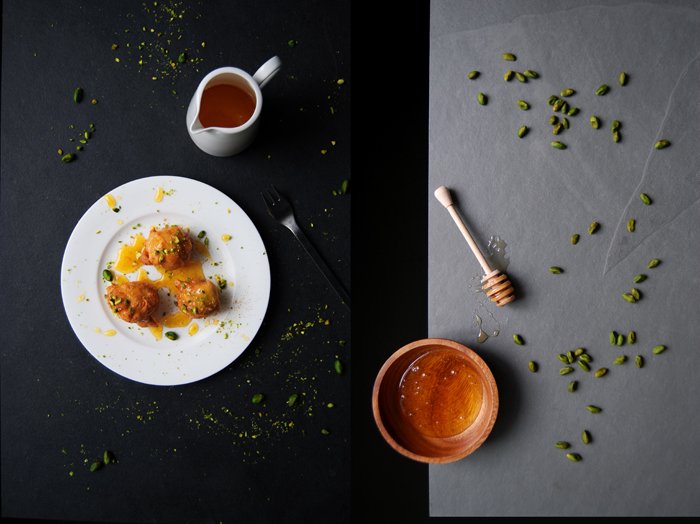
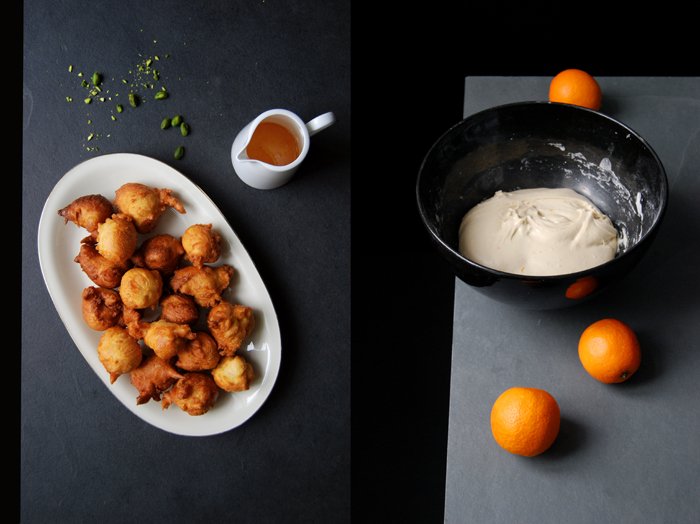
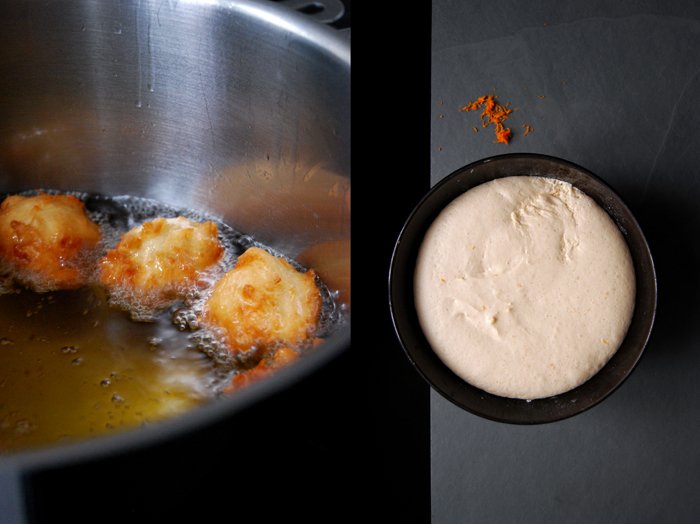
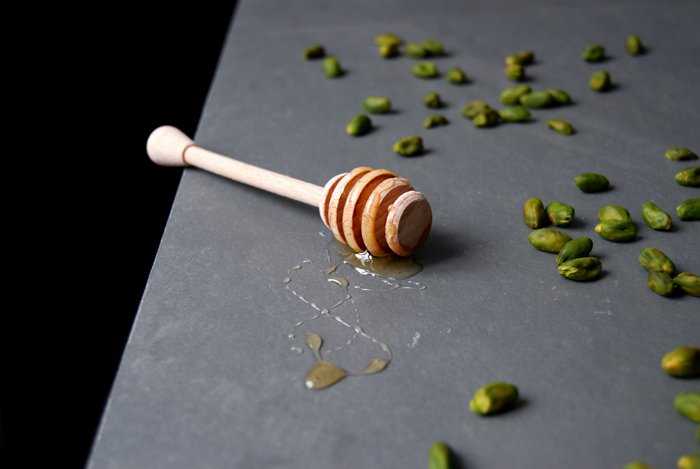
After some research, I discovered something new, Greek doughnuts called Loukoumades! I called my sister as her husband is half Greek and they often spend their summers in Greece. Nina got very excited about this sweet and told me that they savoured it all the time during their last holiday on the island of Thassos. Her husband would play Bouzouki in a mountain village in the evenings with his friends while my sister enjoyed plates of Loukoumades, with lots of honey and cinnamon. After her colourful description, my decision was made, I had to try them! The next morning I made an orange flavoured yeast dough, a bit softer and with more yeast than my usual recipe. You have to scoop out the little Loukoumades with a spoon and cook them in hot fat. It only took a few minutes and I had a plate full of golden doughnuts in front of me, coated voluptuously with orange-honey syrup and sprinkled with chopped pistachios and a bit of cinnamon. It was amazing, I know I can trust my sister when it comes to sweet treats!
Loukoumades with Honey, Cinnamon and Pistachios
For 24 small Loukoumades you need
plain flour 400g / 14 ounces
dry yeast 2 sachets (each 7g / 1/4 ounce)
granulated sugar 1 tablespoon
salt 1 teaspoon
milk, lukewarm, 150ml / 5 ounces
water, lukewarm, 125ml / 4.5 ounces
orange zest 1 heaped teaspoon
honey 1 tablespoon
pistachios, unsalted, chopped, 60g / 2 ounces
ground cinnamon, for serving
vegetable shortening for deep-frying 1kg / 2 1/4 pounds
For the syrup
quality honey (liquid) 150g / 5.5 ounces
freshly squeezed orange juice 50ml / 1 3/4 ounces
granulated sugar 1 tablespoon
orange zest 1 teaspoon
In a large bowl, combine the flour, yeast, sugar and salt. Add the milk, water, honey and zest to the mixture and mix with the dough hooks of your mixer for about 5 minutes. The dough should be elastic and come off the sides of the bowl, it will be a little sticky so don't mix with your hands. Cover the bowl with a tea towel and let it rise in the warm oven (35°C / 95°F) for 45 minutes (top/ bottom heat and not fan-assisted!).
For the syrup, bring the honey, orange juice and sugar to the boil and cook on medium heat for about 5 minutes or until it's a thick syrup. Stir in the zest and keep warm.
In a large pot, heat the vegetable shortening. Check the temperature with a wooden spoon, it's hot enough when little bubbles form around it. Scoop out a small walnut sized ball off the dough (this works best with 2 tablespoons) and carefully drop it into the hot fat. Start off with one ball, the Loukoumades should cook for 3-4 minutes to turn into golden balls. If they become too dark after a shorter cooking time, turn down the temperature (which is what I had to do after the first batch), they will need at least 3 minutes for the centre to cook through. They should be golden and not dark brown. Take them out with a slotted ladle and put them on a kitchen paper to remove excess fat. Serve with the warm syrup, chopped pistachios and a little cinnamon.




Rolled Potato Noodles with Parsnip, King Trumpet & Portobello Mushrooms
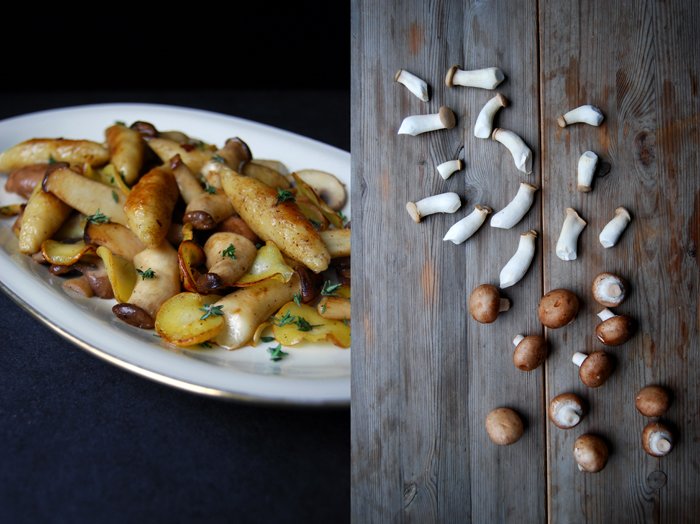
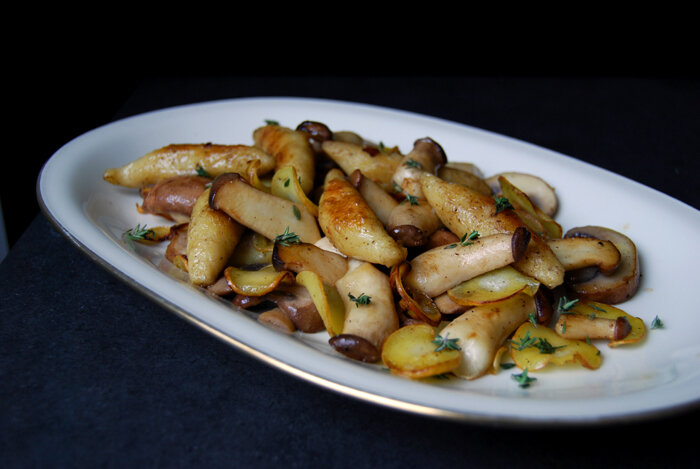
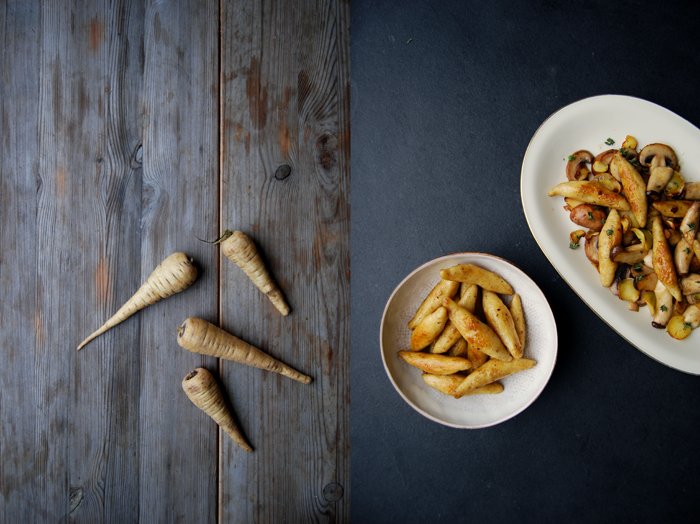
Hearty! This word describes best how I feel about this dish, hearty Swabian potato noodles called Schupfnudeln in German (meaning rolled noodles) meet king trumpet and portobello mushrooms sautéed with the thinest slices of parsnip and fresh thyme. This is another one of those dishes that puts me into the mood for a cosy hideaway, a little hut in the forest, lit up with candles and an open fire. I think I need a holiday, each meal I cook at the moment, each ingredient, whatever its origin may be, pulls my mind out of my kitchen into another dreamy scene and they all have one thing in common, silence, peace and seclusion.
As there's nothing planned, I have to take these precious little moments of my imaginary / culinary holidays and rest my mind wherever my kitchen activities may take me. Be it on an imposing mountain top with a sandwich in my hand and the wide horizon right in front of me, or in a wooden hut in the dark forest which calls for a warming soup while I sit on a wooden bench wrapped in warming blankets. I could go on and on, a long walk on a lonely beach and a little crumbly piece of quiche (something I used to do when I lived in Whitby in England), or a paper bag full of fish and chips savoured at the harbour while I watch the fishermen scrub their boats. But I'll stop this now, my real world appetite calls for a real meal and it can't get any better than a plate full of these scrumptious golden Schupfnudeln and Mushrooms!
Schupfnudeln are similar to Italian gnocchi, the dough is a bit more firm and their shape is long. You can eat them straight after being cooked in water but I like to fry mine to golden, buttery bites which puts them right on the next level. They are so good that I always eat more of them than I should, especially in combination with thyme, mushrooms and parsnip, both cooked with a bit of bite, it's too good!
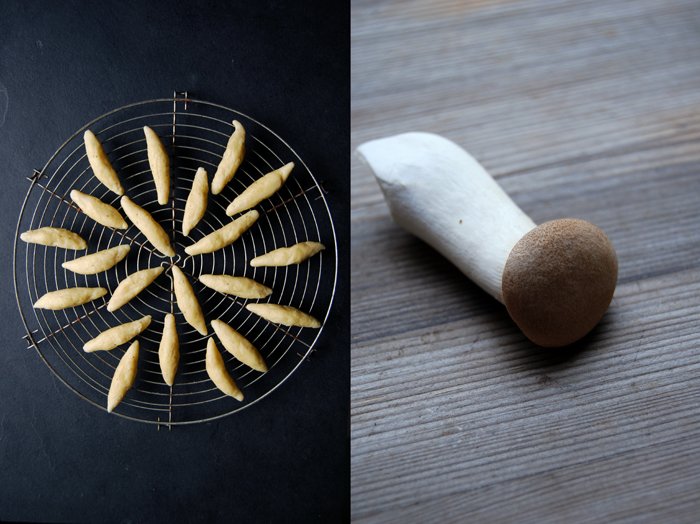

Potato Noodles with Parsnip, King Trumpet and Portobello Mushrooms
For 4-6 people you need
For the potato noodles/ Schupfnudeln
potatoes, cut into cubes, 420g / 15 ounces
butter 1 heaped tablespoon
organic egg yolk 1
plain flour 250g / 9 ounces
nutmeg, freshly grated
salt 2 1/2 teaspoons
pepper
olive oil, to fry the Schupfnudeln
butter 1-2 tablespoons, to fry the Schupfnudeln
Cook the the potatoes in salted water until soft (around 15 minutes). Drain them when they are done. Press the drained potatoes through a potato ricer and mix immediately with the butter and egg yolk. Put in a cool place (in the fridge) until the mixture is completely cool (!).
In a large pot, bring plenty of salted water to the boil.
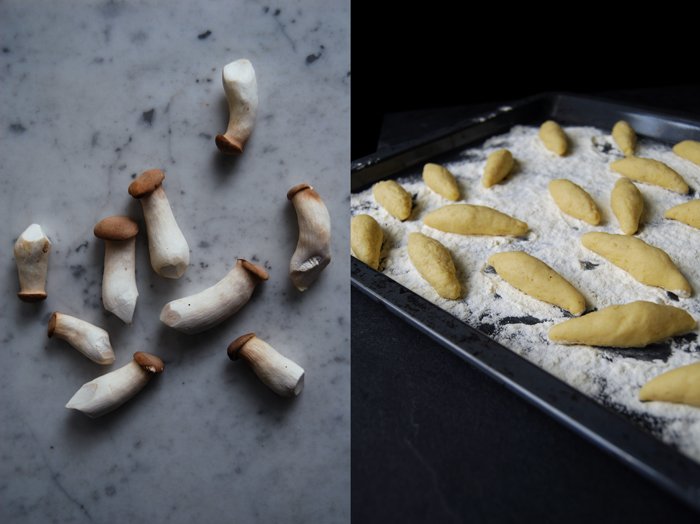
With a spoon (or your hands), mix the cold potato mixture with the flour, salt, nutmeg and pepper until combined, add more flour if the mixture is too sticky. Dust your hands with flour and take a small walnut sized ball off the dough and roll between your hands to a sausage/ Schupfnudel shape as you can see in the pictures (the ends should be pointy). Keep them on a floured baking sheet.
Cook the Schupfnudeln in batches in the boiling water for 3-4 minutes, when they start to come up and float on the surface take them out with a slotted ladle and put them on a wire rack to cool.
In a large heavy pan, heat a splash of olive oil and the butter and fry the Schupfnudeln until golden on all sides, season with salt and pepper.
For the mushrooms
king trumpet mushrooms, bottom cut off, cut in half (lengthwise), 250g / 9 ounces
portobello mushrooms, bottom cut off, cut into 1/2cm / 1/4" slices, 550g / 1 1/4 pounds
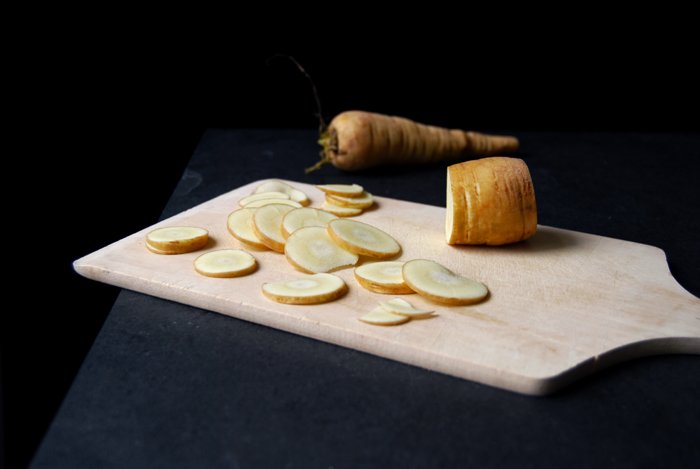
small parsnips, scrubbed and cut into very thin slices, 3
fresh thyme, a few sprigs
olive oil
butter 1-2 tablespoons
salt and pepper
Fry the parsnips in a splash of olive oil on medium-high for about 5 minutes or until golden and al dente, stir constantly. The rim should be light brown but not black!
Heat a splash of olive oil and some butter in a large pan and sauté the king trumpet mushrooms for 1 minute on each side on high temperature, they should be al dente. Season with salt and pepper, add some thyme leaves and take them out of the pan. Keep them on a covered plate while you cook the portobello mushrooms.
In the same pan, heat some more olive oil and butter and sauté the portobello mushrooms for about 2 minutes on each side (also on high temperature). Season with salt and pepper, gently mix with the king trumpet mushrooms, parsnips and some fresh thyme leaves. Serve on a warm plate with the fried Schupfnudeln.



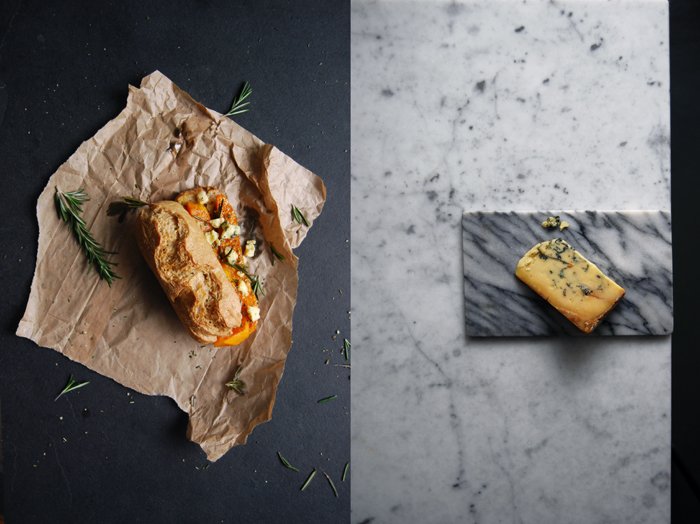
Roasted Pumpkin, Stilton and Rosemary Bun
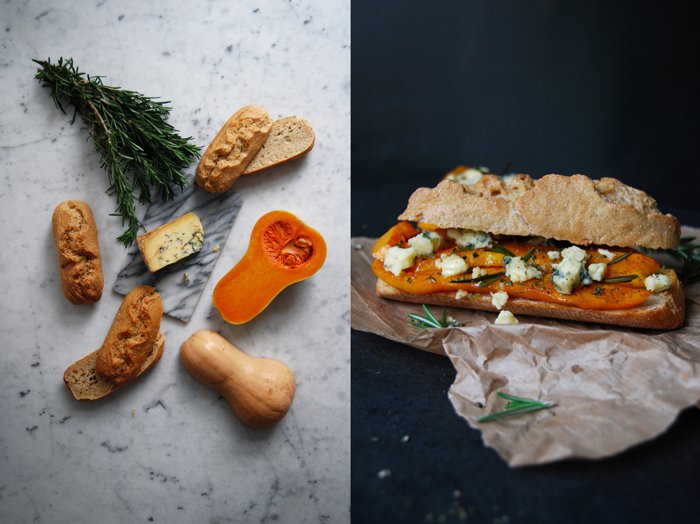
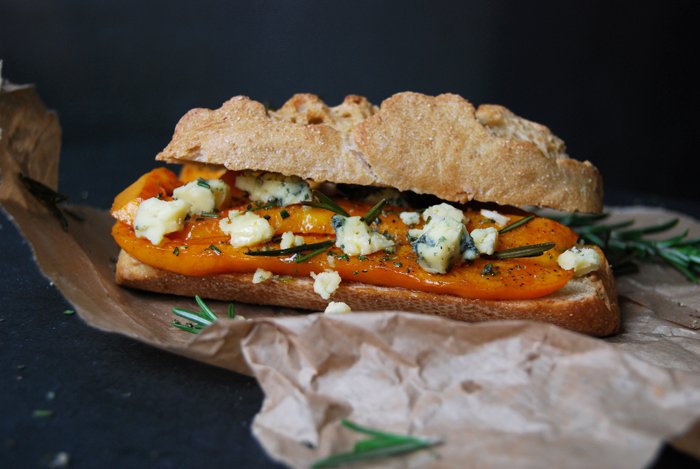
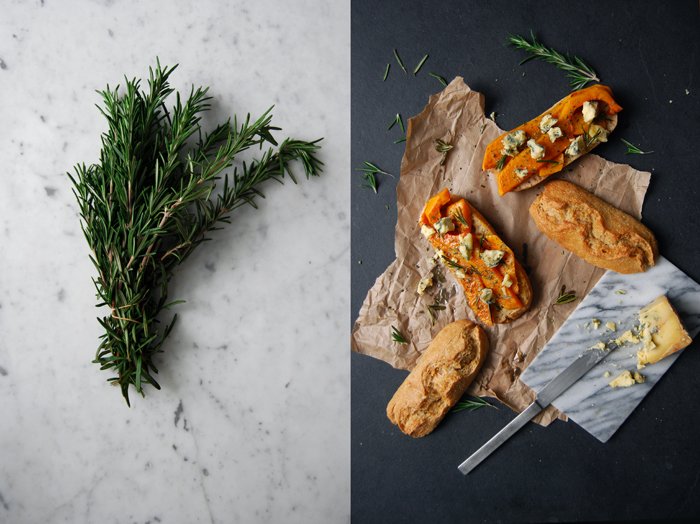
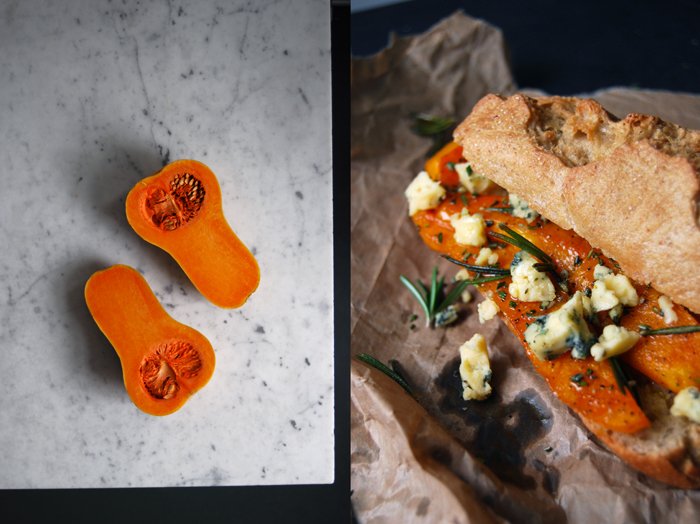
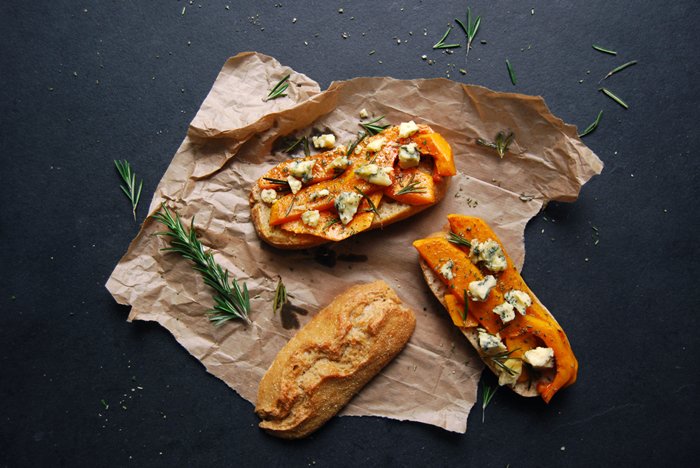
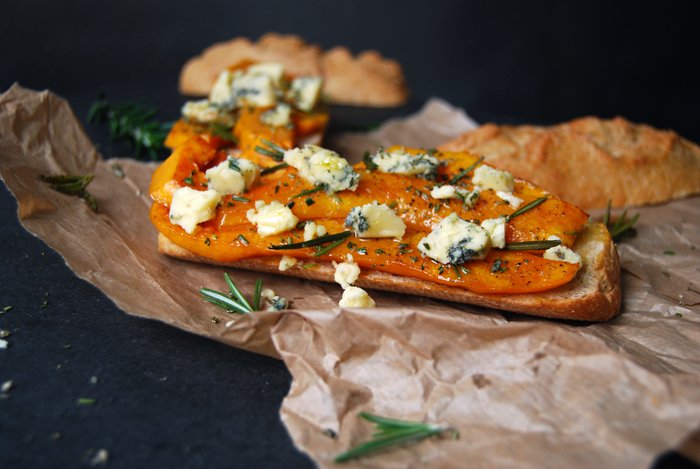
Sweet butternut squash steaks grilled in the oven to caramelized perfection, sharp Stilton and woody rosemary, these are the simple but convincing components of this impressive sandwich. What can I say, we loved it! After the obligatory initial doubts from my boyfriend, who, sometimes, prefers to see some slices of crisp bacon and melted cheese on his sandwich rather than my extravagant kitchen experiments, we finally met at the kitchen table for our little snack date and savoured with great satisfaction.
The task was easy, the nearly overpowering sweetness from the squash had to be controlled somehow and the steady British blue cheese did a great job. This cheese works so well with the ripest fruits, with figs and peaches melting in your mouth, or pears dripping with juices, so why shouldn't it cooperate with a robust butternut squash that's been forced (by me, the oven and a little sugar) to resemble honey?
Butternut Squash, Stilton and Rosemary Bun
For 3 sandwiches you need
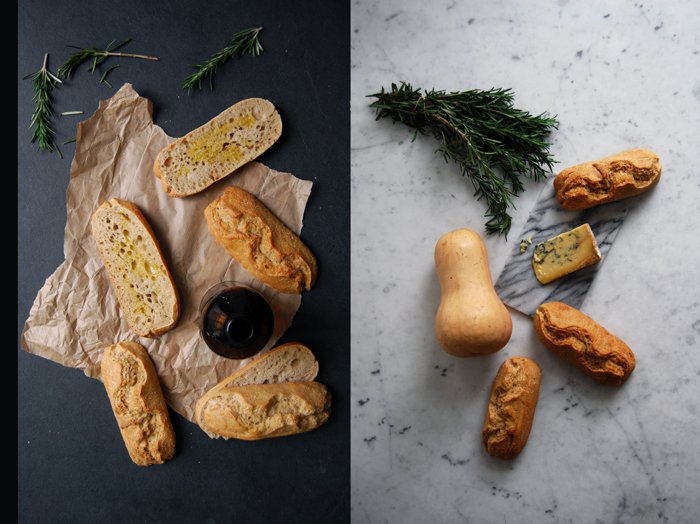
rustic white buns, cut in half, 3
small butternut squash, peeled, the seeds scraped out, cut into long 1cm / 1/2" thick strips, 1 half
Stilton (or any other strong blue cheese), crumbled, 100g / 3.5 ounces
rosemary, finely chopped, 1 teaspoon plus a few sprigs
granulated sugar 1 1/2 teaspoons
Fleur de Sel
pepper
olive oil
butter 1 teaspoon
Set the oven to 200°C / 390°F.
In a pan, heat a splash of olive oil and the butter. Add the pumpkin steaks to the pan, fry for 1 minute and sprinkle them with half the sugar before you turn them around. Sprinkle with the remaining sugar and turn them after 1 minute. Take the pan off the heat after 30 seconds and spread the butternut squash steaks in a baking dish, sprinkle with the rosemary (chopped and sprigs) and roast in the oven for 4 minutes or until the pumpkin is soft.
Brush the inside of the buns with olive oil, lay 2-3 warm slices of pumpkin on each of their bottom halves and sprinkle immediately with Stilton, rosemary sprigs, pepper and Fleur de Sel. Enjoy!

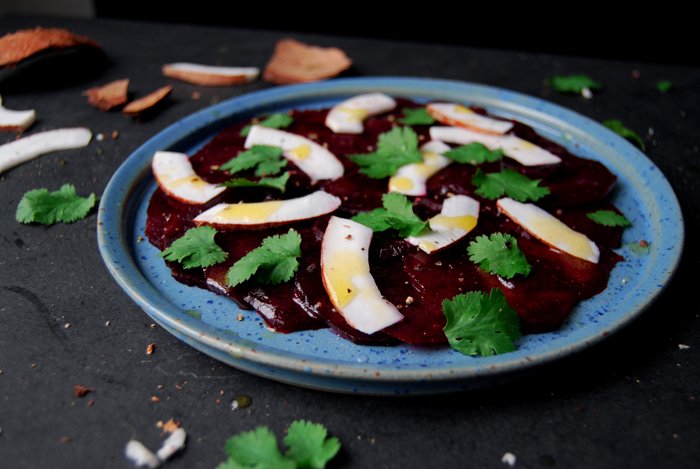
Beetroot Carpaccio with fresh Coconut and Coriander

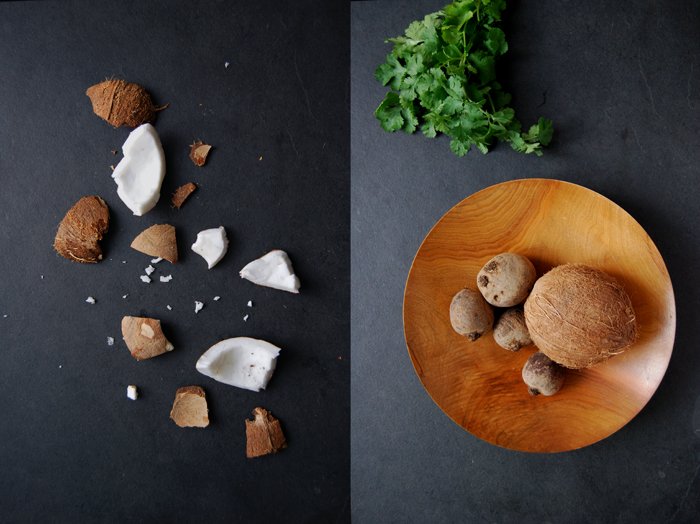
Sometimes I must have a coconut in my kitchen, not because I'm so crazy about the taste, more because I love the whole ceremony of opening them. First I punch 3 holes into the top to pour out the coconut water (which I like a lot) and then I hammer it open. It really makes you feel like you have to work for your food, which is a rare experience in our culture. I don't know how often I hit my thumb and swore I would never do it again, but I can't help it, here I am again with a big hard nut on my kitchen floor, fighting for my food.
As soon as the white meat is peeled out of the shell I keep it in a bowl of water as it dries out really quickly. It's quite a nice snack to nibble on but for today's lunch I had different plans, I had a beetroot carpaccio in mind, sprinkled with crunchy coconut slices and fresh coriander. I used the coconut's water for the dressing and whisked it with olive oil, orange juice and some of Arnold's Maltese Orange Blossom honey (I still have a little bit left and treat it like a treasure!). The earthy beetroot can take the combination with strong flavours and this one is quite exotic, if you're up for something more simple, try the combination with apples and pomegranate!

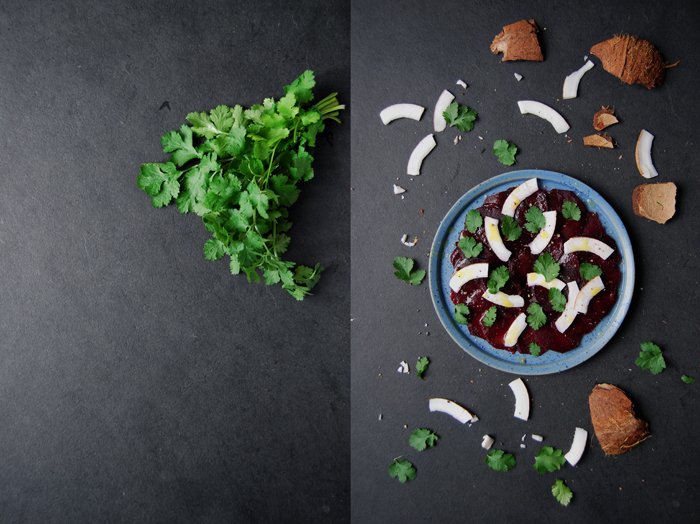
Beetroot Carpaccio with fresh Coconut and Coriander
For 2 you need
small beetroots 4
bay leaf 1
fresh coconut 1/4
fresh coriander leaves, a small bunch
coconut water 1 tablespoon (from the coconut)
olive oil 2 tablespoons
freshly squeezed orange juice 2 tablespoons
quality honey (liquid) 1/4 teaspoon (if it's frim, warm it up in a pan)
salt and pepper
Cook the beetroots with the bay leaf in salted water for about 45 minutes, rinse with cold water and let them cool.
Carefully punch (or drill) 3 holes into the top of the coconut (I use a clean screwdriver and a hammer) and pour the water into a glass, crack the hard skin of the coconut and peel out the white meat. Cut about 1/4 of the coconut into very thin slices.
For the dressing, whisk the coconut water, olive oil, orange juice and honey and season with salt and pepper to taste.
Peel the beetroots, cut them into thin round slices (with a cheese or vegetable slicer) and arrange them on plates. Sprinkle with the coconut slices, the dressing and coriander.

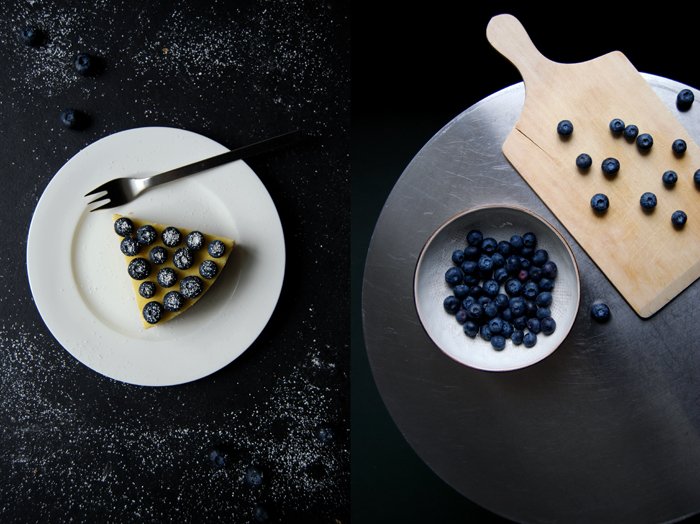
Blueberry Ricotta Cheesecake
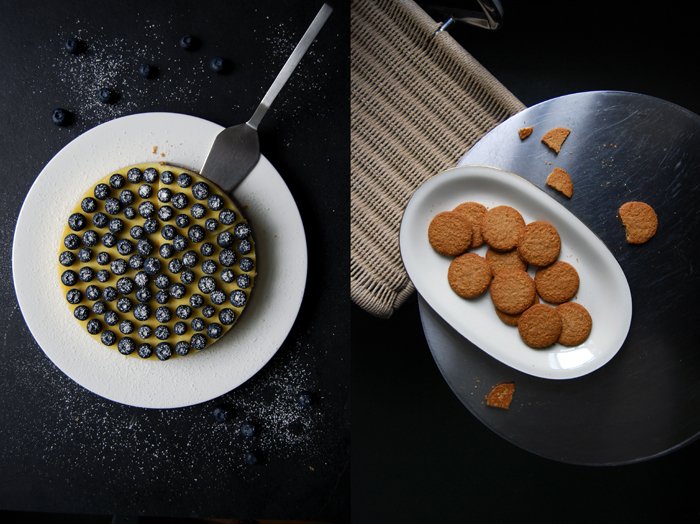
My last cheesecake creation is definitely too long ago, it was a dense treat with lots of orange and lemon flavours, rich in cream cheese with a little addition of Mediterranean ricotta. It was more like a classic New York cheesecake and was so good that for more than a year I haven't bothered to come up with a new recipe. I baked it all winter, its citrusy richness is just perfect for a cosy tea time, and then in summer, I moved on to our old family recipe for the German version of this cake. German Käsekuchen is made with quark and stiff egg whites which gives it a lighter, fluffier texture, it's delicious with fresh berries for a Sunday morning brunch on the balcony!
Despite the wintery temperatures, my mood has already moved on to the next season, spring, sunshine and fragrant flowers. This calls for a new cheesecake recipe!
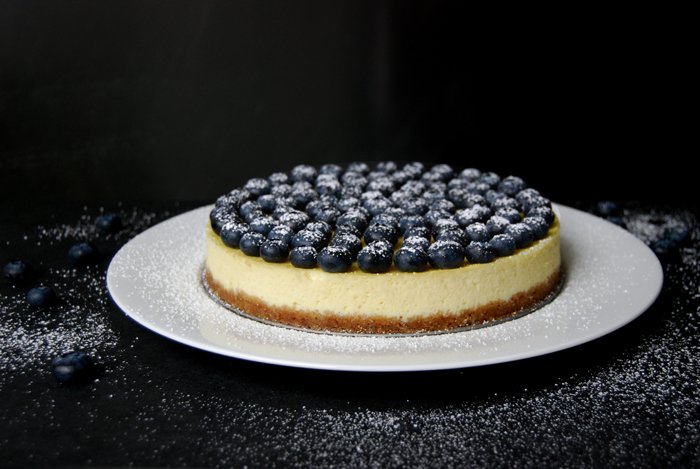
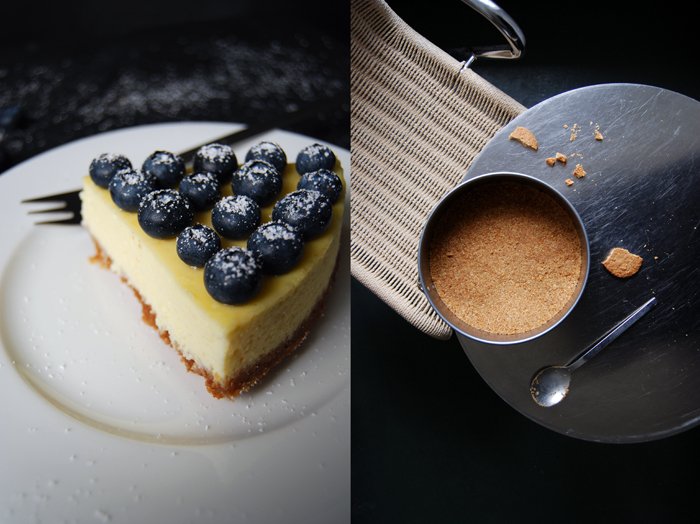
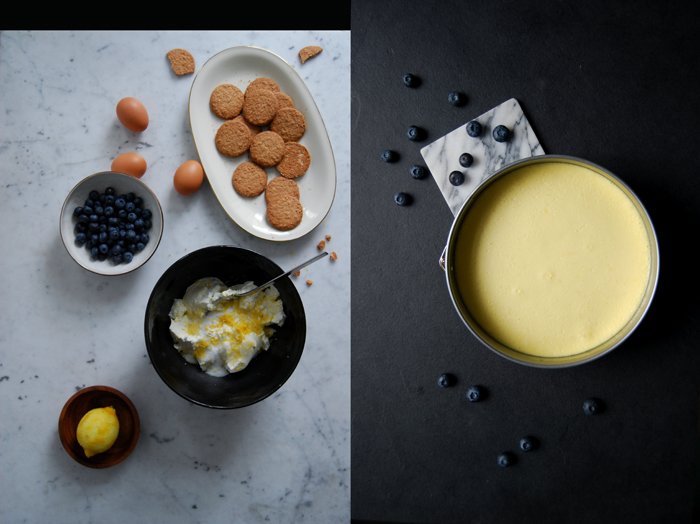
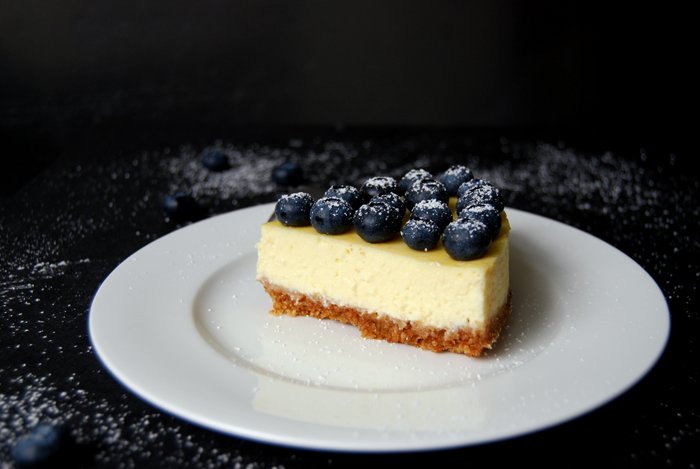
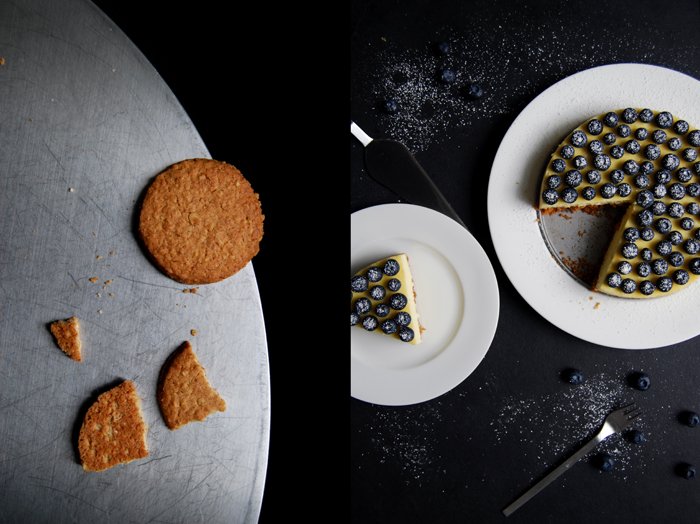
I was after a lighter version so a good amount of the usual cream cheese had to make way for ricotta. For the first time in my life I looked at the amount of fat in both dairy products, something I'm not very interested in most of the time as I want to enjoy my food and not feel guilty. The Italian cheese is definitely the winner (in a good way). It still creates a creamy texture but it's not as filling. I refined the cheesecake mixture with lots of lemon juice and zest and baked it on top of a base of buttery digestive cookies. A fruity topping brought a spring feeling to the recipe, I brushed the cake with a thin layer of apricot jam and spread lots of crisp blueberries on top. It was amazing, one bite after the other was pure bliss!
Blueberry Ricotta Cheesecake
For a 20.5cm / 8″ springform pan you need
digestive cookies (Graham crackers) 210g / 7.5 ounces
butter, melted, 70g / 2.5 ounces
ricotta, at room temperature, 250g / 9 ounces
cream cheese, at room temperature, 300g / 10.5 ounces
granulated sugar 100g / 3.5 ounces
vanilla pod, scraped, 1/4
organic eggs 3
cornstarch 1 teaspoon
zest of 1 large lemon
juice of 1 lemon (4 tablespoons)
a pinch of salt
fresh blueberries about 200g / 7 ounces, for the topping
apricot jam 2 tablespoons, for the topping
water 2 tablespoons, for the topping
icing sugar, for the topping
Crush the cookies in a blender until very fine, or in a plastic bag, and mix with the melted butter until combined. Press the mixture into the springform pan and put in the freezer for 15 minutes.
Set the oven to 165°C / 330°F and put a deep tray or roasting tin in the oven on the lowest position. Boil water in a kettle.
Mix the ricotta, cream cheese, sugar, vanilla, eggs, cornstarch, lemon juice, zest and salt with an electric mixer until well combined.
Take the springform pan out of the freezer and wrap it in aluminium foil twice so that the bottom and sides are well covered to protect the cheesecake from the water while it's baking. Pour the cheesecake mixture on top of the hardened crumbs and place the tin carefully into the tray in the oven. Fill the tray with the boiling water from your kettle. The water should come half way up the wrapped springform pan. Bake for 50 minutes, switch off the oven, open the door a little bit and leave the cake in the oven for about 15 minutes. Take the cheesecake out of the oven, take off the foil but leave the cake in the springform pan. When the cake is completely cool, chill it in the fridge (or outside in winter) for about an hour.
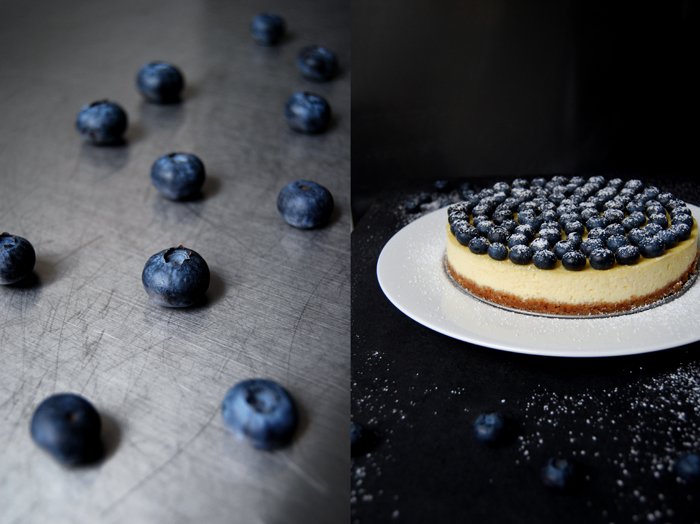
In a saucepan, bring the jam and water to the boil and cook for about 30 seconds, push through a sieve and brush on the cake. Spread the berries evenly on top of the cake and sprinkle with icing sugar before serving.


meet in your kitchen | Claudia's Ukrainian Pelmeni Dumplings
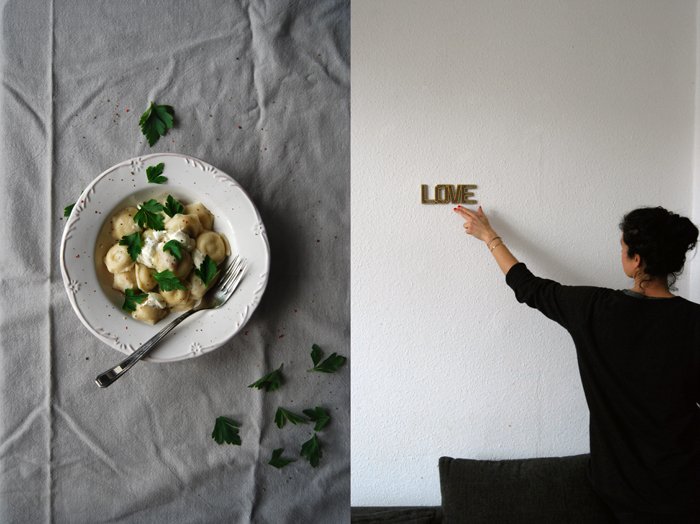
Claudia and Isa from the popular blog Hauptstadtmutti are like sisters, when you're in a room together with them you can feel their closeness and loyalty. Their characters seem aligned, despite their entirely different personalities. They call themselves an old couple, which is one of the biggest compliments for a friendship as it shows the respect and appreciation for each other, at least in their case! The mutual understanding also comes from the fact that the two women live similar lives, they are young, working mothers, they share similar interests and daily issues but also a big passion for fashion! Claudia and Isa only met five years ago and made a big step together, the energetic art director and journalist brought their different qualities together and merged them into their daily blog Hauptstadtmutti (meaning mother of the capitol in German). It soon became a vivid space for Berlin's mothers, their individual style and creative personalities. Pure elegance meets cool effortlessness and eclectic practicality, these mothers defy conventions and break with expectations. Clicking through the blog's street style portraits is an inspiration for any woman!
We planned to have a joint cooking session in one of their culinary spaces, but as both of them are so fascinating and their lives and personalities offer so much to talk about, we decided to split the Hauptstadtmutti kitchen series into two parts. So today, we'll start off with part I, in Claudia's cosy old rooftop flat where she lives with her 5 year old son, a true gentleman who welcomed me with a handshake.
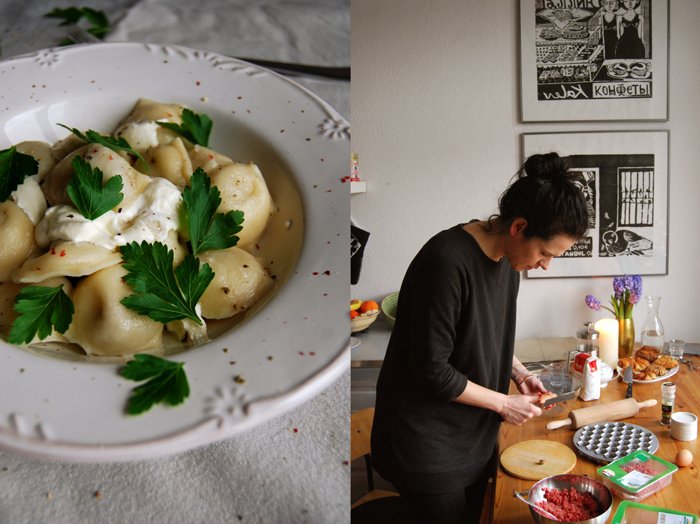
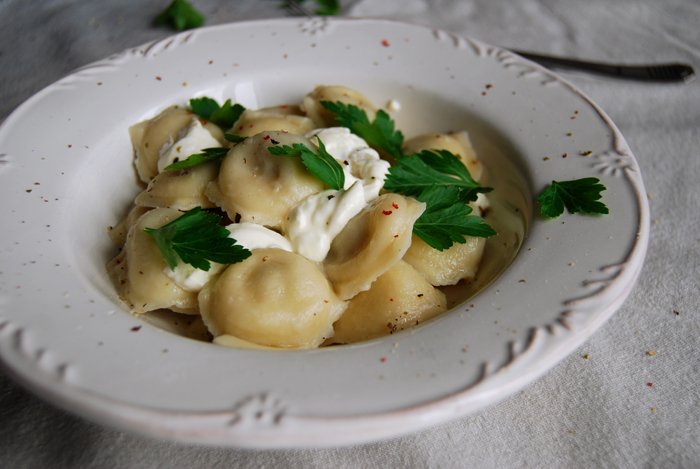
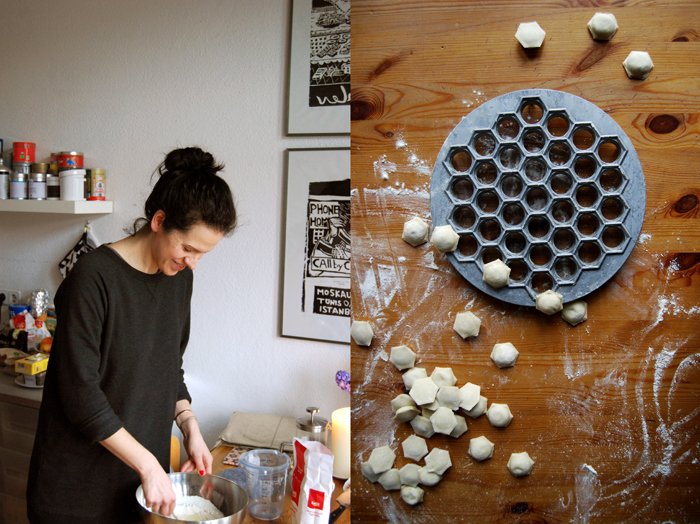
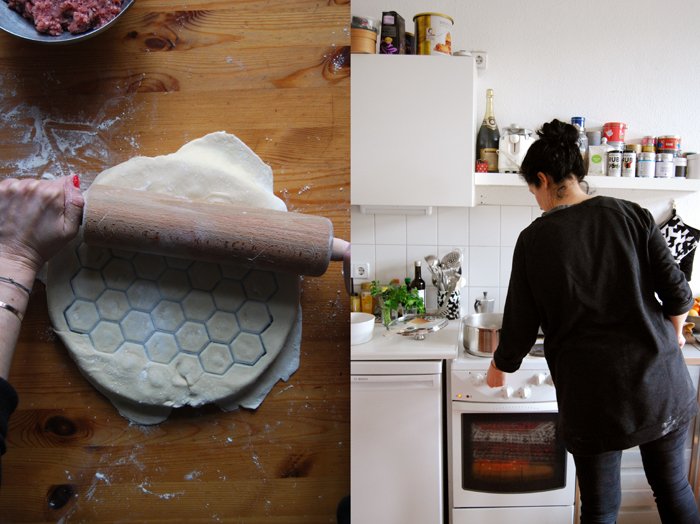
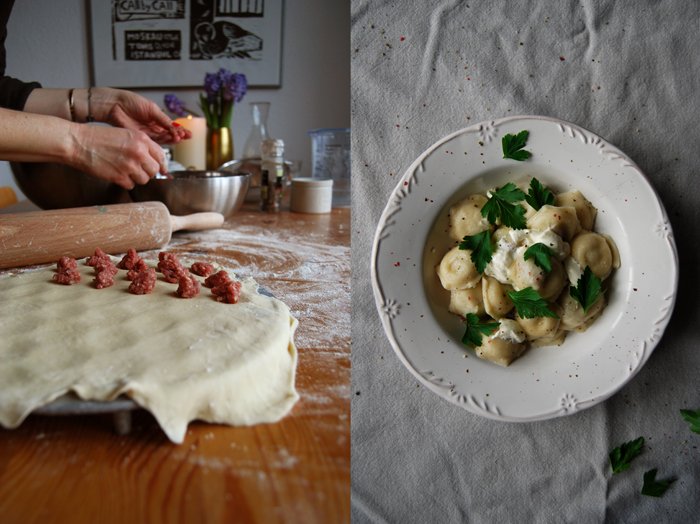
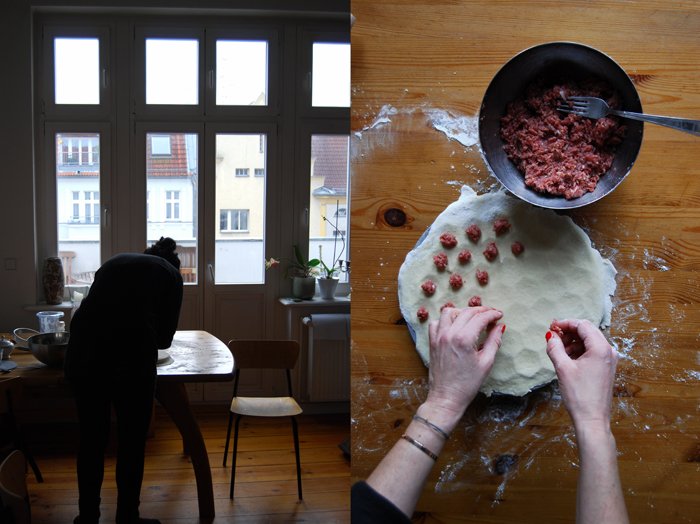
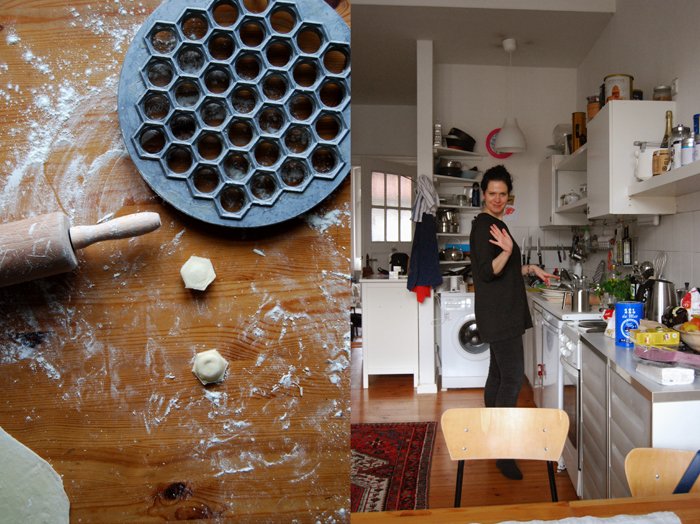
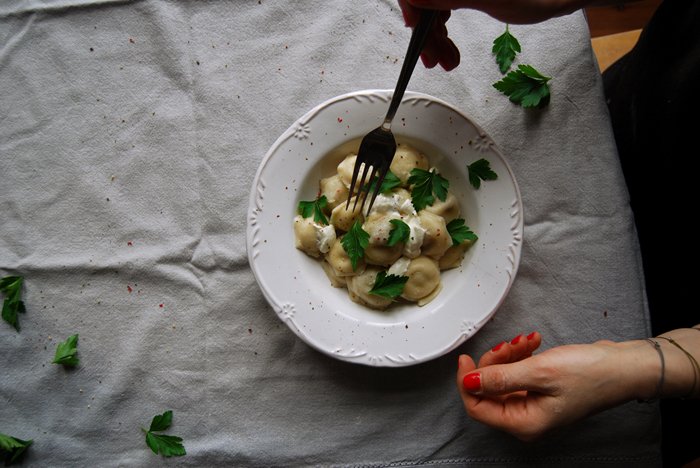
Claudia's mother is from the Ukraine which brought an Eastern European influence to the family's cooking. I'm not very familiar with the country's cuisine so I was very happy when she offered to cook one of the most popular traditional specialities for me. Claudia shared her old family recipe for little meat filled dumplings called pelmeni with me which are traditionally served with crème fraîche, white wine vinegar, mustard and parsley. She uses a beautiful utensil for the preparation which looks a bit like honeycombs made of iron. For the dumpling preparation, she covered this pelmeni maker with a thin layer of pastry, filled each comb with a little ball of spiced minced meat and put another pastry layer on top before she gently rolled over it with a rolling pin. Within seconds, the dumplings were closed and cut into perfectly shaped pelmenis! When I saw Claudia pushing the dumplings out of the frame with her fingers I understood why her little son loves to cook this dish together with her, this is fun!
As much as I enjoyed the preparation, savoring this meal was a delight. There's no doubt why this is her son's favorite meal, it's delicious, honest comfort food. Claudia said that the older generation in the Ukraine still shapes the dumplings with their fingers, the traditional way, without the iron pelmeni maker. I can just see the families standing around a wooden table in the warm kitchen, rolling out dough and filling the pelmenis, like we did on a cold January day in Berlin!
Soon I'll meet Isa in her kitchen for the second part of our Hauptstadtmutti cooking series - to be continued!
Ukrainian Pelmeni Dumplings
For 6 people you need
For the dough
plain flour 500g / 1 pound
salt 1 teaspoon
water 250ml / 1/2 pint
egg 1
Put the flour in a large bowl and form a well in the middle. Add the salt, water and egg, mix with a fork and slowly stir in the flour from the sides. Knead well with your hands to a firm dough, add more flour if necessary. You should be able to tear the dough when it's done. Let it rest while you prepare the filling.
For the filling
minced meat (pork and beef) 400g / 14 ounces
medium onion, finely chopped, 1
egg 1
salt 1 teaspoon
pepper
Mix the ingredients for the filling and shape little meat balls (thumbnail sized).
For the pelmeni
meat broth, well seasoned, 2l / 4.5 pints
melted butter, for serving
mustard, for serving
crème fraîche, for serving
white wine vinegar, for serving
parsley, for serving
crushed pepper, for serving
Bring the broth to the boil.
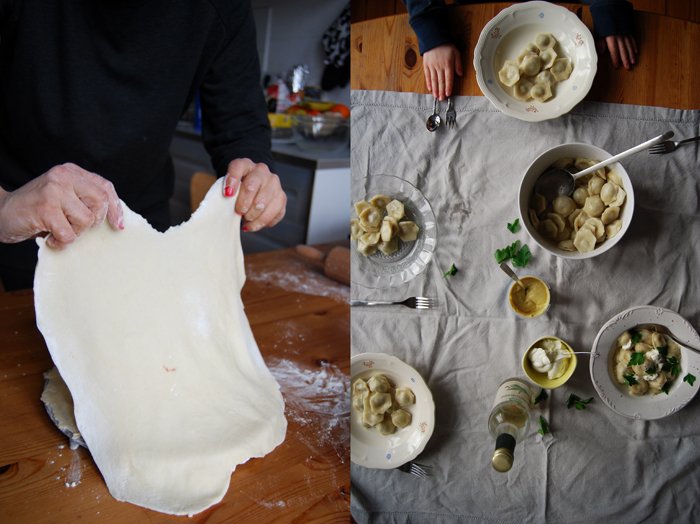
Take a handful of the dough and roll it out very thinly on a well floured surface. If you have a pelmeni maker, cover it with a layer of dough and fill each comb with a little meat ball. Close it with another thin dough layer and gently roll over it with a rolling pin to seal the dumplings and push them through the wholes.
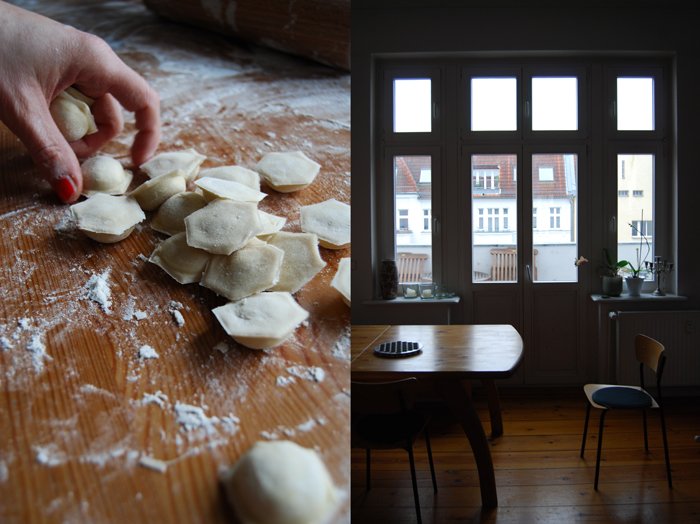
If you want to shape the dumplings by hand, lay the thinly rolled dough on the working surface, spread the meat balls evenly, cover with another layer of dough and cut small squares or circles with a knife or a pizza cutter. Seal each dumpling well by pushing the rim together.
Gently add the dumplings (in batches) to the hot broth and cook on medium-low heat (simmering) for about 7 minutes. Take them out with a slotted ladle and mix the pelmenis with the melted butter. Serve the dumplings with a spoonful of mustard and crème fraîche and sprinkle with pepper, vinegar and parsley.
How would you describe the Berlin mothers you feature on your blog Hauptstadtmutti? What fascinates you about them?
Berlin's mothers are diverse, their style is individual and independent. We love all of them because each single one is special in their own way, and that's her own charisma. We've been taking pictures for our Mama-Streetstyle series for 4 years and we never get tired. The nice thing is that we also get into conversations with them, we have a little interview and get to know some of their secrets, desires and thoughts.
What role does fashion play in your own life? A mother's life is very much determined by practicality, is it possible at all to keep her style and fashion uncompromised?
Fashion occupies and surrounds me. I just enjoy seeing trends and developments evolve, and how they are translated in different cities. My main focus is on mother's fashion as there is still a high degree of practicality involved which shouldn't be underrated. My own shopping and styling has sped up considerably. I don't have the time to shop for hours anymore, that's why I'm very happy that I can buy and discover so much online.
Where do you find your creative inspiration?
Exhibitions, theater and movies, interviews, great people, long chats at the table with friends, traveling the world, the internet and long walks through the city.
How did your cooking change since you became a mother? Can you give any tips for cooking with and for young children?
I try to cook with more time, and good ingredients since my son was born. I set the table nicely, as you eat with your eyes first. My advice to parents is to let your kids eat what is on the table, no extra dishes. And conversation at the table is important, to ask about each other's day, and to eat together with many people, that's fun and social. Children tend to eat better in company.
You've lived in Prague and Kiev, your family roots are Ukrainian, Russian and East-German, how would you describe the Eastern European cuisine you grew up with and the cooking you experienced while you lived in the Czech Republic and the Ukraine?
Eastern European cooking is primarily heavy! It has to satisfy the appetite. The Ukrainian cuisine also relies on fish and vegetables which I love a lot. The recipes are often very easy to prepare, and in the end, the table is full of lots of different dishes, not just one plate with one meal, which I find boring anyway. All Eastern European meals are connected with long conversations at the table and, of course, lots of alcohol. My grandmother in the Ukraine would feel ashamed to put just one dish on the table. That's why we spend days in the kitchen cooking for festive events and family feasts. She asks me all the time what I cook for my son and if he eats properly, she's convinced that I don't give him the right food.
This is what I associate with my time in Prague: many young, committed chefs who traveled the whole world before they came back home, new restaurants opening with the most exquisite, modern Czech kitchen. Great! Always surprising! Apart from that, I remember the delicious apricot dumplings by my friend Andrea's grandmother, with lots of sour cream, to die for!
What was the first dish you cooked on your own, what is your first cooking memory?
A soup made of grass, soil and water in a little doll's cooking pot in my grandmother's garden in the Ukraine. My dolls loved it, with fresh apricots for dessert!
Who influenced and inspired your culinary style the most?
My grandmother in the Ukraine, but I also like to get inspired by my friends who cook for me.
What are your favourite places to buy and enjoy food in Berlin?
Turkish markets for fruits and vegetables, the Russian supermarket Stolitschnaja on Landsberger Allee in Berlin for Russian products.
What did you choose to share on eat in my kitchen?
Pelmeni, Ukrainian dumplings.
If you could choose one person to cook a meal for you, who and what would it be?
You, Meike, and some fish!
You're going to have ten friends over for a spontaneous dinner, what will be on the table?
Pelmeni!
What was your childhood's culinary favourite and what is it now?
Wareniki (dumplings with cherries and sour cream) by my Ukrainian grandmother, today it's all kinds of variations of fish and aubergine.
Do you prefer to cook on your own or together with others?
Together with others.
Which meals do you prefer, improvised or planned?
It depends on my mood and the guest.
Which meal would you never cook again?
A Jamie Oliver recipe with meat, I forgot which one it was ....
Thank you Claudia!

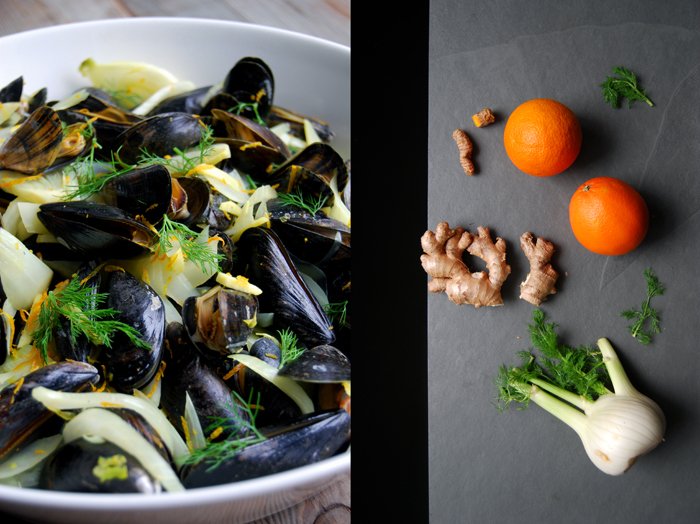
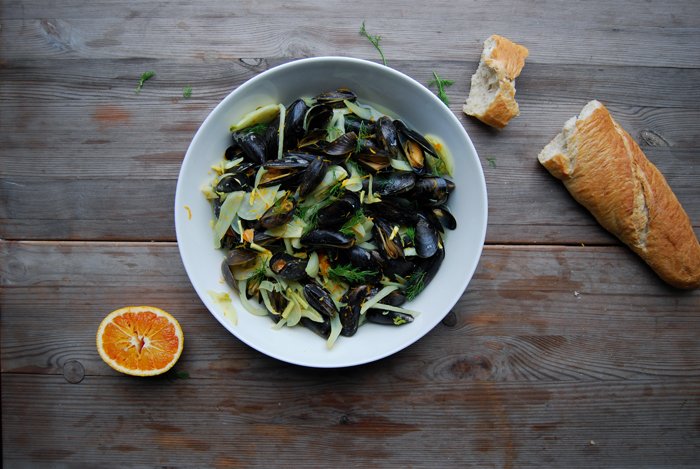
Blood Orange Mussels with Fennel, Ginger and Turmeric Roots
I'm still in my post Christmas meat-reduced phase, I just don't feel inspired to throw a heavy roast in the oven, or put a steak in the pan. Although the annual feasting is already a month ago, my appetite calls for vegetables and seafood, light on the body and preferably refined with lots of citrus fruits, herbs, spices or whatever comes into my mind.
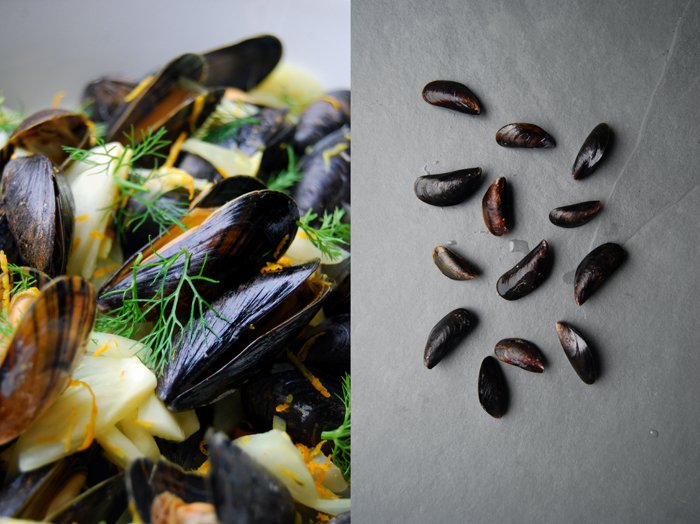
Out of all the wonderful culinary gifts we get from the sea, mussels are one of the easiest to prepare and luckily, they're still in season. I like to be brave when it comes to seasoning their cooking juices, I want each single flavour to be present to infuse their meat, this is not the time to be shy! Today's recipe follows this rule and makes the most aromatic broth, it's perfect to dip little pieces of crunchy baguette in. This is almost the best part of this meal and every time we have mussels on the table, it fills me with excitement. So, I chose a combination of sweet blood orange, fennel, fresh ginger and turmeric which literally melts in your mouth, it's a colourful explosion of fresh flavours. Look at the bright yellow, the vibrant orange and refreshing green, translate that into taste and you'll have an idea of what happened at our lunch table!
For the cooking broth, I mixed the citrus fruit's juice with some white wine and grated a little zest which created a wonderful aroma. Roots were my next addition, strips and slices of warming ginger and luckily, I can get fresh turmeric at the moment. The deep orange root is a fragrant concentrate, it's so unique you can't compare it to anything else, not even the powder. When I peel the thin skin off it turns my fingers into a golden yellow, it had the same effect on the broth and looked stunning. I couldn't help it, this buoyant dish just put a smile on my face!
Some more mussel inspiration:


Blood Orange Mussels with Fennel, Ginger and Turmeric
For 2-3 people you need
fresh mussels 1 kg / 2 pounds
white wine 200ml / 1/2 pint
freshly squeezed blood orange juice 50ml / 1 3/4 ounces
blood orange zest 1 tablespoon
small fennel bulb, quartered and thinly sliced, 1 plus the fresh green, chopped, for the topping
fresh ginger, cut into small strips, a thumb sized piece
fresh turmeric, sliced, 1 thumbnail sized piece
bay leaf 1
salt 1/2 teaspoon
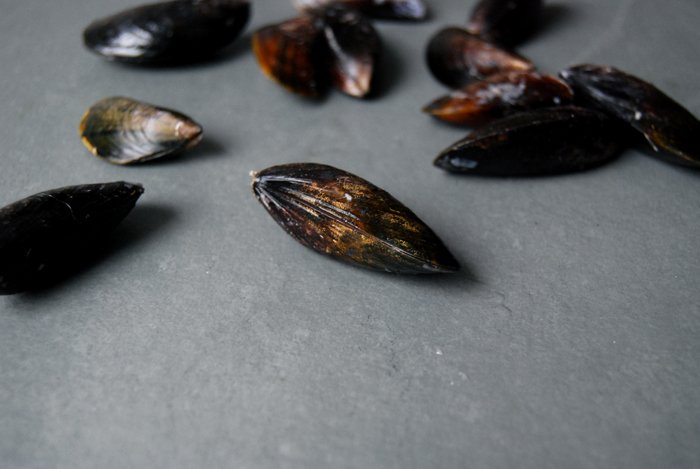
Rinse and scrub the mussels under cold water and cut off the beard, discard any broken mussels.
In a large pot, bring the wine and juice with the zest, fennel, ginger, turmeric, bay leaf and salt to the boil. Add the mussels to the hot broth, close with a lid and cook on lowest heat for 5 minutes or until the shells open (shake the pot once or twice while cooking or gently mix with a slotted ladle). Discard any mussels that don’t open! Sprinkle the mussels with the fresh fennel green and serve immediately, preferably with baguette and a glass of chilled white wine.

White Bean Hummus and Lomo Prosciutto Sandwich
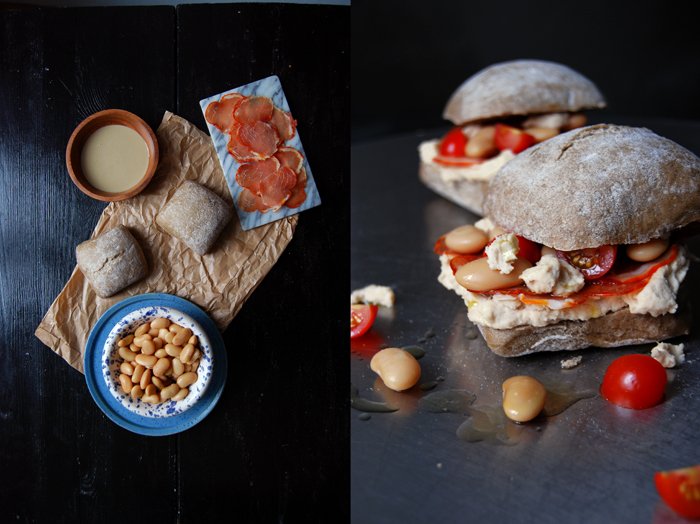
I'm sorry that the blog wasn't reachable this morning, my web provider had some technical issues. It's fixed now and the food is back!My first hummus sandwich was a luscious recipe which our Godchild's father passed on to me. Last year Guy introduced me to the amazing Sabih, a popular snack from Israel where he grew up. It combines velvety hummus, grilled aubergine and hard boiled eggs packed between two slices of juicy bread. It's the kind of sandwich which makes you lick your fingers afterwards as you don't want to miss out on the tiniest crumb. Shockingly enough, it's been a year since I wrote about it and it's time to play around with some hummus variations. It can't just be chickpeas, big white beans puréed with tahini paste, fresh garlic and lemon juice create an equally delicious dip, maybe a bit softer so you have to go easy on the tahini as it can easily be too overpowering.
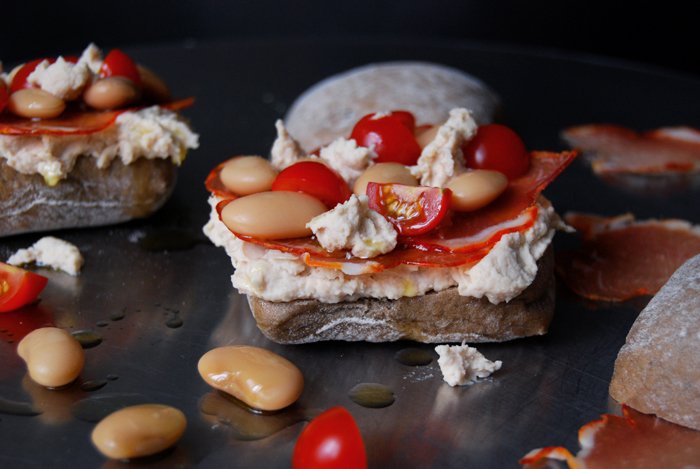
Although I had decided to go for white bean hummus for my new Sandwich Wednesday creation I wasn't sure about the further additions until my aunt Ursula asked me if I would be interested in some of her party leftovers. She's a gourmet, so I never refuse whatever she brings to my kitchen! She came with a plate of the finest Serrano and Lomo (meaning pork loin in Spanish) prosciutto, both of extraordinary quality. I chose the Lomo for the sandwiches it had the perfect balance of an expressive character without dominating the other ingredients. The Spanish delicacy merged perfectly with the white bean flavour, I just added some cherry tomatoes for a bit of freshness, another one of my aunt's culinary gifts.
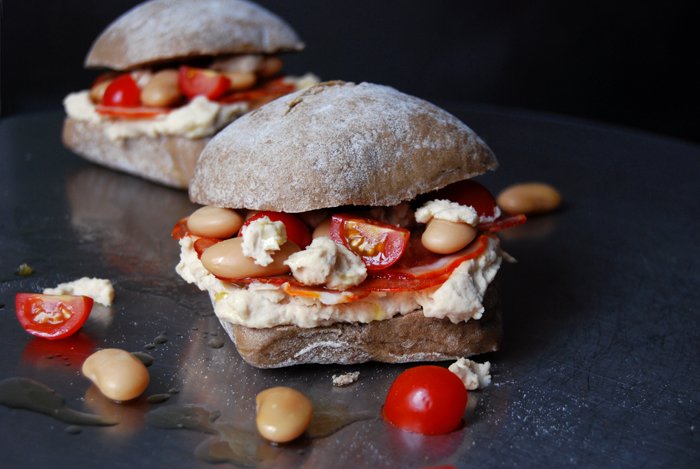
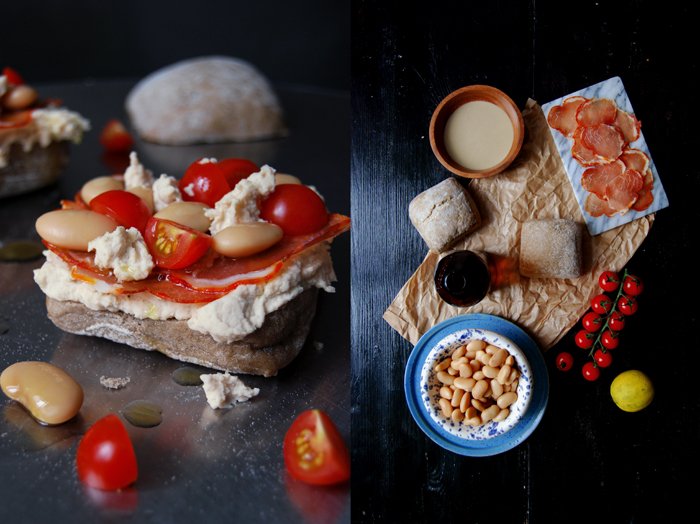
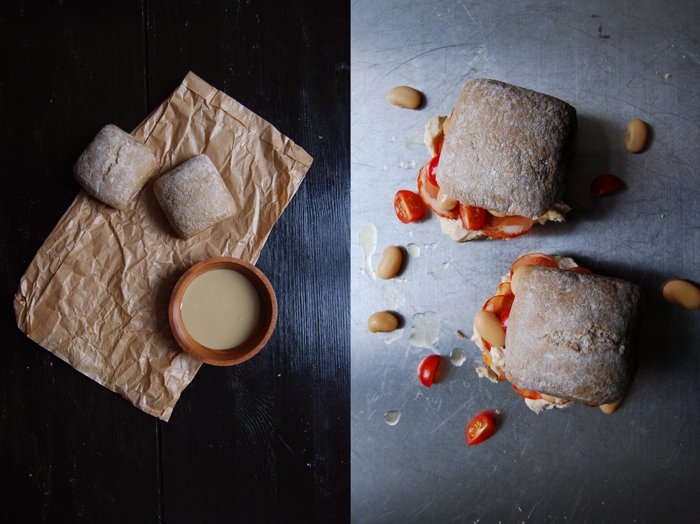
White Bean Hummus and Lomo Prosciutto Sandwich
For 3 sandwiches you need
rustic buns, cut in half, 3
Lomo prosciutto (or San Daniele) 15 small or 6 large thin slices
ripe cherry tomatoes, quartered, 6
butter beans, canned, rinsed and drained, 250g / 9 ounces
tahini paste 1-2 tablespoons
garlic, crushed, 1 clove
freshly squeezed lemon juice 2 tablespoons
water 1 tablespoon
salt
olive oil
Purée 200g (3.5 ounces) of the beans with the tahini, garlic, lemon juice, water and salt in a blender. Season to taste, add more water if the mixture is too dry.
Spread the bean hummus voluptuously on the bottom half of each bun and arrange the prosciutto, the remaining beans and tomatoes on top. Sprinkle with a little olive oil, close the bun and enjoy!



Potato and Endive Gratin with Chèvre and Thyme
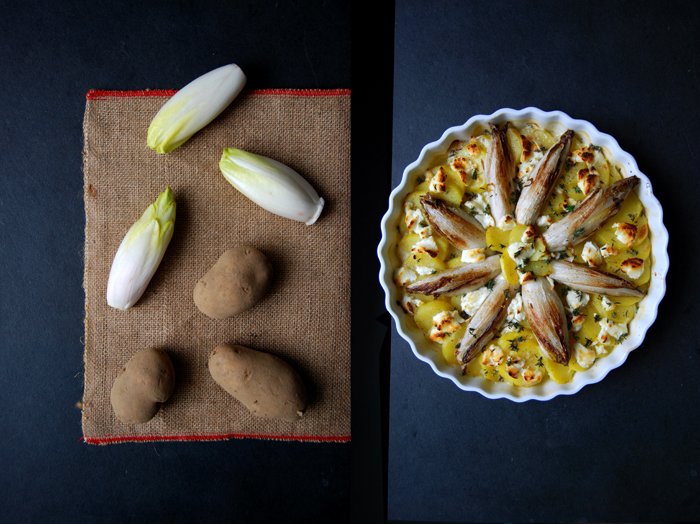
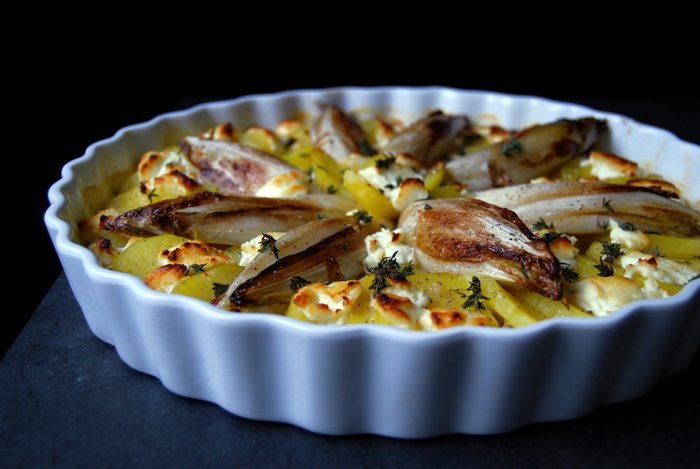
A gratin has the same effect on me as pizza or lasagna, I just want to cuddle up on the sofa and get cosy. This dish spreads such a beautiful aroma of baked cheese and herbs through my flat, it instantly relaxes me. Sometimes I just sit in front of the glass oven door, enjoying the scene of bubbling cream and cheese that turns from an unspectacular pale white to a landscape of golden brown peaks. They look like tiny volcanos with dark tips ready to burst. It's just a gratin but when you look at it long enough it carries you away!
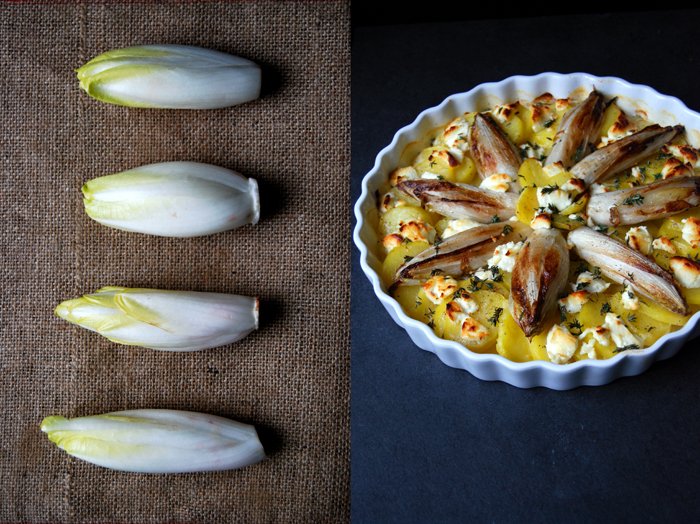
I don't remember how many different potato gratin recipes I have tried out in my kitchen, there were so many. I shared the ones with dried porcini, black pudding, apples or parsnips and today there will be a new addition to the selection: Potato and endive gratin with chèvre and thyme! The combination is great, quite strong with sweet, bitter, milky and woody flavours. I wanted a quick dish, so I boiled the potatoes and sautéed the endives before I baked them with cream and milk in the oven. You could easily come up with some variations and use raclette or blue cheese instead of the chèvre, or add some slices of pears or apples, mix in some chopped rosemary or whatever comes to mind to suit your cosy dinner.
Potato and Endive Gratin with Chèvre and Thyme
For 3-4 people you need
potatoes, boiled, peeled and sliced, 700g / 1.5 pounds
Belgian endives, cut in half, 4
heavy cream 100ml / 3.5 ounces
milk 60ml / 2 ounces
freshly grated nutmeg
salt 1 teaspoon
pepper
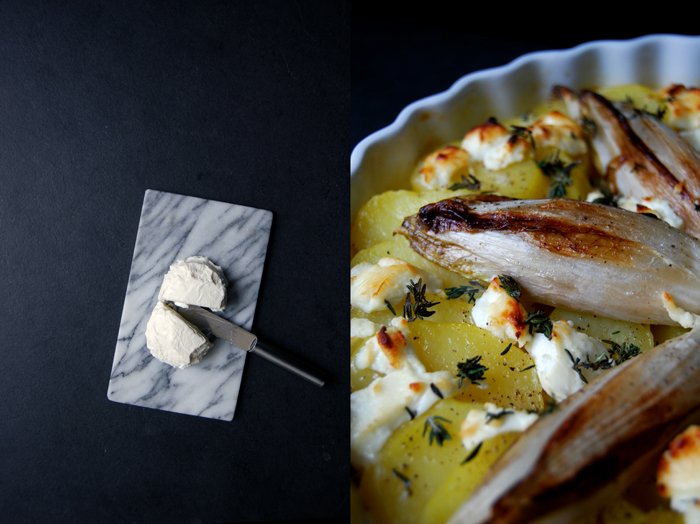
chèvre 125g / 4.5 ounces
thyme, the leaves of a small bunch
olive oil
butter 2 teaspoons
Set the oven to 200°C / 390°F and butter a round 28cm / 11" gratin form or baking dish.
In a pan, heat a splash of olive oil and butter and sauté the endives for 2 minutes on each side on medium-high. Season with salt and pepper.
Whisk the cream and milk and season with salt, pepper and nutmeg. Arrange the potatoes and endives in the buttered dish and pour the cream and milk mixture over the vegetables. Sprinkle with chèvre and thyme and bake for 18 minutes. Turn the oven down to 160°C / 320°F and bake for another 5 minutes or until golden brown. Let the gratin cool for a few minutes before serving and season with pepper to taste.



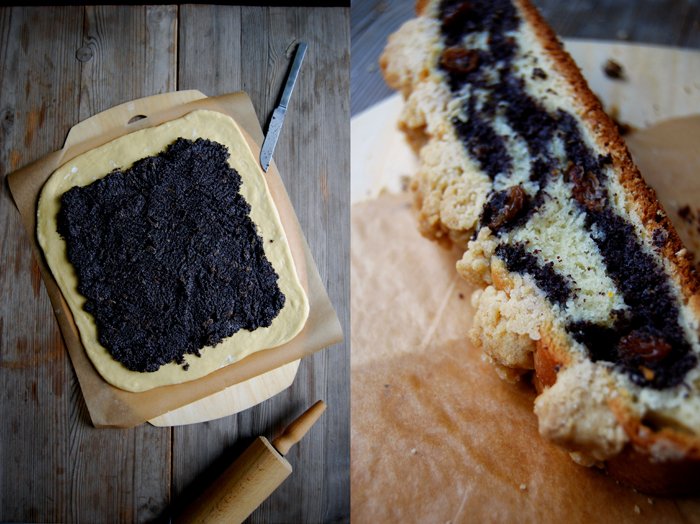
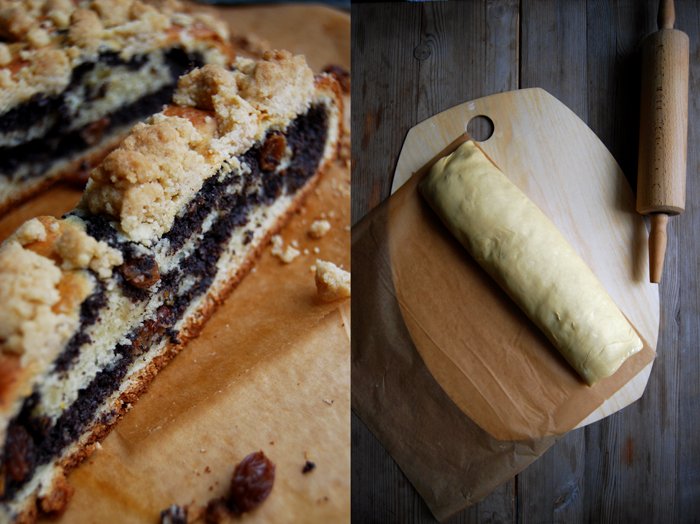
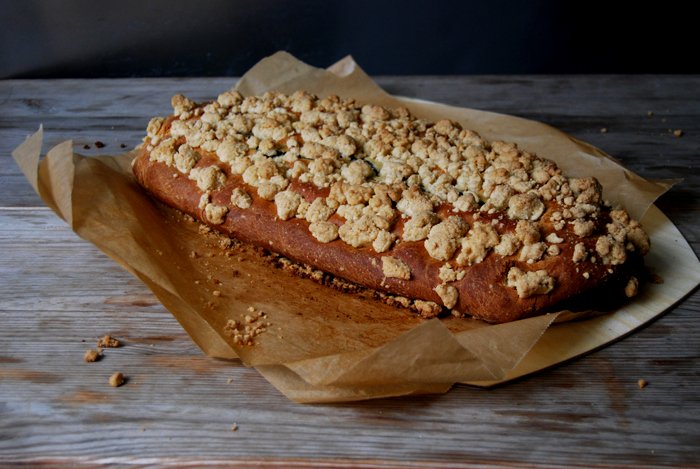
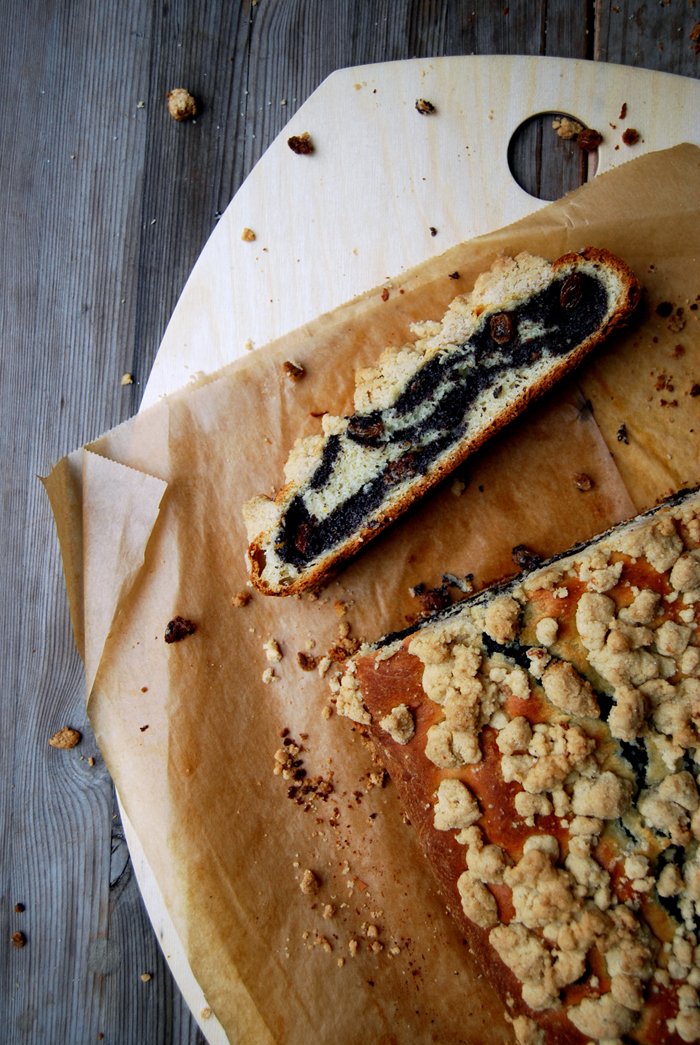
German Poppy Seed Strudel with Cinnamon Crumbles
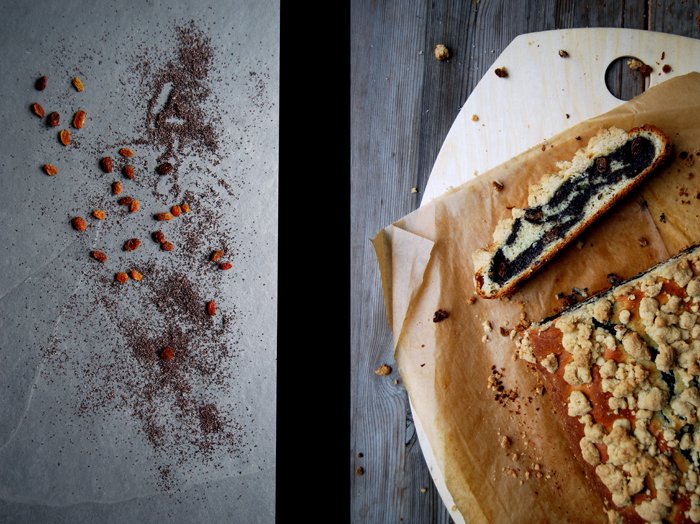
As a child I went through different sweet phases with quite an obsessive persistence. There were times, if not years, when I bought a scrumptious short crust ring topped with gianduja cream and chocolate at least once or twice a week from my hometown's confectionery, it's a decadent treat called Nougatring in German. When I fell in love with a cinnamony cherry crumble cake from a French bakery as a young teenager I bought a piece of it every day after school. For months I wanted nothing more than this buttery pleasure, it felt like the best culinary discovery of my young life. Luckily, I was always quite tall and didn't have to worry much about the effect of my obsessions on my weight, my culinary enjoyment was always greater than my vanity!
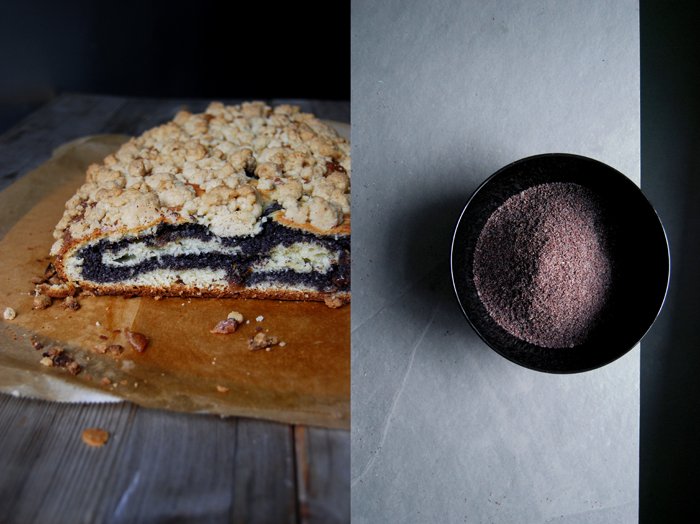
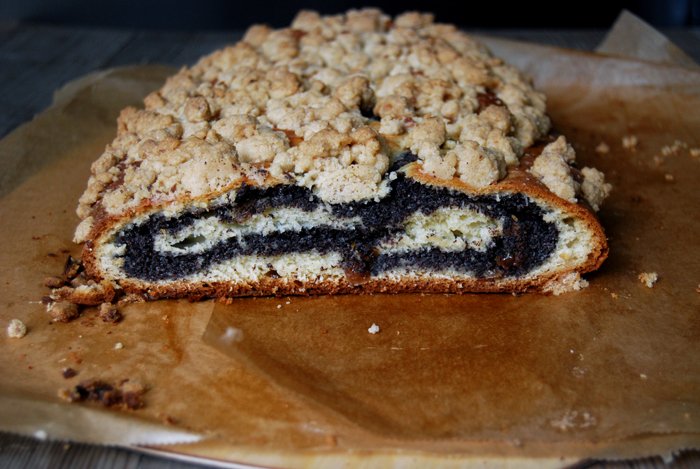
I remember that my family, especially my mother and aunts, used to tell me that I should enjoy it to the fullest as with age, I wouldn't be able to eat these amounts without repentance. They were so right! I simply can't eat so many sweets anymore, a fact which I regret, especially when I have to refuse a piece of tempting cake, this would have never happened in my early years! The only thing that didn't change is my excitement for these treats and my complete misjudgment of the amount of cake that two people can actually eat. I prefer my baked sweets well sized, you never know if an unexpected guest may appear at the door step. The same happened to me a few days ago when I decided to make a traditional German poppy seed cake. This was another one of my childhood favourites, soft and spongy yeast dough wrapped around a juicy poppy seed and raisin filling. In the North Rhine Westphalia area where I grew up, this rich strudel is topped with sweet and buttery crumbles which is simply amazing in combination with the seeds and pastry. When I prepared all the ingredients on the kitchen counter I remembered how much I used to love this cake and decided to make a huge strudel, ignoring the fact that my partner isn't too fond of poppy seeds or yeast cakes for that matter. I didn't expect guests either but I had a rustic picture of a huge strudel in mind, with impressive proportions.
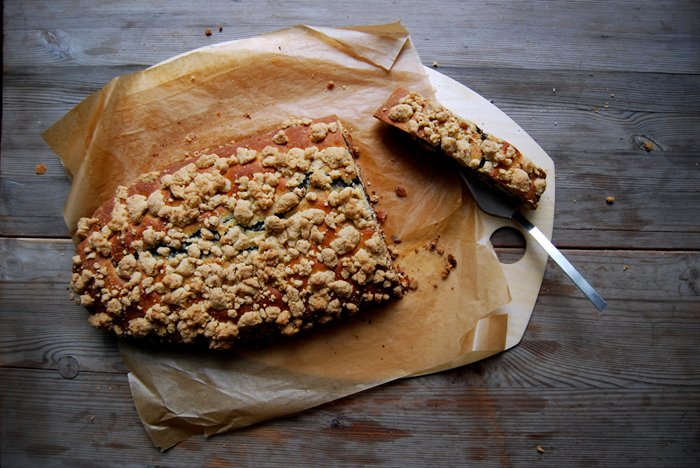
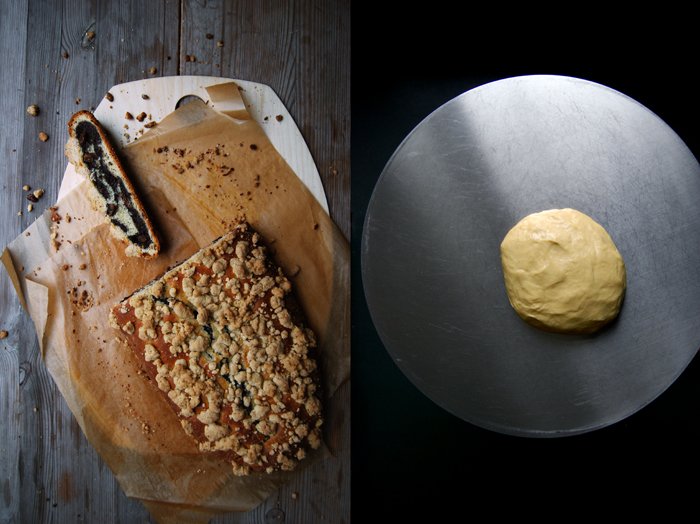
I got what I asked for! The strudel woke up all the culinary memories of my childhood and tasted exactly how I wanted it to be, even my partner liked it a lot, but still, after 2 big slices we just looked at each other and thought "what are we going to do with this massive strudel?". Luckily, I can always rely on my family. My aunt Ursula came for a quick visit, she is as much a fan of this cake as I am. She replaced her dinner with two slices of my strudel monster and she looked very happy when I offered her to take half of it home. The lesson is, a cake can never be too big, there will always be friends and family who enjoy it as much as the baker does!
German Poppy Seed Strudel with Cinnamon Crumbles
For 1 huge strudel for about 10 people you need
For the yeast dough
plain flour 480g / 17 ounces
granulated sugar 80g / 3 ounces
dry yeast 1 sachet (7g / 1/4 ounces)
a pinch of salt
butter, melted, 80g / 3 ounces plus 1 tablespoon to brush the strudel
milk 175ml / 6 ounces
In a large bowl, combine the flour, sugar, yeast and salt. Mix the milk with the melted butter (the mixture should be lukewarm) and add to the dry flour-mixture. Mix with the dough hooks of the mixer for a few minutes, the dough will be quite moist. Dust the kitchen counter with a little flour and continue kneading and punching with your hands for a few minutes until you have a soft and elastic dough ball (if the dough sticks to your fingers add more flour). Put the dough back into the bowl, cover with a tea towel and let it rise in the warm oven (35°C / 95°F) for 70 minutes (top/ bottom heat and not fan-assisted!).
For the poppy seed filling
milk 420ml / 14 ounces
granulated sugar 100g / 3.5 ounces
ground cinnamon 2 leveled teaspoons
orange zest 2 teaspoons
poppy seeds, cracked, 250g / 9 ounces
raisins 80g / 3 ounces
In a sauce pan, bring the milk, sugar, cinnamon and orange zest to the boil. Stir in the poppy seeds and let the mixture cook on lowest heat for about 5 minutes, stirring constantly. When the filling is thick and the milk is soaked, add the raisins, mix and let it cool.
For the crumbles
Prepare the crumbles shortly before baking the strudel.
plain flour 100g / 3.5 ounces (plus more if the crumbles are too sticky)
granulated sugar 60g / 2 ounces
ground cinnamon 1 teaspoon
butter, melted, 60g / 2 ounces (plus more if the crumbles are too fine)
Combine the dry ingredients in a bowl, add the melted butter and mix quickly with the hooks of your mixer, stop as soon as the mixtures crumbles. If it doesn't form crumbles, add a little more flour and sugar, if the crumbles are too fine add a bit more melted butter.
The strudel
Set the oven to 180°C / 355°F (top/ bottom heat).
Take the dough out of the bowl, punch it down and knead for 1 minute.
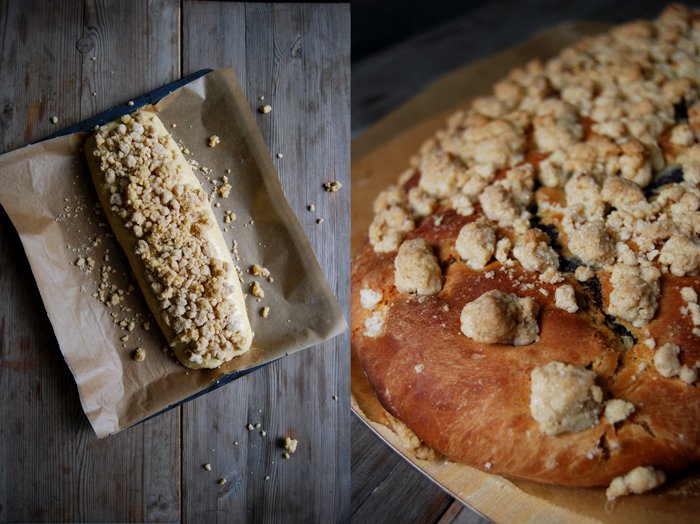
Dust a piece of parchment paper (big enough to cover a baking sheet) with a little flour. Roll out the dough on the parchment paper until it's roughly 35 x 35cm / 14 x 14". Spread the poppy seed filling on it evenly, leave a rim of 1-2cm / 1/2-1". Roll the dough up tightly, gently pull off the parchment paper while rolling the dough. The fold should be at the bottom. Close the sides well, cover with a tea towel and let it rise for 15 minutes (on a baking sheet lined with parchment paper).
Brush the strudel with 1 tablespoon of melted butter. Prepare the crumbles, spread them over the strudel and gently push them into the yeast dough. Bake for 50 minutes or until the yeast dough is golden brown.

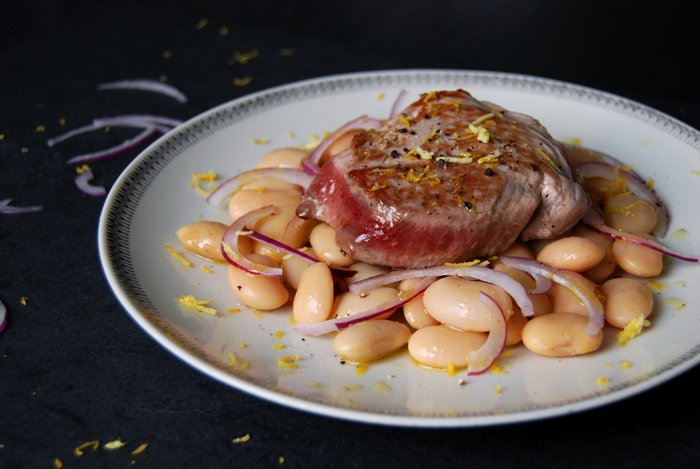
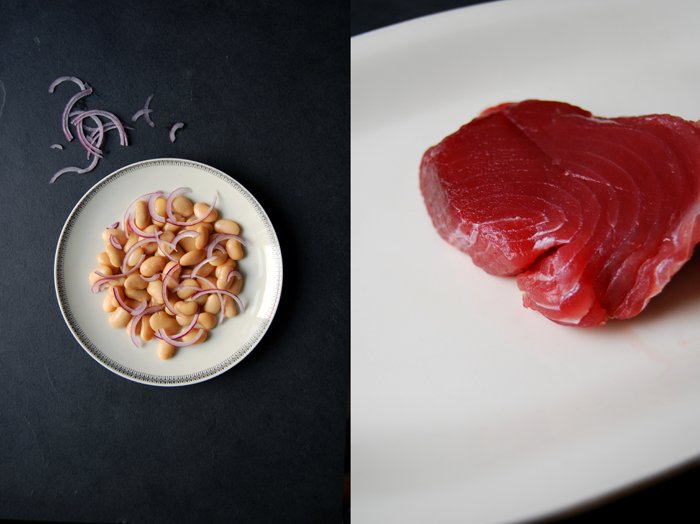
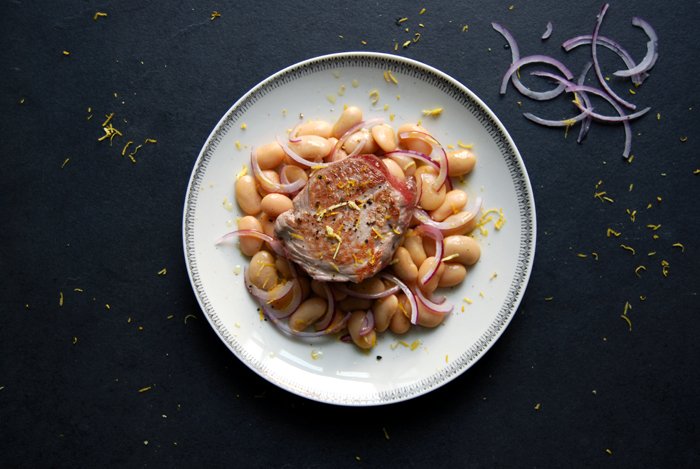
Seared Tuna with Ginger, Lemon, Butter Beans and Onions
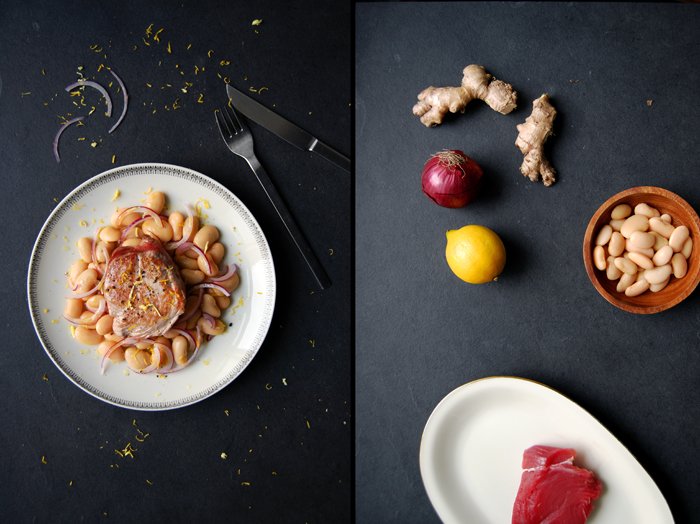
A tuna salad with white beans and onions is a wonderful light treat on a warm, summery evening, unfortunately, this is not exactly the kind of scene I find in wintery Europe at the moment. However, with a few minor changes, this dish can become something that can satisfy the needs of a cold day in January. Replace the canned fish with a fresh steak, add some warming ginger and crushed black peppercorns to it, and you'll see it in a different way. Instead of the small cannellini beans which are perfect for salads I went for a can of butter beans. The big, velvety legumes are rich and quite filling, a small plate is more than enough and you won't feel hungry for hours! This is why I prefer them in the cold season, for hearty dishes like my butter bean and fennel soup, although they are often featured in Mediterranean summer dishes.
The preparation didn't take any longer than the salad: I seared the firm steak for just a minute on each side as I wanted it to stay slightly pink inside, if you leave it on the heat too long it becomes dry. Some like to cook tuna for a few seconds to keep it completely raw but that's not my thing, other recipes recommend finishing it in the oven for a minute after it's been pan-seared. My piece was about 2 1/2cm / 1" thick and it was cooked to perfection. I sprinkled the tuna with freshly grated ginger and lemon zest and put it on top of the beans mixed with thin slices of red onions. The vegetables had a fruity dressing made with olive oil, freshly squeezed orange juice, white Balsamico vinegar and some of the grated root and citrus peel to pick up the aromas. It felt like a far away summer memory in a different setting which is great as long as it tastes so good!
I also don't want to miss out on telling you some great news: I'm so excited, eat in my kitchen has been featured in the German food magazine Lust auf Genuss! In the February print issue you can find an interview with me and an orange and lemon recipe I developed for the magazine with lamb chops and mashed potatoes.
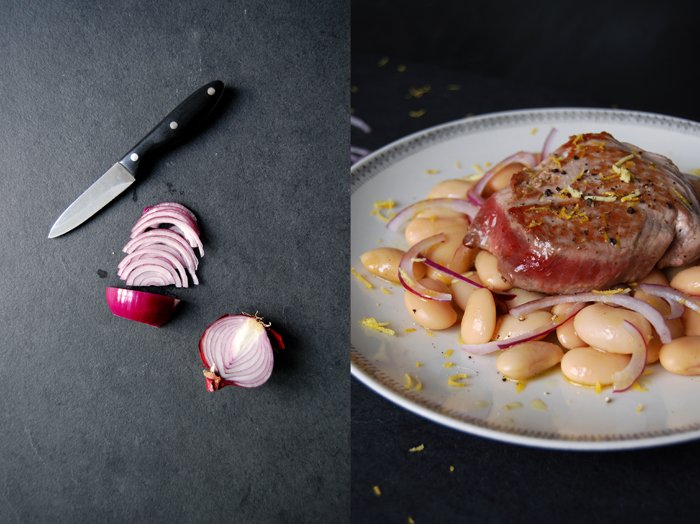
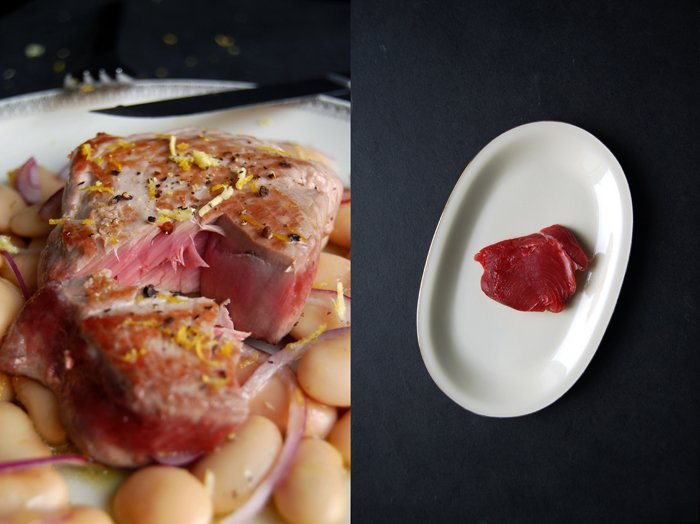
Seared Tuna with Ginger, Lemon, Butter Beans and Onions
As a lunch for 2 you need
tuna steak (about 2 1/2cm / 1" thick) 200g / 7 ounces (take 2 steaks for 2 hungry people)
canned butter beans, rinsed and drained, 240g / 8 1/2 ounces
small red onion, cut in half and very thinly sliced, 1
olive oil 3 tablespoons plus more for frying
freshly squeezed orange juice 1 tablespoon
white balsamic vinegar 1 tablespoon
lemon zest about 1/4 teaspoon
fresh ginger, grated, about 3/4 teaspoon
salt and pepper
Whisk 3 tablespoons of olive oil, the orange juice, vinegar, half the lemon zest and 1/2 teaspoon of the grated ginger and season with salt and pepper to taste. Mix the beans and onions with the dressing and arrange on plates.
Heat a little olive oil in a pan and sear the tuna for 1 - 1 1/2 minutes on each side, the inside should stay pink. Season with salt and pepper and sprinkle with the remaining ginger and lemon zest. Serve on top of the beans.

A messy Sandwich with Roasted Shallots, Grilled Gruyère and Chutney

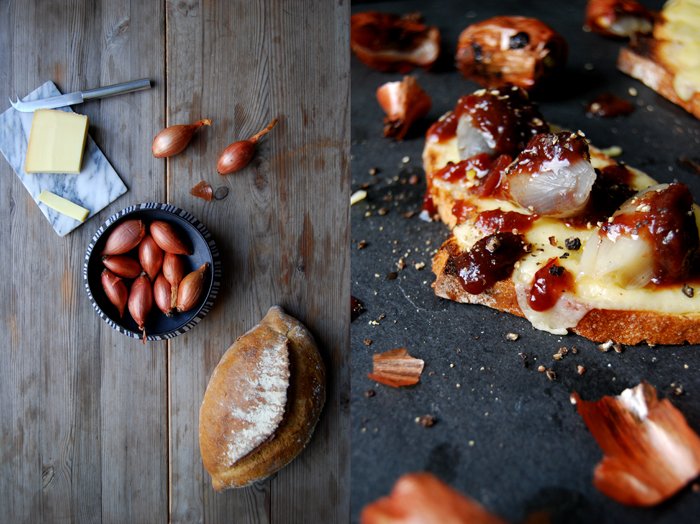
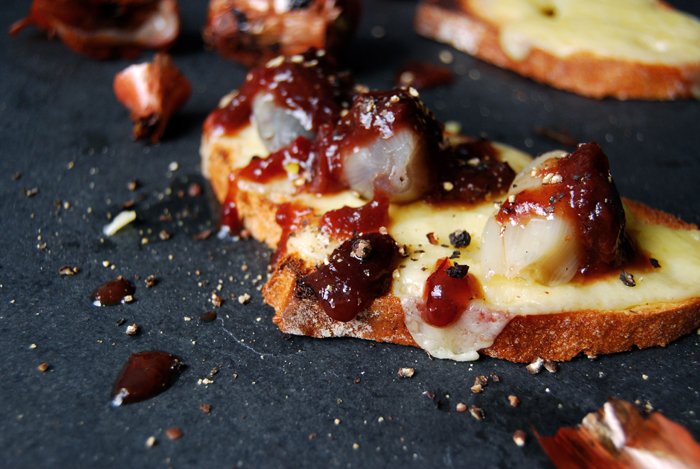
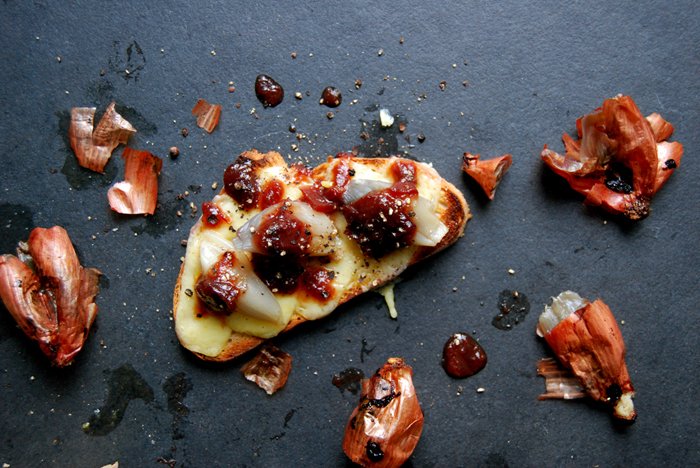
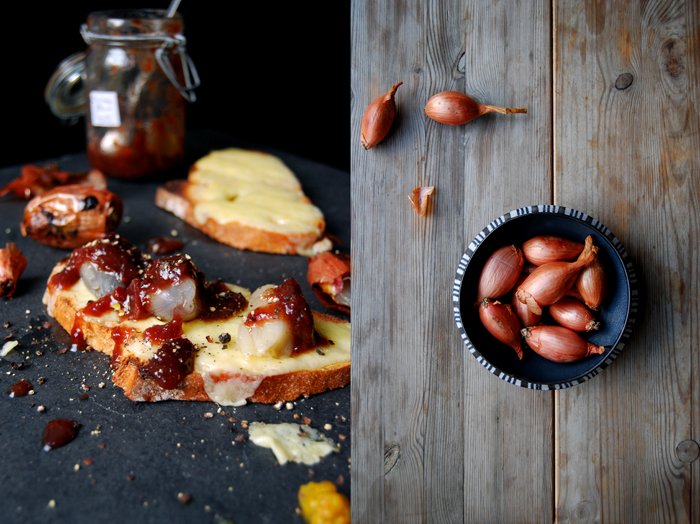
I'm in a mountain mood again, losing myself in thoughts of a warm wooden hut with an open fire place and wide snowy views. This calls for onions and cheese on my sandwich, or rather, tiny shallots roasted in their skin until they turn sweet, sticky and juicy, almost caramelised with aromatic gruyère, grilled until golden brown and bubbling. With these two pictures (and flavours) in my mind, I knew that I wouldn't need much else for today's messy sandwich.
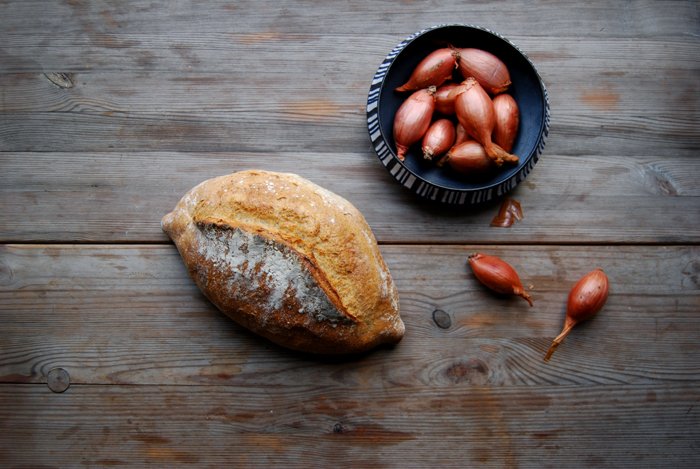
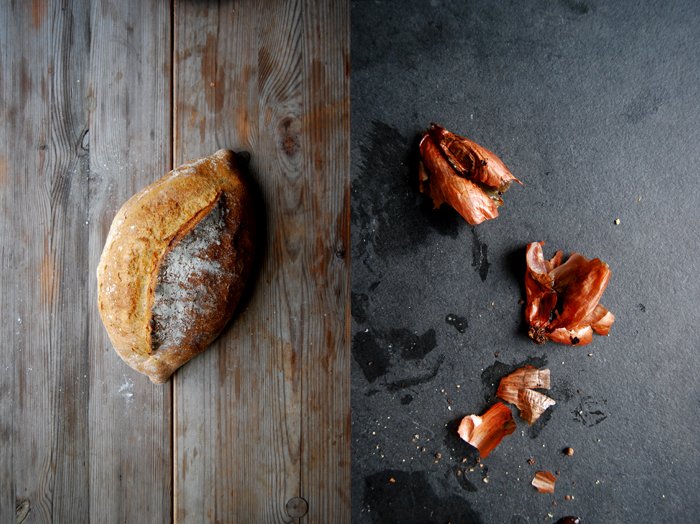
I bought a crunchy sourdough bread, a rustic French loaf, strong enough to compete with the final addition to my hearty sandwich, homemade chutneys and marmalade. Our kitchen table was covered in jars with plum, rhubarb, red pepper and apple chutney, and in a moment of culinary cockiness, I decided to try it with some of my tangerine jam. I started by roasting the delicate onions for less than half an hour before I snipped the ends off and squeezed their juiciness onto the hot grilled cheese. One bite after the other, I tried all the different fruity spreads to come to the conclusion that the golden citrus fruits are interesting but quite a challenge for the taste buds and my plum chutney is the winner. Onions, gruyère and plums simply can't go wrong!
A Sandwich with Roasted Shallots, Grilled Gruyère and Chutney
For 3 sandwiches you need
rustic sourdough bread 3 or 6 slices (if you want a closed sandwich)
small shallots, in their skin, 9 - 12
gruyère, or another strong, hard mountain cheese, thinly sliced, 200g / 7 ounces
a fruity chutney, for the topping
black peppercorns, crushed in a mortar, for the topping
olive oil
Set the oven to 200°C / 390°F (I used the Rotitherm setting).
Coat the shallots in a little olive oil and roast in the hot oven for 25 minutes or until soft, turn them after 15 minutes. They should feel soft when you push them down gently.
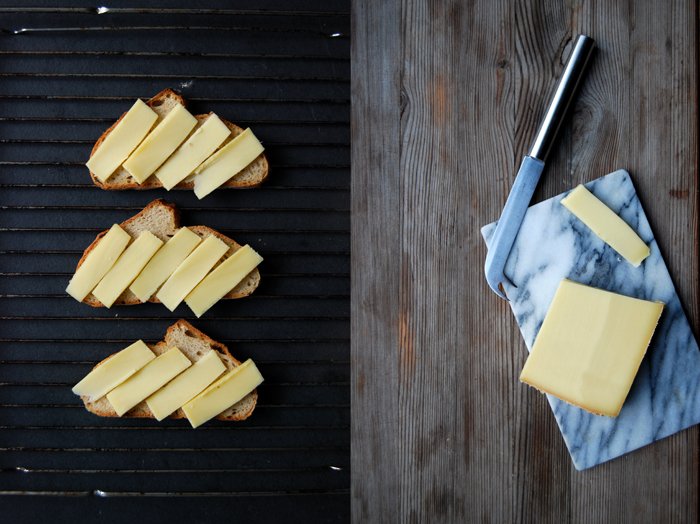
Spread the gruyère on the slices of bread and put them under the grill for 1 - 2 minutes until the cheese starts bubbling. Snip the ends off the onions and squeeze them onto the cheese. Sprinkle with chutney and pepper and enjoy!
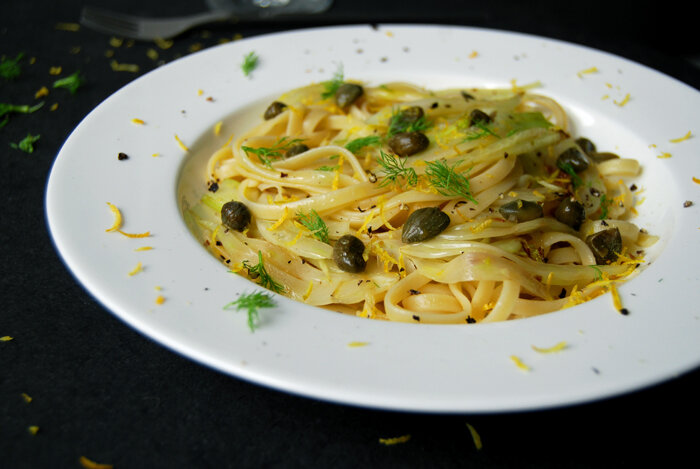
Linguine with Fennel, Capers and Lemon

My fennel carpaccio with salty capers and lemon is one of my favourite winter salads, I always have a couple bulbs in the fridge to prepare this 2-minute lunch or dinner for us. The vegetable is a tasty alternative to cabbages because, for whatever reason, it retains its strong aroma even when it's out of its (natural) season. It's always strong and present, be it baked in the oven as a gratin with Parmesan sprinkled on top, with butter beans in a hearty soup or as a crunchy addition to salads. I would definitely suffer much more from the absence of summery tomatoes, zucchini and bell pepper if there wasn't fennel in the house!
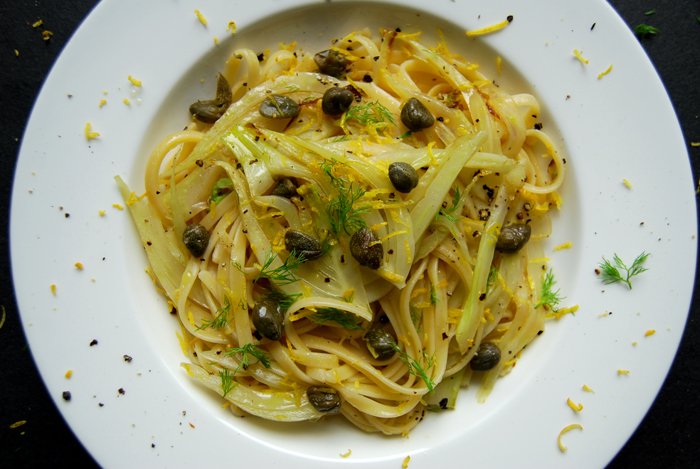
It's been a while since we had a plate of pasta on our table, which is quite unusual for us. Inspired by my carpaccio, I pulled the linguine package out of the pantry and mixed it with thin fennel slices sautéed for just 2 minutes, a handful of capers from Gozo, lemon zest and juice. It was a quick and light dish, tasty and simply good!
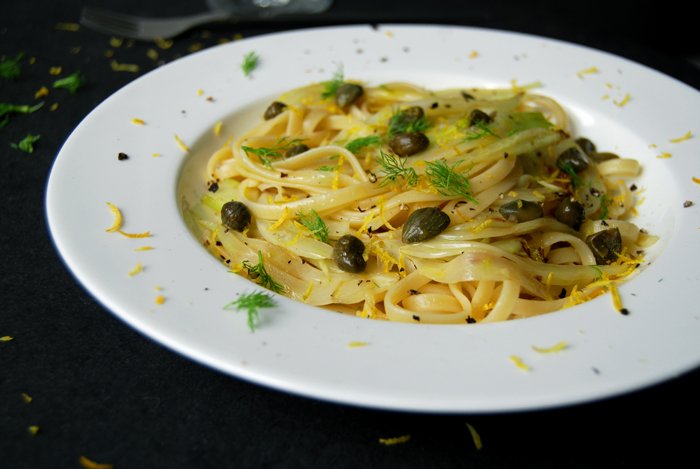

Linguine with Fennel, Capers and Lemon
For 2 people you need
linguine 200g / 7 ounces
medium fennel bulb, bottom cut off, very thinly sliced, 1
capers, rinsed and dried, a small handful, to taste
lemon zest to taste
freshly squeezed lemon juice, 1-2 tablespoons, to taste
salt
black peppercorns, crushed in a mortar, to taste
olive oil
Cook the pasta in salted water al dente, keep some of the water in a mug and set aside.
In a pan, heat a splash of olive oil and sauté the fennel for 1 minute on each side on medium-high heat. Add the cooked pasta to the pan and stir in a splash of the water used to cook the linguine and the lemon juice. Sprinkle with capers and season with salt, pepper and lemon zest and juice to taste.


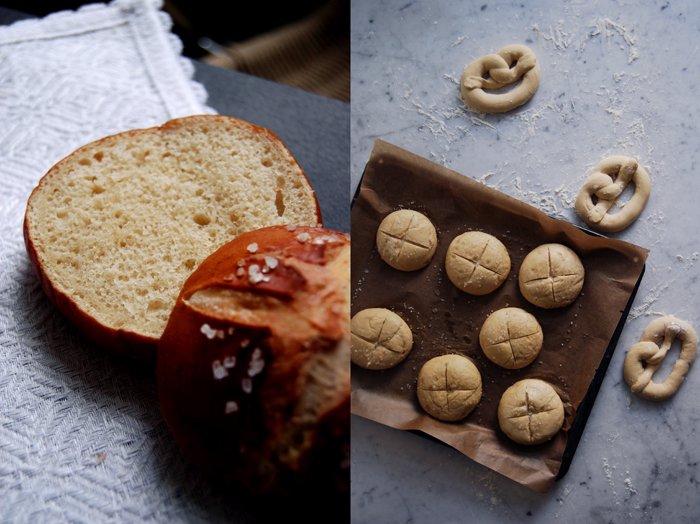
How to make your own Pretzel Buns

When I made my Bavarian sandwich with pretzel buns and Obatzda camembert spread last week I completely underestimated how many people would actually be interested in a recipe for the buns rather than the spread (which is absolutely delicious nonetheless!). I bought the pretty Laugenbrötchen (their German name) which I used for the recipe from my favourite pretzel bakery in my area which, in my opinion, can compete with the products from their origin in the south of Germany. However, there is an ongoing discussion about the pretzel's (and the bun's) quality produced here in Berlin, and if you ask anyone from the Bavarian or Swabian region, they will all agree that it's impossible to find acceptable results anywhere in this city. I disagree! I lived in the South, I still regularly enjoy some of the best pretzel buns from my step father's Swabian hometown Stuttgart, an unchallenged stronghold of pretzels, so I consider myself an experienced critic. The buns you saw last week on the photos were soft and spongy inside, they taste slightly buttery, wrapped in a thin brown crust with coarse sea salt sprinkles. That's all I can ask for!
Motivated by the last sandwich, excited and a bit nervous, I made a brave decision a few days ago, I wanted to make my own pretzel buns! I started some research, learnt about lye, washing and baking soda solutions for the crust, the right yeast dough mixture and the final shaping of the buns and here are my conclusions:
The dough has to be made with a bit of butter for the rich taste, it has to rise twice and once the buns are shaped with the right technique (which I describe in the recipe), they have to cook in boiling water mixed with baking soda for one minute before baking, basically like bagels. The soda solution provides a high ph-value, not as high and strong as lye solution which is often used in professional bakeries, but it's safer and creates a similar browning effect.
When I pulled a piece off my first warm pretzel bun freshly out of my own oven, I was impressed, the texture was right, the crust perfect and the taste was fantastic. I also made a few pretzels which were nice and juicy and not dry (which I don't like at all), but here I still have to improve. The look wasn't right, I know this is not so relevant and, usually, not important for me at all as long as it pleases my taste buds, but we're talking about pretzels! The top part with the knot wasn't slim enough. They looked quite puffed up and out of shape, but they tasted amazing with some butter spread on them so I forgot about that completely. I prefer buns anyway!


Pretzel Buns
For 10 pretzel buns you need
500g / 3¾ cups plus 1 tablespoon all purpose flour (white spelt, type 630, or wheat flour)
1 envelope (7g / ¼ ounce) fast-acting yeast
2 teaspoons fine sea salt
300ml / 1¼ cups lukewarm water, plus water for boiling the buns before baking
40g / 2½ tablespoons unsalted butter, melted and cooled
3 tablespoons baking soda, for boiling the buns before baking
coarse sea salt, for the topping
In a large bowl, combine the flour, yeast and salt.
In a medium bowl, mix the 300ml / 1¼ cups of water with the melted butter (the mixture should be lukewarm) and add to the dry flour-mixture. Mix with the dough hooks of the mixer for a few minutes, it shouldn't be too sticky, add more flour if necessary. Continue kneading and punching with your hands for a few minutes until you have an elastic dough ball. Put the dough back into the bowl, cover with a tea towel and let it rise in the warm oven (35°C / 95°F) for 60 minutes (top/ bottom heat and not fan-assisted!).
Punch the dough down, take it out and knead for 1 minute. Divide the dough into 10 portions, each about 80g / 2¾ ounces. Dust your hands with flour, put a portion of dough on the palm of your hand and roll with the other hand, holding it like a dome. Turn the dough for about 10 seconds on the flat hand until its top is round and firm. This process builds up surface tension and prevents the buns from becoming flat. Continue with the remaining dough. If you make pretzels, roll each portion into a 50cm / 20" long sausage shape with thin ends and twist into a pretzel shape. Cover the buns / pretzels with a tea towel and let them rise for 20 minutes in a warm place.
Set your oven to 220°C / 425°F top / bottom heat and line a baking sheet with parchment paper.
To boil the buns, in a large pot, bring 1000ml / 4¼ cups of water and the baking soda to a boil, watch it as it will start bubbling. The pot should be wide enough for 2 buns to fit in, they don't need to be completely covered by the water. Using a slotted ladle, gently slip two buns into the boiling water and cook for 1 minute (not longer !). Mind that they don't stick to the bottom of the pot and turn them after 30 seconds. Take them out after 1 minute and transfer them to the lined baking sheet. Mind to work quickly, if they sit for too long after cooking them in the baking soda-water mixture the surface won’t be shiny after baking (you can also boil and bake them in batches of 6 and 4 buns.) Score a cross on the tops of the buns, sprinkle with coarse sea salt, and continue cooking the remaining buns. Bake for 16 minutes or until golden brown, the pretzels need just 12 minutes.
If you want to freeze the baked buns / pretzels, don't sprinkle them with salt.




meet in your kitchen| A Greek dessert creation by the Grand Hyatt's Pastry Chef
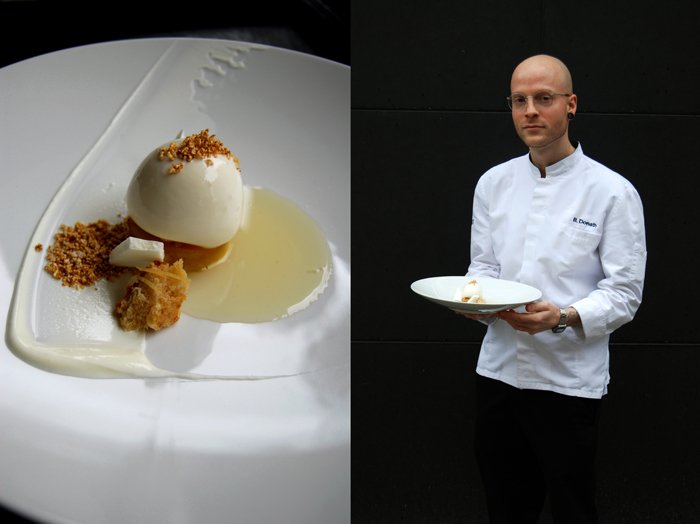
This young man is a sweet genius in the kitchen! His creations open the door to new culinary experiences, but with such respect and care for the single ingredients that besides its spectacular visual effect, the result tastes as comforting as your favourite cake. Benjamin Donath is the Grand Hyatt Berlin's executive pastry chef and furthermore, he's responsible for the dessert creations for German chancellor Angela Merkel and her guests. If that weren't enough, he managed to make me fall in love with a dessert made with Retsina. The Greek resinated wine is rather difficult to appreciate, at least for my taste, but when we met in the Hyatt's kitchen Ben turned it into a fantastic composition called Griechischer Wein. Apart from being a quote from a famous German pop song in the 70s, this means Greek Wine and describes a complex composition which Ben created for eat in my kitchen: fluffy retsina honey sorbet, buttery almond financier, sour apple terrine, light yoghurt espuma, crunchy yoghurt meringue and caramelised amaranth pops. It tasted as impressive as it sounds!
I first met Ben at a Christmas event in December, he helped me to decorate a gingerbread house. The result was so satisfying that it even got a place of honour under my Christmas tree. The chef's patience combined with a determined sense for perfection fascinated me, and I must admit, being the pastry chef of an internationally renowned hotel dedicated to savouring on the highest level made me curious. Ben is the kind of person who follows a goal with a passion once it's in his head. Although he seems too down-to-earth to be obsessed, he is extremely focussed. He won an award as the pastry chef of the German Culinary Team and gathered experiences abroad before he was asked to become Hyatt's executive pastry chef back in 2010. Ben is honest, he admits that he had to learn a lot in the beginning, creatively but also logistically. The responsibility given to him was quite a challenge but he grew into this new position with time and through the trust he received from his team. If you cater to 1500 people and present a selection of dessert creations to the chancellor for her official dinners, you simply have to believe in yourself and that's what Ben does. When he talks about his sweet creations, about contrasting flavours, combining dishes of different textures and temperatures, you can easily hear his dedication, and when you look into his eyes you can see the artist's passion and love for the ingredients he uses to bring his visions to life.
Ben says that he found his own style over the years, his signature, but that's an ongoing journey for him, one that leads him to work ever more minimally. He wants to work with less ingredients and concentrate on maybe four nuances, simple and pure. His creations speak for his creativity and he has many ideas for the future. He would love to involve more herbs in his desserts, so maybe one day he'll take over part of the hotel's roof garden in the name of sweet savouring and turn it into Ben's herbal oasis, we'll see!


Greek Wine by Benjamin Donath
For 4-6 people you need
For the Retsina honey sorbet
water 190 g / 7 ounces
Retsina wine 320g / 11 ounces
glucose syrup 40g / 1 1/2 ounces
granulated sugar 50g / 1 3/4 ounces
pectin (pectagel rose) 3 1/2g / 1/10 ounce
chestnut honey 50g / 1 3/4 ounces
lemon zest
a pinch of salt
Combine the sugar and pectin.
In a large pot, bring all the ingredients with 125g / 4.5 ounces of the Retsina wine to the boil, cook for 2 minutes. Take off the heat and mix in the remaining Retsina wine. Purée in a blender, filter through a cloth strainer and freeze in an ice cream machine.
For the almond financier
granulated sugar 80g / 2 3/4 ounces
egg white 75g / 2 1/2 ounces
ground almonds, roasted, 30g /1 ounce
plain flour 300g / 10.5 ounces
beurre noisette (brown butter), melted and cool, 80g / 2 3/4 ounces
honey 1/4 teaspoon
lemon zest
a pinch of salt
Set the oven to 160°C / 320°F (fan-assisted oven).
Combine the flour and almonds.
Beat the egg white and salt until stiff, adding the sugar gradually. Gently stir in the honey and lemon zest and fold in the flour-almond mixture. Let the beurre noisette drop slowly into the dough and mix carefully. Pour the dough into a baking dish lined with parchment paper, it should come up to 1 1/2 cm / 1/2". Bake the financier until golden on top and baked through, it should stay juicy inside.
For the yoghurt espuma
You will need a cream whipper for the espuma.
milk 25g / 1 ounce
Greek yoghurt 50g / 2 ounces
granulated sugar 2 teaspoons
chestnut honey 1 teaspoon
a pinch of salt
lemon juice 1 teaspoon
egg white, beaten, of 1/2 egg
gelatine 1/3 sheet
Soak the gelatin in cold water and dissolve in a little yoghurt. Mix with the other ingredients and fill 2/3 of a cream whipper with the mixture. Screw on the cream charger and let the espuma soak overnight.
For the yoghurt meringue
egg white 1
granulated sugar 25g / 1 ounce
icing sugar, sieved, 25g / 1 ounce
Greek yoghurt 20g / 1 ounce
salt
lemon juice 1 teaspoon
Beat the egg white and salt until stiff, adding the sugar gradually. Fold in the icing sugar, yoghurt and lemon juice and stir gently until combined. Spread on parchment paper (about 4mm / 1/4" thick) and let it dry in the 40-50°C / 105-120°F warm oven.
For the Retsina syrup
apple juice 25g / 1 ounce
water 25g / 1 ounce
Retsina wine 75g / 2 1/2 ounces
lemon juice 1 teaspoon
lemon zest
granulated sugar 3 teaspoons
chestnut honey 2 teaspoons
In a sauce pan, bring the apple juice, water, half the Retsina wine, lemon juice and zest, sugar and honey to the boil and cook on low temperature (simmering) for 5 minutes. Take the pan off the heat and let it cool to 70°C / 160°F, stir in the remaining Retsina wine and filter through a cloth strainer.
For the apple terrine
granulated sugar 40g / 1.5 ounces
water 2 teaspoons
baking apples, peeled, cored, quartered and cut into 1/2cm / 1/4" slices, 250g / 9 ounces
a pinch of salt
lemon zest
calvados 1 teaspoon
cinnamon stick 1/4
In a wide sauce pan, bring the sugar and water to the boil. When it turns into a golden caramel add the apple slices, salt, lemon zest and cinnamon. Close with a lid and cook for 5 minutes on medium heat, turn the apples once every minute. Take the apples out with a slotted ladle and set aside. Keep the juices in the pan, add the calvados and bring to the boil. Cook down to a thick sauce and gently mix with the apple slices. Line a baking sheet with cling film, pile the apples on the cling film (a few centimetres / inches high), cover with cling film and a second baking sheet. Press together with weights for 10 minutes. Put the compressed apples wrapped in cling film in the freezer. When they are frozen, cut out circles with a round 5 cm / 2" cookie cutter (or cut into 5 x 5cm / 2 x 2" squares). They should be at room temperature when served.
For the yoghurt sauce
Greek yoghurt 25g / 1 ounce
salt
granulated sugar
lemon juice
Whisk the yoghurt and season with salt, sugar and lemon juice to taste.
For the caramelised amaranth
popped amaranth 50g / 2 ounces
icing sugar 30g / 1 ounce
butter 1 teaspoon
salt
In a saucepan, warm up the amaranth with 1/3 of the icing sugar on medium heat. When it starts to caramelise, slowly add the remaining sugar (the amaranth will turn glossy). Add the salt and butter and spread on parchment paper. Crumble into small pieces.
The Greek Wine
Spread the yoghurt sauce on a large plate, place the apple terrine in the middle and top with a scoop of Retsina honey sorbet. Spray the yoghurt espuma on top of the sorbet and sprinkle with amaranth pops. Arrange the broken meringue and financier around it and pour some of the Retsina syrup on the plate.


You have been the Head Pastry Chef at the Grand Hyatt in Berlin since 2010. What are the differences between working in the kitchen of a hotel, a restaurant or a confectionery and why did you choose to work at a hotel?
The difference is clearly the size of the operation as well as the versatility of the daily business. Here you need a mix of skills like being creative, being organized and being focused on leading a team and controlling costs. All this is on a bigger scale than it is in an à la carte kitchen. Even though my heart still beats for restaurants, I rather see myself in a company like Hyatt.
Before you settled in Berlin, you also worked in Australia, Mexico and Malta. How important is traveling for your culinary inspiration and what did you learn from the experiences abroad?
To me, this is where a lot of inspiration comes from. You know when you are away from home or your comfort zone that you want to open your eyes to get along and soak up all the different cultures and influences of a certain place. Even though I often don’t realize it right away, ideas for new dishes evolve from places I´ve been to, may it be a weekend in Vienna or a few months in Asia.
What are your memories of the time you worked at the Intercontinental hotel in Malta? Did you learn something about the island's traditional cuisine?
I have to admit that a competition brought me there. I went there to support my former colleague, who was a member of the Turkish national culinary team and after the competition, we supported the Intercontinental Malta for its pre-opening phase. Unfortunately, my stay did not last for too long, but for me, it was a great experience diving into new and unknown international cuisine.
Who or what inspired you to become a pastry chef? Do you have a kitchen idol?
Thats easy to answer. At the age of sixteen, I didn't have a clue what to do or even where I could see myself in the future. I just knew that I wanted to learn a craft. In the end I decided between two apprenticeships, so it was carpenter vs. pastry chef. You can make an easy guess which decision I made. And what can I say, I am still very happy with my choice and haven’t regretted it since. The idol thing is something that I can't really support, there are people by my side for a certain period of time, who I might look up to, but then our ways separate and there will be other people. To be creative in a good team is far better than having idols, in my opinion.
What was the first dish you cooked or baked on your own, what is your first cooking memory?
The first thing I baked was Christmas cookies with my mom. We peeled almonds for it, kneaded the dough and cut it into stars, Christmas trees and all that. I think my first dish was a classic one: spaghetti with tomato-basil sauce. Not my brightest moment, I must admit, but very tasty and simple indeed.
Do you have a sweet tooth or do you prefer to create but not to savour your creations?
I can't really bring this to a point. I love to create and try afterwards, but I am not a "I always have a bar of chocolate at home" type of guy. Although I would rather go for a good sausage, I still have my sweet moments and when I eat in a restaurant, I often have dessert to try, especially when eating at good places.
How do you develop new recipes? What inspires you?
My recipes are always made to complement each other on the plate. You will always find light sweetness with an acid touch to it, there will be something baked as well as something creamy, something iced and something warm. So all in all it is about textures, temperatures and the main thing: the original taste of a product. My inspiration comes from people who surround me in my daily life, be it colleagues or friends. It can be from travels or eating at different places. Sometimes it happens when I just stroll through a market but there are times when there is just nothing in my head. That is when it is time for a day off.
What are your three favourite baking ingredients?
Herbs, Spirits and Chocolate.
When you bake in your own kitchen, what's your favourite recipe and why?
I actually don't bring work home but the last thing I did was gingerbread with the kids. Sometimes we make some ice creams at home, more in summer than at this time of the year. I usually spend more time cooking savoury things.
What advice would you give someone who wants to become a pastry chef?
Go ahead and work in many places such as classic pastry shops, restaurants or hotels with different multicultural teams. Be open for anything and don’t be afraid to fail… if you do, try again. Develop your own style after a while.
What are your favourite places to buy and enjoy food in Berlin?
This would be any good weekend market. I love to be outside, taking my time, sip a cup of coffee and decide on what to cook while looking around, so relaxing.
What did you choose to share on eat in my kitchen?
The recipe is called Greek Wine and is made of Retsina wine, honey, Greek yoghurt, apple and almonds.
If you could choose one person to cook a meal for you, who and what would it be?
It would be Luke Burgess from the Garagistes, Hobart and it would be any of his tasting menues. What I really like about his dishes is the simplicity while they still seem to be so well combined.
You're going to have ten friends over for a spontaneous dinner, what will be on the table?
Mixed starters (olives, dips, veggies, sausage, pita), the main course would contain plain mashed potatoes, red wine shallots, and a big piece of meat, and for dessert I imagine chocolate cake, nuts, toffee and vanilla ice cream.
What was your childhood's culinary favourite and what is it now?
My mom’s tomato sauce. Today I love any good piece of fish like sea bream, sea bass or cod, combined with risotto, greens and good olive oil. All I need to be happy.
Do you prefer to cook on your own or together with others?
Definitely for others or even better with others.
Thank you Ben!


Maltese Minestrone with Tyrolean Crêpes Frittaten
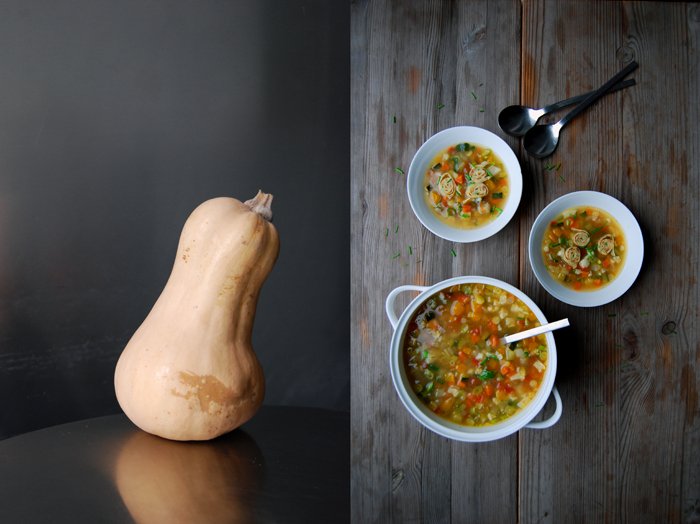
This dish combines the two culinary worlds which influence my kitchen activities the most, Malta's Mediterranean cuisine and Tyrol's cosy comfort food. I cooked a warming minestrone the way I know it from my Maltese granny Edith, with lots of pumpkin, zucchini (qarabaghli in Maltese) and kohlrabi. This soup can take the most varied collection of vegetables so I also added some cauliflower, celery stalk, potatoes and carrots. It's a deliciously sweet broth of all the strengthening fruits of the season, and once the vegetables are chopped, it only takes 15 minutes !
Whenever I sit in Edith's kitchen in Msida enjoying this comforting soul food, she sprinkles freshly grated parmesan over the steaming dish, but here in the North, I wanted to add something richer to satisfy our strong appetite. In the cold season, I'm a big fan of saturating additions to light and healthy soups, Tyrolean frittaten, called Flaedle in the Swabian region in southern Germany, are one of my first choices. They are made of thin crêpes refined with chives, rolled up in a tight wrap and cut into slim strips. Frittaten look like pancake snails and turn a minestrone into a special treat, the eggy pastry adds a hearty feel to this meal which I absolutely love about wintery soups!
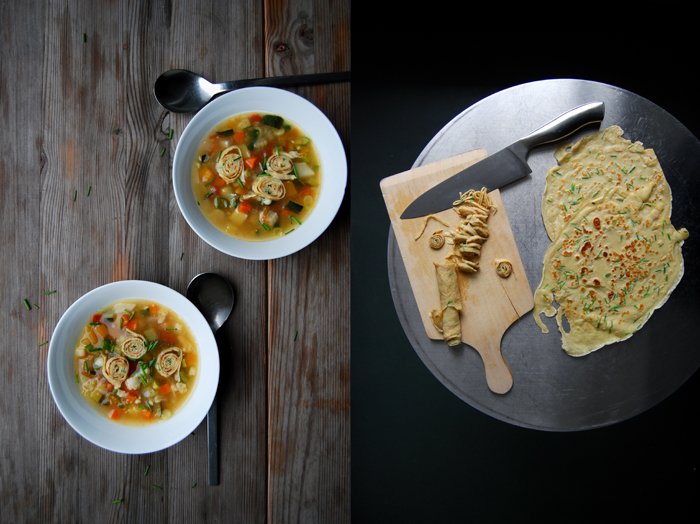
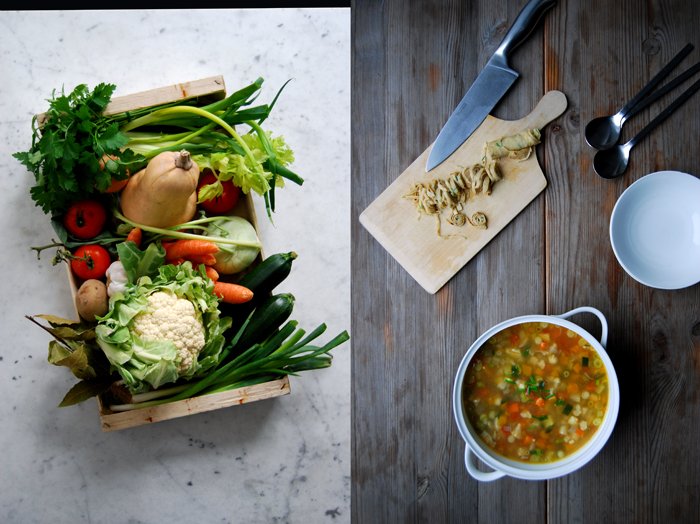
Maltese Minestrone with Tyrolean Crêpes Frittaten
For 4-6 people you need
For the frittaten
plain flour, sieved, 70g / 2.5 ounces
salt 1/8 teaspoon
organic egg, beaten, 1
milk 120ml / 4 ounces
chives, snipped 3 tablespoons
butter, to fry the crêpes
Mix the flour, salt, egg and milk to a smooth dough (with an electric mixer) and let it sit for 15 minutes before you mix in the chives.
In a non-stick pan, heat a teaspoon of butter. Pour in a ladle of the dough, holding the pan in your hand and turning it so that the dough spreads evenly and very thinly. The temperature should be on medium-high as the crêpes won’t need more than 1 minute on each side once the heat is set right. When the crêpe is golden on both sides take it out and continue with the remaining dough. Always heat a teaspoon of butter before you add new dough to the pan. Roll up each crêpe very tightly and cut into thin strips (snails).
For the minestrone
medium onion, chopped, 1
cauliflower, cut into small pieces, 160g / 5.5 ounces
butternut squash, peeled, cut into small cubes, 160g / 5.5 ounces
zucchini, cut into small cubes, 160g / 5.5 ounces
kohlrabi, peeled, cut into small cubes, 50g / 2 ounces
carrot, peeled, cut into small cubes, 80g / 3 ounces
potato, peeled, cut into small cubes, 100g / 3.5 ounces
celery stalk, cut into small cubes, 1
medium sized tomato, cut into small cubes, 1
broth, hot, 1.5l / 3 pints
garlic, crushed, 2 cloves
bay leaf 1
spring onion, thinly sliced, 2
salt and pepper
olive oil
In a large pot, heat a splash of olive oil and fry the onion for a few minutes on medium heat until golden and soft. Stir in the garlic and cook for 1 minute. Add a little more oil and the chopped vegetables (apart from the spring onions), stir and cook for 1-2 minutes. Add the hot broth and the bay leaf, season with salt and pepper and cook for 15 - 20 minutes. Stir in the spring onion, season to taste and serve with the frittaten.