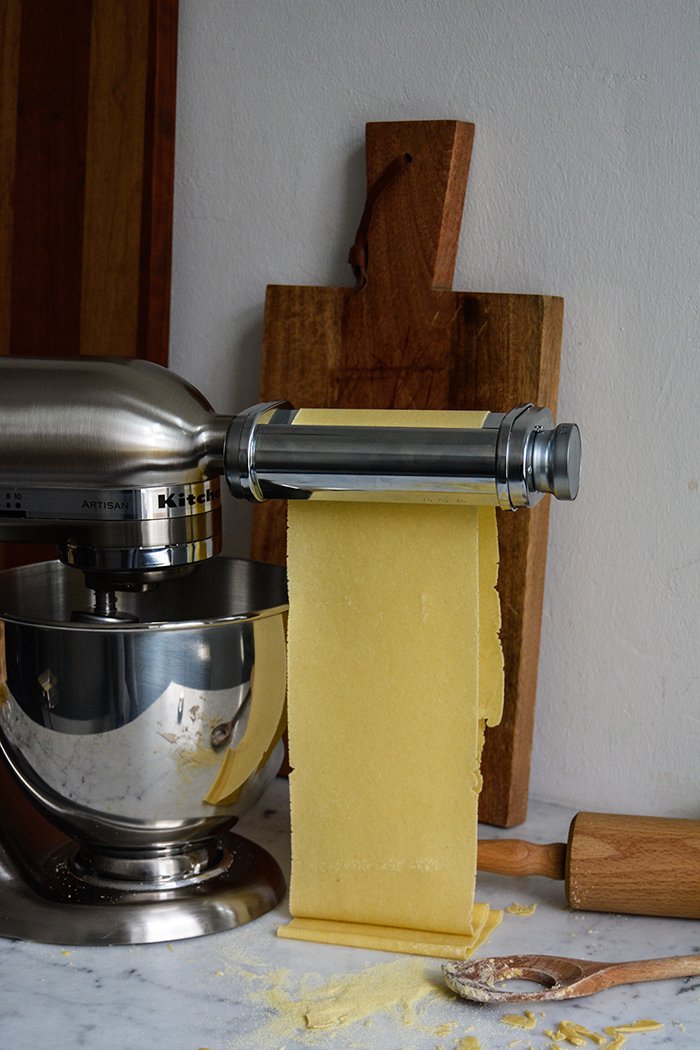
Laurel Kratochvila's Marzipan-Ribboned Challah Knots
I don't even remember how it started. It must have been a few years ago when my man and I welcomed a new tradition: coffee dates. Whenever we find time to take an hour off work, we squeeze in a dark Italian espresso or a creamy cappuccino, happily enjoyed in one of the countless cafés in our area. And on Saturdays - overly excited by the luxury of having plenty of free time - we often stretch it into a lunch-teatime-aperitif date. Just the two of us, chatting about whatever's on our mind, no plans or duties, just lingering until we decide to move on.
On one of these dates, we went to the new Shakespeare and Sons / Fine Bagels. The book shop and bakery used to be close to where we live, but the two owners, Roman and Laurel, had to transfer their cafe and literature business to a new location. That was the first time I tried Laurel's absolutely outstanding chocolate rugelach, which blew my mind and made me want (or rather have to) meet the woman behind this treat.
When we met, our chat led to a Meet In Your Kitchen feature (including my beloved rugelach recipe), but most importantly, I found a woman who's a great inspiration. Laurel loves food, she's obsessed with baking, she's gifted with an unbelievable amount of energy, and when you talk to her, you can see her beautiful soul. She's honest, critical, and crazy enough to overcome her fears and jump into the next adventure. Nosh Berlin is her new baby, a Jewish food week, starting March 17th. It'll be a week packed with talks, feasts, and Jewish food. I already booked my tickets for two events, Molly Yeh is coming on the 22nd and I didn't dare to miss The Gefilte Ball on Thursday. You can find the program of all the events below or on the Nosh Berlin website.
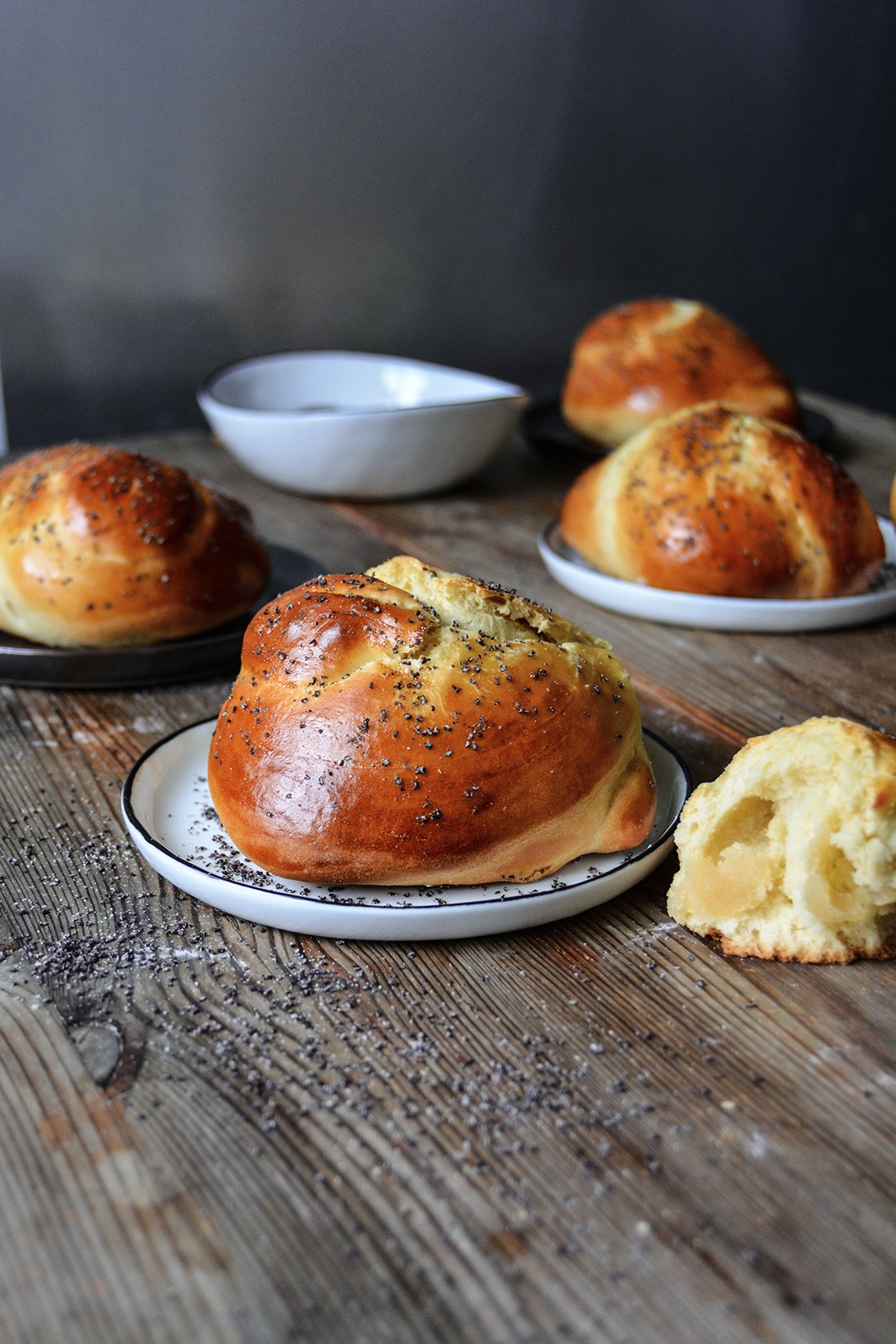
When I met Laurel for a coffee a couple weeks ago to hear everything about her exciting events, I nibbled on my obligatory rugelach and she chose a new creation, her current obsession: a marzipan-ribboned challah knot. She looked so happy whenever she took a bite of her yeast bun that I thought, I need this recipe. Laurel is a nice person who loves to share, I didn't even need to beg her. And here it is, fluffy yeast buns, not too sweet, generously filled with marzipan, and so good, that I ate five of them in a day and a half. Laurel only uses egg yolks, melted butter, and water in this recipe. She uses bread flour, however I replaced it with white spelt flour that comes to use in all of my baking recipes. I had to add a little more flour and I think that a bit more wouldn't have harmed the texture, but helped the knots to keep their shape a bit better and avoided cracks on the surface. As you can see in the pictures, my knots turned into roundish buns in the oven. I didn't mind, challah knot or bun, I love Laurel's latest creation.

Nosh Food Festival
- Friday, March 17th - Kiddush: North African Jewish dinner by Yuval Belhans and Mayaan Meir
- Sunday, March 19th - The Nosh Market at Markthalle Neun Oma and Bella: Movie and a Nosh at Babylon Berlin
- Monday, March 20th - The JCC Krakow presents Jewish Polish Food History. Talk and a tasting
- Tuesday, March 21st - What Jew Wanna Eat? Amy Kritzer, visiting chef from Austin, Texas, presents creative Passover cooking.
- Wednesday, March 22nd - Molly Yeh and Luisa Weiss: Cookbooks, Blogs, and Jewish Baking
- Thursday, March 23rd - Nosh Berlin and Shtetl Neukölln present The Gefilte Ball. Talk and demo with Jeffrey Yoskowitz of The Gefilte Manifesto followed by a klezmer ball.
- Friday, March 24th: Night of Shabbat Supper Clubs
There will also be a couple talks on various Jewish food topics at the Fraenkelufer Synagogue and a showing of Cafe Nagler with a presentation on pre-war Jewish cafe and restaurant life. Additionally, there are Jewish cookery classes all week at Goldhahn and Sampson in Charlottenburg.

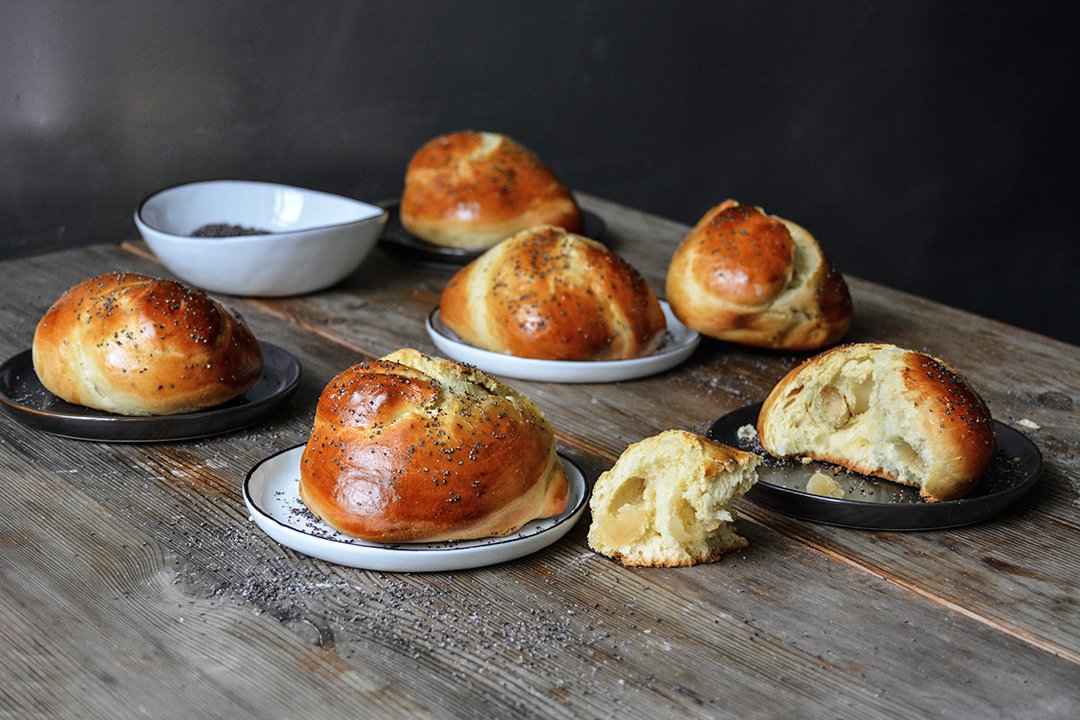
Marzipan-Ribboned Challah Knots
If you decide to double the recipe, use only 9 egg yolks, which is Laurel's original recipe.
Makes 7 challah knots
organic egg yolks 5, plus 1 egg white, beaten, for the glaze
butter, melted and cooled, 40g / 3 tablespoons
water 175ml /3/4 cup
bread flour (or white spelt or unbleached wheat flour), 410-480g (3 cups plus 2 tablespoons - 3 2/3 cups), plus more if the dough is too sticky
granulated sugar 100g / 1/2 cup
fast-acting yeast 1 1/4 teaspoons
fine sea salt 1 teaspoon
marzipan, cut into 7 pieces, 150g / 5 ounces
poppy seeds 1 tablespoon, for the topping
In a medium bowl, whisk the egg yolks and butter. Add water and whisk until well combined.
In the large bowl of a stand mixer, whisk together the flour (410g / 3 cups plus 2 tablespoons), sugar, yeast, and salt. Add the liquid mixture and, using the paddle attachment, mix for about 1 minute until combined. Replace the paddle attachment with the dough hook and knead for about 10 minutes. I use setting ‘4’ on my KitchenAid. Add more flour if the dough is too sticky, but mind that it should stay soft. If you prepare the dough by hand, keep kneading an extra few minutes. Transfer to a clean, oiled bowl, cover with a kitchen towel and let rise in a warm place, or preferably in a 35°C / 100°F warm oven (conventional setting), for about 60-70 minutes or until spongy. When you poke the dough, the indentation of your finger shouldn't spring back.
Punch the dough down and then turn out onto a floured work surface. Give it a quick knead to form it back into a ball and then cut 7 equal pieces. Cover with a tea towel and let rest for about 15 minutes.
Line a baking sheet with parchment paper.
Once rested, roll the dough into logs (about 25cm / 10" long) and then gently press flat. Lay a strip of marzipan lengthwise down the middle of the flattened log (using my hands, I first rolled each piece of marzipan into a long log) and then fold the log lengthwise in half, so you have a marzipan-filled log (see first picture). To fold the log into a knot, make an overlapping circle and then wrap the upper end under and then up through the middle (see first picture).
Preheat the oven to 175°C / 350°F (convection setting).
Once all 7 knots are folded, transfer to the lined baking sheet and brush with the beaten egg white. Laurel puts a little simple syrup in the egg glaze to add some extra sweetness, I left mine plain. Let them rise for about 30 minutes or until puffy. Glaze the challah knots with egg whash a second time then sprinkle with poppy seeds.
Bake for about 20 minutes or until the challah knots are golden brown and shiny.



Winter Caprese: Blood Orange, Beetroot, and Mozzarella di Bufala
I'm sure that I can smell it, I can hear it, if not even feel it on my skin. The promise of spring is in the air. The birds sitting on the naked branches of the tree in front of our living room window know more than us and they sing it out loud. Their voices vibrant and full of energy, they herald winter's nearing end.
With me, it's the same every year, I get impatient, frustrated. I can't wait to pull shorts and dresses out of my wardrobe, and sit outside in one of the city's cafés on a lazy Saturday afternoon, decadently sipping on a glass of chilled white wine. I want to see ripe tomatoes, lush basil, and plump peas on my kitchen table. I already dreamed of a colourful caprese salad waiting for me on a plate - and then I started to think "Wait, it's February, hold on!". But how about a little creativity and open mindedness, what about a winter caprese? There's mozzarella di Bufala in my fridge, sweet blood oranges replace the tomatoes, and boiled beetroot adds an earthy tone that goes unbelievably well with both the fruit and the cheese. I sprinkled it with a sweet date syrup vinaigrette, but maple syrup would be just as good, and a handful of fresh basil leaves (a hint of summer). It was one of the best lunches I've had in a while.
Tomorrow's the start of the crazy season again, carnival's back! If you're looking for some traditional sweet treats for yourself and your loved ones, try one of these sticky fried gems:

Winter Caprese: Blood Orange, Beetroot, and Mozzarella di Bufala
Mind that the beetroot has to cook for about 45 minutes.
Serves 2 for lunch or 4 as a starter
For the caprese
medium beetroot 1
bay leaf 1
small blood oranges, peeled and sliced, 4
mozzarella di Bufala, drained and torn into 2 or 4 pieces, 125g / 4 1/2 ounces
fresh basil leaves, a small handful
black peppercorns, crushed in a mortar (optional)
For the vinaigrette
olive oil 3 tablespoons
balsamic vinegar 1 tablespoon
white balsamic vinegar 1 tablespoon
date syrup (or maple syrup) 1/2-1 teaspoon
fine sea salt
ground pepper
Bring a medium pot of salted water to the boil, add the beetroot and bay leaf and cook for about 45 minutes or until the beetroot is tender (prick with a skewer to check). Rinse with cold water and let it cool; then peel and slice the beetroot.
For the vinaigrette, in a small bowl, whisk the olive oil, both vinegars, and the date syrup. Season with salt pepper and additional date syrup to taste.
Arrange the beetroot and blood orange in a circle on the plates, place the mozzarella in the middle. Drizzle with the vinaigrette (you might not need all the dressing) and sprinkle with basil and crushed pepper. Serve immediately.


Marbled Red Wine and Chocolate Cake
Let's start this beautiful Sunday with some happy news:
The Eat In My Kitchen book is one of Food52's '15 Piglet Community Picks 2017'! Thank you so much for your book love and support! And if I may ask you for a little more support, it would be fantastic if you could write a review of my book on Amazon, it can be a quick one, but it would help me a lot. Here are the links:
So, back to my kitchen: I've always had a sweet tooth, but I'm a bit of a piggy at the moment. There isn't a single day without cake on the table. Be it baked by myself, or a luscious piece of New York Cheesecake or hazelnut mascarpone torte from my favorite cafés around the corner; or those ultra soft and spongy yeast rolls and buns from a bakery - also just around the corner - that I only discovered a few months ago. I need my sugar no matter what my responsible mind tries to convince me of. Maybe I should have a day or two without it, I don't care. I'm the happiest person in the world when I'm snuggled into my beloved Butterfly Chair - that's currently covered in sheep fur for seasonal reasons - with a cup of Earl Gray tea on my lap and a large piece of cake close at hand.
Last week I had even more reason to bake, two birthdays in the calendar called for a sweet feast. I made the Poppy Seed and White Chocolate Babka that I shared with you last Sunday, peanut butter meringues (the recipe still needs some tweaking, but it'll come up soon), and a marvelous marbled red wine and chocolate cake. It's a marriage between my long loved Red Wine Cake and my classic Chocolate Marble Bundt Cake - I couldn't be more satisfied with the result. It's a little less sweet than my original pink wine creation due to the bittersweet chocolate batter swirled in and it's just perfect. Imagine a large bite of this fluffy cake covered in sticky red wine glaze melting in your mouth. Heaven.
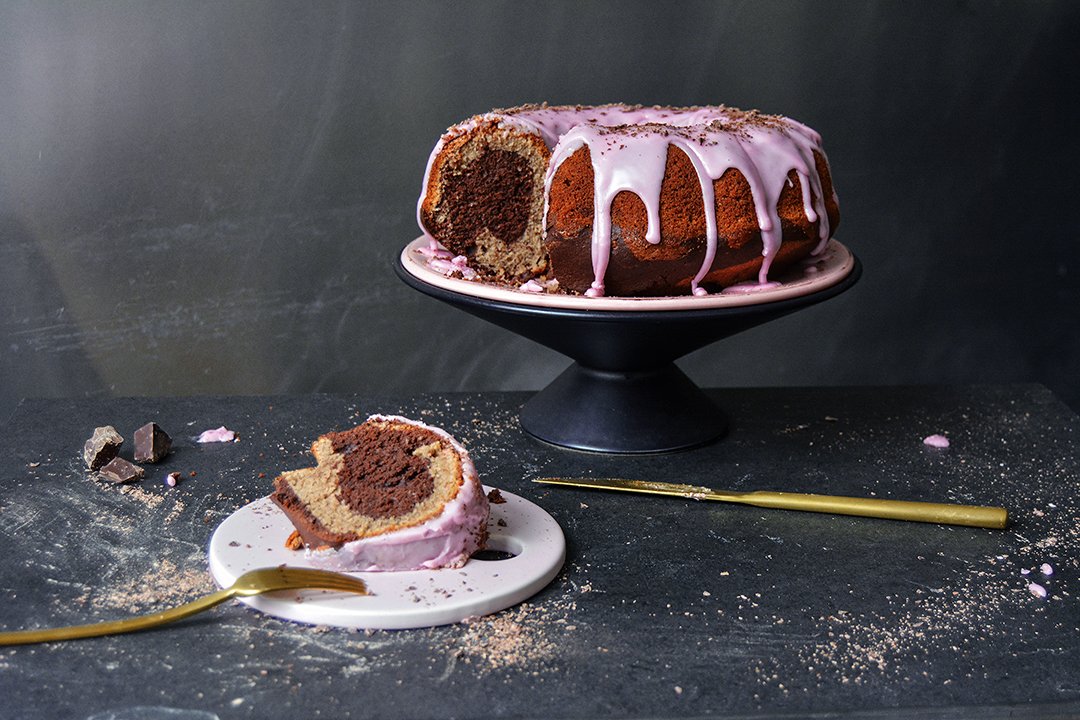
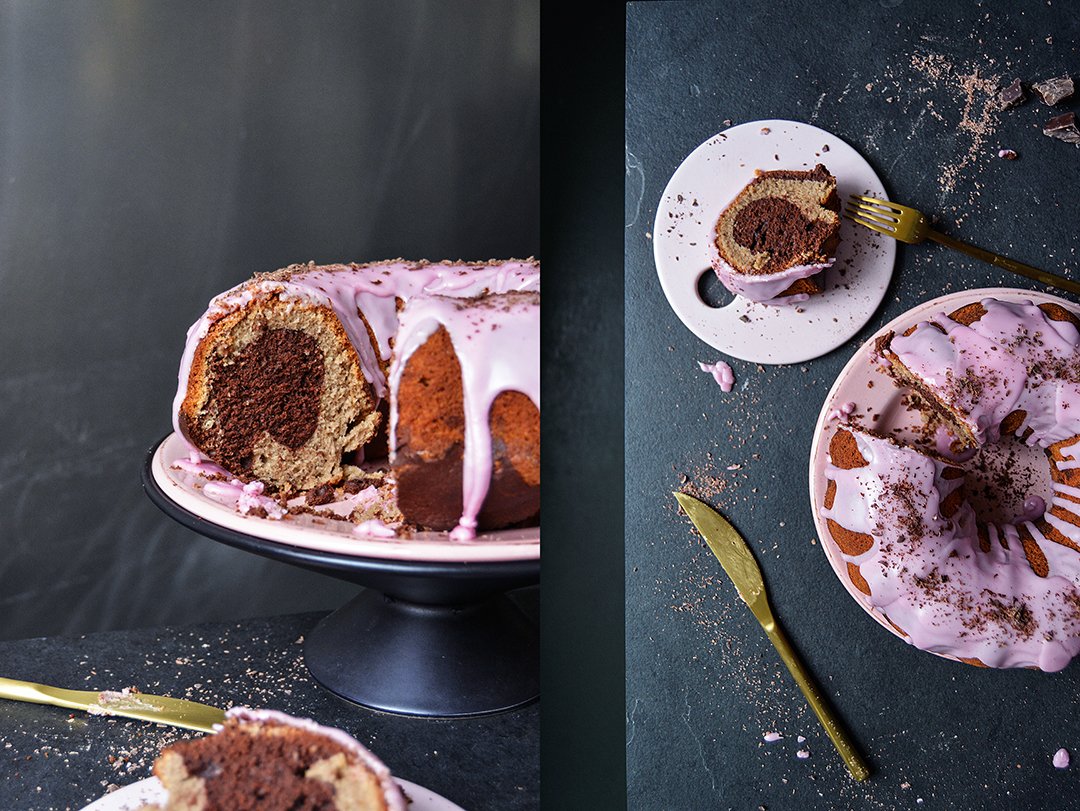
Marbled Red Wine and Chocolate Cake
Makes 1 Bundt cake
dry breadcrumbs, for sprinkling the pan
organic eggs, separated, 6
fine sea salt 1/8 teaspoon
plain flour 300g / 2 1/3 cups
baking powder 3 teaspoons
ground cinnamon 2 teaspoons
unsweetened cocoa powder 2 teaspoons, plus 30g / 1/3 cup for the chocolate batter
butter, at room temperature, 210g / 3/4 cup plus 2 tablespoons
granulated sugar 250g / 1 1/4 cup, plus 1 heaping tablespoon for the chocolate batter
red wine 120ml /1/2 cup
For the icing
icing sugar 220g / 2 1/4 cups
red wine 4-5 tablespoons
bittersweet chocolate, grated, 1 tablespoon
Preheat the oven to 180°C / 350°F (preferably convection setting). Butter a 23cm / 9″ Bundt pan and sprinkle lightly with breadcrumbs.
Whisk the egg white and salt until stiff, set aside.
In a large bowl, combine the flour, baking powder, cinnamon, and 2 teaspoons of the cocoa powder.
In the large bowl of a stand mixer, fitted with the paddle attachment, beat the butter and 250g / 1 1/4 cup of the sugar for a few minutes until fluffy. Add the egg yolks, one at a time, and continue mixing until thick and creamy. Add the red wine and mix until well combined. Using a wooden spoon, fold the egg white and the flour mixture into the butter mixture, alternating about 1/3 at a time, combining well in between.
Scrape half the batter into the prepared Bundt pan. Stir the remaining cocoa powder (30g / 1/3 cup) and sugar (1 heaping tablespoon) into the remaining batter, mix until well combined. Dollop the chocolate batter on top of the lighter batter and spread carefully. Using a small fork, swirl through the 2 batters, carefully from top to bottom, pulling slowly once all the way through the pan. Bake for about 40 minutes (slightly longer if using a conventional oven) or until golden and spongy. Check with a skewer, it should come out clean. Let the cake cool for 2-3 minutes, then shake the pan a little and flip the cake onto a plate to cool completely. If the cake won’t come out, place the warm Bundt pan into a large bowl filled with cold water. This will help loosening the cake from the pan.
For the icing, in a medium bowl, whisk the icing sugar with 4 tablespoons of red wine until smooth. Add more wine if the mixture is too thick. Drizzle the icing over the cake and sprinkle with chocolate while the icing is still soft. Enjoy!


Poppy Seed and White Chocolate Babka
The past week has been crazy and the best way to put my weary mind at ease, is to dig my hands into a ball of yeast dough and knead, and knead, and knead. You can punch and roll it, letting all your energy out until you're exhausted; or you can knead it gently to calm down and feel the pale ball softening slowly between your fingers. Yeast dough is forgiving, it accepts whatever mood you’re in, and it gets better the longer - and harder - you work with it.
The dough for today's babka had to deal with a lot of energy, I must have looked like a boxer training in my kitchen. And it turned out to be the smoothest, silkiest yeast ball my marble counter tops have ever seen. To make babka, you have to be patient, the dough has to rise overnight in the fridge before it transforms into a braided beauty. But then, if you time it well and start early on the second day, you can enjoy the most fragrant cake on your Sunday breakfast or brunch table. And if you don't feel like hassling and hurrying, just take your time and bake it for teatime.
I already shared a babka recipe here on Eat In My Kitchen, last year's Blueberry Lemon Cheese Babka was a hit, not only on my table. This time I wanted to use poppy seeds for the filling to resemble the famous German Mohnstrudel. It used to be one of my childhood's favourites, preferably generously filled with the dark, black seeds. For my filling, I stirred in a handful of raisins, which is also very common in Germany, they make it a bit fruity. But we're not done yet, I have another addition: chopped white chocolate; divine! It's subtle, you can barely taste the little milky bites, but it makes the filling juicier, fudgy in some parts, which is a great contrast to the fluffy cake. For the shiny finish, I used a sticky sugar glaze and I didn't even wait for it to dry, the first slice of a warm yeast cake is always the best.
Update: Here’s the recipe for my Pumpkin Seed and White Chocolate Babka!
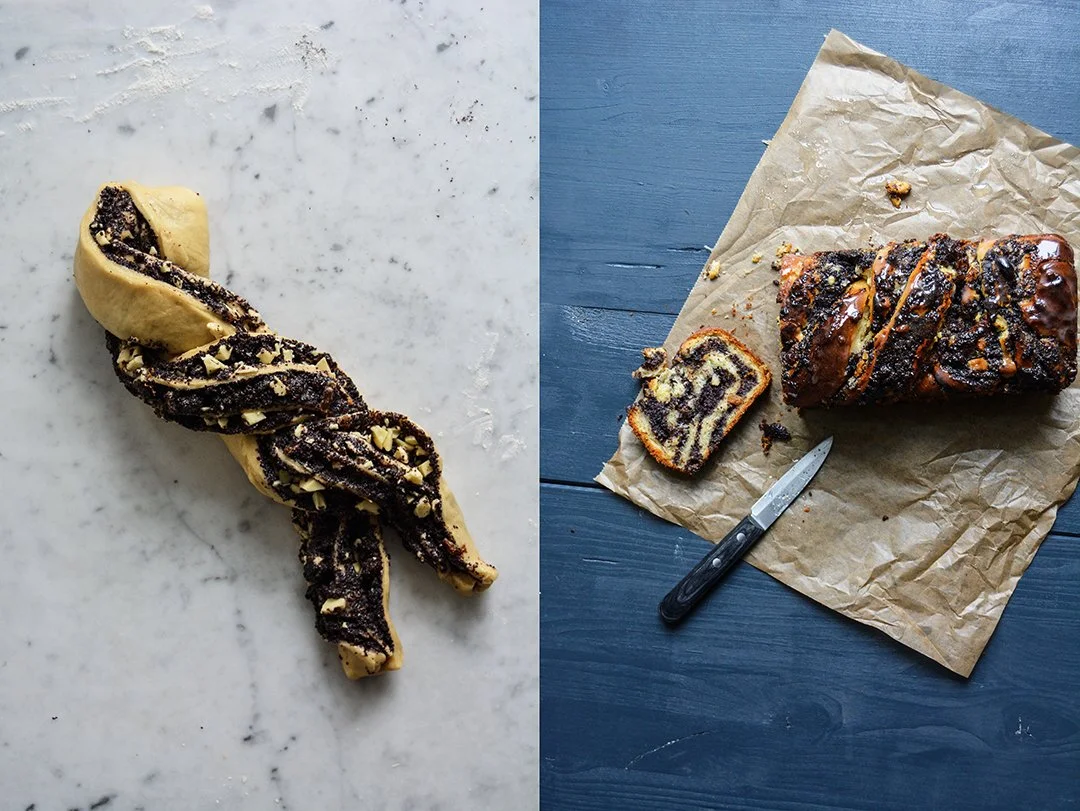

Poppy Seed and White Chocolate Babka
Mind that the babka has to rise twice, the first time overnight (for about 8 hours) in the fridge.
Makes 1 babka
For the dough
plain flour 275g / 2 cups plus 1 tablespoon, plus more if it's too sticky
granulated sugar 50g / 1/4 cup
fast-acting yeast 1 1/2 teaspoons
fine sea salt 1/4 teaspoon
milk, lukewarm, 60ml / 1/4 cup
organic egg 1
organic egg yolk 1
butter, at room temperature, cut into cubes, 75g / 1/3 cup
oil, to grease the bowl
For the filling
milk 210ml / 3/4 cup plus 2 tablespoons
granulated sugar 50g / 1/4 cup
ground cinnamon 1 teaspoon
orange zest 1 teaspoon
poppy seeds, cracked, 125g / 1 1/4 cup
raisins, soaked in warm water for 5 minutes and squeezed gently, 40g / 1/3 cup
white chocolate, chopped, 100g / 4 ounces
For the glaze
water 60ml / 1/4 cup
granulated sugar 100g / 1/2 cup
Day 1 - in the evening:
For the dough, in a large bowl, combine the flour, sugar, yeast, and salt.
Whisk the milk, egg, and egg yolk and add along with the butter to the flour mixture. Knead for about 10 minutes, starting with the dough hooks of a stand mixer and continue kneading and punching with your hands for a few minutes until you have a soft and silky ball of dough. If the dough is too sticky, add a little more flour, but mind that it stays soft. Transfer to a clean, oiled bowl, cover with cling film and put in the fridge overnight.
Day 2 - in the morning:
Take the dough out of the fridge and let at sit at room temperature for about 1-2 hours.
For the filling, in a medium saucepan, bring the milk, sugar, cinnamon, and orange zest to the boil. Take the pan off the heat, stir in the poppy seeds, and let it soak for 5 minutes. Stir in the soaked raisins and let it cool.
Butter an 11 x 24cm / 4 x 9″ loaf pan and line the bottom with a piece of parchment paper.
Punch the dough down, take it out of the bowl, and knead for about 30 seconds. On a floured counter top, roll out the dough with a rolling pin into a 28 x 40cm / 11 x 16″ rectangle. Spread the filling over the dough, leaving a 2cm / 3/4″ rim, and sprinkle with the white chocolate. Starting from one long side, roll up the dough tightly into a log. Pull and press to seal the end onto the roll and place the seam at the bottom. Using a sharp long knife, cut the roll in half lengthwise (see 5th picture). The cut sides facing up, press together two ends and lay one half of the log over the other, continue until you end up with a twisted plait (2nd picture). Push the end together. Tuck the ends underneath the babka and, using the large blade of a knife, lift the loaf and transfer quickly to the prepared pan. Cover with a tea towel and let it rise in a warm place (I keep it on the heater) for about 60-90 minutes or until puffy.
Preheat the oven to 190°C / 375°F (conventional oven). For the glaze, in a small saucepan, bring the water and sugar to the boil and let it cook for 2 minutes, take the pan off the heat and set aside.
Bake the babka in the oven for 30-35 minutes or until golden brown. Check with a skewer, it should come out clean. Mind that depending on where you push it in, there will be melted chocolate on the skewer. Take the pan out of the oven and brush the top immediately with the syrup (use all the syrup). Let the cake cool for about 10-15 minutes before you remove it from the pan. Enjoy slightly warm or cold.


Beluga Lentils with Grilled Cherry Tomatoes, Orange and Rosemary
Spontaneous weekend trips are the best way to calm the weary mind after a busy week. I don't have to travel far, I don't even need to stay overnight, just a few hours in a nearby forest or at one of Berlin's beautiful lakes and I'm back on my feet.
My mother brought many wonderful things into my life. My love for food and cooking was definitely sparked by her own passion. She also fed my need for snuggly Sunday afternoons on the sofa. I sink in a pile of cushions and wrap myself in a cozy quilt, preferably listing to Prokofiev, and a plate of warm waffles on my lap. This used to be one of our favourite weekend rituals. Unfortunately, we haven't made waffles together in a while, but there's another tradition from my childhood days that she introduced me to, which both of us still hold dear. Mother and daughter grab their jackets, hop in the car to find a nice spot in the countryside, and go on a short weekend adventure. We prefer relaxed walks that allow us to chat a little and enjoy the scenery around us. In all these years we must have walked hundreds of kilometres. We walked down narrow paths meandering through the darkest woods, jumped over tinkling waters, and crossed the fields on windy hill tops, where the sky feels endless and the views take your breath away. Mud, rain, heat, or darkness never stopped us from our next adventure.
When Volkswagen asked me for a new recipe, I had to think of one of my favourite places in Berlin for long walks, the gorgeous Müggelsee Lake. Be it spring, summer, autumn, or winter, this lake is a quiet beauty in every season. It's a peaceful place, my beloved weekend get away. Usually, we go to the local bakery and butcher and grab some sweets and a sausage. But this time I had another idea: wrapped in scarves, wool beanie, and a big jacket, sitting on a bench at the lake, we can have a little picnic date, even in winter. I went for a recipe that tastes just as good as a warm lunch and as a cold salad: nutty beluga lentils with sweet and smokey grilled cherry tomatoes and woody rosemary oil. It's a scrumptious trilogy.


Beluga Lentils with Grilled Cherry Tomatoes, Orange and Rosemary Oil
Serves 4
For the lentils
beluga lentils (no soaking required) 280g / 10 ounces
fresh thyme 1 small bunch
fresh rosemary 1 sprig
bay leaf 1
fresh orange peel 4 long strips
balsamic vinegar 1 tablespoon
fine sea salt
ground pepper
For the grilled tomatoes
cherry tomatoes, on the vine, 20
For the rosemary oil
olive oil 6 tablespoons
fresh rosemary, needles only, 4 sprigs
For the topping
freshly grated orange zest, about 1 tablespoon
Preheat the oven to grill / broil (quicker method) or preheat to 220°C (425°F).
Place the lentils in a saucepan with plenty of (unsalted) water, add the thyme, rosemary, bay leaf, and orange peel and bring to the boil. Simmer for about 20 minutes or until al dente (or follow the package instructions). Remove any excess liquid with a ladle, if necessary, and the spices. Stir in the vinegar and season with salt, pepper, and additional vinegar to taste.
Place the tomatoes in a baking dish and grill / broil for about 12 minutes or roast at 220°C / 425°F for about 35 to 45 minutes—their skins should start to burst and turn partly black. Leaving the tomatoes on the vine, divide them into 4 portions.
For the rosemary oil, in a small saucepan, heat the olive oil over medium-high heat. Add the rosemary and, as soon as it starts to sizzle, remove the pan from the heat. Cover and let the herb infuse the oil for at least 1 to 2 minutes. Remove the rosemary from the oil and set aside.
Stir the rosemary oil into the lentils and divide between plates. Arrange the grilled tomatoes and rosemary on top and season with fresh orange zest to taste. Enjoy warm or cold.


Feta and Fennel Barley with Caramelized Kumquats
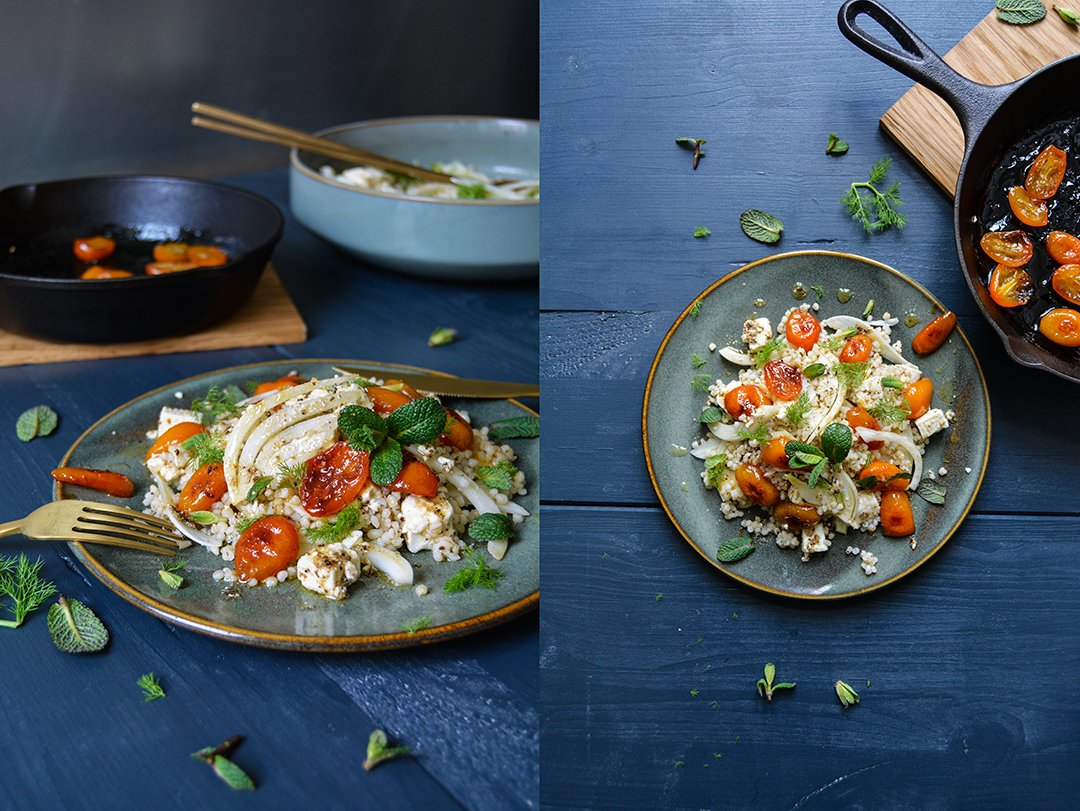
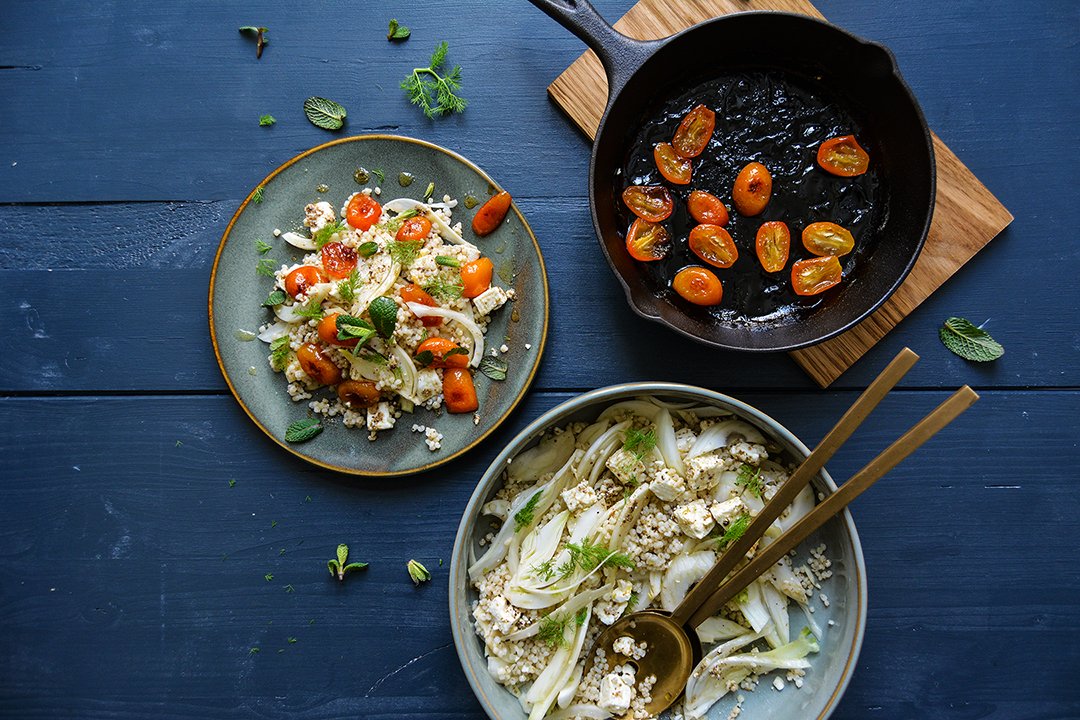
My latest discovery of a barley recipe from Yotam Ottolenghi and Sami Tamimi's stunning Jerusalem cookbook was a life changing event in my kitchen. I finally like barley!
For years my mother has been trying to convince me of the little grain's qualities - unsuccessfully. I'm not a huge fan of orzotto or risotto, I can enjoy both of them for lunch but I wouldn't call them a great source of inspiration. But then, as I thumbed through the pages of Jerusalem, page number 81 caught my attention: Parsley & Barley Salad. The title doesn't mention the ingredient that changed everything for me, feta. The two London chefs marinate the cheese in spiced oil before they finish off their composition with barley, lots and lots of parsley, and spring onions. They also add cashews but I skipped them, I'm not too fond of nuts in my cooking.
So what happens is that, when I really like a recipe, my mind starts spinning looking for variations. First I added much more barley than mentioned in the recipe to turn it into a richer meal befitting these cold winter evenings. Then I stirred in raw, thinly sliced fennel, blood orange juice, mint, and honey-caramelized kumquats (an inspiration from last year's celeriac salad). Ottolenghi and Tamimi use za'tar for their spice oil, which I replaced with ground cardamom and fennel seeds. Crushed coriander seeds and allspice berries are taken from their recipe and add a warming touch to it.
You'll end up with quite a vibrant dish that can be eaten cold, as a salad, or slightly warm, as a main or side dish. Although the spiced oil, salty cheese, and sour kumquats are quite prominent, the nutty barley and crunchy fennel aren't shy here either. What's great about it, is that you can play with it, add and change spices, fruits, and vegetables according to your mood and the season. Just stick to barley and marinated feta, that's the secret.

Feta and Fennel Barley with Caramelized Kumquats
Serves 3-4
pearl barley 100g / 1/2 cup
olive oil 5 tablespoons, plus a splash
coriander seeds, ground in a mortar, 3/4 teaspoon
allspice berries, ground in a mortar, 1/2 teaspoon
fennel seeds, ground in a mortar, 1/2 teaspoon
ground cumin 1/2 teaspoon
ground cardamom 1/4 teaspoon
feta, cut into cubes, 150g / 5 ounces
medium fennel bulb, quartered, cored, and thinly sliced, 1
freshly squeezed blood orange juice 4 tablespoons
fine sea salt
ground pepper
fresh mint leaves, a small handful
For the caramelized kumquats
honey 2 tablespoons
kumquats, cut in half lengthwise, seeds removed, 12 (or 12 orange fillets, peeled)
freshly squeezed orange juice 4 tablespoons
Cook the barley in salted water until al dente, drain in a colander, and rinse briefly with water.
In a medium bowl, whisk the olive oil, coriander, allspice, fennel seeds, cumin, and cardamom. Add the feta and mix gently until the cheese is coated with oil and spices, set aside.
For the caramelized kumquats, in a small, heavy pan, heat the honey over high heat until liquid and bubbling. Add the kumquats and orange juice and cook for about 2 minutes or until golden brown on the bottom, turn and cook for another 1 1/2 - 2 minutes or until soft and caramelized; mind that they don’t become too dark.
Transfer the barley, sliced fennel, orange juice, and feta with the spiced oil to a large bowl and stir gently. Season with salt and pepper to taste, stir in a little more olive oil if it's too dry. Sprinkle with mint and arrange the kumquats on top. Enjoy warm or cold.


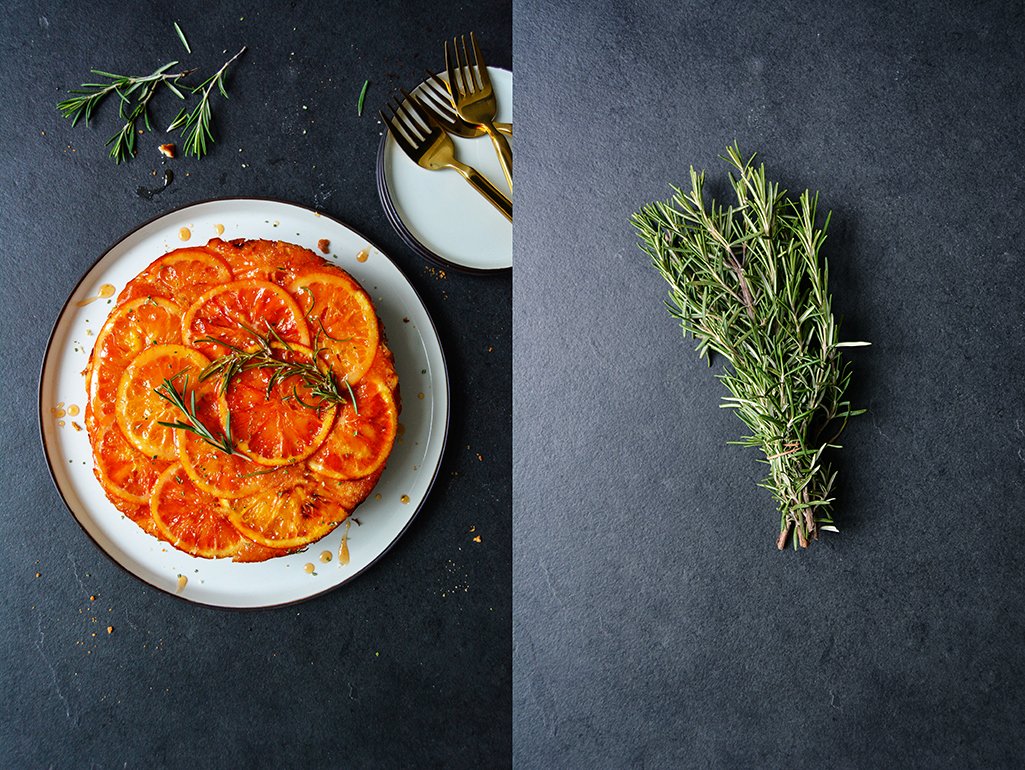
Blood Orange and Rosemary Upside Down Cake
I already had my post written for today's bright orange Sunday cake, but then, yesterday's news from the US hit me. It felt so wrong to just write about a recipe, my mood, my day; why should I write about me and my food, when on the other side of the Atlantic, a single man throws everything away that our so called civilized world claims to stand for. How can we, or the president of the United States, ban citizens from certain countries (Iraq, Iran, Yemen, Libya, Somalia, Sudan, Syria) from putting their feet onto American ground?
I'm German, my country's history shows what happens when we tolerate and support the insane actions of a single man. Didn't we learn anything? Is it still possible for us to allow a man to run a country who doesn't show the slightest feeling of compassion? Didn't we, in the western world, hypocrites, arrogantly accuse other countries of exactly that?
Before I was sad, now I'm concerned.
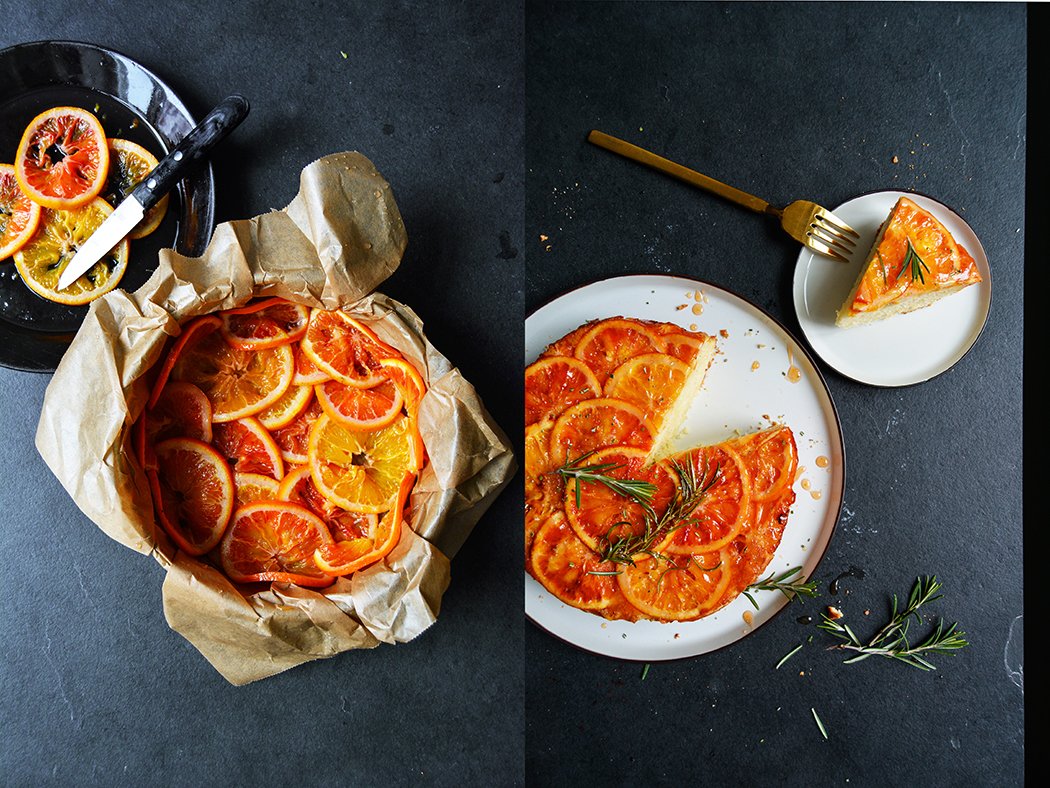
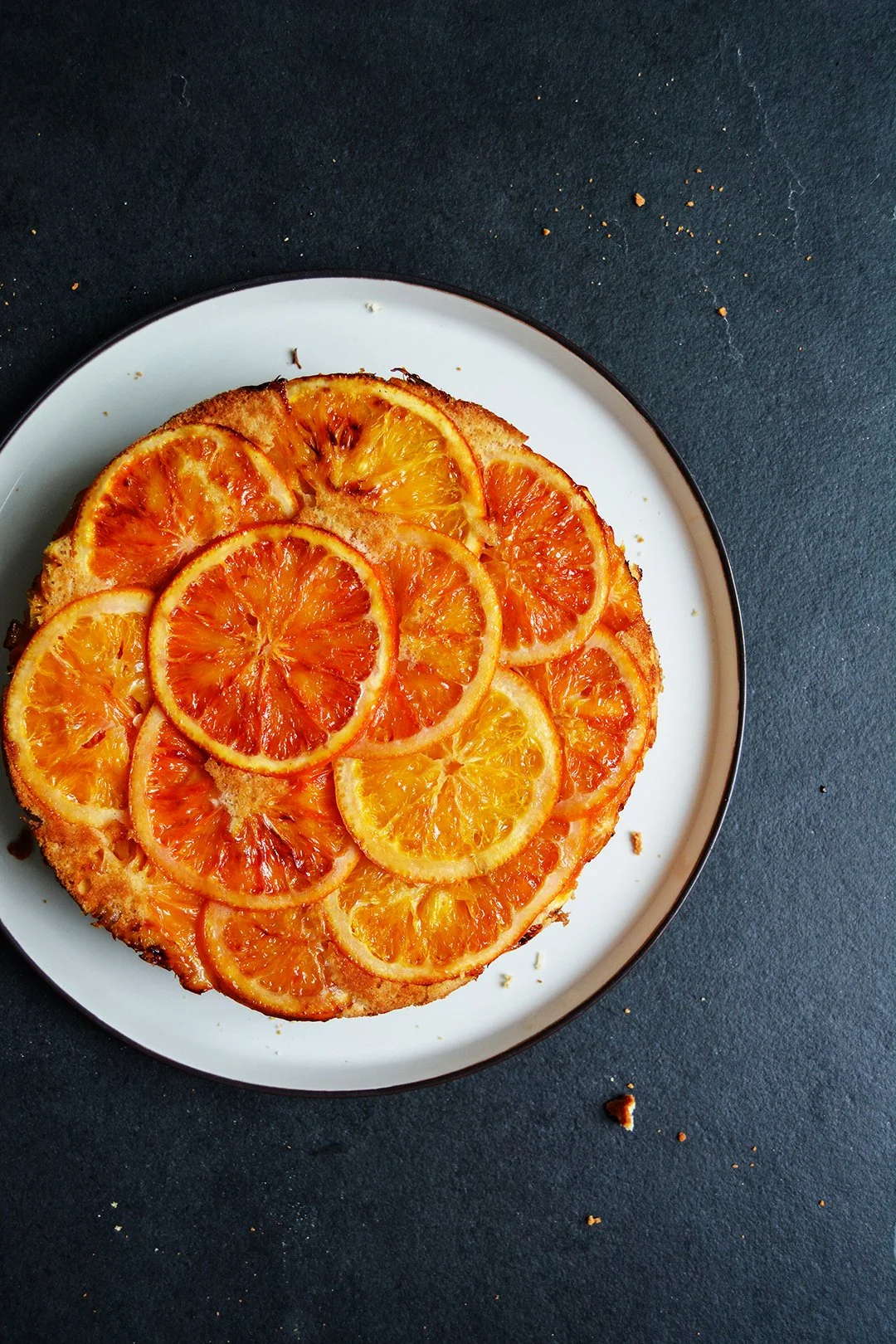
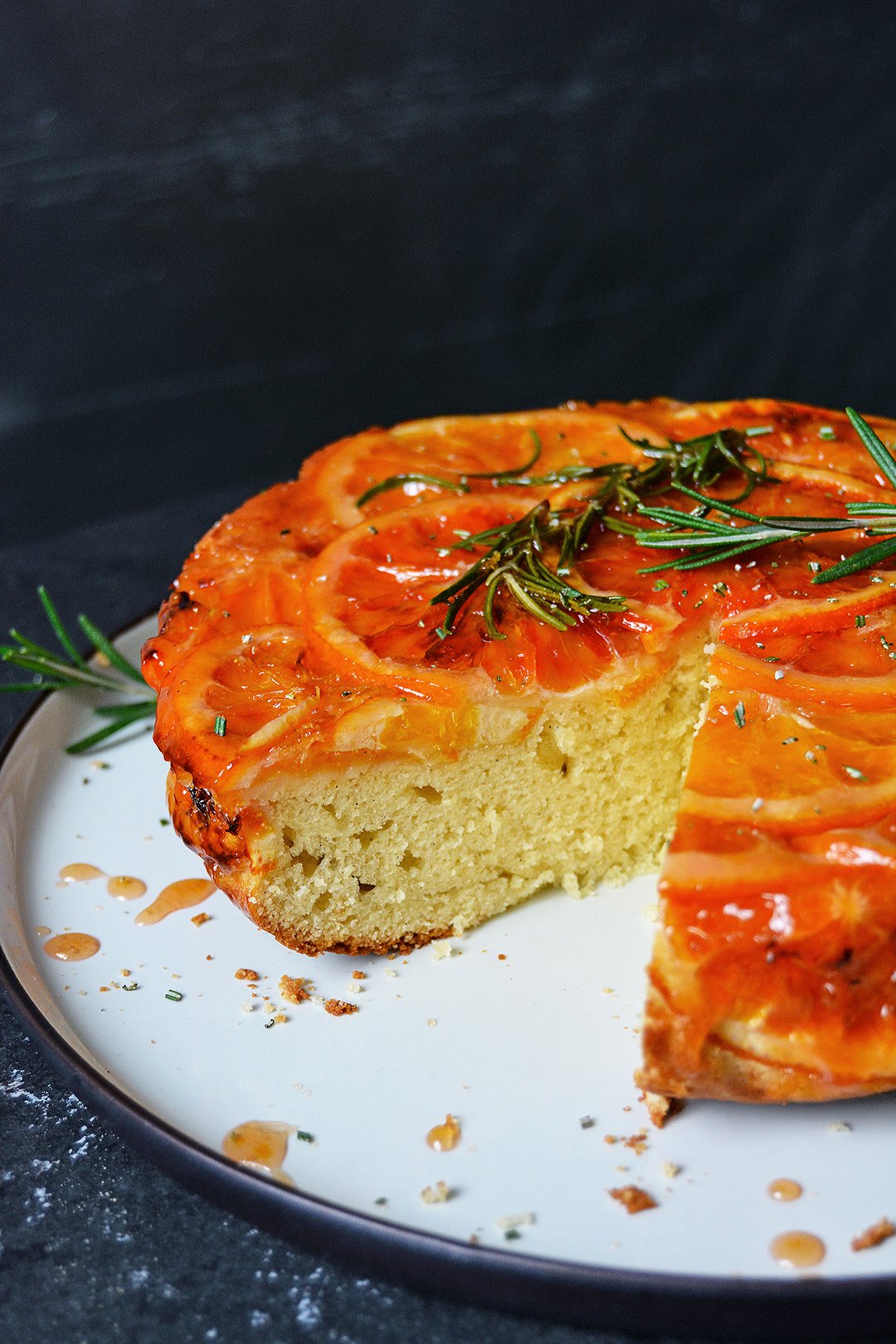
And yes, I baked a cake. It's an upside down cake - for an upside down world - made with Sicilian blood oranges. It looks like a glowing Mediterranean sunset, peaceful. Some prefer to cut off the citrus fruits' peel, I leave mine on for a tangy touch. I first sliced and then cooked three fruits in sugar water with a sprig of fresh rosemary to infuse the pulp. About half an hour later they were soft, ready to become the fruity base of a light and fluffy upside down cake, thanks to beaten egg white folded into the batter. The citrus is very present, which I like, the herbal note is subtle. If you prefer you can use less fruits, but I recommend creating a thick juicy layer of orange slices. They keep the cake wonderfully moist and fruity, also on the second day.

Blood Orange and Rosemary Upside Down Cake
Makes 1 (20 1/2cm / 8") cake
For the oranges
water 120ml / 1/2 cup
granulated sugar 100g / 1/2 cup
organic blood oranges, rinsed, scrubbed, and the ends cut off, 3
medium sprig of rosemary 1, plus a few needles finely chopped (optional)
For the dough
plain flour 200g / 1 1/2 cups
baking powder 2 teaspoons
butter, at room temperature, 80g / 1/3 cup
granulated sugar 150g / 3/4 cup
organic eggs, separated, 2
vanilla pod, split and scraped, 1/2
milk 100ml / 1/3 cup plus 1 tablespoon
fine sea salt 1/8 teaspoon
Preheat the oven to 180°C / 350°F. Butter and line a 20 1/2cm / 8"springform pan.
For the oranges, in a large saucepan, bring the water and sugar to a boil over medium high heat. Stir and let the sugar dissolve. Cut the oranges into thin slices. Reduce the heat to medium, layer the orange slices in the sugar water, and simmer gently for about 25-30 minutes or until soft, but still in shape. Using a slotted ladle, transfer the orange slices to a large plate and let them cool for a few minutes. Add the rosemary to the pot with the orange syrup and set aside.
For the dough, in a medium bowl, combine the flour and baking powder. In a large bowl of a stand mixer, beat the butter and sugar until light and fluffy. Add the egg yolks and vanilla seeds and continue mixing for about 1 minute or until well combined. Quickly beat in the flour mixture in 3 batches, alternating with the milk. Beat the egg white and salt until soft peaks form and fold into the dough.
Arrange the orange slices on the bottom and sides of the prepared pan, fold some of the slices into the corners (see 2nd picture). Scrape the dough on top of the fruits, even it out and bake for about 35-40 minutes or until golden brown and spongy. Check with a skewer, it should come out clean. Let the cake cool for a few minutes before you flip it over, gently remove the parchment paper.
Bring the rosemary orange syrup to a boil over high heat and let it cook for about 2 minutes, let it cool for a couple minutes. Brush the top of the cake with the syrup and arrange the rosemary sprig on top. Sprinkle with a little additional chopped rosemary and enjoy!




16 Recipes for Winter Salads
Berlin, January 2017:
Despite the grey skies and frosty temperatures that come along with Berlin's long lasting winter, I've been in the mood for salads surprisingly often this January. Cozy soups, stewy and rich, would have been more obvious, but no, my appetite longs for winter salads. Celeriac, cabbage, beans, roots, and potatoes inspire my cooking and satisfy my longings for fresh vegetables. And thanks to the addition of citrus fruits, fresh coconut, or turmeric root I never get bored. If you feel the same, take a look at these scrumptious compositions collected on Eat In My Kitchen over the past 3 years (click the titles for the recipes)!
Update, January 2024: Click here for all SALAD recipes on the blog, and here for many more in my cookbooks.
16 Recipes for Winter Salads
Celeriac Salad with Cardamom-Yoghurt, Caramelized Honey Kumquats, and Walnuts


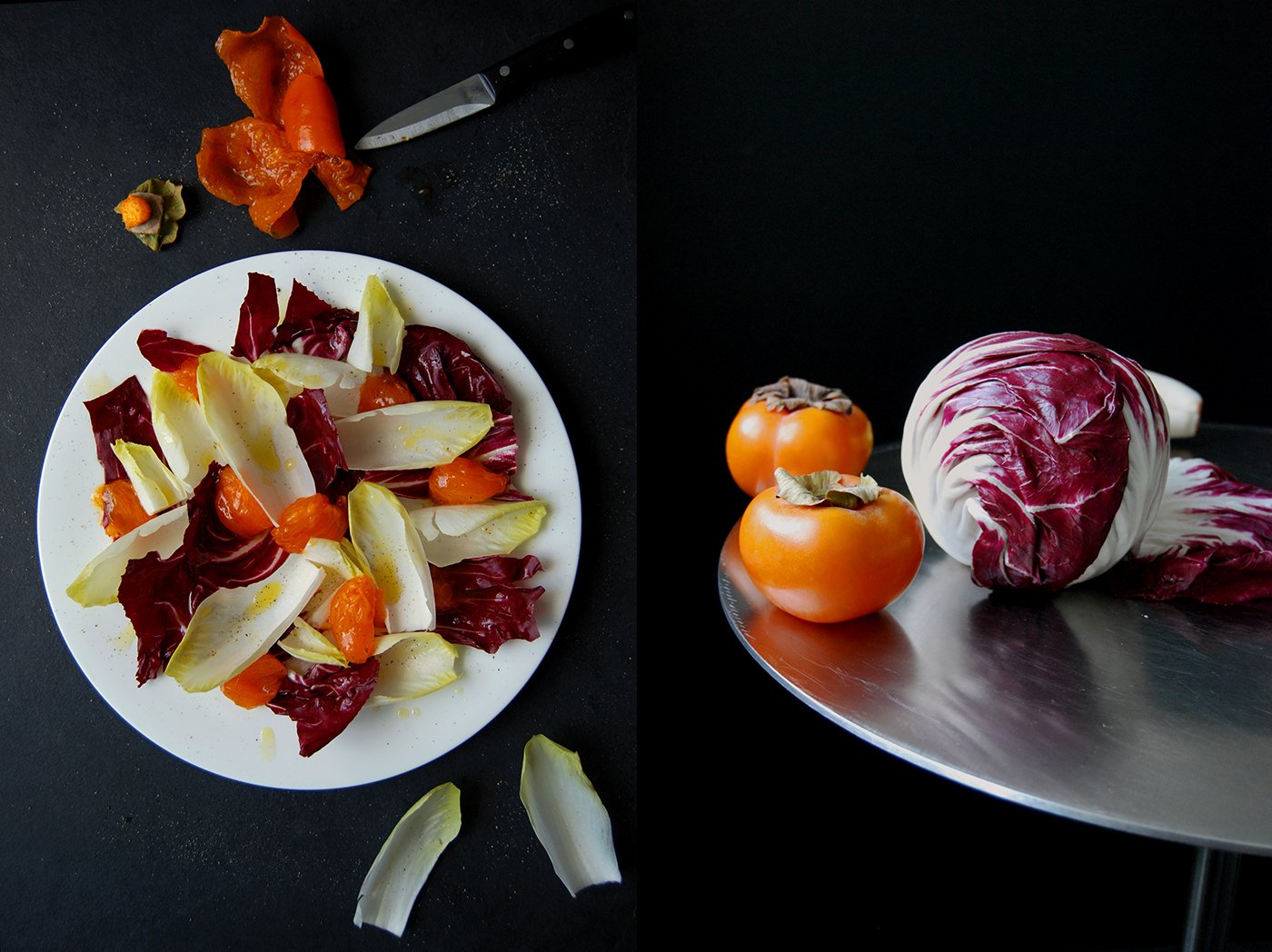


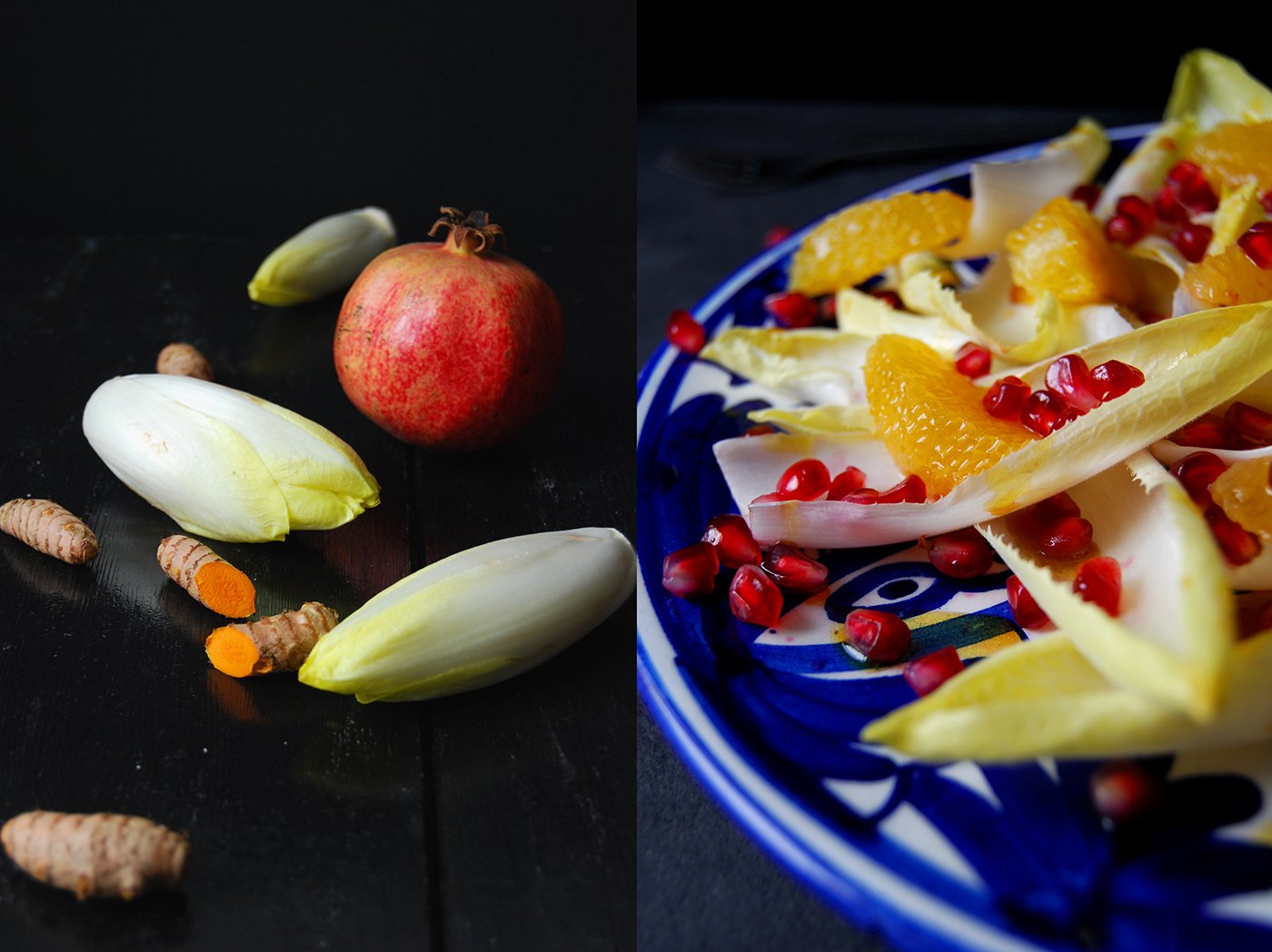


and from my book:
Radicchio, Peach, and Roasted Shallot Salad with Blue Cheese (you can replace the peach with ripe persimmon or pear)

Bavarian Cabbage Salad with Crispy Bacon
(I’m sorry, there’s no picture to share, the quality is too bad. It was one of my very early blog recipes …)
Enjoy!


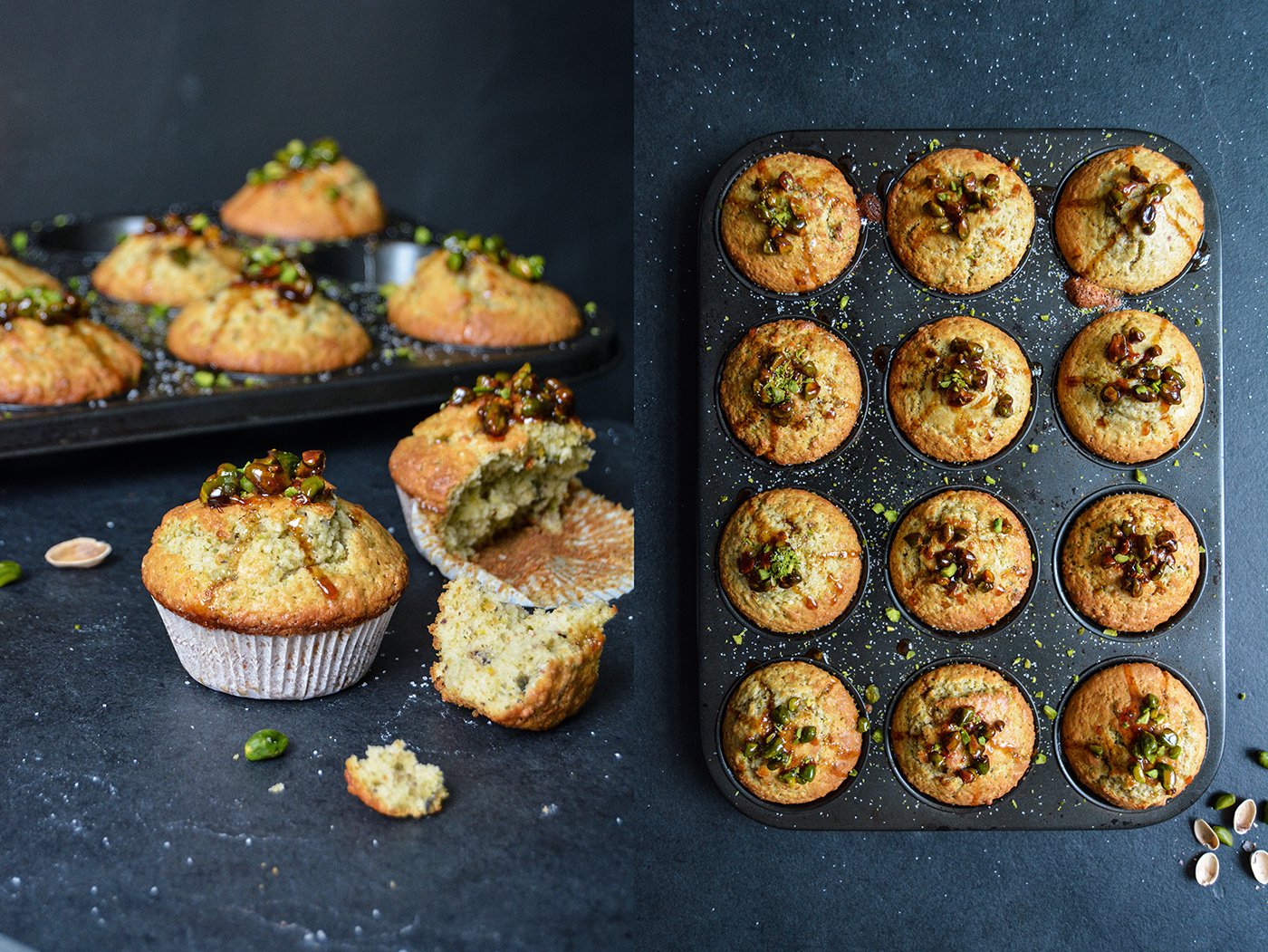
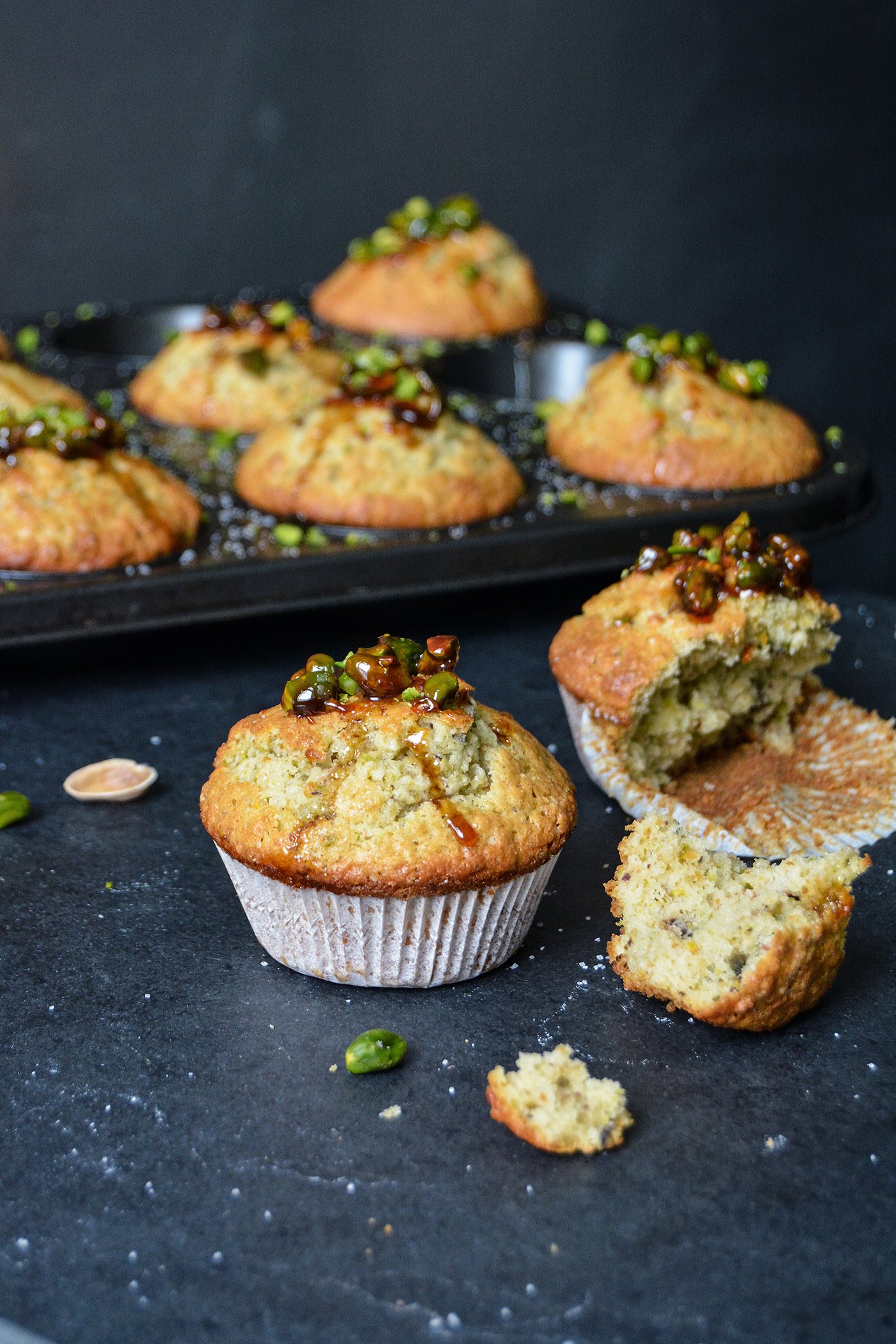
Pistachio Orange Blossom Muffins with Caramelized Pistachios
Pistachios have been on my mind since I tried the most divine breakfast spread during my stay at the stunning Villa Athena in Agrigento in Sicily. Velvety smooth and creamy, slightly sweet and nutty, I'm not surprised that this traditional Sicilian Crema di Pistacchi is so popular in Italy. The texture is similar to the more common chocolate hazelnut spread, but it tastes a million times better, and it's bright green. I love it and I can't wait to start working on my own recipe.
However, there are much quicker ways to satisfy my current pistachio longings, for example, with fluffy pistachio orange blossom muffins topped with caramelized pistachios. I replaced a quarter of the flour with finely ground pistachios and stirred in a few roughly chopped nuts to add some crunch. Oranges team up very well with the green nuts, so I used a generous splash of orange blossom water and freshly grated zest to refine my little green muffins with a citrusy note. While you caramelize the nuts for the topping, you could also make a little more dark caramel to drizzle over the muffins' golden tops. Bittersweet and sticky, it fits really well, but that's up to you.
Yesterday was a great day, as we felt the united power of women. When I saw the pictures of the women's marches all over the world, hundred thousands of women raising their voice and showing their strength, I felt, all of a sudden, the cold fading that gathered in my heart in the past few months. #womensmarch
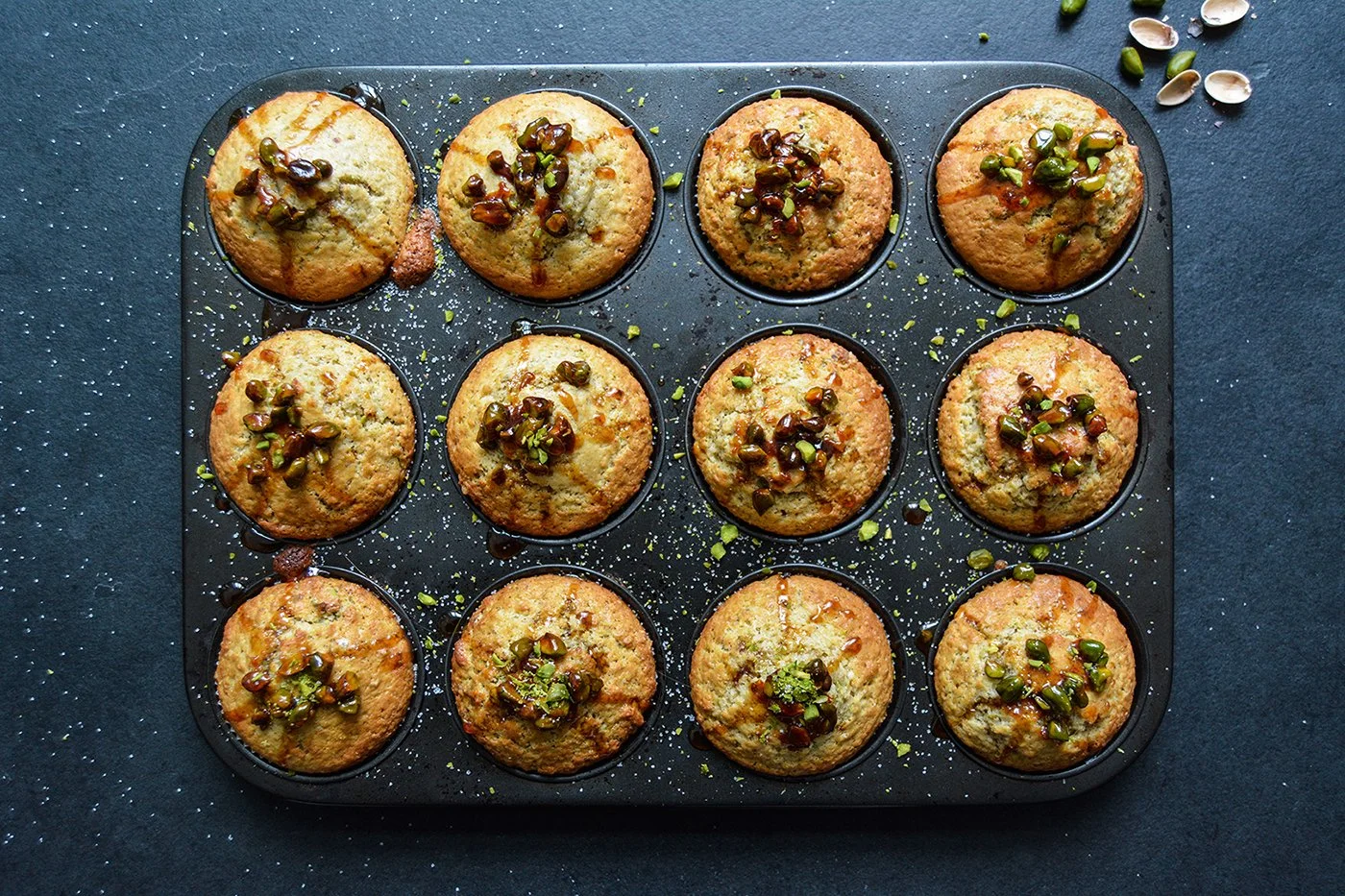

Pistachio Orange Blossom Muffins
Makes 12 muffins
shelled salted pistachios 120g / 1 cup
plain flour 320g / 2 1/2 cups
granulated sugar 150g / 3/4 cup
baking powder 3 teaspoons
baking soda 1/2 teaspoon
fine sea salt 1/8 teaspoon
butter, melted and cooled, 120g / 1/2 cup
freshly grated orange zest 1 teaspoon
vanilla pod, split and scraped, 1/4
whole milk 210ml / 3/4 cup plus 2 tablespoons
organic eggs 2
quality orange blossom water, preferably organic, 3 tablespoons
paper muffin pan liners 12
For the caramelized pistachios
shelled salted pistachios, a handful
granulated sugar 2 tablespoons
water 2 tablespoons
honey 1 teaspoon
Preheat the oven to 200°C / 400°F (preferably convection setting). Line a 12-cup muffin pan with paper liners.
In batches, rub the pistachios between your hands until most of the salt is scrubbed off. (Alternatively, use unsalted pistachios, in that case add 1/4 teaspoon of salt to the dough instead of 1/8 teaspoon.)
For the muffins, in a food processor or blender, grind 2/3 (80g / 3 ounces) of the pistachios until very fine. Chop the remaining pistachios roughly.
In a large bowl, whisk together the flour, ground pistachios, sugar, baking powder, baking soda, and salt.
Add the orange zest and vanilla seeds to the butter, whisk, and let it sit for a few minutes to infuse the butter.In a medium bowl, whisk together the butter, milk, eggs, and orange blossom water. Add to the flour-mixture and stir with a wooden spoon just until a lumpy batter forms. Gently fold in the remaining chopped pistachios. Mind that if you mix the batter too much, the muffins will lose their light texture.
Spoon the batter into the muffin cups and bake for about 14 minutes (slightly longer if using a conventional oven) or until golden.
For the caramelized pistachios, rub the pistachios as mentioned above to remove most of the salt and chop roughly. In a small, heavy saucepan, bring the sugar, water, and honey to the boil and, without stirring, let it cook until golden and caramelized. Add the pistachios, stir quickly and top each muffin with a teaspoon of the caramelized nuts. Work quickly, as the caramel becomes hard. If it's too sticky, transfer the pan back onto a low heat to melt the caramel.


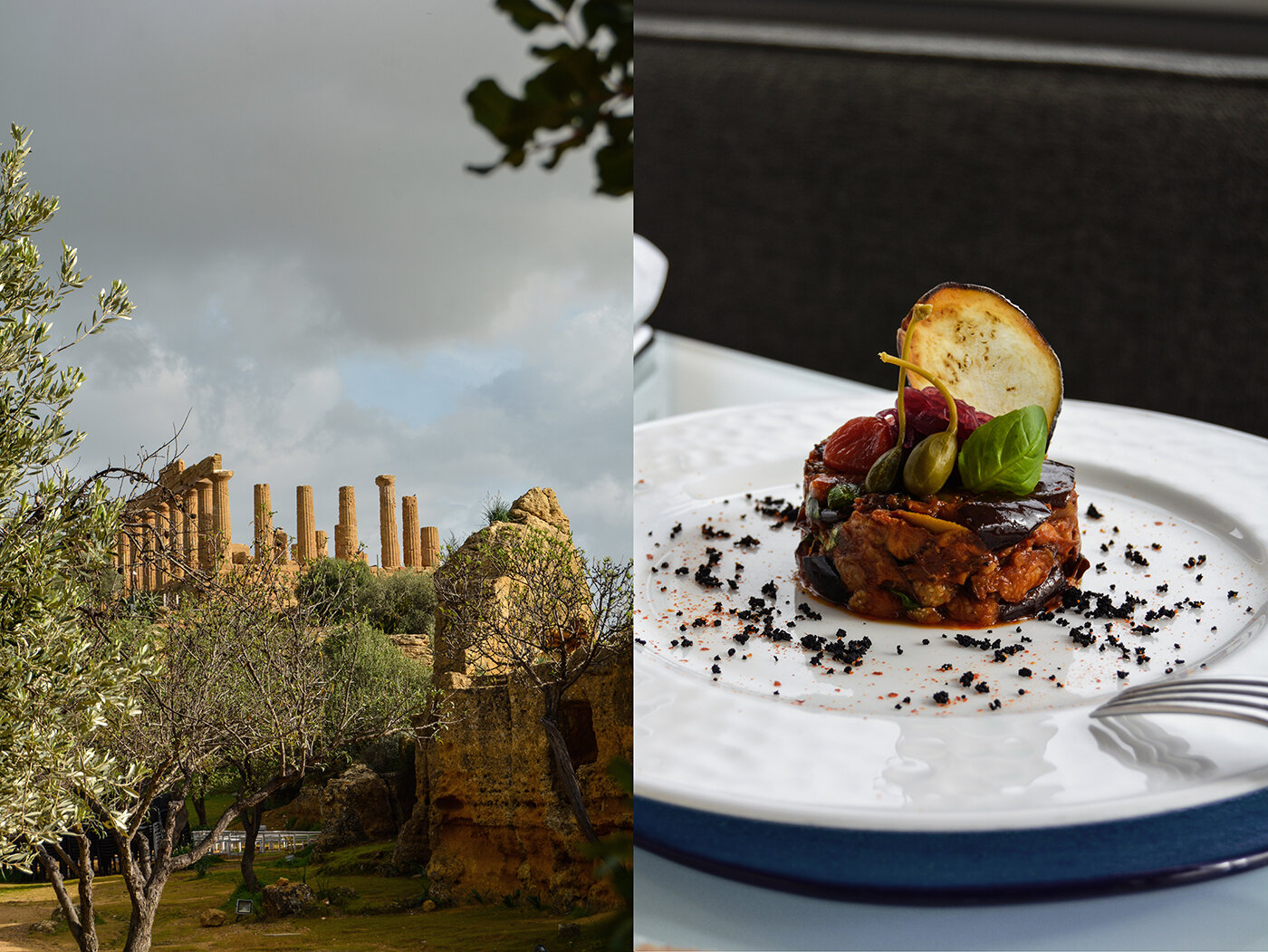
meet in your kitchen | The Temples of Agrigento and Sicilian Caponata

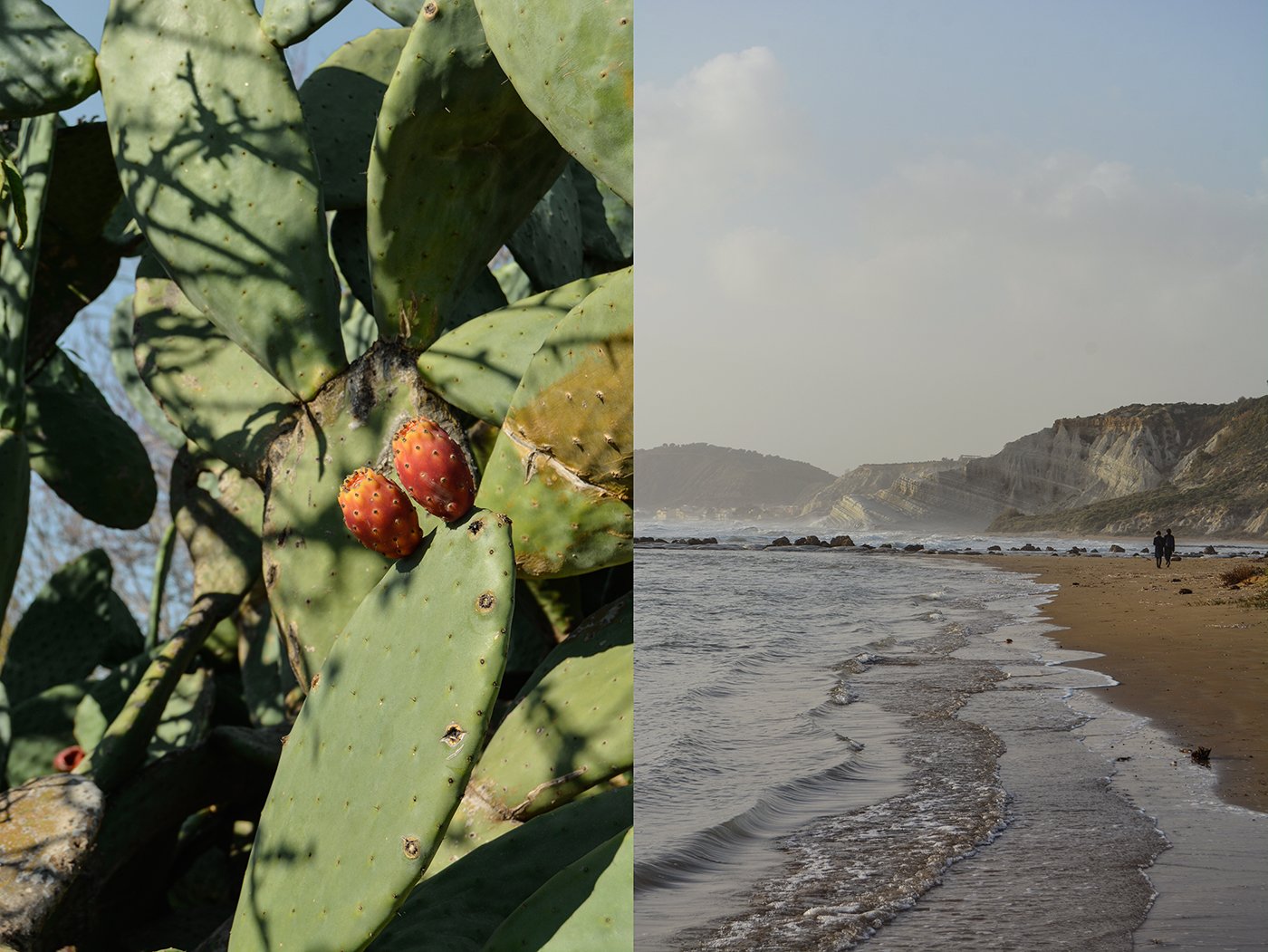
We went to Sicily and it was heavenly - as always in Sicily. But what makes this place so special? Is it the magical light, the outstanding food, the heart warming people? Was it the endless Scala dei Turchi beach, or the breathtaking temples of Juno and Concordia that happened to be right in front of our hotel room? Why did it feel like being close to the Gods when we stayed at the stunning Hotel Villa Athena in the lush, green valley of Agrigento?
Our hotel was luxurious and in a more than fortunate position. The old villa once owned by a noble principessa in the 18th century, is situated in the fascinating Archeological Park and Unesco World Heritage Vale dei Templi. Thanks to the efforts of archaeologist Domenico Antonio Lo Faso Pietrasanta, the Duke of Serradifalco, we can admire the stunning remains of Akragas, one of the most important Greek colonies in Sicily. Founded in 581 BC, this ancient city was spread over 1300 hectares laying graciously on top of two soft hills. Today many traces of its history and rich culture are still present, most spectacularly in the form of a group of temples dating back to the 5th century BC. Best preserved are the Temple of Concordia, the Doric style building is in a surprisingly good state thanks to its transformation into a Christian Basilica in the 6th century AC, and Juno. And this temple literally took my breath away. The Temple of Juno is magical, the atmosphere, the light, the setting, it's mesmerizing. I couldn't take my eyes off its sturdy columns, glowing golden in the afternoon sun. The light seemed unreal, dimmed and dramatic. You can see it in the first picture, it looks like a painting, but it's a photograph.

I came to Agrigento to cook together with Hotel Villa Athena's renowned chef Salvatore Gambuzzo. Thanks to his verve and dedication, the hotel's restaurant, La Terrazza Degli Dei, is mentioned in the Michelin guide and the first star doesn't seem too far away. Salvatore is deeply connected with Sicily and the region of Agrigento, he was born just a few hills away from his restaurant, in Porto Empedocle. He loves his island, he adores its original produce and culinary traditions. Salvatore is a true Sicilian at heart. Inspired by his nonno Giuseppe, a fisherman, and his mamma Giuseppina, he always felt passionate about his home island's food. Becoming a chef was a wise choice made at the young age of 14. Working in Piemonte and Monte Carlo, and then later, becoming the executive chef of the prestigious Belmond Villa Sant'Andrea in Taormina, made him gather fruitful experiences. But it also made him realize how close he feels to the soil where he was born, so he moved back and joined the team at Villa Athena.
Salvatore loves experimenting with new recipes, using the freshest fish from the sea right in front of his door step and the meat from the butchers who he's known for years. In the warmer months of the year he can pick the fruits and vegetables right from the villa's garden, he has absolute control over the produce and products that he uses in his kitchen. Local or regional, mainly organic, and in accordance with the island's inspiring culinary traditions. He feels the duty to protect his culture and pass it on to future generations. As the president of the Associazione Cuochi Agrigento he's an ambassador for his country's regional treasures. We need people like Salvatore to keep our traditions and food culture alive, all over the world.
The chef also has another, quite impressive passion: Savatore falls for food art and creates spectacular sculptures made of potatoes (and other food) preserved with salt and turned into rock-hard everlasting pieces of art. It's unbelievable, he manages to make potatoes look like marble! With pride in his voice, he told me that he brought home eight gold medals from world wide competitions. The preparation takes weeks, but when you hear him talk about it - especially in Italian - it sounds like he's talking about a woman.
It was relatively warm and the Sicilian sun was still strong during our stay just a few days before Christmas. The branches of the citrus trees in the beautiful gardens were lusciously filled with plump lemons, tangerines, oranges, and grapefruit. And as Salvatore showed me his own 'little' garden, I couldn't help but feel envious. Bushes of mint, rosemary, green and violet sage, marjoram, oregano, various kinds of thyme (including thymo alpino), borage, sorrel, basil - it's an orchestra of flavours, always at hand to refine (almost) every creation that leaves his kitchen.

We enjoyed three dinners and two lunches prepared by Salvatore and his team, all of which were rich in aromas and creative in style, never forced or pretentious, and most importantly always heavenly delicious. The chef shows great respect for nature's creations in his recipes, he works with nature's gifts, but never tries to distract from their original taste and quality. The first dish on my plate was Sicilian Caponata, one of the best I have ever had the pleasure to dig my fork into. It was fruity, sweet, and juicy, so thick and chunky that it stood on the plate like a dome. Caponata is a Mediterranean classic, zucchini, eggplant, and pepper, tomatoes and vinegar, it's a simple dish, but this one was so good that I asked Salvatore to share the recipe with me so that I could share it with you. The addition of celery is great and the topping of sugary-sweet dehydrated date tomatoes makes it irresistible. My humble chef was so kind to also share the trick that turns the tomatoes into little addictive bites (see the recipes below).
To give you a little idea of our unashamed feasting, these are some of the dishes we had on our plates:
Insalata di Mare (so simple, divine, I had to eat it twice!), Herb Risotto with Prawns, Spaghetti in Salsa di Cozze e Vongole, Sicilian Cannoli (of course), Mackerel with Citrus and Clams, Taglierini Pasta with Lobster, Belgian Endive and Sheep Ricotta, Spinach Dumplings with Rosemary Squid Ragout, Sicilian Stuffed Red Mullet, Bean Soup with Gragnano Pasta, Lamp Chops in Honey with Sweet and Sour Pumpkin, Sweet Variations of Prickly Pear, Swordfish alla Messinese, Panelle (golden fried Sicilian chickpea fritters)...
And the wine! I must say I'm quite lucky - most of the time - when it comes to picking local treasures from the wine menu, even without guidance. But this time I knew we were in good hands, sommelier and maître d' Salvatore Di Carlo took great care of us and introduced us to one of his favourites, the fantastic Planeta Chardonnay from the territory of Menfi close to Agrigento. We fell in love with this golden, lush wine, so much so that we had to order it again on our last night. And once in a while Salvatore Di Carlo would stop by at our table, just to smell the aroma, and he'd smile. Our red favourite was the dark Baglio del Cristo di Campobello Lusirà Syrah, also a precious local find.
I'm a huge fan of good bread, I call it my favourite food for a reason, so despite all the culinary highlights that caressed my taste buds, I'll never forget the bread served at the villa at lunch and dinner time. Still warm and cut into thick slices, generously sprinkled with the villa's own olive oil, accompanied by a glass of Prosecco and a good chat with our Salvatores - it couldn't get any better. The bread is made of the indigenous Russello durum wheat semolina. This Sicilian grain is dark, golden, and almost red in colour, like the soil around Agrigento. The baked loaf has a beautiful crust, a light crumb, and its nutritious value is much higher than that of wheat. For a sweeter version, we spread it - thicker than necessary - with the hotel's scrumptious pistachio paste, one bite and you'll never ask for chocolate spread at the breakfast table again. I want to work on a recipe to share with you, one of my 2017 kitchen projects.

We met so many lovely Salvatores at Villa Athena, which is not a surprise, as we learnt it's one of Sicily's favourite names. If you go there, it's most likely that this will be the first name you either hear or see engraved in the rocks on a beach (it happened to us). All our beloved Salvatores, be it the chef, the sommelier, or the kind and caring waiters, they were all the reason that we left the villa in sadness - we didn't want our paths to separate. We laughed so much together, they all did everything possible to make us feel fantastic. We can't thank you enough for giving us an insight into your culture and cuisine, for making this wonderful stay at your hotel unforgettable, and for spoiling us so much. Thank you Salavatore (s), Roberto, and Claudia!
Hotel Villa Athena is a member of the group of Small Luxury Hotels of the World, it's the right place to treat yourself under the Mediterranean sun for a couple nights. I find that the colder time of the year is best to enjoy the hotel's extravagant comfort and amenities, it's all quiet and peaceful in the low season. Even the Vale dei Templi was all for us, we were almost the only visitors, however, the hotel offers an exclusive entrance to the Archeological Park, which means you can skip the long line of tourists even in the summer months.


Salvatore Gambuzza's Sicilian Caponata
Serves 10
eggplants 10
vegetable oil, for cooking the eggplants
celery 800g / 1 3/4 pounds
olive oil
onion, cut in half and sliced, 1.1 kg / 2 1/2 pounds
green olives, pitted and chopped, 300g / 2/3 pounds
capers, rinsed and drained, 200g / 7 ounces
fresh tomato sauce 1.2kg / 2 2/3 pounds
tomato paste 200g / 7 ounces
salt and pepper
vinegar 200ml / 3/4 cup plus 2 tablespoons
granulated sugar 180g/ 3/4 cup plus 2 tablespoons
Rinse the eggplants and remove the stems and the ends. Peel the eggplants (optional), cut off the skin as thinly as possible. Cut the eggplants into large cubes and cook them in a generous amount of hot vegetable oil until golden and soft. Transfer to kitchen paper to remove excess oil and set aside.
Trim the celery and remove all the leaves and discard them. Cut the celery into small pieces and blanch in salted water until tender.
Heat a generous amount of olive oil in a large, heavy pan and cook the onions until golden and soft. Add the celery, olives, and capers, cook for a few minutes, then add the tomato sauce. Season with salt and pepper and cook over medium heat. When it's all soft and thick, add the eggplant to the sauce and simmer until soft and mushy.
In a medium saucepan, add the sugar and vinegar and let the sugar dissolve over medium heat, then pour the vinegar over the caponata. Let it simmer until the mixture is thick.
This dish is best eaten cold, topped with candied cherry tomatoes:
Candied Cherry Tomates
(for the topping)
cherry tomates 20
fresh marjoram 5g / 1/4 ounce
fresh thyme 5g / 1/4 ounce
fresh oregano 5g / 1/4 ounce
icing sugar 200g / 2 cups
Preheat the oven to 100°C / 200°F.
Fill a large bowl with cold water and a handful of ice cubes.
In a saucepan, bring water to the boil, add the tomatoes, and immediately transfer them to the bowl with the ice water. Using your fingers, remove the skin, then cut the tops off and discard.
Spread the tomatoes and the remaining ingredients in a large baking dish, mix well, and dehydrate in the oven for 2 hours until the tomatoes are soft and a little shriveled.
Once cool, keep the tomatoes in a jar filled to the top with olive oil.




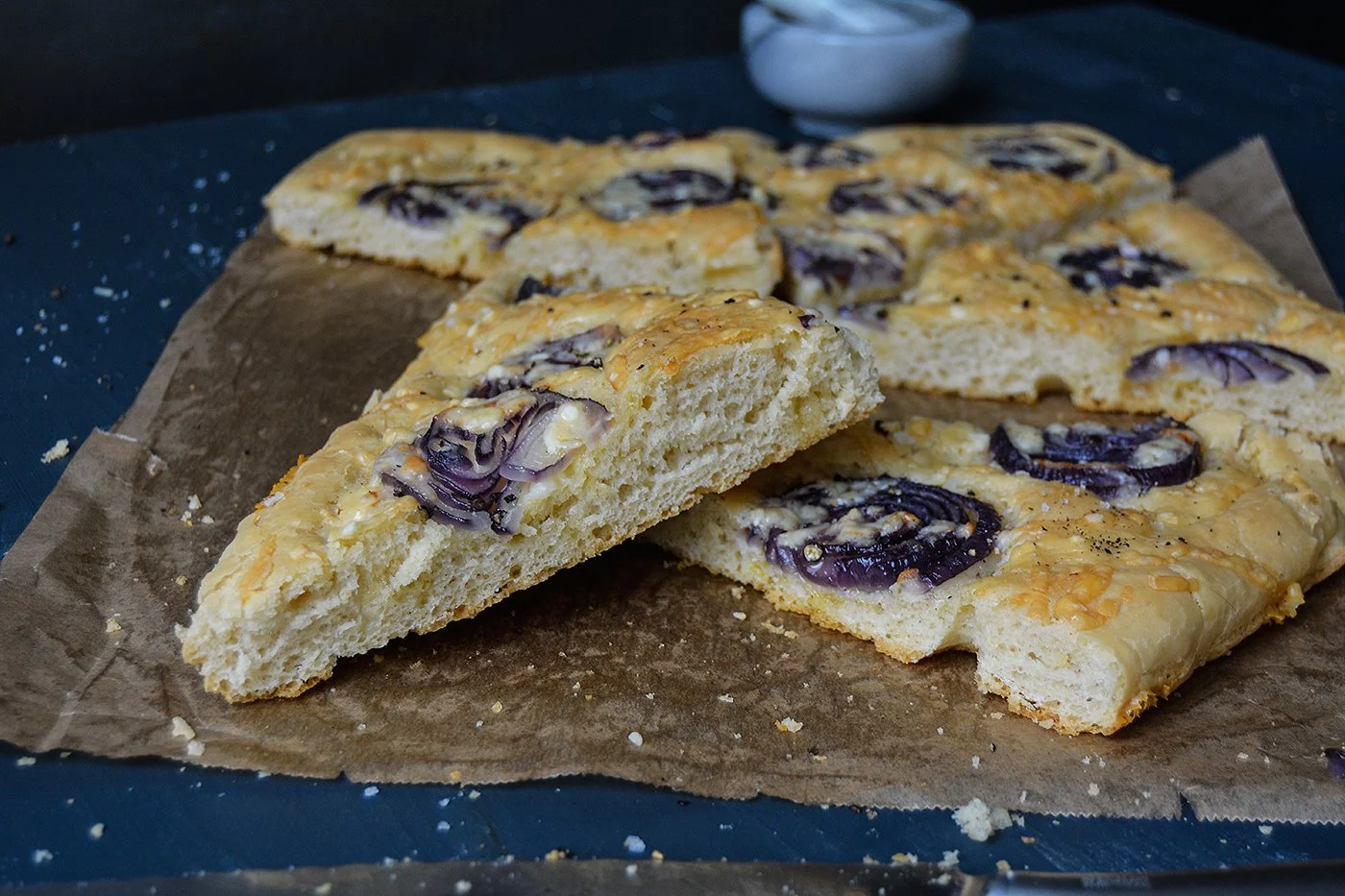
Gruyère and Red Onion Focaccia

We spent our Christmas in the Mediterranean, a premier for me, we normally stay in the cold North. I decorate our tree and the rest of the apartment according to my annual passion for wintery kitsch, and I eat duck, German potato dumplings, and usually (always) too many cookies. 2016 was different, we decided to go to Sicily first and spend a few relaxing days in the heart of the Archaeological Park of Agrigento (I'll share my impressions with you next week). Malta was next on our itinerary, and with it came along lots of sunshine, rough seas, long walks in the countryside, and my wonderful, crazy Maltese family. It was loud and silly, we ate and drank too much wine in front of my Maltese Mama's gorgeous crib in Msida, and I was happy.
I learned that a proper crib is an important part of the Maltese celebration, and I'm talking about cribs of rather large dimensions, well equipped with colourful figures, various animals, a real stable setting made of rocks, and most importantly, an impressive light installation to represent the firmament. Every house leaves the main door open, so that passersby can peak through the glass door to admire the re-enacted scenes of Jesus' birth. I've seen impressive installations that leave no doubt that the Maltese take Christmas very seriously.
Being under the hot Mediterranean sun in the coldest season of the year has many advantages, my vitamin D resources are definitely recharged. Everything is fine as long as you stay outside the house, inside it's freezing cold. A country where the temperature barely drops below 16°C (60°F) doesn't really have to think about those few days of sharp chill. But a person who's used to central heating - me - has to get used to the fact that the bedroom (and the bathroom!) can actually feel much colder than the air outside. I coped and complained, but our sunny walks along the lush green Dingli cliffs definitely made up for it.
And I'll never forget our New Year's Eve in Gozo, we stayed at a beautiful farmhouse at the border of the village of Qala. We had a gorgeous room, with a large terrace and the most stunning views of the islands of Comino and Malta. We ordered 3 (!) pizzas from the local Maxokk bakery, bought a bottle of local red wine from my friends at Meridiana, and just sat on the sofa, amazed by the peace in front of our eyes.
I had never seen Malta like this, so green and in full bloom. My past travels covered everything from March to October, but I always avoided the winter months. I'd love to show you pictures, but I was on a mission, I didn't touch my camera, I stayed offline most of the time, and I slowed down my pace drastically. So there are no pictures, but lots of beautiful memories of time spent in nature, silent, without any disturbing technical devices.
However, when we came back to Berlin, I noticed a slight feeling of dissatisfaction, I missed my Christmas. To make up for my nostalgic longings, I decided to have a Christmas week in January. In the past few days, I baked Christmas cookies and my boyfriend had to listen to me singing along to Christmas carols. My celebrations found their festive peak in a Christmas dinner for two with slow roasted duck (I used the recipe from my book), red cabbage with spices and apples, and German potato dumplings. Now I'm cured and we can move on with our lives - also in the kitchen.
My latest post-Christmas kitchen project led to a hearty yet airy focaccia, topped with thickly sliced red onions roasted on top of the dough in lots of olive oil and a generous amount of aromatic Swiss Gruyère cheese. It's pure comfort food. I cut a thick slice off the warm bread and enjoyed it on a chair that I placed close to the heater. I doubt I ever appreciated central heating as much as I do now.
If you're looking for some more focaccia inspiration, take a look at these recipes:


Gruyère and Red Onion Focaccia
Makes a 25 x 32cm / 10 x 12 1/2″ focaccia
For the dough
plain flour 500g / 3 3/4 cups plus 2 tablespoons
fast-acting yeast 1 (7g / 1/4 ounce) envelope
fine sea salt 1 teaspoon
granulated sugar 1 heaping teaspoon
water, lukewarm, 260ml / 1 cup and 2 tablespoons
olive oil 120ml / 1/2 cup, plus 1-2 tablespoons to oil the baking sheet
For the topping
Swiss Gruyère cheese, or any aromatic hard cheese, coarsely grated, 100g / 7 ounces
red onions, thickly sliced, 2
flaky sea salt
black peppercorns, crushed in a mortar
For the dough, combine the flour, yeast, salt, and sugar in the bowl of a stand mixer fitted with the dough hook. Add the lukewarm water and half the olive oil (60ml / 1/4 cup) and knead on medium-high speed for a few minutes until well combined. I mix it on ‘4’ on my KitchenAid. If the dough is too sticky, add more flour. Transfer the dough to a table or countertop and continue kneading and punching it down with your hands for about 4 minutes or until you have a smooth and elastic ball of dough. Place the dough back in the mixer bowl, cover with a tea towel, and let rise in a warm place, or preferably in a 35°C / 100°F warm oven (conventional setting), for about 60 minutes or until doubled in size.
Oil a 25 x 32cm / 10 x 12 1/2″ baking sheet.
When the dough has doubled in size, punch it down, take it out of the bowl, and knead for 1 minute. Using your hands, stretch and spread the dough on the oiled baking sheet. Cover with a tea towel and let rise in a warm place for about 20 minutes or until puffy.
Preheat the oven to 220°C / 425°F (convection setting).
Using the round bottom of a wooden spoon or your finger, punch around 6 x 7 holes into the surface of the dough. Arrange the sliced onions on top of the dough, pushing the slices gently into the dough. Pour the remaining olive oil over the dough and onion and into the holes. Sprinkle with the cheese and a little flaky sea salt and bake for 20 minutes or until golden and light brown. Sprinkle with crushed pepper and enjoy warm or cold. The focaccia tastes best on the first day.


Tahini Date Cake with Whipped Cream

Welcome 2017! May you bring peace, love, and patience to our lives.
On one of the last days of 2016, we gathered a group of friends from Florence, Israel, and London around our long wooden dining table. To keep it cozy, I cooked Swabian Käsespätzle, the famous homemade egg noodles layered with lots and lots of cheese and soft, golden brown onions. This meal is so rich and comforting, it's perfect for a cold winter's night. I don't know a single person who doesn't find it addictive. Although it's a classic Southern German dish, I've heard quite a few Italians claiming that Italy is its true place of origin. However, my guests from Florence tried it for the first time and they were enraptured.
My guest from Israel inspired me to bake a cake with one of his home country's most popular products: tahini. I made a fruit cake, similar to an English teatime loaf, but I replaced the butter with tahini and olive oil. To say that it was good would be a total understatement. Light, with a soft hint of tahini, it was delicious, especially in combination with the chopped dates that I stirred into the dough and the sesame seeds sprinkled on top. I served this rustic looking beauty with lightly sweetened tahini whipped cream, we were all smitten.


Tahini Date Cake
Makes 1 cake
plain flour 260g / 2 cups
baking powder 1 tablespoon
freshly grated orange zest 1 tablespoon
ground cinnamon 1 teaspoon
fine sea salt 1/8 teaspoon
tahini, mixed well, 75ml / 1/3 cup
mild olive oil 75ml / 1/3 cup
whole milk 90ml / 1/3 cup plus 1 tablespoon
granulated sugar 200g / 1 cup
large organic eggs 4
pitted dates, roughly chopped, 100g / 3 1/2 ounces, plus a few chopped dates for serving
white sesame seeds 1 tablespoon, plus more for serving
For the tahini whipped cream
(the tahini whipped cream serves 4, you'll have to double the amount for the whole cake)
heavy cream 200ml / 3/4 cup plus 2 tablespoons
granulated sugar, to taste
tahini, mixed well, about 1 tablespoon
Preheat the oven to 180°C / 350°F (preferably convection setting) and butter a 20cm / 8″ springform pan.
In a large bowl, combine the flour, baking powder, orange zest, cinnamon, and salt.
In the bowl of a stand mixer, whisk together the tahini, olive oil, milk, sugar, and eggs for about 1 minute until well combined (I mix it on '4' on my KitchenAid). Stir in the flour mixture and continue mixing until no traces of flour are left. Stir in the dates and pour the dough into the prepared springform pan. Sprinkle with the sesame seeds and bake for about 45 minutes or until golden and spongy. Check with a skewer, it should come out almost clean. Let the cake cool for a few minutes and take it out of the pan.
Whip the cream with a little sugar until stiff, adjust sweetness to taste. Add the tahini and whip for a few seconds until well combined. To serve the cake, cut it into large pieces, add a generous dollop of the tahini whipped cream, and sprinkle with chopped dates and additional sesame seeds.
Wrapped in cling film, this cake stays moist for a couple days.


My Maltese Winter Sandwich: Pomegranate Chicken, Red Coleslaw & Bacon

We drove down the winding road to the Grand Harbour in Valletta and stopped our cars in front of an old garage. The wooden door must have seen many storms, the green paint faded and the hinges rusted, it's the salt in the air that takes over whatever it gets hold of. Our friends Michelle and Michelangelo came down to the harbour in the cutest Volkswagen beetle the world has ever seen - in baby blue (Michelangelo would correct me and say it's Diamond Blue). Built in 1968, the car only changed owner once, when our friends bought it in 2010 from an elderly lady from the village of Qormi. It was in mint condition despite its 110,000 original kilometres. The previous owner's name was Teresa and she became the eponym of our friend's little love bug, since then, the beetle is affectionately called Terez.
Terez - and her original 1300cc single port engine, a fact that Michelangelo points out with pride in his voice - has seen a lot since she found her new owner: four overland trips, the latest being our friend's honeymoon trip last summer. The three of them (including Terez) attended the Le Bug Show 2016 in Spa and crossed half of Europe to get there. Malta, Sicily, France, Switzerland, Belgium, and Germany added 5,400 kilometres to the tachometer and seemed to have made the bond between the car and its owners even stronger.
Every car needs a check up once in a while, especially when it's nearly 50 years old, and to make it a little more fun, I joined my friends and brought some food and my camera. While Michelangelo laid hands on the tires, I kept mine busy preparing sandwiches for all of us. It's the peak of winter, a time of year when I usually have to confront Berlin's seemingly endless, yawning grey sky for weeks and months, but here in Malta I'm spoilt with sunshine and vibrant colours. This inspired me to come up with a snack as fresh and bright as the Mediterranean world around me. It's a chicken sandwich, the meat tender and thinly sliced, with purple coleslaw and orange wedges, sparkling pomegranate seeds (some of which I turned into a sticky syrup), crunchy bacon bites, and pungent green onions. The composition is rather difficult to eat, but trust me, the pleasure that you'll feel when you taste it, is absolutely worth it. And the solution is simple, just squeeze it until the sticky juices run out of the sandwich and soak the soft bread - it's a heavenly mess.
Thank you Michelle, Michelangelo, and Terez for a wonderful morning in Valletta!
For more delicious recipes and kitchen inspiration, visit Volkswagen's Pinterest community board Food Bloggers for Volkswagen.


My Maltese Winter Sandwich: Pomegranate Chicken, Red Coleslaw, Orange and Bacon
Makes 6 sandwiches
For the coleslaw
cored red cabbage, cut into thin strips, about 230g / 1/2 pound
fine sea salt
yoghurt 5-6 tablespoons
freshly squeezed orange juice
ground pepper
For the pomegranate syrup
pomegranate juice 180ml / 3/4 cup
granulated sugar 4 1/2 tablespoons
For the sandwich
olive oil
chicken breast 400g / 14 ounces
fine sea salt
ground pepper
bacon 6 slices
lettuce leaves 6
white buns (or ciabatta cut into buns), cut in half, 6
oranges, peeled and cut into filets, 1-2
the seeds of 1 pomegranate
green onions, the green part cut into thin slices, 1
freshly grated orange zest, about 1 tablespoon
For the coleslaw, in a large bowl, mix the cabbage and 1/2 teaspoon of salt and, using your fingers, rub the salt into the cabbage. Let it sit for about 15-20 minutes. Add the yoghurt and orange juice, mix well, and season with salt and pepper to taste.
Preheat the oven to 200°C / 400°F.
For the pomegranate syrup, in a saucepan, bring the pomegranate juice and the sugar to the boil and cook over medium-high heat (it should bubble) for about 7 minutes or until it starts to thicken. Set the syrup aside.
In a heavy pan, heat a splash of olive oil over high heat and cook the chicken breast for a couple minutes on each side until golden, you might have to reduce the heat to medium-high. Season with salt and pepper to taste and transfer the chicken to a baking dish. Roast in the oven for about 8 minutes or until the chicken is cooked through. Check with a skewer, only clear juices should come out. Let the chicken rest in aluminium foil for about 5 minutes. Cut the chicken into slices (about 18 slices for 6 sandwiches).
In a large heavy pan, heat a splash of olive oil and cook the bacon for a few minutes on both sides until golden brown and crisp. Transfer to paper towels, let it cool for a few minutes, then break the bacon into pieces.
Divide the lettuce leaves between the bottoms of the buns and arrange the chicken on top, drizzle with a little of the pomegranate syrup. Spread a heaping tablespoon of coleslaw, 2-3 orange filets, and some pomegranate seeds on top of the chicken. Sprinkle with the sliced green onion, bacon bites, and orange zest, and drizzle with additional pomegranate syrup. Close the bun, squeeze, and enjoy!


Spaghetti with Lemon Pistachio Pesto and Mozzarella di Bufala
I love to end the year with a plate full of spaghetti. It gives me the kind of comfort that pasta masters to perfection. Its beauty and magic lies in simplicity - and in many happy carbs. This year's combination is tangy, a bit creamy, and nutty - it makes me feel good and that's all I need. So here's my Mediterranean creation to celebrate the changeover from 2016 to 2017: spaghetti with lemon pistachio pesto and mozzarella di Bufala.
In the past 12 months of this turbulent year I felt my limits quite often and I flew higher than I thought I could ever fly without burning my wings. I saw my first cookbook being born, being celebrated during my book tour in Berlin, London, Malta, New York, and Washington. I saw the Eat In My Kitchen book reaching the New York Times' list of 'The Best Cookbooks of Fall 2016', which I still can't really believe. So much love and support came into my life, so much happiness has been spread through this book that feels like a baby to me. There were unbelievable highs, so many wonderful moments, moments that I will feel thankful for for the rest of my life. But there were also lows and losses that tore trenches into my heart that will hurt for the rest of my life. I lost a person who's been so close to me that I sometimes can't even say who's me and who's him. He was my mentor, my supporter, my biggest critic, my challenger. He was my friend, my most beloved Swabian, and my step father. I wouldn't be who I am without him, and I'll never again be who I was before he left this world. Eat In My Kitchen wouldn't be what it is without him.
I want to thank all of you for supporting me and my book, for being there and for coming back to these pages here on the blog. Eat In My Kitchen makes me grow every day, this blog makes me go back to my kitchen and experiment more than I would do if I didn't write about it. Thank you for being on this journey together with me.
Have a peaceful and joyful start to the New Year!
Meike

Spaghetti with Lemon Pistachio Pesto and Mozzarella di Bufala
Serves 2
For the spaghetti
dried spaghetti 200g / 7 ounces
olive oil
mozzarella di Bufala, torn into bite sized pieces, 125g / 4 1/2 ounces
flaky sea salt
black peppercorns, crushed in a mortar
For the pesto
freshly grated lemon zest 4 tablespoons, plus more for the topping
freshly grated young Parmesan 4 tablespoons, plus more for the topping
finely chopped shelled pistachios (unsalted) about 1 tablespoon, plus more (roughly chopped) for the topping
olive oil 3 tablespoons
fine sea salt
In a large pot filled with salted water, cook the pasta until al dente. Drain and stir in a little splash of olive oil.
For the pesto, in a medium bowl, whisk together the lemon zest, Parmesan, pistachios, and olive oil and use the back of a spoon to press the Parmesan into the oil until well combined. Season to taste with salt.
Divide the spaghetti and mozzarella di Bufala between plates. Sprinkle with pesto, additional lemon zest, Parmesan, and pistachios. Season to taste with flaky sea salt and crushed peppercorns, serve immediately.


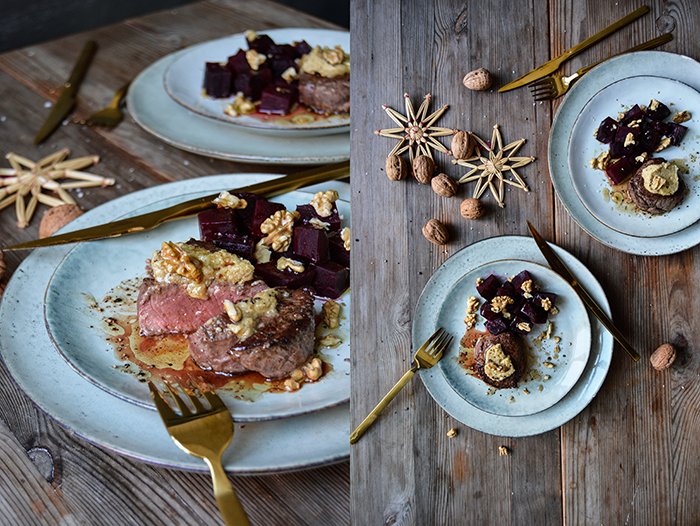
Fillet of Beef, Walnut Butter and Beetroot and scrumptious menus for Christmas
There are many ways to celebrate the holidays and a lavish feast is my way of creating a festive culinary frame when the Christmas bells start ringing. To fill the bowls and platters with roast and gravy, stuffed duck or goose, dumplings and various cabbage dishes may take some time, but these hours spent in the kitchen are so precious to me, that I gladly dedicate a few days to the preparation of some of the most unforgettable meals of the year.
But I'm honest, this year is different, this year used up my batteries. As much as I enjoy every second of shopping for the ingredients for any meal, cooking, baking, and waiting for my creations to be done, I know when I have to slow down. Even if it's Christmas. A meal isn't special just because of the money that's spent on it, or the time put into its preparation. A meal is special when it sparks a firework in the mouth; when we enjoy smelling it, looking at it, and tasting it so much, that we almost feel like children again. Memories and traditions turn a meal into something greater that sets it apart from our everyday foods. The cookies baked on December's snowy weekends using trusted family recipes are different to the sweets that we stir up during the rest of the year. The beloved duck served on Christmas Eve tastes better when the room is lit up with countless candles and the smell of fir is heavily hanging in the air. I love my traditions and I hold them dearly, but Christmas 2016 calls for a break: lots of time for myself and my loved ones, no plans, no duties, just the pleasure of a little laziness at the end of the year. Cooking is fun and it should always reflect the mood that we're in, and now, I'm going to be as slow as a sloth.
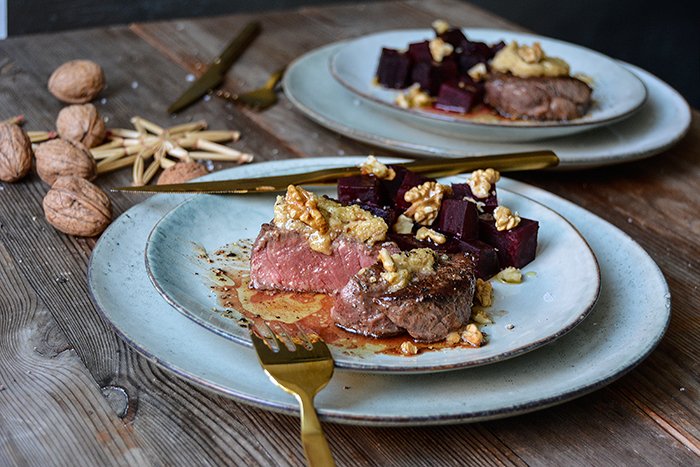
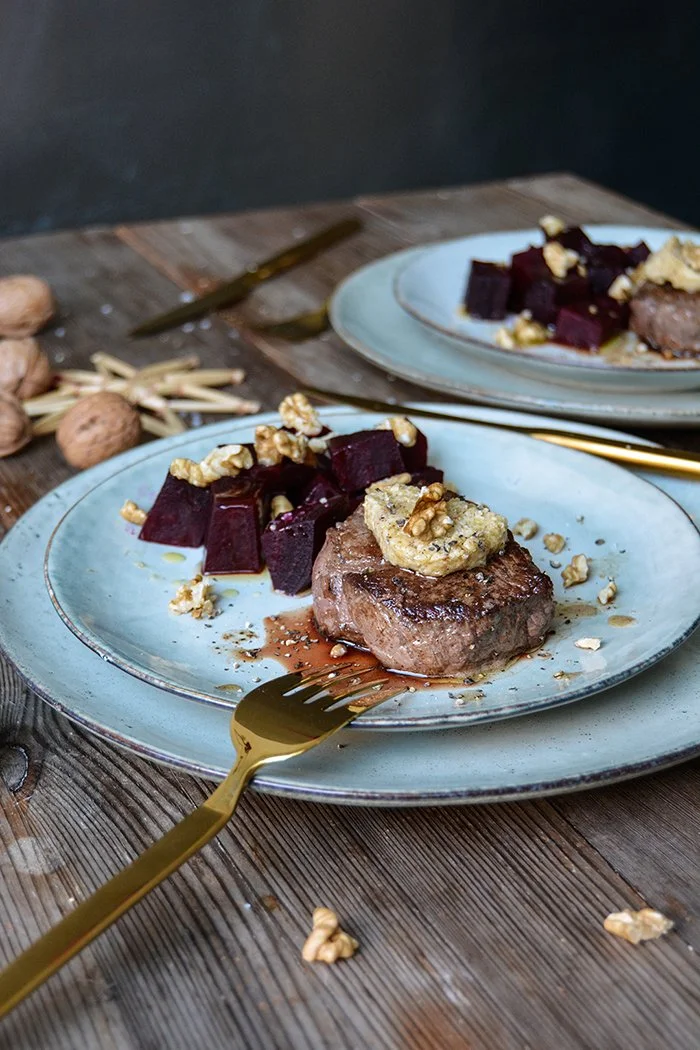
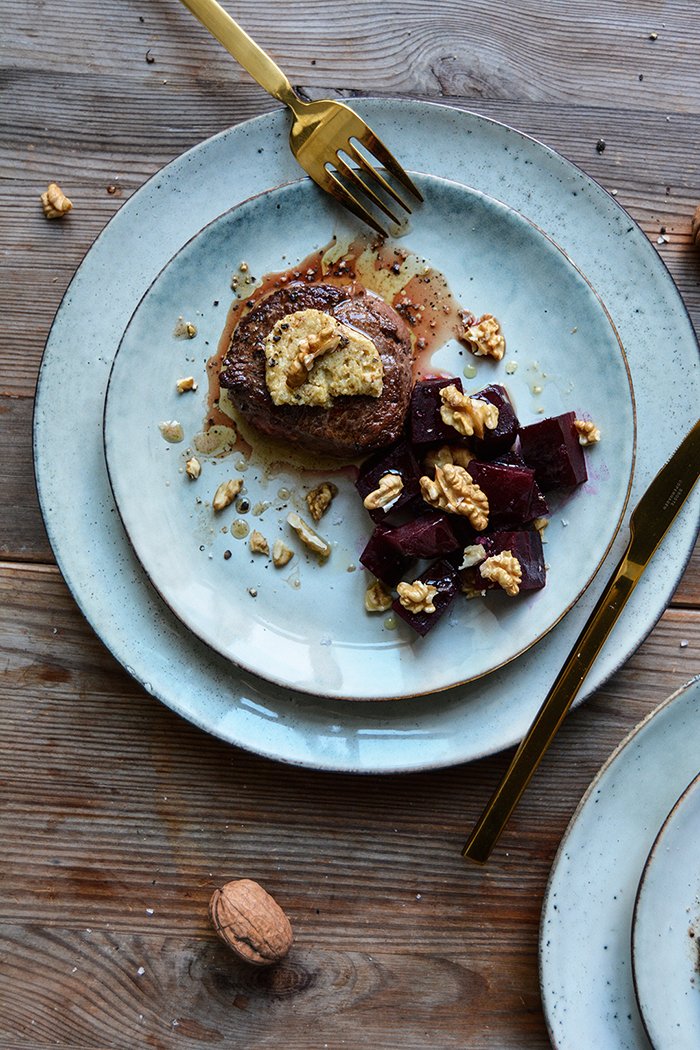
Last week, I kind of unfurled my Christmas menu from the end, starting with the dessert as I shared my Crème Brûlée Tangerine Cheesecake in a Jar. It's a dish that can easily be prepared a day or two in advance, meaning more time on the sofa, unwrapping presents, eating cookies, and listening to Christmas carols. My main dish doesn't need elaborate preparations either, it's a rather minimal composition of honest, pure flavours. The most tender fillet of beef topped with a slice of walnut mustard butter, served along with sweet and earthy beetroot cubes. The red root is cooked al dente, drizzled with olive oil, and sprinkled with Mr. Cini's flaky sea salt from Gozo. Sometimes, simplicity tastes best.
To finish my Christmas menu, I should share a starter with you next week, but I will allow myself to take a few days off and stay offline. As I don't want to leave you and your guests hungry, I have a few recipe suggestions for you from the blog and from my cookbook, not just for starters.
I wish you a peaceful Christmas! Enjoy this precious time with the ones you love!
Meike xx
Here's some more inspiration for your Christmas menu:
Starter
Parsnip and Sweet Potato Soup with Caramelized Plums and Whipped Gorgonzola Mascarpone (Eat In My Kitchen book, page 75)
Chickpea Potato Soup with Rucola Pesto, Lemon and Fried Chickpeas
Artichoke Ricotta and Orange Ravioli (this dish is time consuming, but can be prepared in advance and then frozen)
Main dish
Slow Roasted Duck with Ginger, Honey and Orange (Eat In My Kitchen book, page 171)
Beef Shank and Caponata Stew (Eat In My Kitchen book, page 169)
Salt Baked Salmon Fillet with Dill, Black Pepper and Juniper
Duck Confit with Roast Potatoes, Chestnuts, Plums and Star Anise
Vegetarian main dish
Pumpkin Gnocchi with Roquefort Sauce (Eat In My Kitchen book, page 100)
Potato and Apple Stuffed Cabbage Rolls with Walnut Butter and Gruyère
Farfalle Pasta with Figs, Mozzarella di Bufala and Honey Butter
Dessert
Bittersweet Chocolate-Olive Oil Bundt Cake with Candied Orange Peel (Eat In My Kitchen book, page 221)
Marina’s Lemon Marmalade Ice Cream with Caramelized Pistachios

Fillet of Beef, Walnut Butter and Beetroot
Serves 4
fillets of beef, trimmed, 4 (each about 140g / 5 ounces and 4-5cm /1 1/2-2" thick)
olive oil
unsalted butter 2 tablespoons
flaky sea salt
black peppercorns, crushed in a mortar
For the walnut butter
shelled walnuts 50g / 2 ounces
butter, at room temperature, 50g / 2 ounces
Dijon mustard, about 1 teaspoon
fine sea salt
For the beet
large beets with skin 2
bayleaves 2
flaky sea salt
olive oil
shelled walnuts, broken into pieces, a large handful
Take the meat out of the fridge, rinse and pat it dry, and let it come to room temperature.F
or the walnut butter, finely grind the walnuts in a blender or food processor, add the butter, mustard, and a little salt, and pulse until combined. Adjust the seasoning. Scrape the butter onto a piece of cling film, roll into a thick sausage shape, and keep in the fridge (or in the freezer for just a few minutes until hard).
For the beet, bring a large pot with salted water to the boil and add the bay leaves and beetroot. Close with a lid and let it simmer for about 50 minutes or until the roots are al dente or tender, depending on your preference. Rinse with cold water, peel, and cut into cubes.
In a large, heavy pan, heat a generous splash of olive oil over high heat and sear the fillets for 1 minute on each side. Take the pan off the heat, lower the heat to medium, and add the butter to the pan. Put the pan back on the heat and cook the fillets for about 1 1/2 minutes on each side (for 'medium rare'), spoon some of the butter over the meat a couple times. Season the fillets with flaky sea salt and crushed pepper, wrap in aluminium foil, and let them rest for 2 minutes. Set the pan with the juices aside.
Divide the beetroot cubes between the plates, drizzle with a little olive oil, and sprinkle with walnuts and flaky sea salt. Cut the walnut butter into thick slices. Transfer 1 fillet of beef to each plate and lay a slice of walnut butter on top. Drizzle with the juices from the pan used to cook the meat, serve immediately.
Merry Christmas!




21 recipes for Christmas Cookies
There are few things as relaxing as baking Christmas cookies during the busy days of December. Mixing and kneading pounds of dough while the air in the kitchen is soaked in fragrant sweetness is the best anti-stress remedy. Cinnamon, cloves, citrus fruits, and cardamom, chocolate, almonds and hazelnuts, you don't need many ingredients to give a cookie an extra christmassy touch.
We still have 10 days to go - for the German Christmas on the 24th December, and 11 days for the English and Maltese Christmas. So we have enough time to throw a few more trays of delicious cookies in the oven, to fill the jars, and make our hips happy. Here's some more inspiration from the last three years of Christmas cookie feasting on Eat In My Kitchen. Happy baking!
Click on the titles for the recipes:


Christmas Chocolate Panettone (let’s see it as a giant cookie)




Crème Brûlée Tangerine Cheesecake in a Jar for Christmas
Eat In My Kitchen turned 3! So much has happened around me in the past few weeks that I forgot my blog's birthday on the 23rd November.
I usually create a recipe for this special day - at least in the past 2 years - but now we're all so busy contemplating lunch and dinner menus for December's upcoming festivities, that I decided to skip the birthday bash and move straight on to Christmas. I came up with a dessert that's delicious, gorgeous, and practical in equal measure, a crème brûlée cheesecake in a jar. Its shiny golden prettiness is the perfect finish for a festive table. You can easily bake the cake a day in advance and keep it in the fridge. Sprinkled with sugar, it only needs a few seconds under the hot flame of a blow torch before you and your guests can indulge in the sweeter things in life.
My cheesecake base is made with oat cookies (you can find a recipe for oat cookies in my book on page 234), the filling is a mixture of rich mascarpone and cream cheese refined with tangerine, cinnamon, and vanilla. You could also bake one big cake in a 20cm / 8" springform pan, but it's so much more fun to present these beautiful little jars to your friends and family.
Before you jump to the recipe, I'd like to ask you for two favours:
Food52's cookbook competition, the famous Piglet Tournament, is now open. You can nominate your favourite cookbook and I'd be jumping with joy if you consider giving your vote to the Eat In My Kitchen book. 2016 has brought many wonderful cookbooks to the shelves, but luckily you can vote for more than one book. You can find the form to nominate here, the deadline is the 30th December.
And here's my second question:It would be fantastic if you could also drop a review for my book on Amazon, here are the links:
Thank you so much! Happy 3rd Advent!! xx

Crème Brûlée Tangerine Cheesecake
You'll need 10-12 maison glass jars or ramekins for this recipe.
Serves 10-12
For the base
oat cookies 210g / 7 1/2 ounces
unsalted butter, melted and cooled, 60 / 1/4 cup
For the filling
cream cheese, at room temperature 300g /11 ounces
mascarpone, at room temperature 250g / 9 ounces
granulated sugar 100g / 1/2 cup
vanilla pod, split and scraped, 1/2
large organic eggs 3
cornstarch 1 heaping teaspoon
freshly grated tangerine zest 1 tablespoon
freshly squeezed tangerine juice 3 tablespoons
ground cinnamon 1/4 teaspoon
fine sea salt 1/8 teaspoon
For the topping
granulated sugar
tangerine zest (optional)
For the base, crush the cookies in a food processor or blender until finely ground. Transfer to a large bowl, add the melted butter, and stir until well combined. Divide the cookie mixture between the glass jars or ramekins, using the bottom of a shot glass to press it firmly and evenly into the jars, especially along the edges. Freeze for 20 minutes.
Place a deep roasting pan, large enough to fit the glass jars comfortably, on the lowest rack of the oven. Preheat the oven to 160°C / 325°F. Fill a kettle with water and bring to the boil.
For the filling, in a large bowl, use an electric mixer to beat the cream cheese, mascarpone, sugar, vanilla seeds, eggs, cornstarch, tangerine zest, tangerine juice, cinnamon, and salt until well combined.
Pour the cheesecake batter on top of the chilled cookie base and transfer the jars to the roasting pan in the oven. Slowly pour the boiling water into the roasting pan until it comes about one third to half way up the sides of the jars. Bake for about 20 minutes or until the filling is just set but still slightly wobbly in the center. Turn off the oven, leave the oven door slightly open, and let the cheesecake cool for about 5 minutes, then take the cheesecake out of the oven and let cool to room temperature. Once cool, the cheesecake can be refrigerated for 2 to 3 days. Or, you can finish the crème brûlée topping right away for serving. (Don't refrigerate the cheesecake when it's still warm, or the base will turn soggy.)
For the topping, sprinkle a generous amount of sugar on top of the cheesecakes, about 1 teaspoon for each jar. Using a blow torch, burn the sugar until golden brown. Let it cool for a couple minutes until the burnt sugar is hard, sprinkle with tangerine zest, and serve immediately.


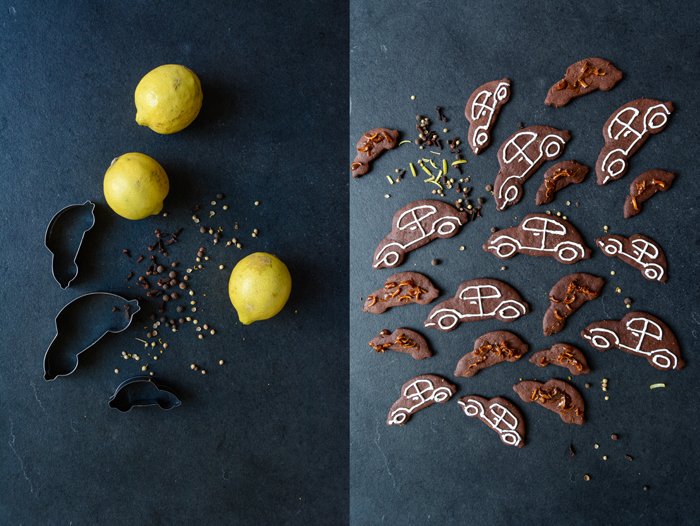
Chocolate Spice Christmas Cookies with Candied Lemon Peel
I used to have a huge spice box in my kitchen that didn't look very pretty and also wasn't particularly practical. For whatever reason, I decided in my early kitchen years to store all my spice filled glass jars and tiny metal tins in this box and that's where I kept them for two decades. This beaten and buckled box still exists, I just use it for potatoes at the moment (even a box has to stay flexible in life). I used to arrange my spices in two layers of jars, so when I needed juniper berries from the bottom, I would always have to empty the whole thing. Rather impractical.
Around two years ago, I renovated my kitchen, I changed the sink and cupboards on one side of the room. When everything was set up, I had a skype call with my Maltese mama Jenny to proudly present my work to her. Not that she's particularly experienced in kitchen renovation, it's rather the opposite, she still works in her gorgeous sea-blue kitchen gem from the 60s. I don't remember why, but we started discussing the spice-situation in my kitchen. There's a slim cupboard with two sliding drawers next to my sink, so when we had our video chat, we both looked at this drawer and decided that it should become my spice cupboard. I arranged everything that same day and since then I'm more than happy to have such a luxurious overview of my spice collection.
The spices I use the most, right at the front when you open the door, are Maltese fennel and coriander seeds, the whole range of peppercorns in black, green, white, and pink, cinnamon, and cardamom. Jars of cumin, cloves, aniseed, allspice, juniper berries, and mustard seeds are right behind. Then there's the hot section, with cayenne and urfa chilli, plus sumac and a few spice mixtures. I love this cupboard, it's a bit chaotic, and it's still a colourful collection of various jars and containers, but it smells beautiful.
Although I generally prefer a certain order in my kitchen, there are zones and tools in this room that seem to follow their own rules. Cookie cutters, for example, tend to end up in places where I don't even know how they got there. I bought a large metal ring at one point to get my growing collection under control. Every year I buy a couple new ones to add to the classics, to stars, angels, and Santa. I tend to have annual favourites. Squirrel, sausage dog, and deer were popular for a long time, which might speak for my love of cute animals. My collection of three beetles is relatively new, maybe I need a car? Who knows. But apart from giving my cookies a cute look, a cutter should be practical. For example, I barely use the deer anymore because the cookies tend to lose their antlers in the oven, so it looks rather sad. My beetles however are very cooperative, roundish, no narrow parts, and they are even big enough to get a proper royal icing decoration.
I must admit that decorating sweets is not one of my best talents. But I thought it would be nice to bake some cookies at this time of year that you can decorate - especially if there are kids around the baking table. And if you're as lazy as I am and you have a soft spot for citrus, I have a great alternative for you. Decorate half the batch of these delicious chocolate spice cookies with royal icing (I recommend you trust the pros and buy the mixture from a baking shop) and make your children happy. For the other half, caramelize lemon peel until sweet and crunchy, sprinkle this sticky golden mixture over the remaining cookies and make yourself happy. These are the adult cookies. They aren't as pretty as the cute hand decorated ones, but the combination of dark chocolate, cinnamon, cloves, coriander, aniseed, and candied lemon peel makes up for it. They taste so unbelievably good that you won't even mind the looks.
For more delicious recipes and kitchen inspiration, visit Volkswagen's Pinterest community board Food Bloggers for Volkswagen.


Chocolate Spice Christmas Cookies with Candied Lemon Peel
Makes about 50 cookies
For the cookies
plain flour 260g / 2 cups
unsweetened cocoa powder 50g / 1/2 cup
baking powder 1/4 teaspoon
freshly grated lemon zest 1 tablespoon (from 1 large lemon)
ground cinnamon, 1 teaspoon
cloves, ground in a mortar, 10 (about 1/2 teaspoon ground cloves)
coriander seeds, ground in a mortar, 2 teaspoons
aniseed, ground in a mortar, 1/2 teaspoon
allspice berries, ground in a mortar, 4
fine sea salt 1/8 teaspoon
butter, at room temperature, 130g / 1/2 cup plus 1 teaspoon
icing sugar 120g / 1 1/4 cups
organic egg 1
For the decoration
(if decorating half the cookies with royal icing and the other half with candied lemon peel)
royal icing mixture, whisked with a little water, about 60g / 2ounces
granulated sugar 50g / 1/4 cup
water 2 tablespoons
very thin strips of fresh lemon peel, 1 small handful
In a large bowl, combine flour, cocoa powder, baking powder, lemon zest, cinnamon, cloves, coriander, aniseed, allspice, and salt.
In the bowl of a stand mixer, fitted with the paddle attachment, beat the butter and icing sugar until fluffy. Add the egg and mix for about 1 minute or until well combined. Replace the paddle attachment with the dough hook, add the flour-spice mixture to the bowl with the butter, and mix until well combined. Form a thick disc, wrap in cling film and put in the freezer for about 20 minutes.
Preheat the oven to 160°C (325°F) and line 3 baking sheets with parchment paper.
In batches, roll the dough out thinly (about 3mm / 1/8" thick) between cling film and cut out cookies in whatever shape you like. Keep the remaining dough in the fridge while cutting the cookies. Arrange the cookies on the lined baking sheets and bake, one baking sheet at a time, for about 6 minutes or until golden. Let them cool for a few minutes before you transfer them to a cooling rack.
For the royal icing, whisk the royal icing mixture with a little water (following the instructions on the package) and, using a piping bag with the smallest attachment you can find, decorate half the cookies.
For the candied peel, in a small saucepan, bring the sugar and water to the boil. When it starts to caramelize add the lemon peel. Lower the heat to medium and cook for about 3 to 4 minutes or until the peel is golden and soft—mind that it doesn't burn. While the caramel is still liquid (you can leave the saucepan on lowest heat), quickly sprinkle the remaining cookies with the candied lemon peel.
Happy baking!


Persimmon Hazelnut Thumbprint Cookies

Around this time last year, I came up with a recipe that took my beloved persimmons and turned them into streusel bars - it was nothing less than divine. I'm a huge fan of this gorgeous fruit, especially when it's overly ripe, soft as jelly and honey-sweet. To use it in Christmas baking is tricky, as it can easily get lost under spices and butter, it needs a balanced composition that allows its fine fruitiness to shine.
When I last bought a bunch of persimmons from my local vegetable man, I could have just turned them into another batch of streusel bars. But I love creating new traditions and I decided to challenge myself to come up with a new persimmon Christmas cookie recipe every year. So in 2016, I'm celebrating my young tradition with a cookie classic, jam filled thumbprint cookies, called Husarenkrapfen in German. The buttery shortcrust is refined with hazelnuts, cinnamon, and vanilla - at least in my kitchen. The fruity filling in the middle is usually red, made of red currants or raspberries. But as I looked at the orange coloured fruits on my kitchen table, I decided to purée and cook the pulp of a persimmon with a generous amount of vanilla to enhance its flavour. It's an unfussy jam, a spoonful of honey, just a tablespoon of sugar, and 5 minutes on the heat. Perfect for my slightly nutty Husarenkrapfen.
Happy 2nd Advent!


Persimmon Hazelnut Thumbprint Cookies
You can either bake the cookies filled with the jam or bake the plain cookies first and drop a dollop of the jam into the holes once they are cool (which I prefer). It looks prettier and the taste of the fruit is more present.
Makes about 50 cookies
For the dough
plain flour 300g / 2 1/3 cups
ground hazelnuts 100g / 3/4 cup plus 2 tablespoons
baking powder 1/2 teaspoon
ground cinnamon 1/2 teaspoon
fine sea salt 1/8 teaspoon
butter, soft, 150g / 2/3 cup
granulated sugar 130g / 2/3 cup
vanilla bean, split and scraped, 1/2
organic eggs 2
For the jam filling
large ripe persimmon, peeled, 1 (250g / 9 ounces)
vanilla bean, split and scraped, 1/2
honey 1 teaspoon
granulated sugar 1 tablespoon
icing sugar, for dusting
For the dough, in a large bowl, combine the flour, hazelnuts, baking powder, cinnamon, and salt.
In the bowl of a stand mixer fitted with the paddle attachment, beat the butter, sugar, and vanilla seeds until creamy. Add the eggs, one at a time, and mix well in between. Add the flour mixture, change to the hook attachment, and mix until combined. The dough will be quite soft. Scrape onto a long layer of cling film, form a thick disc, wrap it, and put in the freezer for about 25 minutes.
Preheat the oven to 180°C / 350 (preferably convection setting). Line 2 baking sheets with parchment paper.
For the jam, purée the persimmon and vanilla seeds in a blender or food processor. Transfer to a small saucepan, stir in the honey and sugar, and bring to the boil. Cook over medium-high heat, it should be bubbling, stirring once in a while, for about 4 minutes or until it starts to thicken. Set aside and let the jam cool.
Cut off a slice off the dough, roll into a sausage shape, and cut off pieces, keep the remaining dough in the fridge. Using your hands, roll the pieces into 3cm / 1 1/4" balls. Press the end of a wooden spoon into the middle of each ball, pushing almost through to the bottom and leaving only a thin layer at the bottom of the cookie (otherwise the holes might close during baking). Transfer to the lined baking sheets and bake, one sheet after the other, for about 14 minutes or until golden. Let the cookies cool completely, then fill with the persimmon jam and dust with icing sugar.
If you want to store the cookies in a cookie box, I recommend adding the jam filling before serving. They become a bit softer after a day if they are filled and it's also easier to store them without the filling.


Artichoke, Ricotta and Orange Ravioli
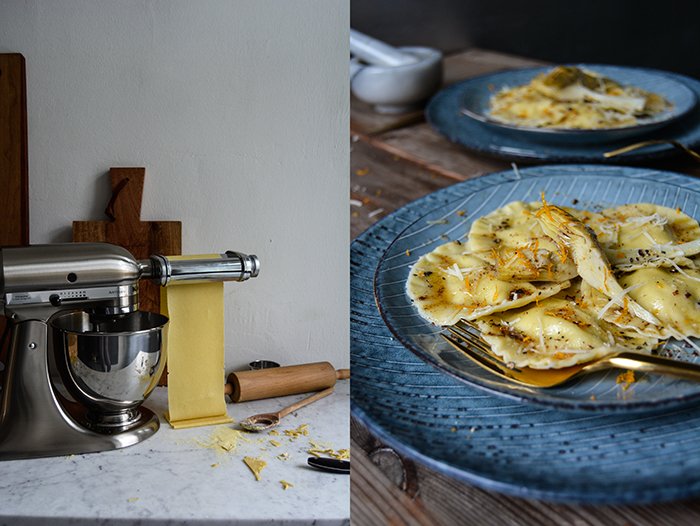
If you decide to make your own homemade pasta, be prepared that you'll never be able to eat store bought pasta again (you'll feel less satisfied with it at the very least) - and that you won't feel your arms and abs for a couple days. To knead the dough by hand is necessary and labor-intensive. I had moments when I felt slight doubts about whether the crumbly mixture in front of me would ever turn into a smooth ball, but it worked. I needed all my patience and muscle power to get there, but the result tasted so good that I'd do it all over again (after my muscles got some rest).
My pasta project started last Friday and ended on Saturday afternoon. I first tried a recipe by Sicilian chef Dario Cammarata who only uses plain flour, durum wheat semolina, salt, egg yolks, and olive oil. The result tasted amazing, but getting there was so much harder than what I remembered from when I visited the chef in his kitchen in Frankfurt earlier this year. What seemed so easy in Darios's hands, didn't want to work as smoothly in my own.
Dario taught me that ravioli are best when they are made with egg yolks and not whole eggs. I have no doubt that this is true, the texture is light and perfectly al dente. But to knead my own dough made of 10 egg yolks, flour, and semolina almost made me cry. The mixture was so hard and fragile, I needed an alternative that was less stressful. I still used my egg yolk dough to make a few ravioli, which were perfect, and I made tagliatelle. And these were the best tagliatelle of my life - taste, texture, and thickness were spot on!
Early the next morning I went back to my kitchen. More eggs in the bowl (this time including the egg whites), with a fresh and open mind and a quenchless appetite for fresh pasta, I felt optimistic. Kneading the dough still required some serious muscle power (maybe it's just me, my arms are not the strongest), but it was manageable. And this time I totally enjoyed pulling the thin layers of fresh pasta through my KitchenAid pasta attachment. I needed about two test sheets, but then I was in business. They were so thin that I could see my hand through them.
For my first homemade ravioli, I chose a filling that still allowed me to enjoy the fine taste of the egg pasta. After all this work it didn't feel right to knock it out. The combination of preserved artichokes and fresh ricotta refined with a little orange zest was just right, present, but not overpowering. I served it with melted butter and golden artichoke hearts, briefly seared in the sizzling fat. A little crushed pepper and some more orange zest, and my work was done.
My KitchenAid has three pasta attachments and I'm particularly fond of the tagliatelle cutter. Once I was done with the ravioli, all the shorter pieces and leftover dough went through this attachment and they were perfectly cut into the thinest, tastiest pasta. Cook it al dente and add a knob of butter, freshly grated aromatic hard cheese, and black pepper, and you'll have the best meal ever. Buon appetito!

Artichoke, Ricotta and Orange Ravioli
Homemade ravioli are time and labour-intensive. They are a great starter or main dish for a dinner party, but I recommend preparing them a day in advance to keep it stress free. Freeze them (uncooked) and cook them in boiling salted water just before serving for 4 minutes. I recommend using a pasta machine for this recipe.
Makes 20-24 ravioli / serves 2-4
For the pasta dough
plain flour 150g / 1 cup plus 2 tablespoons
durum wheat semolina 150g / 5 1/4 ounces
fine sea salt 1/4 teaspoon
large organic eggs 3 plus 1 egg yolk
olive oil 1 tablespoon plus 1 teaspoon
water, cold, 1 tablespoon
For the filling
preserved artichoke hearts, drained and squeezed, 160g / 6 ounces
fresh ricotta 125 g/ 4 1/2 ounces
olive oil 1 tablespoon
freshly grated Parmesan 25g / 1 ounce
a pinch of freshly grated orange zest
fine sea salt
ground pepper
For serving
butter 4 tablespoons
preserved artichoke hearts, drained and cut into 6 pieces each, 2
Parmesan
black peppercorns, crushed
a little orange zest
For the pasta dough, in the bowl of a stand mixer fitted with the dough attachment, combine the flour, semolina, and salt. Add the eggs, egg yolk, and olive oil and knead for about 5 minutes (I set it on '4' on my KitchenAid). If it's too dry, add 1 tablespoon of water, but not more. If it's too sticky, add a little semolina and flour. On the counter top or on a stable table, using your hands, continue kneading the dough for about 15 minutes until smooth. It will still be firm. I find it easiest to leave it in the shape of a thick disc for the first 5-7 minutes, punching and kneading it, and scraping the crumbs together. Then I knead it and roll it into a ball (see pictures below). Form a ball, wrap it in cling film, and let it rest in the fridge for 1 hour.
For the filling, purée the artichoke hearts, add to a bowl along with the ricotta, olive oil, Parmesan, orange zest, salt, and pepper. Whisk until smooth and adjust seasoning.
Divide the dough into 4-8 portions (depending on the width and power of your pasta machine). Roll out 1 portion with a rolling pin until it's thin enough to fit into your pasta machine. I started using position '1' on my pasta attachment, using the speed setting '2'. Pull the dough through the pasta machine twice, fold it in the middle, flatten it a little with the rolling pin if necessary, turn it 90°, and pull it through the pasta machine. Continue 2-3 times. Change to a thinner setting (I used '3') and pull the dough through the machine about 3 times, without folding it. Using a knife, straighten the sides of your pasta sheet and cut off excess dough. Continue using the thinner settings of your pasta machine until you can see your hand through the dough (I used '5' and then '6' at the end). If the dough is too sticky, use semolina, but no flour.
Sprinkle the rolled out pasta layer with semolina, fold it gently, and cover with cling film. Continue rolling the remaining dough.
Sprinkle a large baking sheet with semolina. Bring a large pot of generously salted water to the boil.
Lay out a layer of pasta and mark it with circles, using a 7cm / 3" round cutter (or whatever size and shape you prefer). Add a teaspoon of the filling in the middle of each marked circle. Dip your finger in water and wet the rim of the circles. From a second sheet of pasta, cut out circles of the same size, lay on top of the filling, and using your finger, push around the rim (see picture above). Using the cookie cutter, cut out the ravioli and press a little fork all around to seal the rim (see picture below). Transfer the ravioli to the prepared baking sheet.
In batches, cook the ravioli in the simmering water for about 2-3 minutes or until al dente.
To serve the ravioli, in a saucepan, heat the butter over high heat until golden brown, add the artichoke hearts, turn gently, and sauté for 1 minute.
Serve the ravioli sprinkled with the butter, Parmesan, orange zest (optional), and crushed pepper and lay the sautéed artichokes on top.