
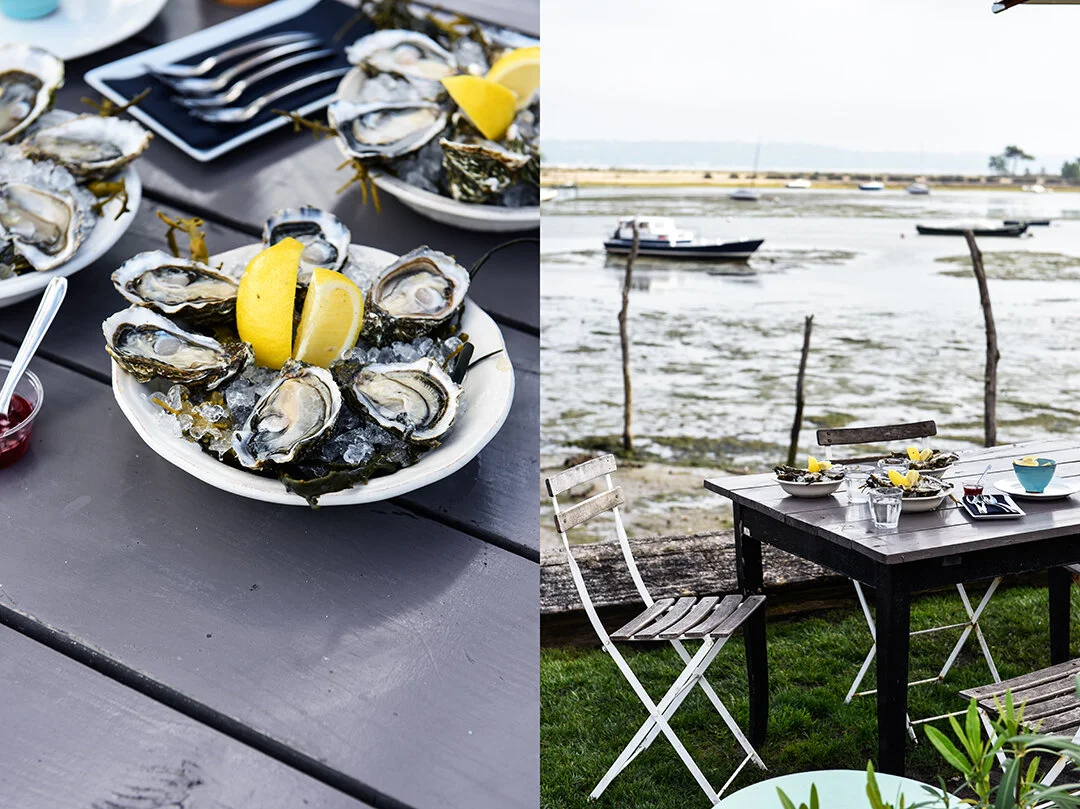
Meet In Your Kitchen | Chez Boulan's Oysters at Stunning Cap Ferret

Cap Ferret is a dream in pastel blue and pink. The beach seems endless, the sky sinking silently into the waves that hit the shore like a rock, angry thunderous foam vanishing meekly on the golden sand. It's a place you never want to leave again, just walk forever, barefoot and happy, and the sun in your face.
I came to this headland touching the Atlantic in the Aquitaine region in France to eat oysters. It was a simple mission, I expected good, pure and honest tasting oysters, fresh like a sip of the sea, but I wasn't prepared for so much beauty! In the summer months, the seaside villages turn into a crazy beehive, we skipped that and were welcomed by tranquil bliss. Two landscapes dominate the cap, the open sea and vast beaches on the west, and the lagoon on the east, the Bassin d'Arcachon changing its face constantly due to the tides. This is the lap where mother nature lets the best oysters in the world grow slowly over 4 to 5 years, nurtured and rinsed by clear French waters.
Alison and her husband Alex run Damien Boulan's wonderful Chez Boulan restaurant. It's a bit like a beach hut, built out of wood, the wind blowing the salty air through the open kitchen, the garden looks almost tropical. There's a wooden pier above the fading water that seems like the perfect place to sit and enjoy a plate full of fleshy oysters and a glass of white wine – if only I could sit there every day. Damian took over the family business from his father, he's passionate when it comes to oysters and spends most of his time taking care of them at the banks. They are like babies, you have to look after them. It's a lot of work that the whole cap seems to be dedicated to, with deep love for their work and the sea.
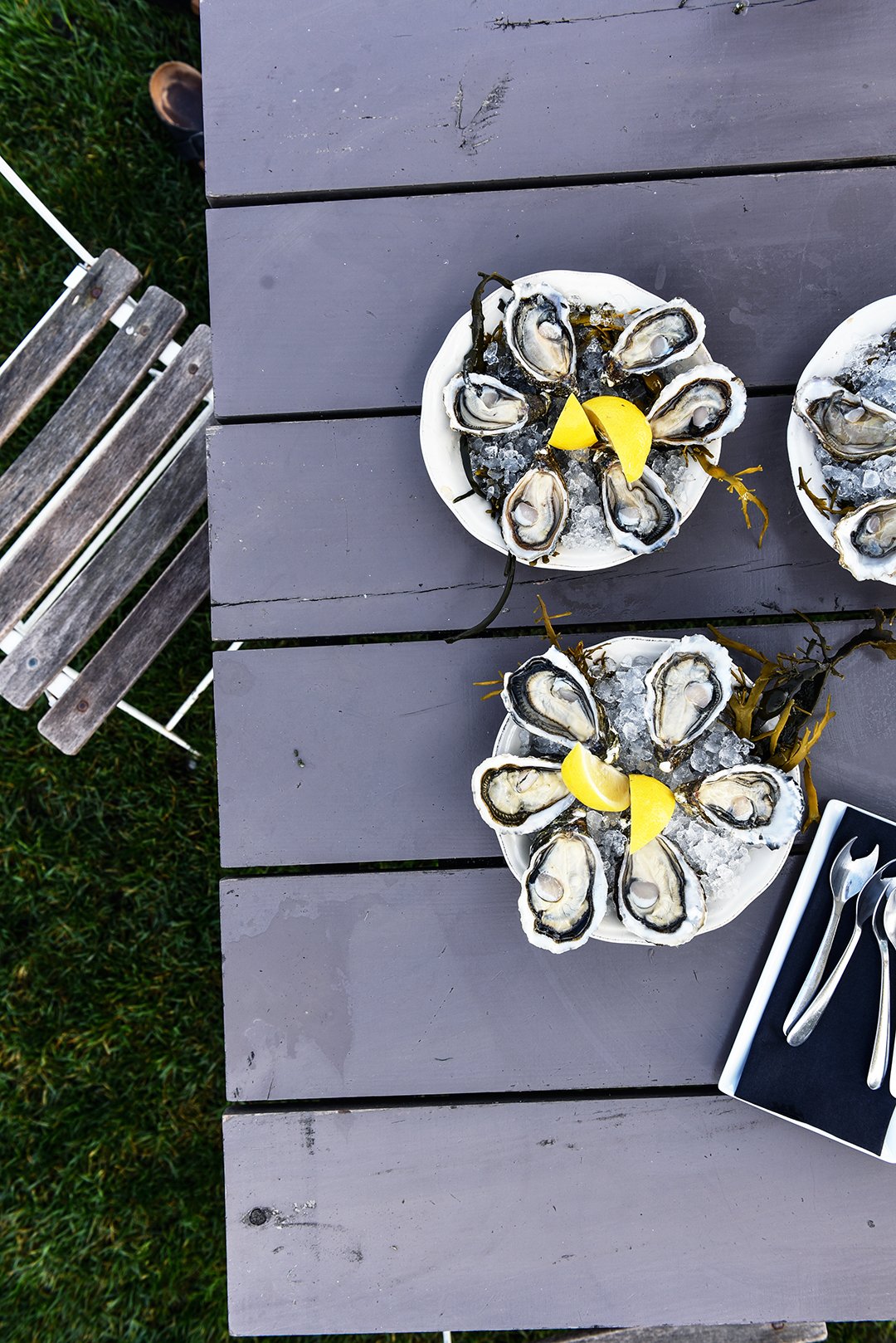
When Alison told me to pick oysters from the baskets at the entrance of the restaurant for my lunch, I felt like a kid in a candy store. Various shapes and colors, small and large shells, and they all smelled and looked so beautiful. I had an oyster tasting, which I highly recommend to get a feeling for the fine differences - there are no rules, you just follow your taste. The same counts for serving, some prefer this treat from the sea pure or with a squeeze of tangy lemon, or with sour mignonette, French shallot vinaigrette, just a few drops are enough. Alison added a new inspiration to the palate, freshly chopped mint leaves. Whatever you go for, just make sure that the oysters come straight from the sea, freshly cracked open in front of your eyes, like at Chez Boulan.
If you plan a trip to Cap Ferret, stay at the stunning La Maison du Bassin hotel. Each room looks like an old captain's cabin, the wood is dark and the view is breathtaking. And don't forget to book a table for dinner, the food and wine are divine. You might order too much wine and champagne from their fantastic menu, but don't worry, the hearty breakfast with eggs and croissant will make up for it.
In the next months, I’ll share many Meet In Your Kitchen features with you that took me to California, Italy, France, and Japan. Thanks to Zwilling for sponsoring these features for our culinary trip around the world!


Cap Ferret Oysters à la Chez Boulan
Serves 1
For the mignonette
60ml / ¼ cup red wine vinegar
1 teaspoon shallot, very finely chopped
Ground black pepper
For the oysters
6-12 fresh French oysters (preferably from Cap Ferret)
1 lemon
A few fresh mint leaves, finely chopped
For the mignonette, in a small bowl, mix together the vinegar and shallot and season to taste with a little pepper.
Arrange the oysters on a large plate and enjoy them pure, with a squeeze of lemon, a pinch of mint, or a drizzle of the mignonette – and a glass of chilled white wine!


How long has Damian Boulan been in charge of the family business?
For 10 years. He grew up here but after university, he went to Paris to be a journalist. He and his father used to speak about the idea to create a degustation – like this garden. This is the garden where we welcome our guests, but it used to be the garden of the Boulan family.
So, the family lives here?
Yes, the mother still lives on the other side of the cabin. They used to talk about the idea to create something like this. Unfortunately, Damian’s father died and Damian was told to come back to take over the business, to work with oysters, and to continue the family history. When he was told about this project of his father, he created it.
But first he didn’t want to become an oyster farmer?
No, but when you see him working with the oysters, you can see this is a real passion now. It’s his history.
Where are the oysters?
Most of our oysters are behind the Mimbeau – the Mimbeau is the sandbank that you can see – and they are just behind there. You cannot imagine it but behind there are a lot of banks and most of our oysters are there.
Is there a season for oysters?
We have a saying in France, that you eat oysters during the months with an "R". So, September, October, November, and so on. The idea that it’s “bad” to eat them in the summertime is because this is the period of the “milk”. That’s why. But you can eat oysters all year long.
What is the milk?
The milk is the way for the oysters to reproduce. During that period, you can see a bag of milk , but not like milk that you can drink. We call it milk because it’s creamy.
(Oysters are protandric and spawn in summer, they look swollen and milky. During their first year, they spawn as males by releasing sperm into the water. As they grow over the next two to three years, they spawn as females by releasing eggs.)
Someone told me that some people specifically like them during this time of the year.
Yes, yes. In summer, we tell people if the oysters are milky or not, because they are very surprised when they realise that this is the period, although it’s totally normal.
How do environmental changes affect the oysters?
I’m not a specialist but as we work very closely with the production, we know that the oysters need more time to grow because of climate change. They used to need 3 years to grow, but now it’s 3 to 4 years. It depends.
Because the water is warmer?
Yes, because of the water, and there is less food for the oysters.
Do you have a kitchen hack that you can share with us?
There are two ways to open an oyster. You have to choose the one you like, but the idea is to keep the oyster “safe” and whole. We (at Chez Boulan) open it from the base of the oyster. We put the knife in here just like this and then, we lift the knife up, and then we cut. The idea is that when you have the second part of the oyster, there is nothing on the second part.
Thank you, Alison!







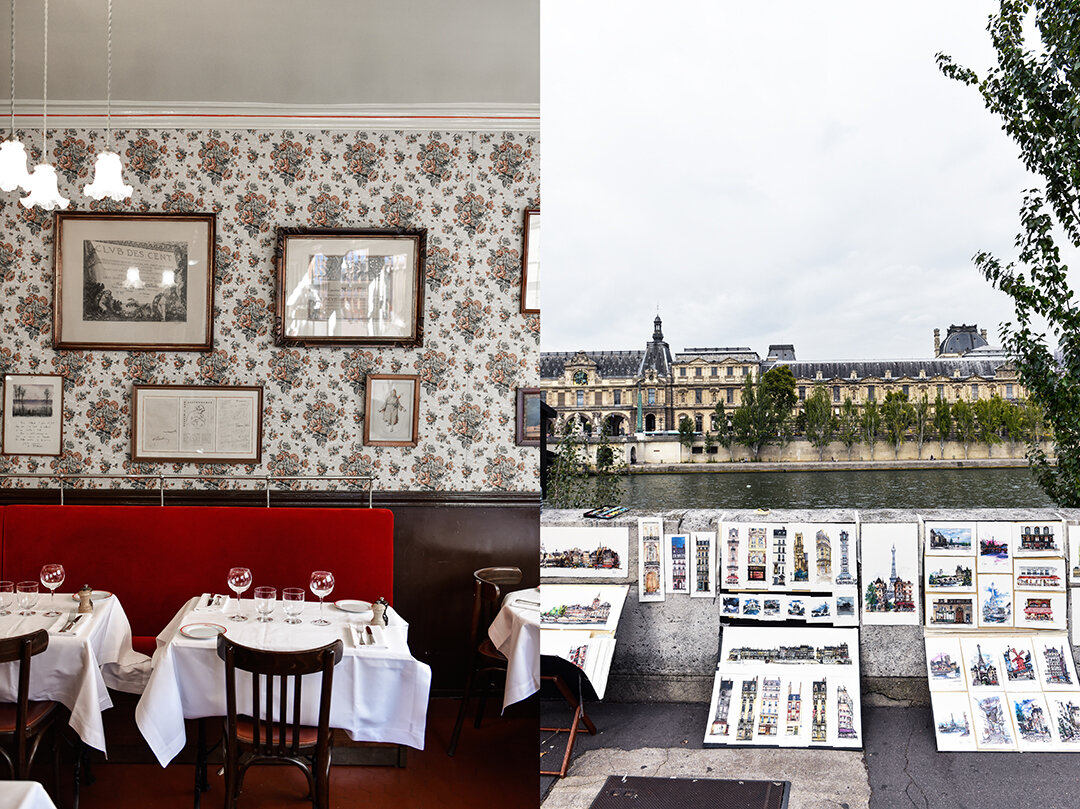
Meet In Your Kitchen | Paris and the Mystery of Chez Allard

In 1932, Madame Marthe Allard decided to open a restaurant in Paris, Chez Allard. It is the beginning of a story deeply woven into traditional French country cuisine, a story of resolute women who love to cook, who master French classics to perfection, and passionately share their creations on Rue Saint-André des Arts, in the heart of the lively St German-des-Prés, until today. You could call Chez Allard a gourmet bistro, cozily elegant, the flaming red benches and wooden chairs in front of floral wallpaper filled with happy guests for more than 80 years. The interior barely changed, and so did the dishes on the menu, there's still a strong focus on many of Madame Allard's original family recipes from Burgundy, passed from one woman to the next.
As soon as her son's wife, Fernande, joined the family, the chef didn't hesitate to introduce the young woman to all her kitchen secrets, and so the next generation was secured. Marthe Allard stayed in the small kitchen on Rue Saint-André des Arts all her life, for more than half a century, tweaking and refining her famous rustic staples, like Challans Duck with Olives or Sole Meunière.
After decades of female power at the cooker, there was finally a man in charge for 20 years, but when Alain Ducasse took over the restaurant, he knew he'd pass the reign to a woman again. Chez Allard has a female spirit, a female soul, Chez Allard is a woman. Since 2015, Fanny Herpin has been responsible for keeping the restaurant's tradition alive, the recipes that became "old culinary friends" to so many guests. The young and celebrated executive chef manages to incorporate this history and at the same time giving it validity 80 years after the first pages of Allard were written. Fanny is calm, quiet, but she's a woman you shouldn't underestimate. Her instructions are short and precise, she's charismatic. When you open the ornate glass door to the restaurant, you stand right in front of Chez Allard's heart, the kitchen. The room is open and there isn't much space to move, this kitchen has to work smoothly and there's no doubt that Fanny accomplishes this task with grandeur.
Fanny Herpin is from Bordeaux, like Alain Ducasse, they even learned at the same culinary school. Both of them feel the same strong connection to their home region's famous cuisine and products and have many of them freshly brought to the restaurant every day, like the fois gras on Allard's menu. When Fanny talks about food, or when she peels carrots with the precision of a scientist, you can feel her love, her passion, her obsession with quality. When she discovered the wonders of cooking and baking, she was hooked. Alan Ducasse was always her idol, she studied his recipes, she dove deeply into the magic that he's been creating for decades. So when he called her to ask if she'd like to fill the position at Chez Allard, she was just 26, she remembers, "It was a big day, I didn't believe it was possible. I asked are you sure, me?" She says that she's still a little bit nervous when he comes and visits her at the restaurant. There's a humble heart inside this strong, inspiring woman.
The dish that she cooked together with us felt like a bite of Paris, her Petits Rougets Barbets au Beurre Blanc (red mullet with a buttery, vinegary shallot sauce and sautéed root vegetables) was as pretty and perfect as the city that it was made in.
In the next months, I’ll share many Meet In Your Kitchen features with you that took me to California, Italy, France, and Japan. Thanks to Zwilling for sponsoring these features for our culinary trip around the world!

Petits Rougets au Beurre Blanc
(Red Mullet with Beurre Blanc and Glazed Roots)
By Chef Fanny Herpin – Chez Allard
Serves 4
For the Beurre Blanc
80g / 3 ounces shallots, finely chopped
150ml / 2/3 cup aged wine vinegar
50ml / ¼ cup dry white wine
3g mignonnette pepper (coarsely ground pepper)
400g / 14 ounces cold Echiré butter, cut into small pieces
Juice of ½ lemon
For the vegetables
4 navet turnips
4 large carrots
1 yellow turnip
¼ celeriac
1 green radish
4 red radishes
4 baby leeks
50ml / ¼ cup olive oil
Fleur de sel
Freshly ground pepper
1 garlic clove, with skin
1 sprig of thyme
500ml / 2 cups and 1 tablespoon chicken broth
30g / 2 tablespoons butter
For the fish
4 red mullet fillets, about 250g / 9 ounces each
Fleur de sel
Freshly ground pepper
Olive oil
For the Beurre Blanc, in a medium saucepan, bring the shallots, vinegar, wine, and mignonette pepper to a boil over medium heat. Reduce the sauce gently and gradually add the butter, stirring and whisking constantly to combine the sauce and the butter. If you add too much butter at once, the sauce won't bind. Adjust the seasoning and add a dash of lemon juice; set aside (at room temperature).
For the vegetables, peel the turnips, carrots, celeriac, and green radish. Cut the celeriac into diamond shapes, the green radish and turnips into "half moons". Scrape and rinse the red radishes.
Bring a medium pot of salted water to the boil. Rinse the leeks and blanch until soft. Transfer to a bowl filled with ice water, immerse quickly, and lay on paper towels. Cut the leeks into strips.
In a large heavy pan, heat the olive oil over medium heat and sauté the vegetables separately for about 1-2 minutes. Transfer all the vegetables to the pan and season with salt and pepper. Add the garlic, thyme, and broth, cover the pan, and cook until soft. Before serving, add the butter, stir to glaze the vegetables, and season with salt and pepper to taste.
For the fish, season the mullet fillets with salt and pepper on the meat side. Heat a splash of olive oil in a large heavy pan over medium-high heat and sear the fillets, skin side down, for 4 minutes or until the fish is done, the skin should be lightly crispy. Flip the mullets over, then transfer to a grid and set aside.
Arrange the mullet fillets, slightly overlapping each other, on one side of the plate, the vegetables on the other side, and a spoonful of the Beurre Blanc in the middle. Serve immediately.


Can you tell us a little bit about what you do and who you are?
My name is Fanny and I’m from Bordeaux. I’m 27 and I’m Head Chef at Allard, a restaurant from Alain Ducasse.
In which part of France did you grow up? Where did you spend your childhood?
In Bordeaux, in the southwest of France. I studied there and afterwards, I left to Paris.
Did the cuisine of Bordeaux influence you a lot?
Yes, yes, yes, of course! The food in Bordeaux is very important for me. There is the foie gras and the duck. My mother was always cooking at home with my family, so I have a big influence from there which is always there when I cook, both at home or in the restaurant.
Do you get products from Bordeaux for Chez Allard?
Yes, the foie gras, for example. I was at the same school as Alain Ducasse in Talence. We attended the same culinary school. So, I know that the products are also important for him.
How old were you when you started your career?
I started at 22.
Did you always know that you wanted to become a chef?
Yes, yes, because I like to eat! Since always! At home, I was always cooking but more sweets, like cakes and everything. I did culinary training when I was 22 – just one week! - and I was sure.
And that was the moment that you decided no more sweets, but cooking, more savoury cooking?
Yes, exactly.
Do you still do sweets sometimes?
Sometimes, but just at home. Because it’s very different: pastry and cooking. It’s two different jobs.
Why did you want to become a chef? Was it just because you loved to eat so much or did you meet other chefs that inspired you?
Yes! Alain Ducasse, of course! When I was at school and I was starting to learn, I read a book about Alain Ducasse – the big book with all the recipes – and I knew that he has a lot of restaurants in the world: the bistro and the 3 star Michelin restaurant. So, I asked to do a culinary training in his restaurant. I did it and after that I was sure that I wanted to become a chef. I really like to manage people. It’s like a family that works together. It’s a lot of work but it’s my passion. I love to do it! I want to do it for the rest of my life.
When you started, did you ever dream that one day you would be here? That you would be the chef at Allard?
Of course I did, but I was thinking maybe after I’m 30. But I became the chef here at 26. It was really fast!
How did you feel when he called you and asked you to become the Head Chef?
(Laughing) It was a big day! I didn’t believe it was possible. I was working in London and he asked me to come here to take the position. I said, “Are you sure? Me?” He said, “Yes, come!” So, I came here one weekend, I saw Alain Ducasse, and we talked about the position here and… let’s go! One month later, I was here and I started work. I have a lot of support because it’s a big company. I am not alone. I’m the head chef for this restaurant but I have other head chefs above me so I am never alone. I always have someone to help me, to support me, if I want it. For that, it’s super!
Does Alain Ducasse come here often to see if everything is going well?
Yes, of course. He comes sometimes to spend time with friends, but he comes for work, too.
Does it make you nervous when he's here?
A little bit, of course, but that’s normal. I’m always impressed by him when he’s here but it’s always a good moment.
Chez Allard has a very strong line of female chefs. It was founded by Madame Allard who passed the recipes on to her daughter-in-law who took over from her. There was a female chef before you and now you’re here. Do you think that this restaurant has a female spirit or a female soul? Is Allard a woman?
Yes, it’s tradition! Marthe Allard started to cook here. After her, it was Fernande. When Alain Ducasse took over the restaurant, he said, “I want to keep this tradition because it’s strong.” Laetitia Rouabah, the chef before me, worked here for three years before they asked me to take this position. It’s very important to keep the tradition. When people come here they say, “there have been female chefs here for a long time.” It’s very strong identity. For me, it’s also very important to keep that spirit.
Is there a difference between men and women running a restaurant in the kitchen? Does it feel different?
I don’t think so. It’s not about men and women. It’s just about the person and their personality. We’re all different.
There are a lot of traditional recipes on the menu that Madame Allard invented or came up with – so how much of Alain Ducasse is in the recipes here at Allard?
We keep and use all the recipes, but Alain Ducasse brings less sugar, less salt, and less fat to the recipes. That, for Alain, for all his restaurants, is the way to think and to work now.
How often do you change the menu?
I keep a menu throughout the year, but some dishes I change according to the season. For example, we have just started to introduce root vegetables and pigeon to the menu. In the summer, it was tomato salads and raw fish. We change the menu every two or three months, depending on the season.
Do you have a favourite season?
It’s now! (late summer) Yes. The pigeons, and all the different birds – it’s a very exciting time.
Do you love Paris?
Yes, of course (laughing)! I really like this city because there are a lot of different restaurants: bistros, Michelin restaurants, and also there are a lot of small restaurants with different food and cultures. So that’s interesting for me. And it’s a beautiful city. You can walk everywhere – it’s beautiful.
Do you go to restaurants a lot?
Yes, sometimes. I try to go once a week.
Can you go out and eat at a restaurant and just relax and enjoy it? Or do you analyse the food?
No, I’m always thinking but it’s less than before (laughing). Before, I was too hard!
What does healthy food mean for you?
Healthy food, for me, is when you use good products, produced in a way that respects the environment, and when it’s good for you, for the body, for your health. Voila!
What is your greatest kitchen hack?
Yes, actually I have something very important for me. It’s when you cook meat, you must let it rest. If you cook the meat for 10 minutes, then you let it rest for 10 minutes. This way, the meat is soft.
If you could choose one person to cook a meal for you, who and what would it be? Alain Ducasse?
(Laughing) No. It would Laurent Garnier because I’m a BIG fan. Maybe a dessert, like a chocolate cake, something easy and good.
If you’re going to have 10 friends over for a spontaneous dinner, and you don’t have much time to plan or go shopping, what will be on the table?
Foie gras toast! (Laughing) It’s easy!
Do you prefer to cook on your own or together with others when you’re at home?
Alone, I think, because I can do what I want. When there are a lot of people in the kitchen, it’s like my job here. I do that every day. I always have to check everything and to be everywhere. So, sometimes I really like to cook alone, just me in the kitchen, to relax, and to take the time to cook.
Do you prefer improvised or planned cooking? Again, at home in your own kitchen.
Planned. Always.
So even when you cook at home you always know exactly how you’re going to do it?
Of course! I always know what I want to do – I have everything in my head. Sometimes, at home, if I’m missing an ingredient, it’s ok. I can remove it. Here at the restaurant, it’s not possible, but at home, I can change it.
But there’s always a plan?Y
es. Always. I’ve always worked like that!
Thank you very much, Fanny!


Meet In Your Kitchen | Cécile Molinié's Life and Cooking in Paris

You only need to walk along the Boulevard Saint-Germain on a sunny afternoon to understand Paris. You'll promise yourself that you'll come back - for the rest of your life. Once you've seen this city, a piece of you will stay there forever. Just walk and gaze up at the facades of the elegant sandstone buildings of the 19th century Haussmann era, dotted with white wooden shutters. Or sit in a café, get comfy on a colorful French wicker chair at a marbled bistro table, a glass of crisp white wine in front of you, order a Galette, crêpe, or escargot, and look at the chic people around you scurrying on the cobblestones. The trottoir is a stage in Paris, and the bistro is the place to watch it from.
We could have just stayed in Paris, visited renowned restaurants and celebrated chefs in their praised kitchens and we would have never had to leave this inspiring city, but when we decided to include France in our culinary trips around the world together with Zwilling, I had to think of the whole picture that the country paints. France, to me, is the trinity of Paris, the countryside, and the sea. It's the capital's seductive charm, its haute cuisine, food temples that attract gourmets from all over the world to enjoy the pleasures of French tradition, to create the best food with the most refined techniques and ingredients. It's a city that rouses and satisfies your appetite, you'll never get enough of it.
Then there's the countryside and its more rural cooking, frugal, hearty, and meaty, all those wonderful delicacies coming from the soil and the woods, and also the home of French wine. And which region would be better to learn about the country's famous wines and winemakers than the picturesque Médoc. There are so many fantastic French reds and whites and there's a compelling mystique about the vineyards covering the slopes around the city of Bordeaux.
To make the trilogy complete, we have to look at the sea. All those oysters and clams, fresh fish and lobster, these treats that are often served raw or so pure that you can still taste their salty freshness. It's always better to go to the fruits from the sea than letting them come to you, so we packed our bags and went to Cap Ferret. It's a long peninsula stretching into the rough and cold Bay of Biscay, where the beaches are long and lonely, the people are kind and welcoming, and you can eat the best oysters of your life straight from the banks, all day long.
So we started our trip in Paris and Cécile Molinié's kitchen was the first place we visited for a new series of Meet In Your Kitchen features in France.

Four children and a cat called Cookie are enviably lucky to call Cécile Molinié their maman. Her Paris kitchen is the cozy heart of the big family's beautiful home close to the Jardin du Luxembourg, in the capital's vivid Quartier Latin. The room is bigger than normal city kitchens and opens onto a spacious, green terrace. It's filled with lots of light, life, and laughter, while delicious food spread out on the large island and table is a tempting invitation to come together and indulge in maman's creations. It's a family kitchen where the six Parisians, Cécile, her husband, and their kids, meet to share their day, to cook together, and turn their daily meals into little feasts.
Cécile is an excellent cook, her grandmothers passed their passion on to her and this heritage found fruitful ground in the young woman, she's been fascinated by the excitements of the culinary world since she was a little girl. At the age of 16, Cécile already prepared the meals for dinner parties of 20 guests at her parents' home. The house was always open to friends, her mother loved to entertain, but didn't feel inspired by the kitchen herself. So Cécile gladly took over those duties and became more and more skilled as a cook, she refined her taste and became impressively precise through experience and practice. Tender Boeuf Bourguignon, Blanquette de Veau, or petite Madeleines are staples in her repertoire, she loves the famous French classics and curiously dives into the country's different regional cuisines.

Southern France inspired her to create a recipe for sea bass bedded on sugary-sweet roasted tomatoes. She finishes off the summery composition with lemon slices grilled in the oven until the edges are crisp and golden, it's a colorful firework of flavors and textures. How could I disagree when she offered to cook this dish together with me in her kitchen? I've been waiting impatiently for the day to come to finally meet her, in the kitchen that I knew from her famous Instagram account where she shares visual bites from her life. The pictures are stunning, she's just as talented behind the camera as she is at the cooker. You can feel her love for her city, so much so that you want to stroll along the Seine, the bistros and boulevards together with her. When she visits her second home just outside Paris and posts episodes from her country life, you seriously wish you could move in with the whole family.
So we finally met in Paris, but before we pulled the pots and pans out of the cupboards in her kitchen to cook, we went to the beautiful market on Rue Mouffetard in the 5ème arrondissement. The shops and stalls of the daily farmers' market gathered on this street make you want to pack your bags and make Paris your home. We filled our shopping baskets with wonderfully milky Sainte-Maure de Touraine, ripe Saint-Nectaire from Auvergne, and the creamiest Saint-Marcellin from Fromagerie Véron. The beauty of the presentation at the fishmonger took my breath away. Quality and freshness are unbeatable, wherever you look. Gills and eyes clear and shiny, crabs are still alive, bulots (sea snails) freshly cooked, and the oysters in the wooden baskets taste salty-cold like the sea. Cécile's butcher is right next door, you can smell the golden poulet rôti rotating on metal skewers all along the cobblestone street, their hot juices dripping onto the potato wedges perfectly placed at the bottom of the grill. Packed with warm baguettes from the boulangerie under our arms, the baskets overflowing with all these delicacies, we went back to Cécile's kitchen and started cooking.
In the next months, I’ll share many Meet In Your Kitchen features with you that took me to California, Italy, France, and Japan. Thanks to Zwilling for sponsoring these features for our culinary trip around the world!

Sea Bass with Candied Tomatoes and Roasted Artichokes and Potatoes
By Cécile Molinié
Serves 4-6
For the sea bass
1kg / 2 ¼ pounds cherry tomatoes
Olive oil
Fine sea salt
Ground black pepper
2 organic lemons, very thinly sliced
2 large sea bass fillets
A few young sprigs fresh thyme
For the side dish
4-6 baby artichokes, trimmed
1 lemon
1kg / 2 ¼ pounds little potatoes (preferably a sweet variety), rinsed and scrubbed
Olive oil
Fine sea salt
Ground black pepper
Preheat the oven 170°C / 350°F.
Spread the cherry tomatoes in a large baking dish, add a splash of olive oil, salt, and pepper, mix, and roast for 1 hour or until soft and candied.
While the tomatoes are in the oven, spread the lemon slices in a large baking dish, drizzle with 1 tablespoon of olive oil, and bake them, with the tomatoes, for 30 minutes or until they soften.
For the side dish, bring a large pot of salted water to a boil, add the juice of 1 lemon and the artichokes, and cook for 15-20 minutes or until tender. Drain, rinse quickly with cold water, and set aside.
Cook the potatoes in a medium pot of salted water for about 15-20 minutes or until almost soft; drain and set aside.
Preheat the oven to 200°C / 400°F.
When the tomatoes are done, arrange the sea bass on top of them, season with salt and pepper, and cover with the roasted lemon slices. Roast for about 10-15 minutes or until the fish fillets are done, you should be able to flake the fish with a fork. Mind that you don't overcook it. Sprinkle with the thyme.
While the fish is in the oven, heat a splash of olive oil in a large heavy pan and sauté the potatoes and artichokes over medium heat, stirring once in a while, for about 15 minutes or until golden and crispy. Season with salt and pepper to taste and serve immediately when the fish is done.

What brought you to Paris?
I came here because of university. My younger sister was admitted to a very good post-baccalaureate school, Henri IV, here in this neighbourhood. As I was the eldest one and I was good with managing a home and cooking, my mother wanted us to go together. So I was admitted to the prestigious law school here, and then…I never left!
Did you fall in love with the city immediately?
Paris? No, because I was the country girl, and there was all this noise….The year we arrived, there was a big strike during the winter and all the cars were stuck and it was a big mess…
So, you didn’t have an easy start?
No, but we could go back to the country every weekend. At the university, I didn’t know anyone – there were 1000 students! And I was the little girl from the country inside the big city…
Were you always interested in photography?
Yes, yes. I remember that when I was a child, I won a little camera because I did a drawing contest, and then when I was 16, my dad gave my sister and I a nice Canon camera – I remember! An old one, you know an analogique (analog).
How did you get into cooking?
I love to cook. My mother is more an intellectual woman than a….
…a kitchen woman?
Yes! So, I had an interest in cooking – I don’t know why – and I took over the kitchen at a very young age. She let me do whatever I wanted so I tried new recipes, I made notebooks, and as my parents had lots of friends coming from all over the world – they were very welcoming – I used to cook a lot!
So you cooked for the family and for friends! For how many people?
I don’t know! But when I was 16, I could cook big meals and it was great because you have some meals where you need to be in the kitchen and do things at the last moment, so my mother was with the friends and I was cooking!
What’s your favourite dish cooked by your grandmother or one of your grandmothers?
My father’s mother used to make a very good blanquette de veau, a very good one. My mother’s mother, she’s from the southwest of France, so it’s more about zucchini, eggplants, and tomatoes, more Mediterranean – and she cooks very well, too. In my husband’s family, it’s not as we call in France plats en sauce, you know all these stews. It’s more about very good produce, cooked well.
Does your husband love to cook too?
He cooks rarely, but when he does it’s a very elaborate meal. We are great fans of Alain Passard, the chef of the Arpège. I used to be invited to his restaurant when I was a student by a friend. We go there for very special occasions, so my husband has his book and sometimes he cooks from this book. He cooks very creatively and elaborately, but not that often.
So, he’s more the weekend chef?
I would say, once a year!
So, once a year he’s the weekend chef but then he’s fantastic!
Yes, exactly! I think it’s what men do: amazing things, but not that often for food…
Where do you find your inspiration for your recipes?
At the market first because you see the food and you think “ah, I want to do that or this” and then cookbooks. I think I love cookbooks! I love to read them, I like to see the pictures, but I’m not good at following the recipes exactly.
But that’s not important! I think cookbooks are…
…a great inspiration. I still have one from when I was a very young woman and I still look at it, because the recipes are all good. Really, the inspiration comes from the market or from other people. At the market this morning, I spoke to a guy who was telling me what he was going to cook for his parents for lunch – you take ideas from everywhere! And some blogs too, but you need to have time to read them – sometimes it’s easier to have a book.
Do you prefer to cook when you’re here in Paris or in the countryside?
In the countryside, it’s usually the weekend so we have more time. And maybe you think I’m picky but I prefer to cook with gas rather than with induction.
What does healthy food mean for you?
Healthy means first of all cooked with good produce. I want my kids to have veggies and fruits every day. They are picky eaters, I must confess! I try to have them eat fresh fruit and veggies – it can be compote, it can be soups, it can be raw – healthy, for me, is when you have all the nutrients that you need in the food.And homemade, mostly homemade. I rarely buy frozen food. Some frozen pizzas just for when I have no other plan, but I prefer to cook eggs and potatoes instead.
What is your greatest kitchen hack?
When I bake cakes, I use the baking paper. In France, it’s not that automatic to do that.
So, you can’t live without baking paper?
No! And then I always have some veggies to roast. You know, I am very organized, so sometimes I start to cook in the morning – even at 7am, when the kids are just waking up. I always roast some cherry tomatoes, zucchini… And when it’s winter, pumpkin – that kind of thing. I always like to have something roasted.
So being organized in the kitchen is one of your greatest tips?
Yes, when you work and you have a lot of kids, who often come for lunch and dinner. And bread. I’m sorry, but we eat a lot of bread! I always have some bread! And butter! And cheese!
You’re going to have 10 friends for a spontaneous dinner, what will be on the table?
It’s going to be pasta – I’m sorry! – because we always have pasta and fresh Parmesan. We often have ham. In French we call that – you know the proscuittto crudo? The big ones that you can slice yourself – so I often have that. I could do pasta with fresh tomatoes and basil – I always have basil – so all good produce but very simple. And a good bottle of wine! That’s something that I would do if I had an impromptu meal with lots of people. Everybody is happy with that kind of food. And then fresh fruits or cooked fruit that’s easy to do.
If you could choose one person to cook a meal for you, who and what would it be?
I love Alain Passard’s food. So if he could come cook for me, a delicious vegetable dish, I would like it! I like light food.
If you could choose between improvised and planned dinners, what would you prefer?
I like to plan because I know I’m happy to plan something. It makes me happy to anticipate the people’s happiness. But sometimes, it’s stressful to plan something. You want to have a good result. I am a perfectionist, so sometimes when you plan ahead and you want people to be happy, I’m often disappointed by the result. When it’s impromptu, you don’t have much time to think about it and it’s more about the pleasure to be together. You know, I think as much as I like to plan a meal and to share it with friends, when I do something that’s not planned it is super good, too. So I don’t know what I prefer!
You like both!
I prefer everybody to be happy around the table and laughing. If the food matters too much then sometimes you lose something in the pleasure of being together.
Do you prefer to cook on your own or together with others?
I like when my kids give me a hand, and I like to cook with friends, because it’s something to share, but I am faster by myself!
Thank you very much, Cécile!


Meet In Your Kitchen | Roll your own Sushi at Kyoto's Awomb

Kyoto shares a kind of peace with its visitors that immediately takes control over body and mind. It answers all your questions and makes you speechless.
The city has two faces, the busy modern one of concrete, glass, metal, and noise, and then there's the quiet side, when Japan's old capital unfolds its true beauty. It's not superficial, this beauty touched me deeply. You can see it, smell it, and taste it. Natural materials and clear lines create a compelling minimalist aesthetic dominated by dark wood and coal colored roofs shimmering silvery in the misty light. Silent stone gardens, temples, and shrines erase the noise in your head and fill it with serenity.
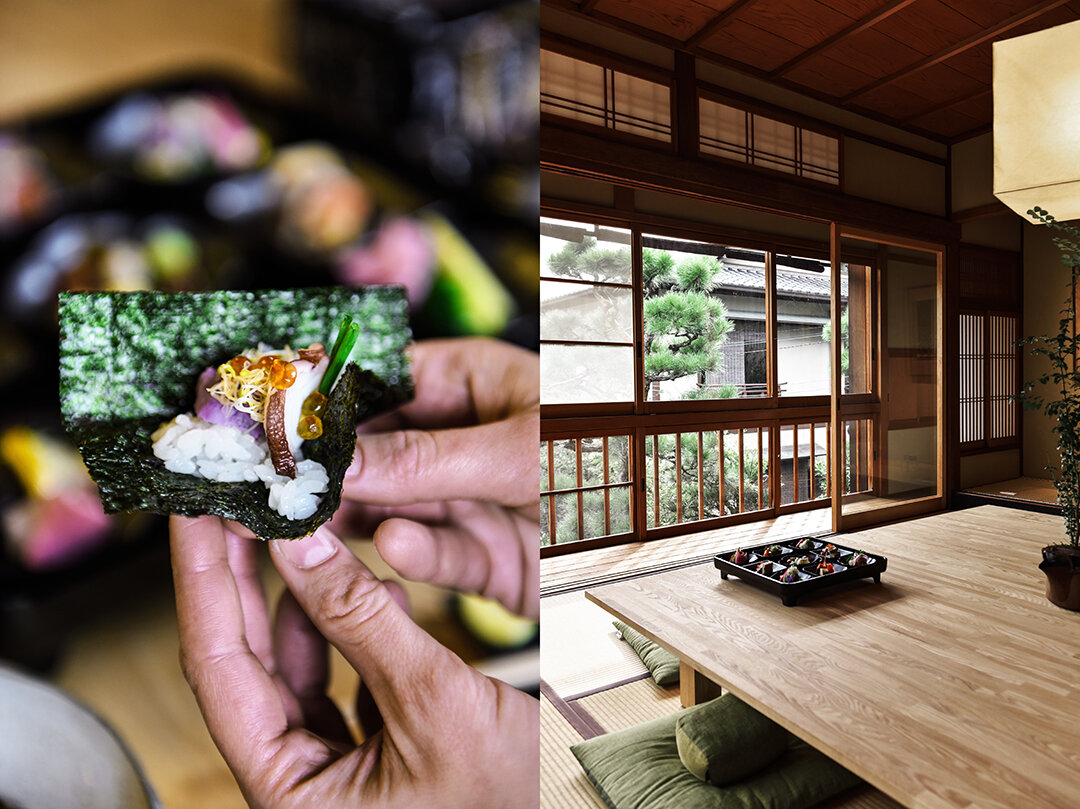
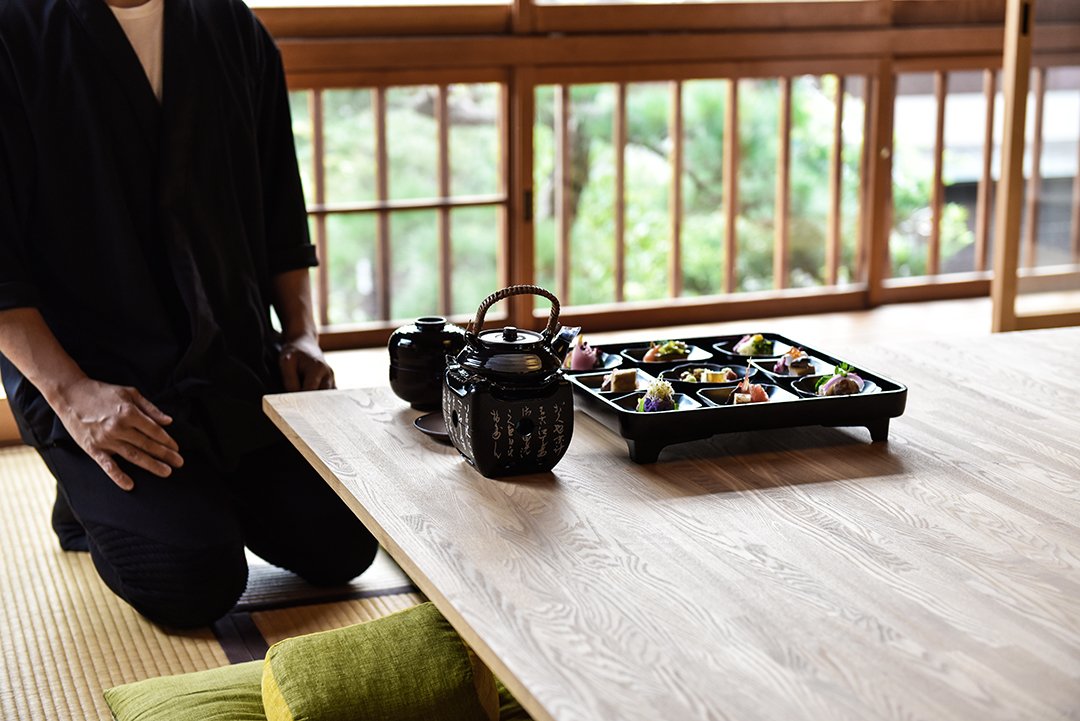
If this feeling could manifest itself in a restaurant, this would be the wonderful Awomb. The restaurant is in an elegant traditional house, hard to find in a narrow side alley in old Kyoto. You sit on the floor, on Tatami mats made of rice straw, in front of a low wooden table. The room is filled with natural light, golden warm as honey. The subtle sound of the floors creaking and birds hiding in the tall pine tree in front of the window break the gentle melodies of the traditional Koto music playing in the background. It sounds a bit like a harp, melodic yet hard, pure as single water drops.
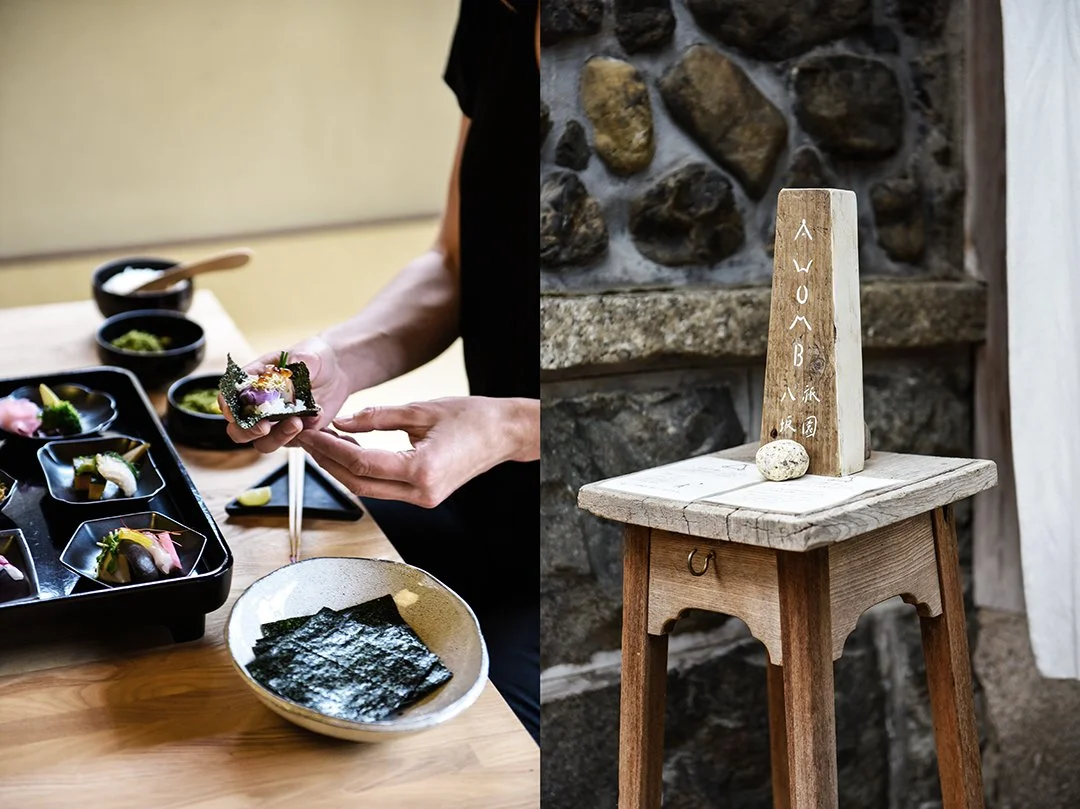
The food created here is quite a new concept. Owner Ujita Hiroshi brings hand-rolled sushi, which is usually served at home, to the restaurant table to share with friends. A bowl of white rice, a teapot filled with steaming dashi broth, and a black lacquered tray full of little plates filled with stunning delicacies are the center piece of this culinary experience: you come to Awomb to roll your own sushi in one of the prettiest rooms that I've seen on my trip. The food itself, each little plate, looks like a piece of art. Seafood and vegetables can be mixed and combined according to your mood and refined with various seasonings, like fresh wasabi, grated ginger, plum sauce, salted vegetables, dried shrimp with mayonnaise, or tasty soy sauce jelly cubes. You can either add the ingredients to the rice bowl and eat it with chopsticks, or you can go for sushi in seaweed – rolled in your hands.
There's no chance that I'll ever have such a vast variety of ingredients to choose from in my own kitchen, but it's so inspiring, I tried totally new combinations. I've learned that you shouldn't be shy, just try not to use more than 4 to 5 main flavors and you'll be rewarded with astonishing results. I got a bit excited and went overboard - the German girl came through - but my first "sushi in a bowl" made with pink grapefruit, salmon, fried sweet potato, square bean, gari (pickled ginger), and finely cut green matcha crepes tasted fantastic. Then I combined purple potato mash, octopus, and Ikura (salmon roe) and rolled it in seaweed, which turned into such a delicious beauty that I have to share this recipe with you.
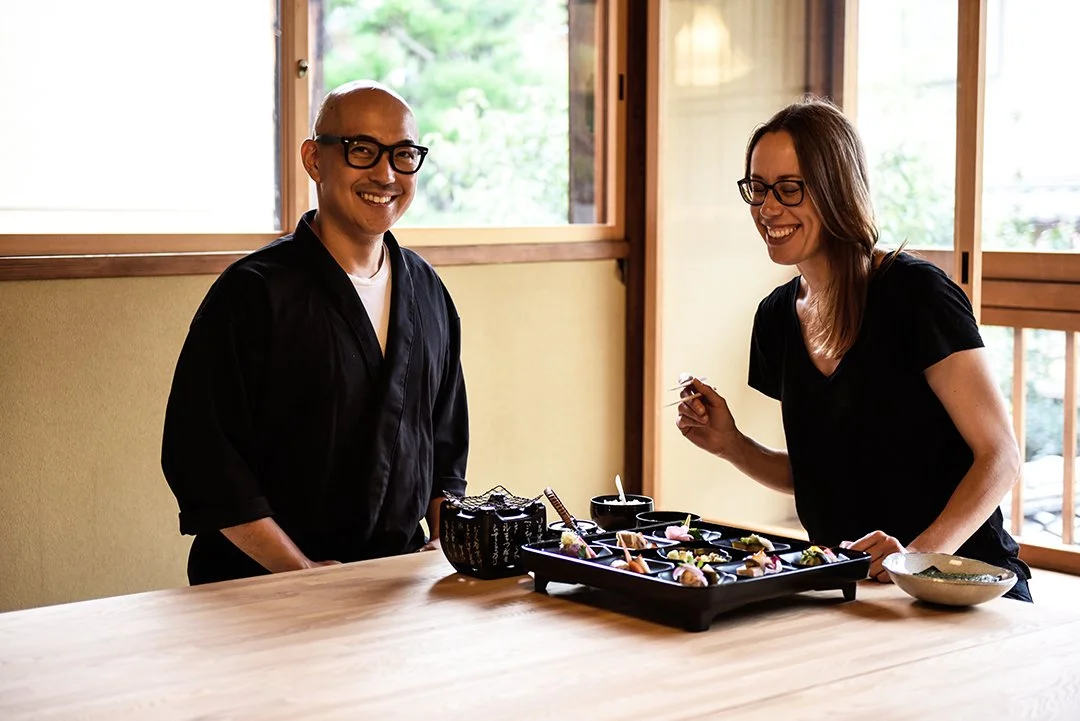
The quality of each ingredient used at Awomb is outstanding, which isn't a surprise, Ujita Hiroshi comes from a family that has been in the sushi business for decades. However, the young man didn't want to follow his parents' footsteps, he decided to start his own food adventure. His vision, to make hand-rolled sushi a delicious and fun experience for friends outside their homes, is a huge success. Long lines and waiting lists call for a well-planed reservation.
In the next months, I’ll share many Meet In Your Kitchen features with you that took me to California, Italy, France, and Japan. Thanks to Zwilling for sponsoring these features for our culinary trip around the world!


Build Your Own Sushi:
Hand-rolled Sushi and Sushi in a Bowl inspired by Awomb
Serves 2
For the mashed purple potatoes
100g / 3.5 ounces boiled and peeled purple potato, cooled
1-2 tablespoons heavy cream
1 teaspoon butter
Fine sea salt
Coarsely ground black pepper
Freshly grated nutmeg
For the hand rolled sushi
Dried seaweed, cut into squares
Sushi rice (recipe below)
Octopus, boiled and cut into bite-sized slices
Ikura (salmon roe)
For the sushi in a bowl
Sushi rice (recipe below)
Pink grapefruit, peeled and cut into segments
Raw salmon, sushi grade, cut into bite size slices
Fried sweet potato
Boiled Edamame beans
Gari (pickled ginger)
Matcha crepe, very finely chopped
(if you make your own crêpes, mix 1 tablespoon of cooking grade matcha powder with 90g / 2/3 cup of plain flour)
Seasonings (optional)
Freshly grated wasabi
Freshly grated ginger
Plum sauce
Soy sauce
For the mashed purple potatoes, purée the potato, heavy cream, and butter in a blender or food processor until smooth and season to taste with salt, pepper, and nutmeg.
For the hand rolled sushi, place 1 tablespoon of sushi rice in the middle of a sheet of dried seaweed. Add 1 teaspoon of the mashed purple potatoes, a slice of octopus, and half a teaspoon of salmon roe. Roll like a cigar, add seasonings to taste, and enjoy.
For the sushi in a bowl, add about 2 tablespoons of sushi rice to a small bowl and stir in seasonings to taste (add just a little bit). Add 1 grapefruit segment, 2 slices of salmon, 1 crumbled slice of fried sweet potato, 2 Edamame beans, and a little pickled ginger. Sprinkle with 1 teaspoon of the chopped matcha crêpe and enjoy!
For the sushi rice
2 tablespoons rice vinegar
1 tablespoon mirin (rice wine similar to sake)
1 tablespoon sugar
½ teaspoon salt
180g / 1 cup short-grain sushi rice
240ml / 1 cup cold water
In a small bowl, heat the vinegar, mirin, sugar, and salt, over low heat, stirring until sugar and salt dissolve; let it cool.
Rinse the rice 4-5 times with cold water, then drain in a colander for 15 minutes.
In a medium saucepan, bring the rice and water to a boil. Reduce the heat to low, cover the pot, and simmer the rice for 15 minutes. Take the pot off the heat and let it rest for 15 minutes, don't lift the lid. Transfer the rice to a large glass bowl.
Sprinkle the warm rice with the cold vinegar mixture and stir gently, you can fan the rice while mixing, that will help it to dry if it's too sticky. Cover with a damp kitchen towel while you prepare the sushi. Sushi rice is best served at body temperature.
What inspired you to open a sushi restaurant?
My parents ran a sushi restaurant that was very traditional but I wanted to do something different, something unique to me. I decided to focus on the idea of customers making their own sushi in an enjoyable way, and I started my own place.
Is that popular in Japan?
Hand rolled sushi (temakizushi) is popular now but it’s basically something that’s not eaten out. Everyone eats it with their families at home or at house parties. I thought that people would probably enjoy it if they could do something different and eat it at restaurants.
Which ingredients do you serve for the sushi creations?
Please let me tell you about aezushi, it’s sushi that you mix and prepare yourself. Firstly, we have vegetables and fish, we have sashimi – grilled conger eel – and turnip. There are vegetables from Kyoto that we often use, and this is yuba – a delicacy made from soybean milk. Further we have mackerel, which is served pickled in vinegar and Japanese scallop. Then we have shirae, a salad with white sesame, tofu, and white miso. We have aemono, which is vegetable, fish or shellfish dressed with miso, vinegar or sesame. Here is squid and fish roe. When you’re preparing the dish, you mix the seasoning with the other things and then eat it. We have lightly grilled skipjack tuna with deep fried tofu. Pickled ginger. Broccoli. There’s also octopus. Conger eel. Salmon. Pumpkin. Pak Choi and Kyoto taro root.
And we also have the soup. I’ll light the flame, once smoke starts to come out, it’s done. Then you mix it with small boletus mushrooms and eat it.
Thank you, Ujita Hiroshi!


Meet In Your Kitchen | Taka's Japanese-Italian Fusion Cuisine in Kyoto

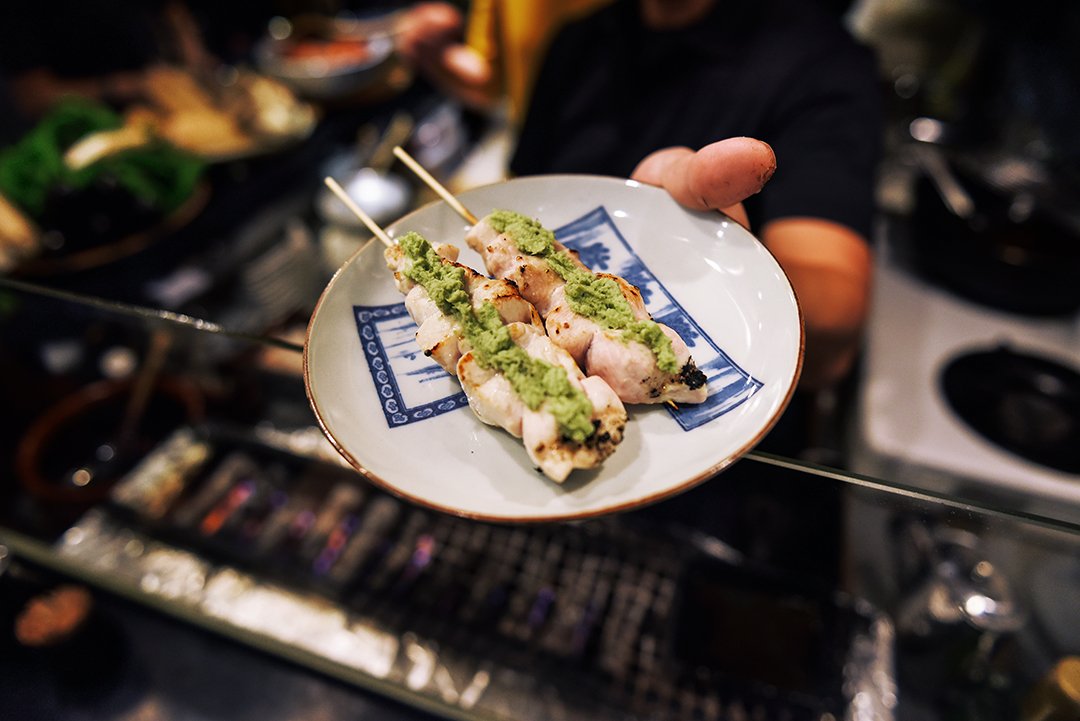
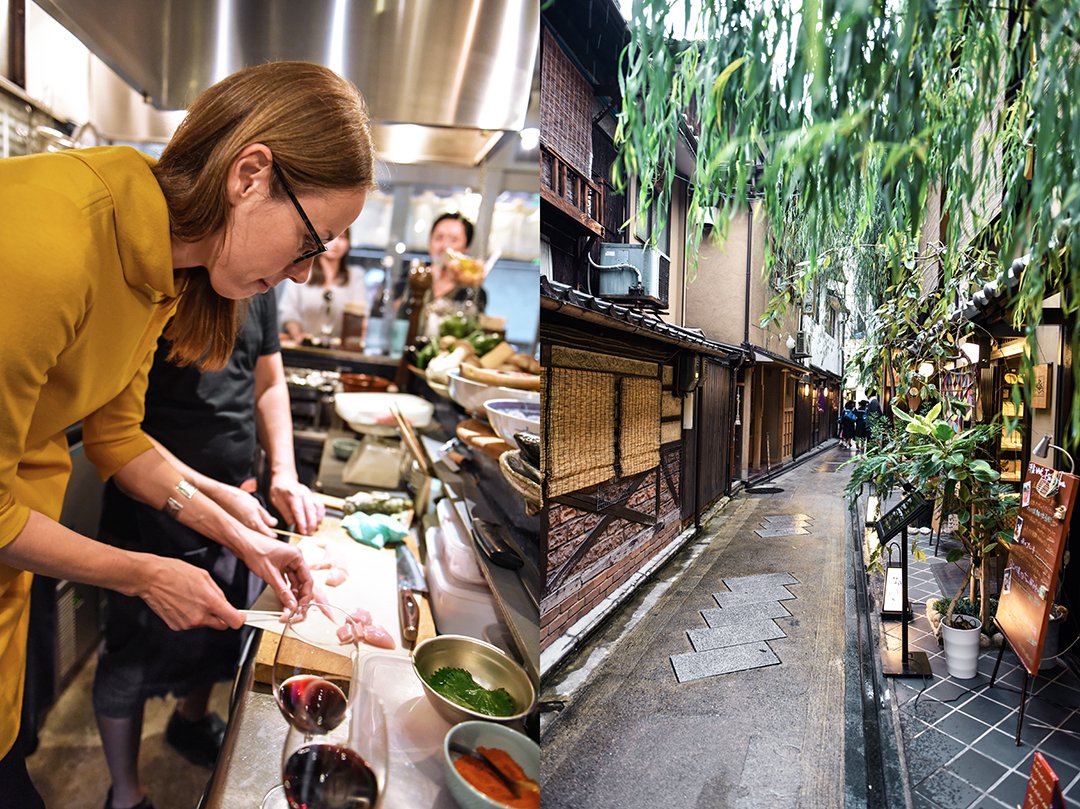
Eating at Taka's restaurant in Kyoto feels like having a Japanese feast celebrated with your exuberant Italian family. The place is tiny, it's in a narrow old house tucked into a small secluded alley right in the old city's busy heart. An L-shaped counter separates the celebrated chef from his hungry guests, however, there's a lot of interaction going on. The kitchen is open so you can follow all of Chef Nishimura Takashi's steps, how he grinds the fresh wasabi in smooth circles on a shark skin-covered wooden board (the only proper way to grind the green root as I've learned). The charming chef looks like a versed dancer. He quickly grabs pots and spices from the shelves behind him and then, in the next second, turns around to briefly cook tender chicken sashimi (see the recipe below) in the flames of his little grill; or local beef, or mackerel until it has a crispy golden crust all around. The restaurant's menu is a revelation, sea urchin spinach and tempura lotus root sprinkled with matcha salt are simply divine. Sitting at the counter and enjoying Japanese tapas is a feast in its true meaning: You eat, drink, and share delicious treats with old and new friends.
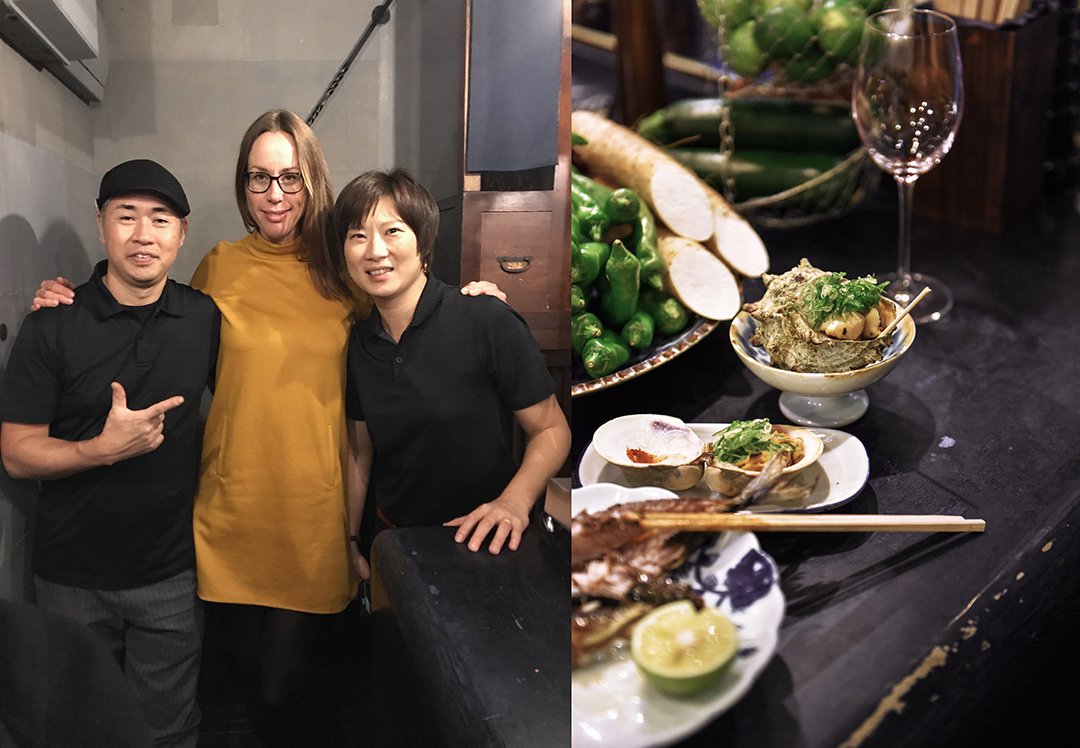
Kyoto born Chef Taka has lived and worked abroad for years, in Australia, Denmark, and in Italy, in Milan, where he also met his wife Akane. Before they opened their gastro pub in Kyoto, Taka worked at Armani's Nobu Milano restaurant for 10 years, which explains why you can also find wonderful organic Tuscan wines and Mediterranean style dishes on the menu, like the fruitiest eggplant slowly cooked in an aromatic tomato sauce. It's the combination of these two worlds that makes the couple's restaurant in Kyoto so exciting, yet at the same time it's so relaxed. It's the kind of place where you end up chatting with the guests sitting next to you, exchanging stories and dishes, saying Kanpai (cheers) with a glass of red wine in your hand or ending the night with an extensive sake tasting involving everyone in the room.
Taka and Akane love food and people, the people who visit them, their guests, and the people they work with, their kitchen team, but also the suppliers who deliver fresh produce and products of the best quality to this tiny kitchen in the heart of Kyoto. The couple knows all of them personally, they've been working with them for years, most of them coming from the area. Having lived and worked in two food meccas in the world, Italy and Japan, the restaurateurs say that they can only create fantastic food, if the ingredients are perfect, vegetables picked at the peak of their season, the meat coming from animals that were bred and fed with care and respect. Japanese and Italian cooking is similar, both cuisines are very simple and focus on good ingredients, and at Taka, they create a very complete fusion.
In the next months, I’ll share many Meet In Your Kitchen features with you that took me to California, Italy, France, and Japan. Thanks to Zwilling for sponsoring these features for our culinary trip around the world!


Grilled Chicken Sashimi with Wasabi
By Taka Nishimura
Chef Taka uses chicken of outstanding quality, he knows the farmer and he can guarantee the meat's quality and freshness, which is why he can serve this dish almost raw. However, it is highly recommended to cook chicken until it's cooked through.
Serves 2
4 skinless, boneless chicken breast tenderloins, sashimi grade
Freshly grated wasabi
Rock salt
4 wooden skewers
Heat the BBQ.
Cut each chicken tenderloin into 6 pieces and thread onto the 4 skewers. Grill lightly until just done.
Spread the chicken with freshly grated (!) wasabi and season with salt to taste. Serve immediately.
Could you introduce yourself?
My name is Nishimura Takashi. I lived in Italy for a long time, about 15 years. I worked in a world-renowned restaurant called NOBU. And about 2 years ago I moved back to Kyoto, my hometown, to open this small restaurant.
What is your most cherished childhood memory connected to the kitchen?
A cherished memory would have to be, when I was a child, all I watched were shows about food on TV. All I watched were cooking TV shows, and I remember cooking a lot with my siblings when we were small. No one in my family is a cook, I'm the only one who followed a career as a chef. And it was when I was in primary school that I decided to become a chef, it was then that I decided to learn how to cook Japanese cuisine.
Why did you decide to move to Italy and work in Italy as a chef?
Well, I had always made Kaiseki cuisine in Kyoto, I trained in Kyoto Kaiseki for about 15 years. And so then, at that time, Kyoto was amazing, it was a narrow entrance into Japanese cuisine. Now foreigners come here to learn how to cook Kaiseki, but it wasn't like that at all back then. So I wondered why? Japanese people go to Italy to study Italian cuisine, and to France to study French cuisine. So I thought, why don't foreigners come to Japan to study Japanese cuisine? I figured that if that was the case than I wanted to go abroad to teach Japanese cuisine, that's what I felt I wanted to do. And I remember feeling that I'd been a chef for 10 years, I'd learnt a lot in that time and wanted to share my knowledge abroad. So I chose somewhere that had similar food. I first chose Italy because I thought they had a simple way of cooking, and ingredients that had a lot of umami, where Japanese cuisine would be accepted by Italian tastes. And then I worked at NOBU in Italy.Now, in the last 10 years, things changed. Many chefs come to Kyoto and Osaka, Tokyo, studying the Japanese style.
What changed over the years?
That was probably because Japanese chefs became more open-minded. I think one reason is that they began to look outside Japan more. Also, famous chefs wanted to learn more about the mentality behind Japanese Kaiseki cuisine and how to make it. Making each course and slowly serving one small plate after another is Japanese Kaiseki's style. That's how you draw people to your restaurant. You're delicate even when you serve the food, there is even a special orientation for each plate.Every country's cuisine is wonderful, but in Japan it's all about the cut. For example, how sashimi is cut, how the vegetables are cut, how the meat is cut. These cuts create an excellent style of cooking, it's Japanese cooking. It's "katsuru" which means "cuts", which is what gives it such a high aesthetic. Even with sashimi the chefs cut them beautifully. It creates a very unique Japanese aesthetic. The kitchen knife cuts amazingly, every day you need to sharpen your knives, and sharpening them is one part of a chef's training, and I think even foreigners now sense this beauty. That's what I think. Vegetables cut straight, how they're beautifully peeled into hexagons, all kinds of shapes, the manual work that goes into it is amazing.
What makes a good knife? What are the important features of a good knife?
Of course how it cuts, the better it cuts the more beautiful the cut is. Also, how it feels when you hold it. You might have the same knife, but their weights can be different. Or there are knives that suit only you, so Japanese chefs will always buy their own knives. There's also a balance to them. And chefs are using them for a long time, for the entire day, so it needs to not get worn out, it needs to not be a burden for chefs that work for a long time. I think all of these things are considered when knives are made, there's a long history for this. Japanese knives are very particular. Fish is fish, vegetables are vegetables, meat is meat, and we divide them as such, but I think a knife that can be used for all of these is amazing.
What is special about Kyoto cuisine compared to other parts of this country?
I'd say how we compose the meal. There are a lot of difficult things about it but the best thing is how you can enjoy it as you like. Next is how the plates match. There are a number of Japanese meals where you look at the plates as you eat, and there are lots of regions that can make great plates. There's also the matter of gathering good ingredients. Of course each region of Japan has its own wonderful ingredients, but among those, you have Kyoto chefs who will search all over the place to find the best ingredients of the season and who will think of their customers’ faces as they make them. That mentality is unbroken, it's passed down from generation to generation, there's always been this fantastic culture. That's why there are so many things that I think are amazing.In Kyoto, it's really easy to distinguish between the 4 seasons. So when autumn comes you can use autumn ingredients and incorporate their beauty into the food. Kyoto chefs understand this sensibility.
How close is the relationship between you and your suppliers?
That's a great question. You can do that really easily in Kyoto. I've been working… since I was young, so I've been working with suppliers since the beginning. There are fishmongers and vegetable suppliers that I've known for over 30 years. People also introduce me to people they know, like butchers. I've used a lot of connections, and I try to use Kyoto wholesalers as much as possible, and I want to use them more. I have my restaurant in Kyoto right now. We say "local produce for local consumption", and it was the same in Italy. There are ingredients specific to regions and I try to incorporate them in my cooking as much as possible. Now I get requests from the Ministry of Agriculture and other chefs help out too. I want to help revitalise the area, so I get introduced to a lot of different people, and I can get hold of good ingredients. That really makes this job easier.
What was your vision for your restaurant?
I wanted a small restaurant where I could be close to customers sitting at the counter, so they're closer to the chef too. That way everyone can enjoy themselves as they eat, that makes the meal even more delicious. That way people's circle of friends could grow too. I want to make a restaurant like that and introduce everyone to it. And if I get any foreign customers, I want to help give them a place where they can make wonderful memories of Kyoto. I really wish from the bottom of my heart that I can help them make memories.
Thank you, Taka and Akane, for creating wonderful food and memories!



Meet In Your Kitchen | Masako Imura's White Curry in the Heart of Tokyo
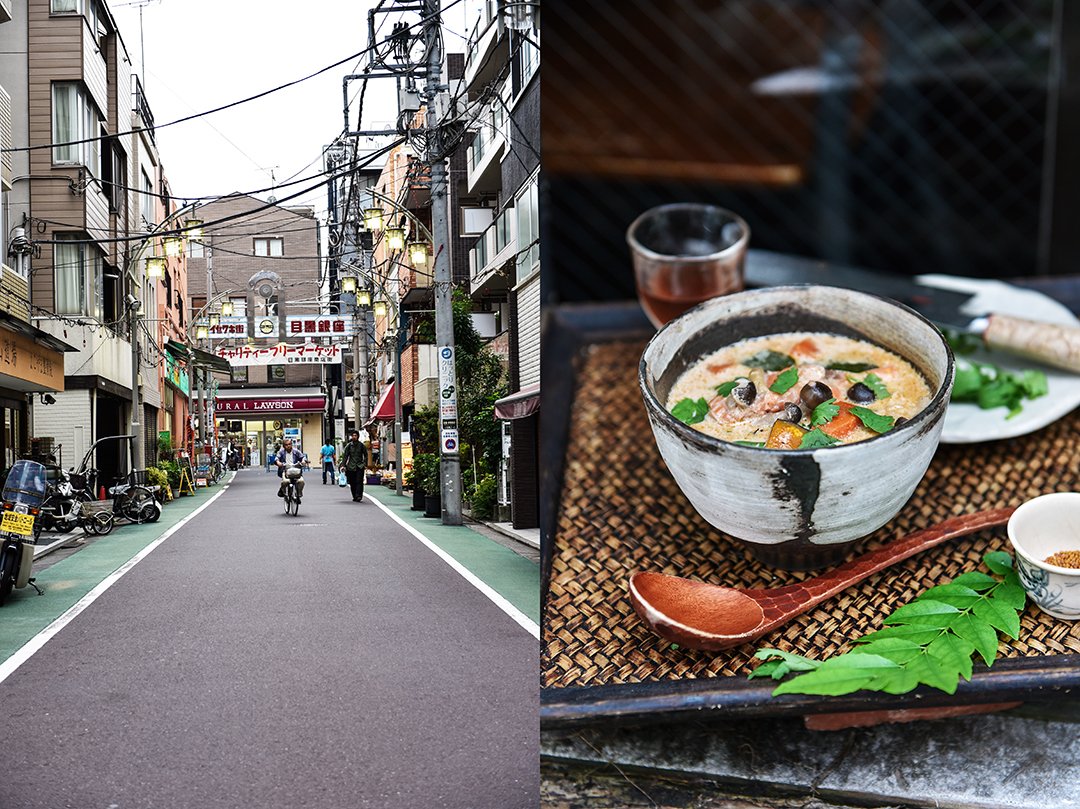
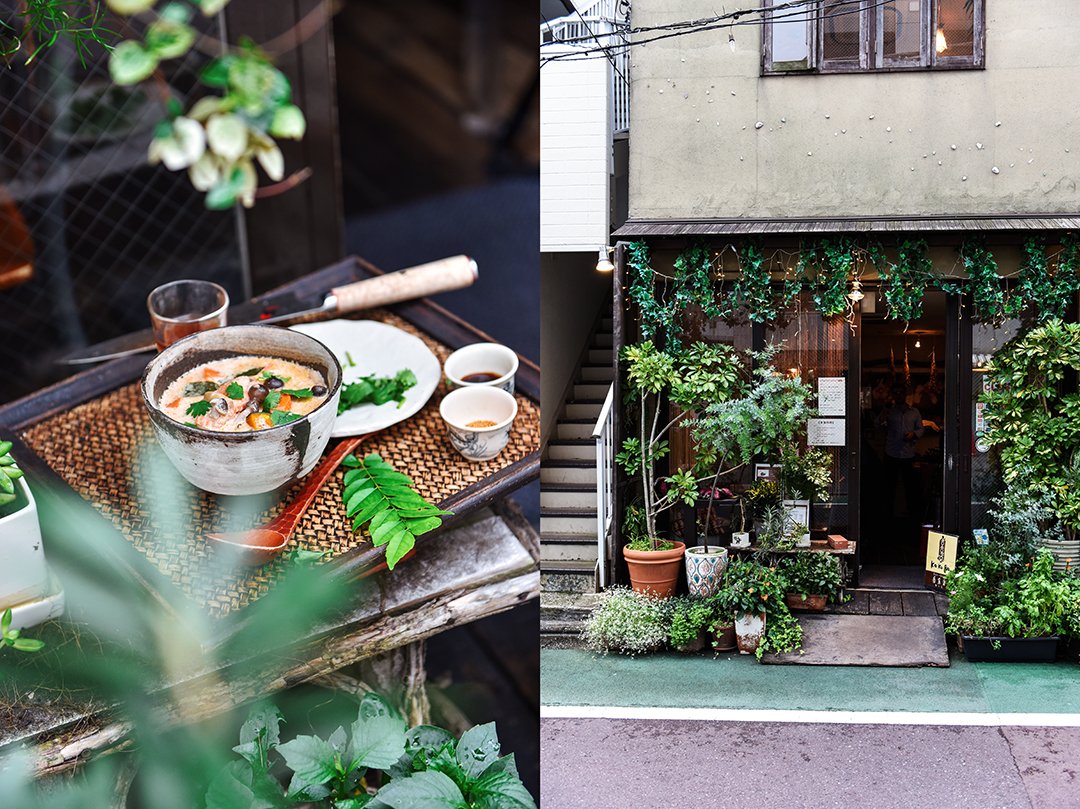
It's quite a surreal scene that Chef Masako Imura chose for her acclaimed Kakura restaurant: classical music playing in the street from invisible loudspeakers, no cars, but people riding bicycles or walking slowly listening to the gentle harmonies filling the city's warm air. We're in Tokyo, right in its vibrant heart, however, the peaceful scenery, the narrow house where the restaurant sits snugly speaks a different language. The green facade covered in ivy and sparkling little lights, pots of flowers, herbs, and leafy plants arranged in front of the restaurant's window, create a vivid contrast to the city's monotonous grey. Aromatic mint, basil, rosemary, and curry leaves grow right at the chef's doorstep ready to be brought into the kitchen and turned into complex spiced dishes.
The outside couldn't suit the inside any better, it's a green oasis created for a restaurant that celebrates Japanese curry based on the old knowledge of Chinese medicine. Masako Imura's creations are rich, colorful, and delicious. Her Kakura Curry, Black Curry, her seasonal vegetable, or fish curries are a pure pleasure to eat and caress and activate different parts and functions of the body. The nutritionist follows a holistic philosophy, in which mind and body, people and nature complete each other in harmony. The ingredients that she uses are organic, regionally and seasonally sourced, the chef knows how to treat each vegetable with respect and creativity. It's about healthful food that gives you energy rather than taking it away from you.
Fans from all over world, many artists and musicians, love her beautiful cuisine, all those fascinating flavors that Masako brings to the table at her cozy restaurant that she opened in 2005. The food warms up your soul. When you get a chance to meet her in her kitchen for a few hours to chop and chat, and peek into her pots and pans, you get a glimpse of this universe that makes her creations so unique and special. Spices are her most important tool, the heart of every composition. She works with perfectly balanced curry mixtures, individually put together for each dish, like in the fish curry that she shares with us. The warming fragrance of mustard seeds and curry leaves sizzling in hot oil are the start, the tempting invitation, before the other parts follow to add more depth: Nam Pla (fish sauce), shrimp paste, ginger, and colorful spices, which she attentively arranges in little bowls next to the cooker. Lotus root, sticky Japanese potato, golden pumpkin and carrot, and various mushrooms lend freshness and flavors to a creamy sauce full of heat.
The love for the kitchen lies in the family, Masako Imura's mother taught her daughter how to cook and use food for more wellbeing. Masako was the youngest, but physically the weakest, her mother paid a lot of attention to her girl's diet. Nourishing, natural, and rich, using Chinese medicinal cuisine, it helped her to become the strong and inspiring woman that she is today, loved for her curry creations at the Kakura restaurant.
In the next months, I’ll share many new Meet In Your Kitchen features with you that took me to California, Italy, France, and Japan. Thanks to Zwilling for sponsoring these features for our culinary trip around the world!


Autumn White Curry with Salmon
By Masako Imura
Serves 3-4
3 tablespoons rapeseed oil
1 tablespoon mustard seeds
8 curry leaves
100g / 3.5 ounces onion, cut into 1 cm / ½ inch cubes
60g / 2 ounces radish, cut into 1 cm / ½ inch cubes
60g / 2 ounces carrot, cut into 1 cm / ½ inch cubes
100g / 3.5 ounces shimeji mushrooms, shredded
3-4 fresh cayenne peppers, finely chopped
1 tablespoon grated ginger
1 tablespoon grated garlic
40g / 1.5 ounces shrimp paste
1 teaspoon salt
1 teaspoon fish sauce
1 teaspoon garam masala
1 teaspoon ground coriander
1 teaspoon ground cinnamon
1 teaspoon ground cardamom
1 teaspoon garlic powder
1 tablespoon coconut flour
1 tablespoon almond flour
5 g sweet radish root
500ml / 2 cups water
800ml / 3 1/3 cups milk
30g / 1 ounce lotus root, cut into 1 cm / ½ inch cubes
60g / 2 ounces yam, cut into 1 cm / ½ inch cubes
90g / 3 ounces pumpkin, cut into 1 cm / ½ inch cubes
10g / 1/3 ounce white cloud ear mushroom, soaked in water
300g / 10 ounces salmon filet, cut into bite size pieces
Boiled white rice, for serving
A handful fresh coriander leaves, for serving
In a large pot, heat the oil, mustard seeds, and curry leaves over medium-high heat for about 15 seconds or until the seeds start popping. Add the onion, radish, carrot, and shimeji mushrooms, turn the heat down to medium and sauté, stirring once in a while, until soft.
Stir in the cayenne peppers, ginger, garlic, shrimp paste, salt, and fish sauce and cook for 1-2 minutes; then add the garam masala, coriander, cinnamon, cardamom, garlic powder, coconut powder, almond powder, and sweet radish root, stir and cook for 1 minute.
Pour in the water and milk, bring to a boil, and cook, uncovered, for about 20 minutes over medium heat. Add the lotus root, yam, and pumpkin and cook for about 5 minutes or until soft. Gently stir in the white cloud ear mushroom and salmon and cook for 5 minutes or until the salmon is cooked through; season with salt to taste.
Divide the rice and curry between bowls, sprinkle with fresh coriander, and serve immediately.


What is your most cherished childhood memory in the kitchen?
I couldn't eat carrots, so every day my mum would mash them up so they were easier for me to eat. Every single day without fail. Now I love them.
How old were you when you decided to become a chef?
It was actually quite late, I was 25. Actually, I used to be a cooking instructor, but I was 25 when I wanted to work in a real restaurant as a chef.
What makes Japanese cuisine so special?
It has to be the culture of using dashi. Western cuisine uses stock but in Japan we use kelp and bonito and have the custom of using dashi instead. Staple Japanese food will almost always harness dashi, giving them a subtle undertone of flavour. I would say that's what makes Japanese cuisine special.
What kind of dashi do you use in your restaurant?
I use dashi made from kelp and dried shiitake mushrooms.
Which role does curry play in Japanese cooking?
I would say it's similar to Japanese miso soup, each family will have their own curry. Mum's curry will always taste like mum's curry. We've always had miso soup, but lots of Japanese people say their favourite curry is their mum's curry. But each Japanese family will have their own Japanese curry. Normally.
Do you have a close relationship with the suppliers of your restaurant?
There are suppliers I'm close to and those I'm not so close to, but I buy products from them because I trust them, because they're people I know.
Are organic and local products important to you?
Very, very important!
Is there a rising interest in Japan for organic food?
It’s incredibly popular.
Do you think that the people - over the last few years - became more critical with their food?
I've found that lately more and more people are concerned about their health, and so I've been getting a lot more customers who express interest in organic and chemical free food, as well as cuisine that incorporates Chinese medicine.
What fascinates you about Chinese medicine?
The more I learn about Chinese medicine the more it makes sense, so I study more and more. Of course, each person is different so I have to learn what that means. There are things that will work for someone but not for others, so I diagnose each individual and carefully select the Chinese medicine that works best for them. I love it that, what each person has to eat, is always going to be different.
Where did you learn about Chinese medicine?
I studied at the Japanese branch of the Beijing University of Chinese Medicine.
What made you so interested in Chinese medicine?
I'd have to say it was when I was young, my mum used natural things. She actually used natural Chinese medicine more than conventional medicine. Well, we went to the doctors when we were sick, but if we had to take medicine, had to put something in our bodies, we took Chinese medicine. Yeah, that was it. Ever since I was really small, we went to a Western hospital for treatments, but if we had to take anything she always used these really old, traditional Chinese medicines because she thought they were safer. That's how I was brought up. Then I learned a little about macrobiotics and all sorts of other things. But it wasn't because I thought "people have to eat these", it was because each person's biological makeup is different. And so, I started to make food using Chinese medicine for individuals to match their individual makeup. I slowly realized that I didn't just have an interest in this, that this was real cooking. There are foods that can be good for certain people but not good for others. There are all kinds of medicinal diets that are good, but finding the right ones for each person can be a challenge.
What's the clients’ feedback? Do the people come because they want healthy food? Or do they just come because they find it's delicious?
I think they come because it's delicious and healthy. Because they want to be healthy in a delicious way.
What's your association with the cherry blossom season?
It's the season students start the new school year so it's seen as the season of new beginnings. It makes me feel really optimistic. This area here called Nakameguro is famous for a lot of cherry blossoms, it's also called a town of cherry blossoms.
Can you use the blossoms for your cooking?
Yes, I use them a lot. I put them into the rice, ice cream, and pudding. The ingredients I use will vary depending on the season, but they're all good for you.
Thank you very much, Masako Imura!


Meet In Your Kitchen | Tokyo's Tsukiji Fish Market & the Secret of Sushi Dai

Traveling is bliss. To leave the known behind and discover new tastes and smells, cities and landscapes is food for our minds, it lets us grow, change, and evolve.
Flying into Tokyo and seeing its cityscape spread out peacefully in front of me in misty pastel colors felt unbearably exciting. It's a place where I had never been before, a place that everybody told me would change me, and my culinary perspectives. Food plays a central role in Japan's complex culture, food of high quality is not a random choice, it's a philosophy, they are tied together, inseparable. I was curious and impatient to put the first bites of the country's celebrated cuisine into my mouth, but also to wander around and fully experience the next stop of my culinary trip around the world together with Zwilling.
Japan is a world of contrasts, connecting the past and the future, silence and noise, gardens and buildings, minimalism and colorful kitsch, it all exists right next to each other, framed by a fascinating culture of multiple layers, it's not easy to grasp. Its depth is captivating and disorienting, it's mysterious, and sometimes hard to understand for someone who comes from the outside. I usually visit countries for my Meet in Your Kitchen features that I'm personally connected with, either through former trips or through my own culinary upbringing. So I usually take a lot of experience, information, and understanding for a culture with me, but when you enter a world that you've never seen before, you can't just look at its kitchens. It's not enough to visit the famous Tsukiji fish market in Tokyo or talk to the cities' celebrated chefs and enjoy unknown culinary pleasures at their excellent restaurants.
I wanted to see more, I wanted to listen to the stories – or at least some of them - that make this culture so rich and colorful, in and outside the kitchen. I joined a tea ceremony at 6 in the morning when the sun and the birds just woke up. I visited the famous temples in Kyoto, we stayed at one of them (Jorengein) overnight, and I interviewed a temple gardener to gain a better understanding of the gardens and their centuries-old architecture. I got swept away by this overwhelming peace that takes over your mind like a wave, when you sit on the wooden steps in front of the meditative gardens of the Ryoanji or Kenninji Temple. Time seems to stop as you enter the stone gardens, there seems to be an invisible curtain between the world outside and the world inside the temples' walls.
I felt a bit worried, how would it feel to be in a country where you can't read any signs, where you can't really communicate, or even order a taxi or book a table at a restaurant? Would I get lost in translation and miss out on the "real" Japan? I believe the best way to discover a new city is on foot, to walk and keep your eyes open, and not to be shy. Just smile, the easiest form of human communication. That's what we did on our first evening in Tokyo and within seconds we found one culinary gem after the other.
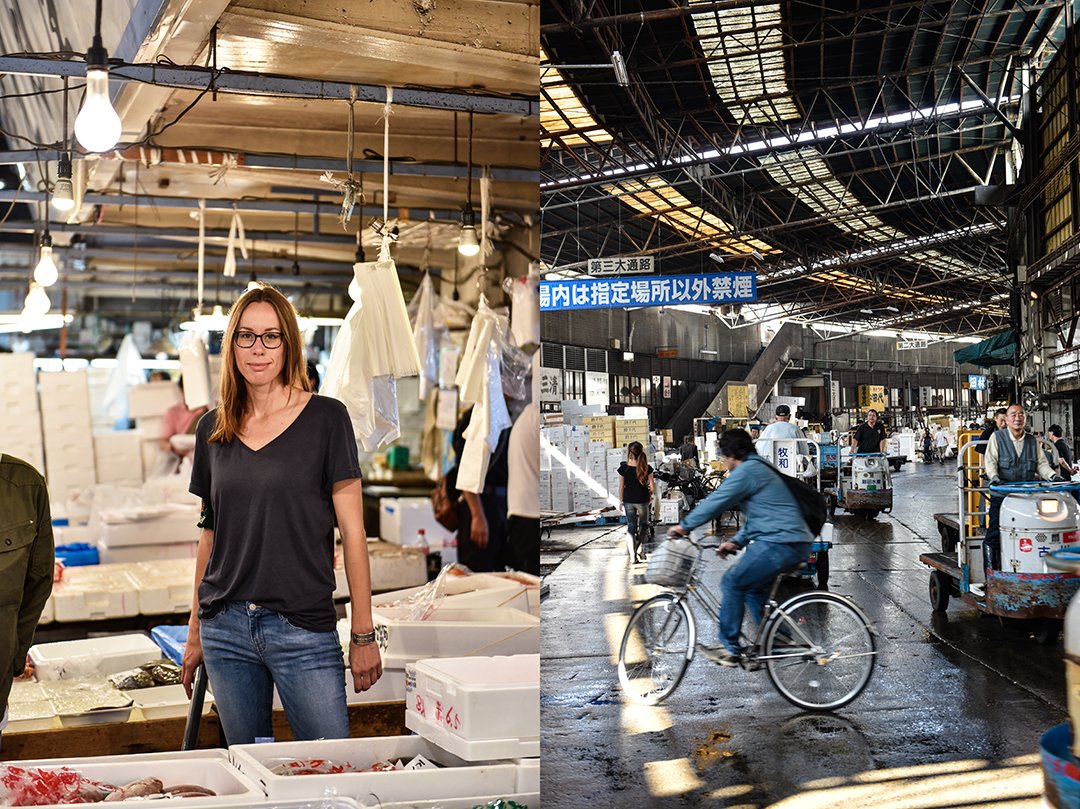
The Tsukiji fish market has its own pace, it's fast, busy, and loud, it's a universe with its own rules. The craziness starts late at night, at 2am. When Tokyo is still asleep and covered in quiet darkness, fishermen, chefs, and fishmongers stream into the legendary halls to buy and sell, to bid on tuna at the famous auction and ship the daily catch out into the world.
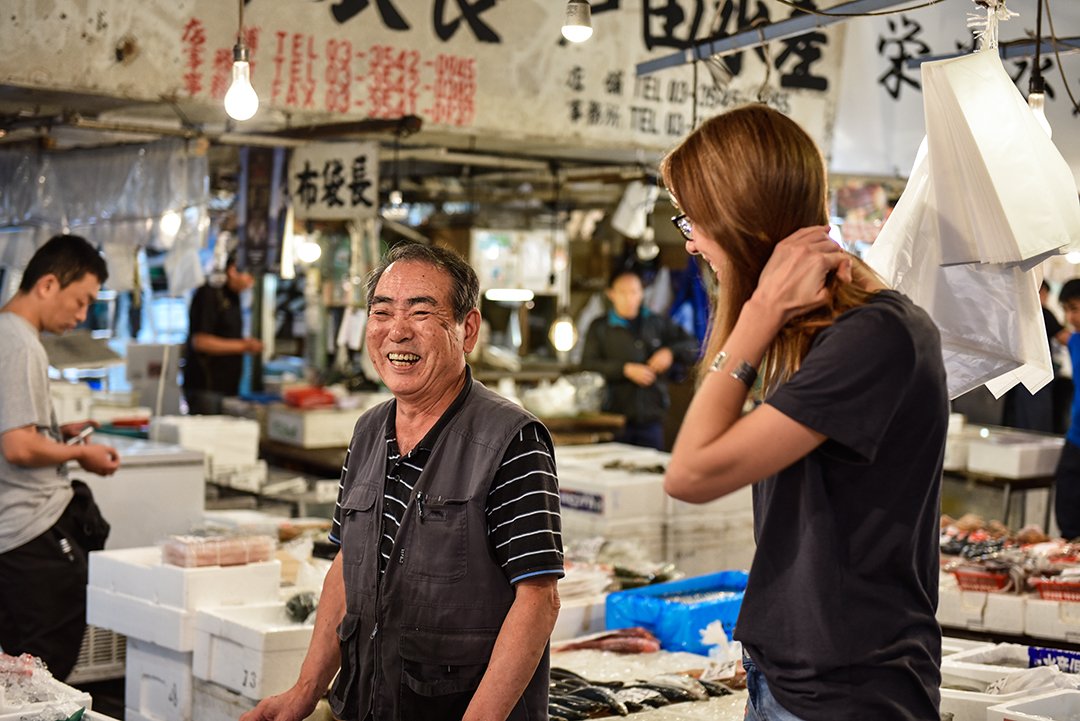
The floor under the filigree metal construction built in 1935 is grey and wet from the ice, daylight cutting sharply through the skylights falls onto men in rubber boots carrying bags and boxes, running diligently, or driving little electronic carts so fast that you have to jump quickly to save your life. It's a man's world, running like clockwork. The world's biggest market for fish and seafood is the heart of the fishing industry. It's the place where the sea's treasures are rated and traded, where the best fish in the world is taken straight into the kitchens of the sushi restaurants that set up their businesses in the low buildings around the market. Yet it's also the place where you can listen to the stories of the people who've been working with the sea and its gifts for generations, these people are concerned about the state of this sensitive ecosystem. The number of fish decreased dramatically and shoals that used to pass the coasts seasonally are missing. Due to global warming, summer fish fills the fishing grounds during winter and the fish that used to flourish in the cold season is nowhere to be found. There is such a beautiful and rich variety out in the seas, which we've always used in our kitchens, but we have to keep the balance. The fishmongers and chefs that I met all said the same. "Fish and seafood used to be a delicacy, a special treat, if we degrade it to fast food, we're going to lose this treasure!" saysMr. Yokoyama, the owner of EIKO Suisan Fisherman fish store at Tsukiji.
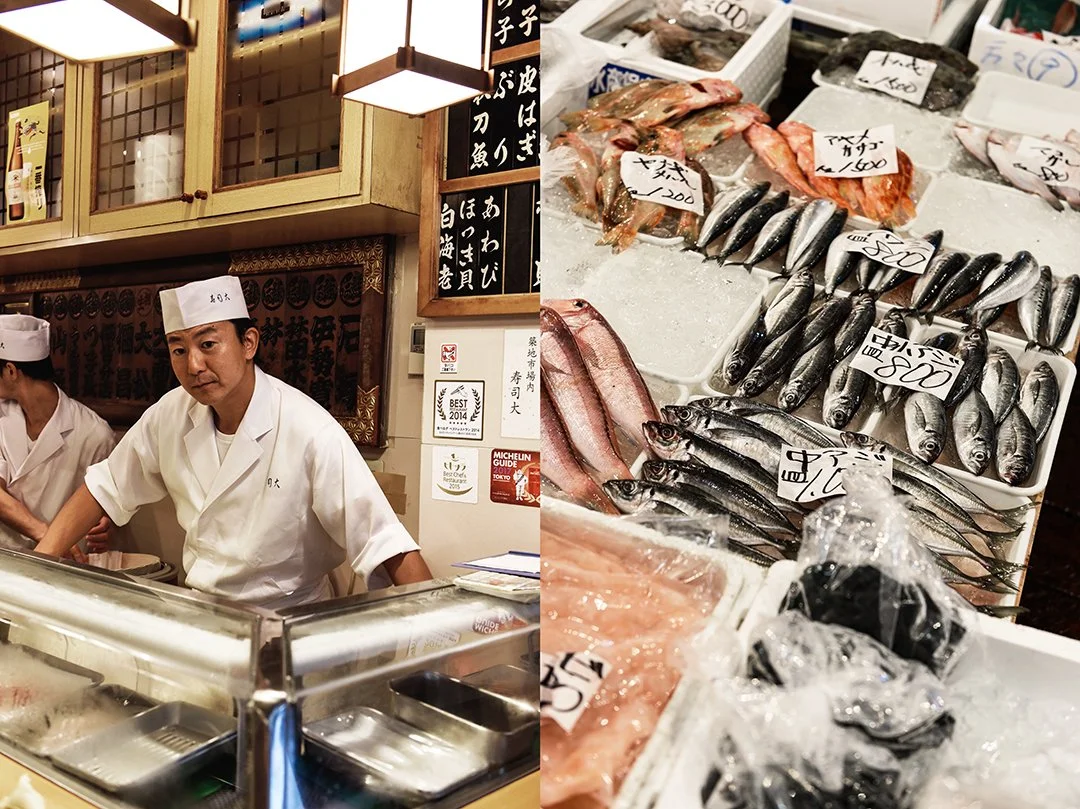
At Tsukiji, you can admire the whole abundance that nature gives us, hundreds of different kinds of fish and seafood, in all colors and sizes, mussels, crustaceans, octopus, and sazae (turban sea snail). It's almost mesmerizing to wander through the corridors between the stalls, which makes it hard to pull yourself away from it. Going straight to one of the most celebrated restaurants in the area definitely helps. Sushi Dai is just outside the market, you can easily spot it, as it has the longest waiting list and queue lined up outside the curtains swinging at its door.
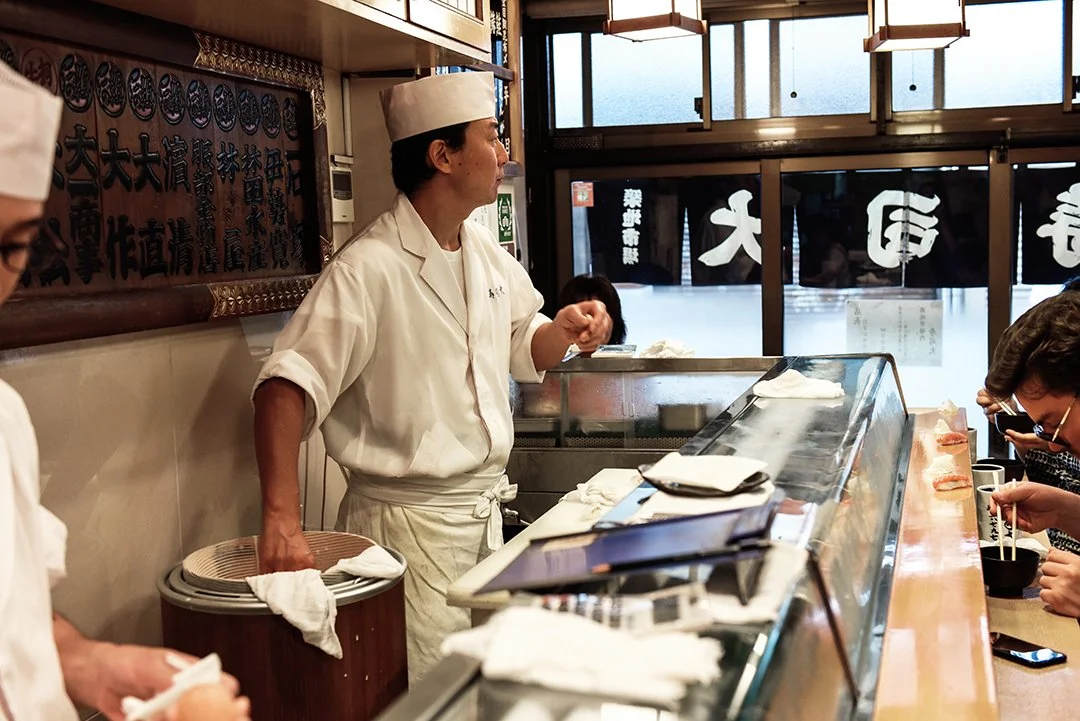
Chef and owner, Urushibara Satoshi, has two outstanding qualities. There's no doubt that he makes some of the best sushi creations in town, he learned from his father, but this man also has highly entertaining qualities. He's like a conductor and Sushi Dai is his stage. Behind his narrow restaurant's counter, he attentively cuts the fish and shapes the rice, you can see that he was trained for more than 20 years to become the master that he is today. The movement of his hand and arm looks like a smooth dance, so concentrated yet intuitive. And this man is funny! As he placed one gorgeous creation after the other in front of us, he told us stories with the dramatic voice of an actor, you can see and taste that he truly enjoys what he does.
Every morning at around 3am, he goes to the Tsukiji market to pick the fish for the menu. The relationship between him and his suppliers is close. He knows that a pure minimal treat like sushi depends on the quality of its ingredients. Sushi is what it's made of, a handful of ingredients. So trust the masterly hands of Urushibara Satoshi and his team of chefs and go for the Omakase menu. Depending on the daily catch and find at the fish market, you can indulge in the freshest tuna, flounder, and horse mackerel, or Ikura (salmon roe) rolled in seaweed. Scallops and clams, prawns and sea urchin, every piece looks like a piece of art, every bite is like tasting the sea.
Thank you Mr. Yokoyama for showing us around at Tsukiji, Urushibara Satoshi for your fantastic sushi and humor, and Makiko for guiding us through your city!
In the next months, I’ll share many new Meet In Your Kitchen features with you that took me to California, Italy, France, and Japan. Thanks to Zwilling for sponsoring these features for our culinary trip around the world!

How to make sushi
I'll share a recipe for sushi rice with you, but when it comes to the most important ingredient, the fish, I can only recommend to go to your trusted fish monger and ask him which fish he can offer, fish of the best sushi quality. After I ate sushi in Japan, prepared by outstanding sushi masters, I don't even bother eating it anywhere else anymore. No matter if you go for fatty tuna belly, halibut or fish roe, it has to be of the best quality. Then you just cut it into slices, eat it pure, or lay it on a bite of rice. Heaven.
For the sushi rice
2 tablespoons rice vinegar
1 tablespoon mirin (rice wine similar to sake)
1 tablespoon sugar
½ teaspoon salt
180g / 1 cup short-grain sushi rice
240ml / 1 cup cold water
In a small bowl, mix the vinegar, mirin, sugar, and salt, stirring until sugar and salt are dissolved; let it cool.
Rinse the rice 4-5 times with cold water, then drain in a colander for 15 minutes.
In a medium saucepan, bring the rice and water to a boil over high heat. Reduce the heat to low, cover the pot, and simmer the rice for 15 minutes. Take the pot off the heat and let the rice rest for 15 minutes, don't lift the lid. Transfer the rice to a large glass bowl.
Sprinkle the warm rice with the cold vinegar mixture and stir gently, you can fan the rice while mixing, that will help it to dry, if it's too sticky. Cover with a damp kitchen towel while preparing the sushi. Sushi rice is best at body temperature.

Interview with Urushibara Satoshi, Sushi Dai restaurant, Tokyo
Can you tell us about your work?
I come to work in the morning, go to buy fish, and then I spend the rest of the day serving customers. At 3am I go to buy the fish, and then start making sushi at 4:30 am.
How old were you when you started learning to make sushi?
I was 18. So, that's 27 years ago. I came to the restaurant 25 years ago. I started off making kaiseki ryori in Kyoto. For two years. Then I came back to Tokyo and became a sushi master.
What made you become a sushi master?
As I said, I started off in kaiseki ryori. This is a world where you can't directly serve a customer until you've been doing it for 20 or 30 years, and then it's just serving sashimi or something. I wanted to be talking to the customers. And within the world of Japanese cuisine, it was only as a sushi master that I could serve customers face to face. So, it wasn't that I became a sushi master because I wanted to, I just had to become a sushi master. And I also just enjoyed it too. That was the first time I really enjoyed my work. I mean, with kaiseki ryori you don't really get to meet the customers. You're working behind the scenes, and it's usually the women who serve the food. The chef has to stay hidden in the shadows. But I didn't want this. I wanted to chat with the customers while I was serving them.
What is your most cherished childhood memory connected to the kitchen?
In the kitchen? I just used to get scolded (laughs). But ever since I was a child, I really loved cooking. I don't know if I was any good, but I would imitate and pretend I was chopping things with a knife, for example. When I was in second or third grade, you know how everyone used to try and peel an apple in one long piece? Well, I was always top of the class in that! Also, if you're going to be a chef, you need more than to be good at cooking. It's most suited to someone who loves eating. More than being good at the actual cooking, feeling a real passion, and a hunger for food and eating is more important. If you don't have any interest at all in eating, then there's no way you'll improve. No way.
What are the essential features of a good knife for you? What makes a good knife?
First of all there's the length of the one I use. There are lots of different types of lengths. And it comes down to the weight, the thickness of the steel. At first, this knife used to be this long. But you sharpen it. So, it gradually becomes shorter and shorter. So the length and things like that are not features that last. Because the knife just gets gradually shorter. So, what else? The most important thing is that it can be controlled most effectively. I mean that it cuts exactly as you want it to. After that, the weight... Well, there are different types of people. People who like lightweight knives tend to use the strength of their arm to cut. I like heavier knives, and I use the weight of the knife to cut the fish. So, for me, I prefer a long, heavy knife. But it depends what kind of person you are. Everyone's different so I can't give a definitive answer. But that's what I like.
How old is your knife?
I'm about 3 to 4 years into this one. On average, I would replace it after around 6 years.
How do environmental changes affect the fish that you buy for your restaurant?
Yes, it has had a huge impact. But, I don't know if it's the climate, or the flow of the ocean. This year, there's the kuroshio Japan current, and the fish follow the flow of rivers where there are a lot of plankton. So, they come closer, don't they. Then, when this Japan current approaches, that's when we fish. But, this year it's more erratic, so there are lots of types of fish that don't come close to Japan as a result. So, I don't know if it's the temperature, or related to the flow of rivers. But there are fish we can't catch. Each year it's something different: one year might be good for yellowtail and the next year might be bad; or one year is good for saury and the next is bad; or another year might be terrible for sardines. It's like this every year. For example, I've been doing this for 25 years, and each year has been different. No two years are the same. At the moment, for example, there is a lack of urchins. This year, the fishermen can't catch any salmon, and the saury is not so good. There are so many different situations. That's why you have to adapt each year. You just simply can't keep making the same sushi for 25 years. The fat distribution is also completely different. I mean, completely. This is what a battle with nature looks like. So, I keep an eye on the weather forecast. And depending on the weather, you have to change the fish you stock. It's not like we're working in a factory doing the same thing day in day out. You also have to check whether the fishermen were able to take their boats out. So, yes, of course. I go to the market, and, of course, I buy the fish that is there. But, how can I say? There are some fish that you don't want to run out of. So, with these, if there's a typhoon on the way, we can stock up on them before it comes and store them while they're at their best. There are lots of different approaches.
Do you think we should change the way we consume fish? Like eating less fish?
Yeah, statistically… there are graphs, according to these, there's been a dramatic decrease in the amount of fish people eat. But, compared with when I was young, 'conveyor belt' sushi restaurants are really popular. So I think sushi has become something really familiar for young people. This also has made it feel like something cheap. When we were young, if you didn't have wads of cash, you couldn't eat sushi - that's the image I had. So, it has definitely become something more familiar for the younger generation. So, even in and around my restaurant, we get a lot of university students coming in, even in the morning. That's something you never would have seen in the past.
How we can deal with the situation?
This is something that we battle year in year out, day in day out. All you can do is do as much as you can. That means keeping going until you get to a stage where you don't want to make sushi with the fish that is available. I don't know if this situation will ever come. I don't know if this day will ever come. But I just want to keep going until it does. But if it does get to a point where I don't want to work with the fish that is available, then I will quit.
Thank you, Urushibara Satoshi!


Meet In Your Kitchen | Nik Sharma's Goan Coconut Curry

Spices, aromas, and flavors, and a great portion of tradition paired with curiosity create an exciting mix in Nik Sharma's kitchen. Two worlds woven into his life feed the man's inexhaustible creativity: India and the USA. The first country marks his roots, the land where he was born and raised, the latter represents his life since he was 19 and decided to leave the known behind and start an adventure that lasts till today.
Nik established a renowned food blog over the past few years, standing out from the start, visually and culinarily. A Brown Table is loved for its eclectic recipes and stunning pictures. As a cook, Nik makes you hungry, as a photographer, he creates a unique mood that is captivating, appealing in a way that you want to frame his photograph and hang it on the wall and at the same time go straight to your kitchen and cook and eat the dish. He won Best Photo Based Culinary Blog awarded by the International Association of Culinary Professionals (IACP) two years in a row, quite an astonishing career for someone who only grabbed the camera professionally in his mid twenties.
The fact that his dad was a successful photographer in advertising might have influenced the young man's feel for light and compositions, but Nik says there wasn't that much of an exchange about his work between father and son, he only learned how to use a camera after he left home. But despite his parents' warnings - they told him not to follow their footsteps - the photographer, blogger, and soon to be cookbook author did what many kids do: he did it anyway. His mother worked in hotel and restaurant management, she didn't like cooking, but she had a huge folder full of recipes collected from newspapers and magazines. Nik was fascinated by the world of cooking and baking at an early age, he loved spending hours reading through Indian and western creations, he joined the family's cook in the kitchen, and eagerly followed his maternal grandmother's culinary activities. Her Goan heritage is still very present in many of his own recipes.
Reading the titles of Nik Sharma's recipes makes your mouth water, you can literarily smell the warm aroma of cinnamon, ginger, turmeric, cayenne, and rosewater filling the kitchen: Imagine Masala Chai Pumpkin Cake, Khasta Kachori (Edamame-stuffed Fried Indian Bread), Honey Sage Turmeric Wings, Goan Coconut Cake, Cherry Black Pepper Cake, or his Toasted Pistachio Cake with Blood Orange Sauce. The recipe he shares with us for our Meet In Your Kitchen feature is a vibrant explosion framed in comfort food: Goan coconut curry with tender game hen and aromatic spiced rice.
The cook's approach to food is scientific, Nik has an analytic mind and way to think about dishes, but at the same time he looks at things from a "feminine standpoint", he likes curves and his styling reflects that. "I always think of ballet dancers when I shoot, I envision the dish being a solo dance performer on stage, the light's only focused on the dance and everything else is dark. I always think of dance and curves, I find them very sensual, I find straight lines and diagonals a little harsh. Even if I do introduce them in my composition, you'll see that there's a circle cutting through, like a tangent. Again, I bring math into it because I'm a geneticist by training".
You can be a gourmet, an aesthete, and share the beauty of life, but if you're a critical mind, you know that there's always more to talk about at the table: You can often see Nik's hands in his photographs, to show the technique of a recipe, the preparation and instructions, but also to showcase that there are people from different backgrounds, that there is diversity behind the scenes of a restaurant. Nik says "We don't really see them because they are never brought to the front". There's an imbalance in our society, a hierarchy in the way who works in the front or the back of a restaurant, and in the way people are paid and it's our responsibility to talk about this imbalance and solve it.
Every Sunday you can find one of Nik's beautiful recipes in his A Brown Kitchen column printed in the San Francisco Chronicle (if you don't happen to live in the Bay area you can also grab some inspiration online on the newspaper's website) and on October 2nd, 2018, his first cookbook Season will come out. Reflecting Nik's unique style, the book combines the author's roots and fascination for flavors with his journey as an immigrant in the US who lived in different states and experienced the culinary heritage from people coming to this country from all over the world.
In the next months, I’ll share many new Meet In Your Kitchen features with you that took me to California, Italy, France, and Japan. Thanks to Zwilling for sponsoring these features for our culinary trip around the world!


Nik Sharma's Goan Coconut Curry
Serves 4
2 medium red onions, peeled
2 cups grated coconut (unsweetened)
1 cup (240ml) boiling water
1 inch-piece (2.5cm) peeled ginger root
1 teaspoon turmeric powder
8 black peppercorns
1 teaspoon cayenne powder
6 cloves
½ teaspoon ground cinnamon
1 tablespoon ghee or olive oil
2 whole garlic pods
2 Cornish game hens, patted dry
Kosher salt as needed
2 to 3 tablespoons chopped cilantro leaves
Boiled rice or bread, for serving
Cut one onion into thin slices and keep aside until ready to use. Take the second onion and cut it into quarters.
Place coconut, water, ginger, turmeric, peppercorns, cayenne, cloves, cinnamon, and the quartered onion in a blender and pulse on high speed until smooth and combined.
Melt the ghee in a medium-Dutch oven (or a heavy pot) on medium-high heat. Add the sliced onion and sauté until golden brown for about 8 to 12 minutes. Peel any extra paper off the garlic pods and trim about ½ inch (1 cm) off the top to expose the garlic. Add the trimmed garlic pods to the onion and cook for about 1 minute. Then add the ground coconut spice mixture into the pan and cook stirring occasionally for 2 minutes. Place the two Cornish game hens in the pan snuggly and fill the pan with enough water to just cover the two birds. Increase the heat to high and bring the contents of the pan to a rolling boil, then reduce heat to medium-low, cover with a lid and allow to simmer for about 45 minutes to 1 hour until the birds are completely cooked and tender. Taste and adjust the seasoning with salt. Garnish with the chopped cilantro leaves and serve hot with rice or bread.


Watch my interview with Nik in San Fransisco in September 2017:
Thank you, Nik!
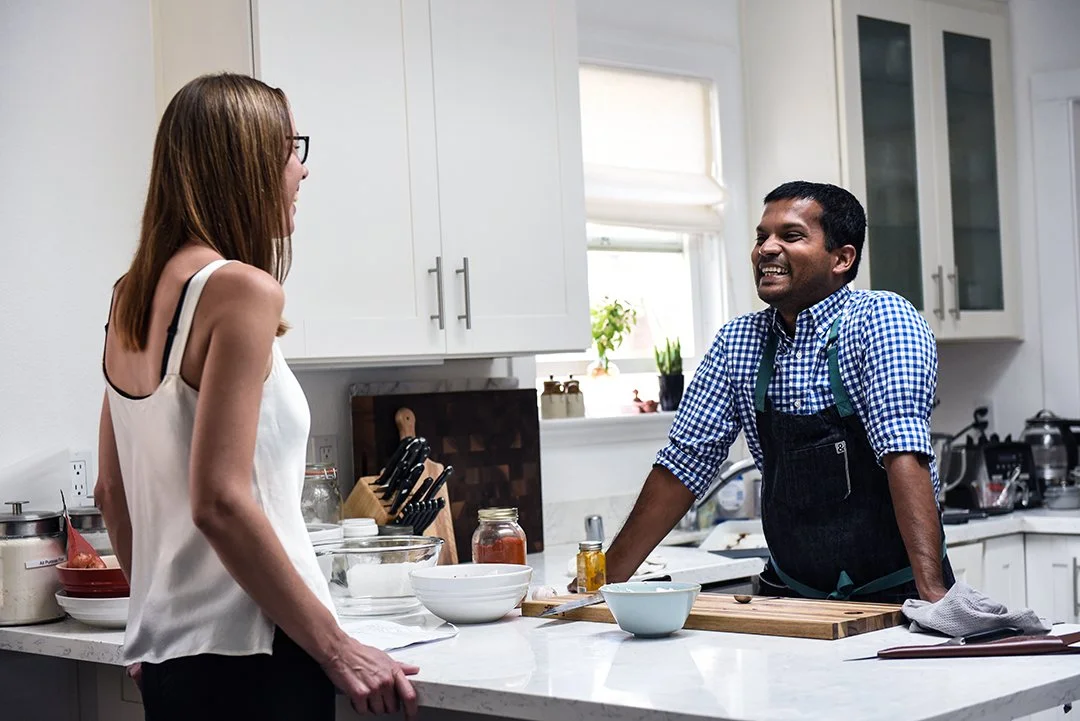


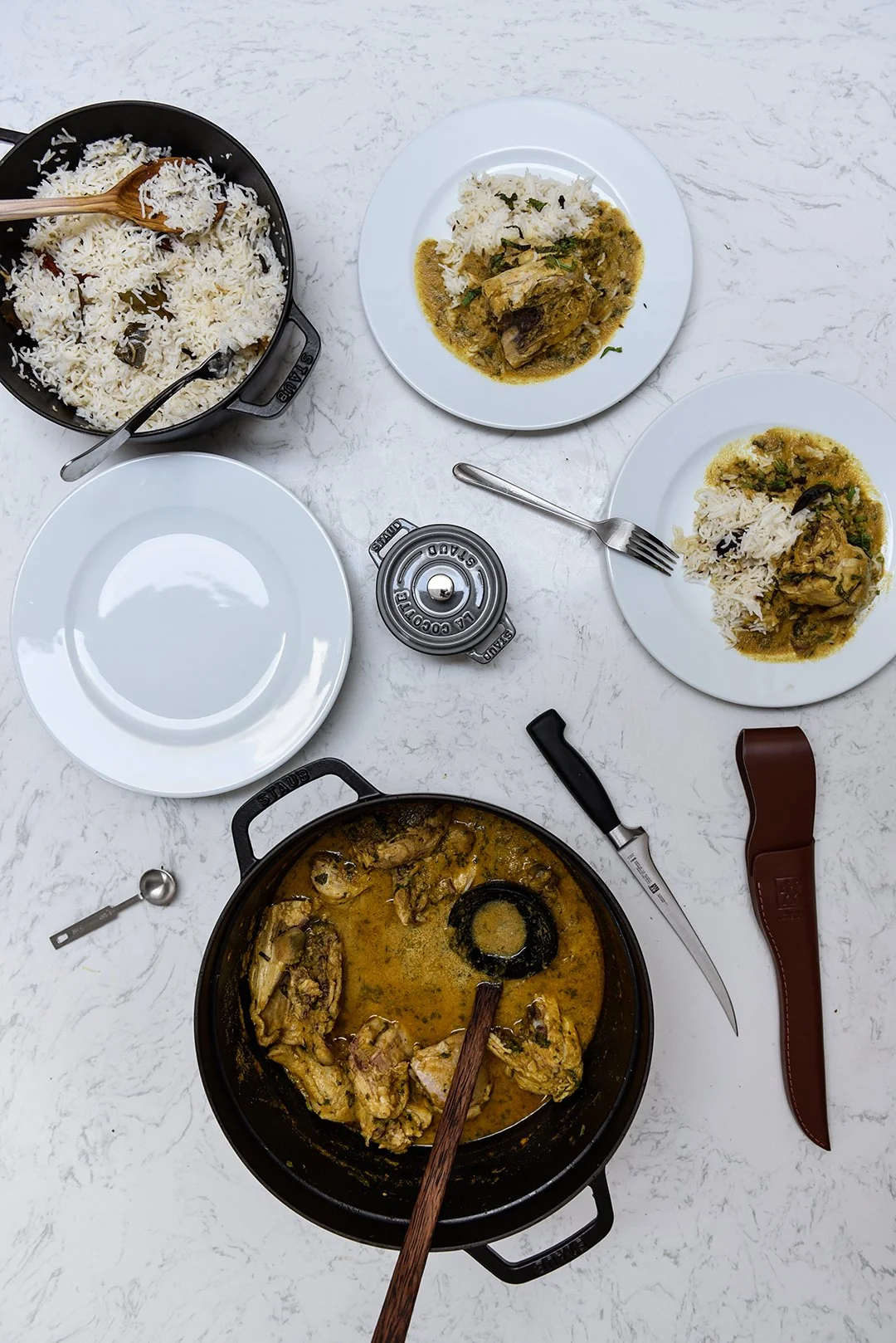

Meet In Your Kitchen | David Kurtz & the best Cubano Sandwich in San Francisco

A food loving friend of mine who lives in San Francisco told me, if you come to California, you must (!) meet David Kurtz and visit his Homage restaurant in Downtown. I trust my friends, especially when it comes to food, so I emailed David that same evening, not only receiving an answer that he was looking forward to cooking with me, but also to showing me around his hometown and spending a day together to give me an insight into his charismatic city that has so many faces.
The first thing that people think of when it comes to San Francisco is the Golden Gate Bridge and – if you talk to bread obsessed foodies and Instagrammers – the famous Tartine Bakery. The bakery is a temple for baked goods that one shouldn't miss, the bridge, however, is a moody diva that is hard to catch. San Francisco is a place of extremes when it comes to the weather, a fact that I had totally forgotten about and wasn't really prepared for. You can be spoilt with blue skies, sunshine, and summery temperatures in one second, then walk two blocks and be swallowed by mist and end up shivering in the cold. It was a bright afternoon as we drove to the famous bridge, impatient excitement in our faces ready to capture its majestic elegance, yet to find ourselves fighting against thunder and rain as we arrived was sobering. Needless to say there was no bridge in sight, but seeing the clouds climbing the hills behind the bridge and filling the bay with darkness and lightning faster than one can run was just as impressive.
The day we met David offered this exact spectrum of experiences, in food, weather, and sceneries. We started at the chef's wonderfully relaxed, casual, yet elegant Homage restaurant, a culinary gem tucked in a little side road surrounded by high office buildings. It's a tranquil oasis in the center of the vibrating buzz of this city. Sitting outside at one of the bistro tables, with a glass of Californian wine in my hand and a scrumptiously dripping sandwich on a chopping board right in front of me, was one of the best memories that I took home with me from this trip. This sandwich, the Cubano, is truly addictive and so famous that, according to David, it would cause a riot if he ever dared to take it off the menu. Imagine the best homemade baguette brushed and grilled in tasty pork fat (homemade lard), filled with succulent anise braised pork shoulder, hot smoked ham, Swiss cheese, mustard, dill pickles, and even more pork fat. It's the best sandwich I ever had in my life.
But before I could take a big bite of this unforgettably delicious lunch snack, David and I met two days before to prepare the dough for the bread in his kitchen and give it time to rise and rest. It was a Saturday morning and David and his lovely assisting, coordinating, and always helping 'right hand' Anja welcomed me and my film crew at Homage. David has the kind of voice and aura that calms you down immediately, whatever instructions he gave, I gladly obeyed and followed, enjoying to learn how to make the restaurant's beautiful baguettes and also being introduced to David and Anja's friends and suppliers at the utterly stunning Ferry Plaza Farmer's Market. The market is their weekly shopping date, it's a mecca for fresh produce. I've seen quite a few markets in my life, but this one is impressive, not only due to its setting right at the bay, but first and foremost because of the freshness and variety of the produce that the farmers offer at their stands:
Tomatoes kissed by the sun in all shapes, sizes, and colors; a sea of polished peppers; fragrant bundles of cilantro, basil, bay leaves, mint, and purslane; farmers' stands specialized in beans (like Romano and Cranberry Beans), or figs, 8 or 10 different kinds of figs gently laid out in baskets, or a stand putting the spotlight on plums, peaches, and nectarines, run by a woman with the sweetest smile, Aomboon Deasy. Each person, each stand at the market focuses on the prettiest crisp fruits and vegetables, celebrating its taste and beauty. One stand in particular left me in an awe: piles of Baby Curly Kale, Red Russian and Dino Kale, green and red dandelion, each leaf packed with so much pungent flavor that you want to nibble them straight out of the baskets (which we did).
I found the perfect partner for my market visit, David and I love food so much so that when Anja gave me a beautiful flower bouquet at the market, both David and I started eating the petals. Like I said, when he tells me in his trustful voice "Meike, you can eat this", I'll eat it! But apart from flowers and greens, I also tried the crunchiest spicy kimchi, candy-sweet September strawberries (a luxury for a German girl who's used to a rather short season of this fruit in her own country), ripe dates right off the vine, and the Rebel Within, a savory muffin filled with a soft boiled egg, sausage, Asiago cheese, and spring onions. It was heaven.

After the 'hard work' at the market and in the kitchen, we spoilt ourselves with a little feast at Nopalito, David's favorite Mexican restaurant. They cook delicious organic classics, like ceviche verde, enchiladas de mole con pollo (shredded tender chicken in a deep rich chocolaty sauce), and grilled fish tacos, all washed down with Michelada, Mexican beer with tomato, jalapeno, orange, lime, and salt – which was quite an experience. And after the meal we went for a walk at Golden Gate Park, where we were supposed to forage for forest snacks that one can find in a city if you keep your eyes open, but we chatted the time away. Wrapped in dense mist hanging heavily in the air, I was amazed by the beauty of the ever changing weather and the surprising scenes that it causes, and by David's philosophy and thoughts about the food that he celebrates at his restaurant.
Homage is a very, very special place that I'll always go back to when I'm in San Francisco, because of David and Anja, because of the food that's created and put together by the chef and his team with so much love and attention to detail in every single ingredient, because of this warm atmosphere that welcomes you as soon as you open the heavy door flanked by the restaurant's black facade, an atmosphere that makes you never want to leave again. And if you want to take a piece of it with you, you can grab a jar of the homemade pickles, jams, or a bottle of the wines and beers brought to Homage by David's friends, a bunch of people who find satisfaction in creating products of outstanding quality, just like David. And thanks to them we enjoy treats that taste so good - maybe because of the last ingredient that David listed in the recipe for his Cubano sandwich that he gave me: Love.
In the next months, I’ll share many new Meet In Your Kitchen features with you that took me to California, Italy, France, and Japan. Thanks to Zwilling for sponsoring these features for our culinary trip around the world!

David Kurtz' Baguette and Cubano Sandwich
David mills the grains for the flour that he uses for this recipe himself, however you can also use store-bought flour. It's recommended to work with grams instead of cups, as it's important to use precise measurements for this recipe.
For the baguette
Makes 3 baguettes
519g water (lukewarm)
30g honey
23g SAF instant yeast
875g all purpose flour
60g fresh whole wheat flour
Or if available (instead of the whole wheat flour)
23g hard red wheat flour
23g soft white wheat flour
14g rye flour
157g good quality lard (cold)
20g sea salt
In a large bowl of a stand mixer, using a fork, combine the water, honey and yeast, let it sit for a couple minutes.
In a large bowl, combine all the flours, add to the yeast mixture and, using the hook, mix for a few minutes or until well combined. Add the lard and, using the hook, continue kneading for a few minutes or until the dough has come together. Add a little more flour if it's too sticky or, if it's too firm, add a little (!) more water. Add the salt and continue kneading until well combined and firm. Form a ball, place in a clean bowl, and cover with a damp towel. Let the dough sit in a warm place for 1 hour. Turn the dough completely over releasing built up CO2 and let rise again for another hour, covered with a damp towel.
Line a baking sheet with parchment paper.Punch the dough down, take it out of the bowl, and divide equally into 3 pieces. Roll into smooth balls and let bench rest for 10 minutes under a damp cloth. When fully rested, take one piece of dough and stretch and pull it into a longish rectangular shape (about 14x5.5" / 35x14cm). Carefully flip 1 long side over until it reaches the middle of the rectangle, mind that no air is trapped in the fold. Then flip the opposite long side over, so that you end up with 3 layers of dough folded on top of each other. Using your fingers, pinch the fold all the way to seal well. Gently roll the dough into a long, thin sausage shape, then carefully, but quickly transfer to the lined baking sheet (the pinched fold should be on the bottom side). Continue forming the remaining 2 baguettes and transfer to the lined baking sheet. Cover with a damp kitchen towel, transfer the baking sheet to the fridge, and let the baguettes rest in the fridge overnight, further developing flavor and retarding the yeast activity.
Preheat the oven to 350°F / 175°C (convection setting). Take the baguettes out of the fridge when the oven is hot and ready.
Spray the baguettes with a little water and bake for 6-12 minutes or until the crust is golden, spraying them with water once or twice while baking. Internal temperature of the bread should be 210°F / 100°C when fully baked.
For the Cubano sandwich
Makes 1 sandwich
1 large piece of fresh baguette, cut in half
Dijon mustard
Whole grain mustard
2-3 thin slices hot smoked ham
1.5 ounces / 40g Swiss cheese (one that melts well), thinly sliced
2-3 anise pickled spring onions (or fresh spring onion), thinly sliced
2-3 dill pickles (gherkins), cut in half
5-7 ounces/ 150-200g braised pork shoulder (preferably cooked with anise and citrus), pulled or shredded
Good quality lard (pork fat)
Love, most importantly
Heat two heavy pans, preferably cast iron, over medium-high heat.
Spread the inside of the baguette with Dijon and whole grain mustard. Lay the ham on the bottom and topside of the opened baguette. Arrange the cheese, spring onions, and pickles on top of the ham. Spread the braised pork shoulder on top and close the baguette. Brush one pre heated pan with fresh lard, carefully place the Cubano onto the pan’s surface and brush more lard onto the top of the baguette. Squeeze, or press the Cubano with the other preheated pan directly on top of the sandwich. Cook in the pan, on medium heat, turning once, for a few minutes or until the cheese has melted and the crust of the bread is golden brown and crunchy.
Prepare with love and serve immediately with a large sliced pickle.


Watch my interview with David in San Francisco in September 2017:
Thank you, David!

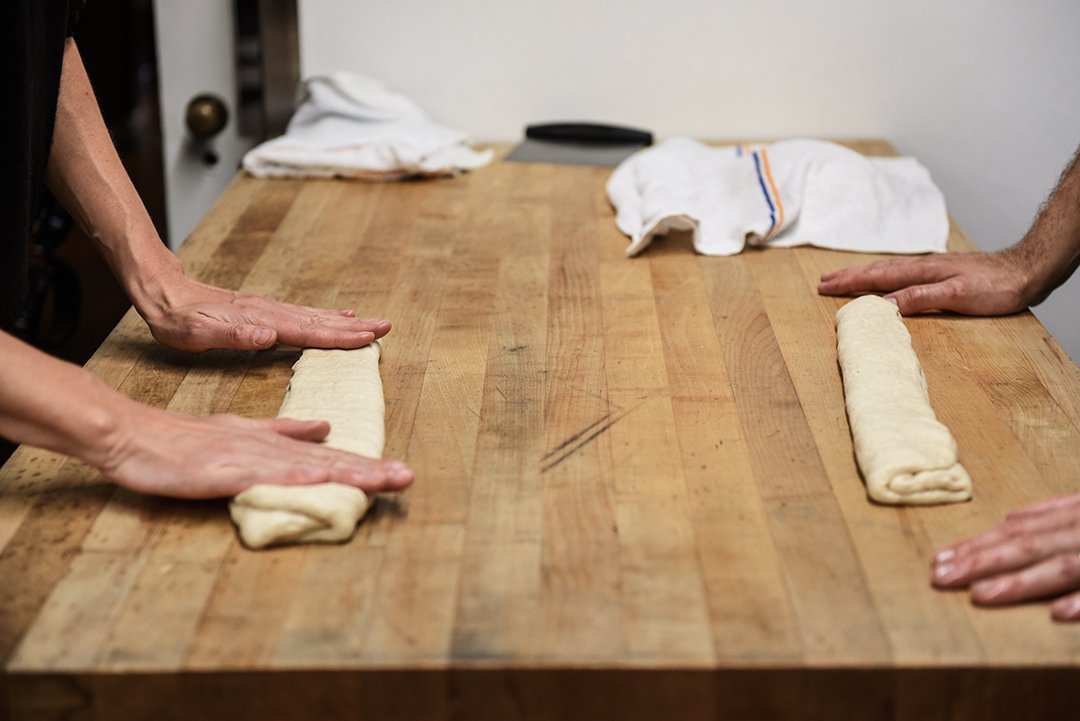

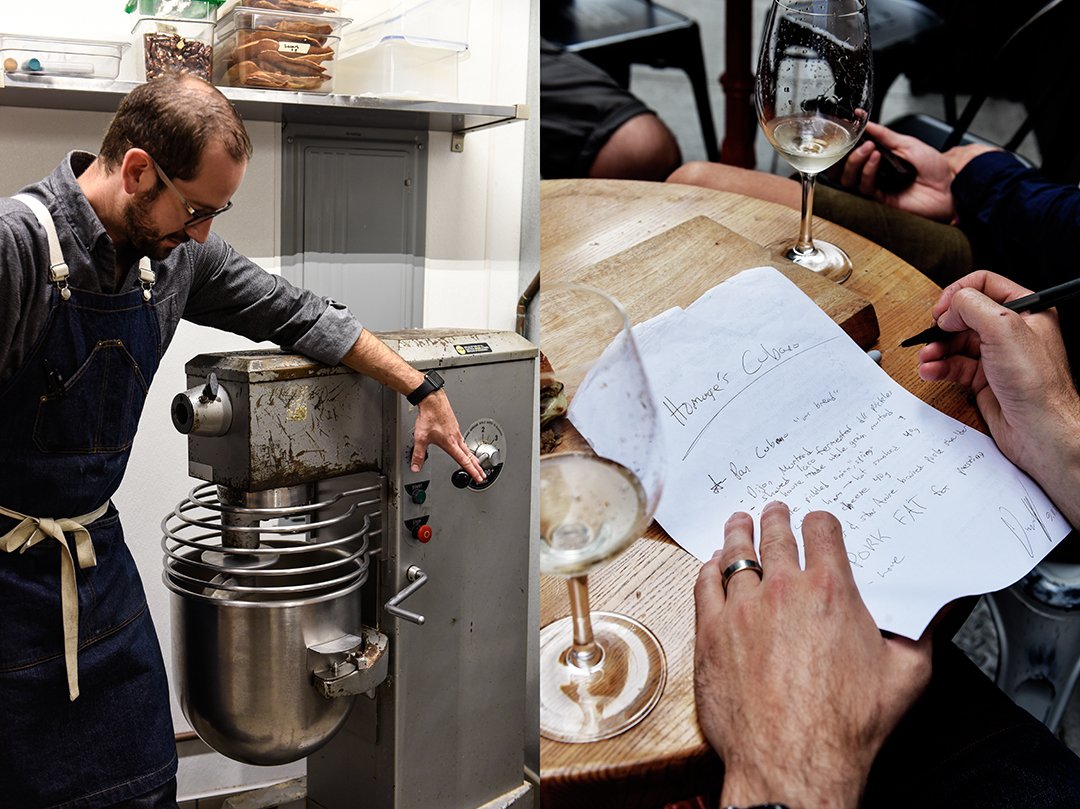





Meet In Your Kitchen I Maria Sinskey's Culinary Take on Napa Valley

The air is hot and dry in Napa, not the slightest movement, it stands still, wrapping the hills and vines in a magical silence.
We first stopped at a lake, Lake Hennessey, on our way to meet the Sinskeys at Robert Sinskey Vineyards. The scene was too peaceful and beautiful, as perfect as a postcard, the calm water spread out in front of us. A man sat at the sandy bank staring into the bluest sky reflecting on the water's surface, I walked through the swaying grass and my film team made jokes about unseen alligators. Later, Maria Sinskey told me that there are rattlesnakes in the area – sometimes it's good not to know the danger around you and enjoy the moment.
I had seen the wines of the Robert Sinskey Vineyards on the menu of some of the best restaurants in San Francisco, friends praised the quality of their reds and whites, so there were enough reasons to pick this particular wine maker in Napa on my culinary trip through California. But what struck me goes beyond an excellent bottle of wine: it's the Sinskeys' philosophy of making honest wine, their work ethics oblige them to take care of their team, who also hold shares of the company and have been with the wine making couple for decades. Maria and Robert create an environment of togetherness, they cherish people, nature and its gifts, they live a good life and share it with the ones around them.
Robert Sinskey was a photographer in advertising, he's an artist, a philosopher, he never went to a wine school, but maybe that's the reason why he makes good wine. It was a call from his father 25 years ago that changed his life, Sinskey senior needed help at his wine business, and young Rob fell in love with his new obsession for grapes and what you can do with them. He turned the 200 acres of premium vineyards into an organic, biodynamic ecosystem at a time when this step wasn't as popular as today, he was a pioneer, inspired by Rudolph Steiner's 1928 "Agriculture" manifesto. Believing that, if you harvest grapes of outstanding quality, you don't actually have to do much, you can let nature do its thing and trust. In that respect, the Sinskeys feel closer to the European than the American tradition of wine makers. Rob says "wine should not be a quick study, but rather, sneak up on you, seduce you, and evolve in the glass and in the bottle. The goal is to make pure wines of character that pair well with cuisine." And now, his wonderful wife Maria comes in.
Maria Sinskey is an acclaimed chef and cookbook author from New York, she's the cooking soul of the winery. She worked at Michelin starred restaurants in France but when Rob won her heart, she moved to Napa and set up her beautiful open Vineyard Kitchen right in the heart of the winery's rustic stone building, next to the wine tasting room. It's not a restaurant, you can only book and enjoy her exquisite culinary compositions along with a tasting experience (a visit and reservation is highly recommended). Maria and Rob follow the same credo: nature is good, trust her, treat her well and you'll be gifted. Organic fruits and vegetables come from the garden, sheep grazing the vineyards provide wool and meat, beehives pollinate the orchards and bring the most delicious honey to Maria's kitchen.
You could call it an utopia, you could call the Sinskeys dreamers, but decades of creating fantastic wine and food with and not against nature that people praise all over the world, living and working harmoniously in a community with love and passion, and feeling - as a guest - the spark of happiness and dedication jump over, would prove you wrong.
Maria spoilt us like kids with her elegant, deliciously cozy comfort food. Her duck confit was a revelation and her herb marinated rack of lamb with sun-ripened tomato and herb blossom salad tasted just heavenly, thankfully she shared the recipes with us.
Check for visits: robertsinskey.com
In the next months, I’ll share many new Meet In Your Kitchen features with you that took me to California, Italy, France, and Japan. Thanks to Zwilling for sponsoring these features for our culinary trip around the world!


Sun-ripened Tomato and Herb Blossom Salad
________________
Herb Marinated Rack of Lamb with Buttered Green Beans, Roasted Potatoes, and Lamb Jus
By Maria Sinskey
Sun-ripened Tomato and Herb Blossom Salad
Serves 6
Capture the flavor of ripe, just-picked tomatoes at their peak with this simple salad. The sweet tomatoes are gently scented with herb and arugula flowers that provide small bursts of intense flavor. Blossoms can be gathered as herb and arugula plants bolt. If herb blossoms aren’t available use small herb sprigs and leaves instead.
6 ripe garden tomatoes, about 2 pounds, assorted colors and sizes
Extra virgin olive oil
Aged balsamic vinegar
Flaked sea salt
Freshly ground black pepper
¼ cup (a handful) mixed herb blossoms – dill, arugula, basil, chive
Core and slice the tomatoes into ¼-inch / ½-cm thick slices and fork-size wedges. Arrange the tomatoes on a serving platter. Drizzle with olive oil and balsamic vinegar. Sprinkle with sea salt and grind a few grinds of black pepper over. Scatter the blossoms over the top. Serve with simple crisp flatbread if desired.
________________
Herb Marinated Rack of Lamb with Buttered Green Beans, Roasted Potatoes, and Lamb Jus
Lamb Jus (to serve with the rack of lamb, can be prepared in advance)
Yield: 2 cups (470ml)
1 head garlic, cut in half horizontally
4 tablespoons unsalted butter, divided
2 medium shallots, peeled and sliced thinly
1 cup (240ml) red wine
4 cups (950ml) lamb stock
1 medium plum tomato, fresh or canned
1 3-inch / 8-cm sprig rosemary
Kosher salt
Freshly ground black pepper
Preheat the oven to 375°F (190°C). Wrap garlic in aluminum foil and bake until garlic is aromatic, soft and caramelized, about 45 minutes. Reserve.
Heat a 3-quart / 2.8-l saucepan over medium-high heat, then add 1 tablespoon butter. When the butter starts to brown, add the shallot and cook for about 2 minutes until the shallot is wilted and starting to turn golden.
Add the wine and bring to a boil. Reduce heat and simmer until wine is almost dry, about 10 minutes. Add the lamb stock, roasted garlic head, tomato, and rosemary spring. Bring to a boil and then reduce to a simmer. Simmer until stock is reduced by half. Strain the jus into another pan and season to taste with salt and pepper. Reserve at room temperature for up to 4 hours otherwise refrigerate.
To serve: Return sauce to a simmer. Check seasoning, then whisk in the remaining 3 tablespoons of butter until emulsified. Serve immediately.
Herb Marinated Rack Of Lamb
Serves 8
The herb marinade for the rack really perfumes the meat if it is done a day or two ahead of time. The same marinade can be used for many other cuts as well. It is best to remove as many of the herbs and garlic before roasting as they will burn and create off flavors.
2 lamb racks, 8-9 ribs each
¼ cup (60 ml) extra virgin olive oil, plus 2 tablespoon for roasting the meat
4 garlic cloves, unpeeled and crushed
2 4-inch / 10-cm rosemary sprigs, crushed
6 thyme sprigs, crushed
4 rosemary sprigs for garnish
Sea salt
Freshly ground black pepper
Clean the rib bones well by scraping off meat and sinew with a small sharp knife. Cut the racks in half so that each has four ribs. Mix together the olive oil, crushed garlic, crushed rosemary and thyme sprigs in a large bowl. Add the lamb and coat well. Grind some coarse black pepper over all. Wrap well and marinate the racks overnight.
The next day prepare the roasted potatoes first, then continue roasting the lamb.
Preheat the oven to 400°F (200°C). Remove the lamb from the marinade and scrape off as many herbs as possible.
Heat a large sauté pan over medium high heat and add 2 tablespoons of olive oil. Season the lamb well with salt; no additional pepper should be necessary, and sear fat side down until golden, about 7 minutes. Turn over so that the fat side is up and roast in the preheated oven for 17-20 minutes for medium-medium rare (120°F / 50°C internal temperature). Let the rack rest for 10 minutes before cutting. Prepare the beans while the meat is resting.
To serve, cut each lamb rack half into 2 equal pieces, two bones per chop, and serve on individual plates or a platter with the roasted potatoes, beans, and lamb jus.
Olive Oil and Sea Salt Roasted Potatoes
Serves 8
2 pounds yellow potatoes, Yukon Gold or similar
Sea salt
3 tablespoons extra virgin olive oil
3 tablespoons unsalted butter melted
Preheat the oven to 425°F (220°C).
Peel the potatoes and cut into ½-inch / 1.25-cm pieces. Reserve in a bowl of cold water to keep from browning.
Fill a large pot with water and bring to a boil, season well with salt. Add the potatoes and boil for 7 minutes until the potatoes are tender. Drain the potatoes into a colander. Make sure they are very dry.
Place the well-drained potatoes in a large sauté pan and toss them with the olive and butter and additional salt to taste. Place the pan in the oven and roast for 30 to 40 minutes until the potatoes are golden and crispy on the edges. Keep them warm.
Buttered Green Beans
½ pound freshly picked green beans or haricot vert
Salt
3 tablespoons unsalted butter
Trim the stem off of the beans but leave the slender pointed tips. Reserve.
Ready a medium bowl of ice water. Bring a large pot of water to a boil. Add salt until the water tastes of the sea. Add the beans and cook until tender about 3-4 minutes. The thinner and fresher the beans the faster they will cook. Remove the beans from the pot with a pair of tongs or skimmer and plunge into the bowl of ice water to stop the cooking. When beans are cool, remove from the ice bath and let rest in a strainer or colander to drain.
To serve: melt the butter in a large sauté pan and add ¼ cup (60ml) water. Bring to a boil to emulsify, season with salt to taste. Add the beans and toss until heated through. Remove with tongs to a serving plate. Serve immediately.


Watch my interview with Maria in Napa in September 2017:
Thank you, Maria!

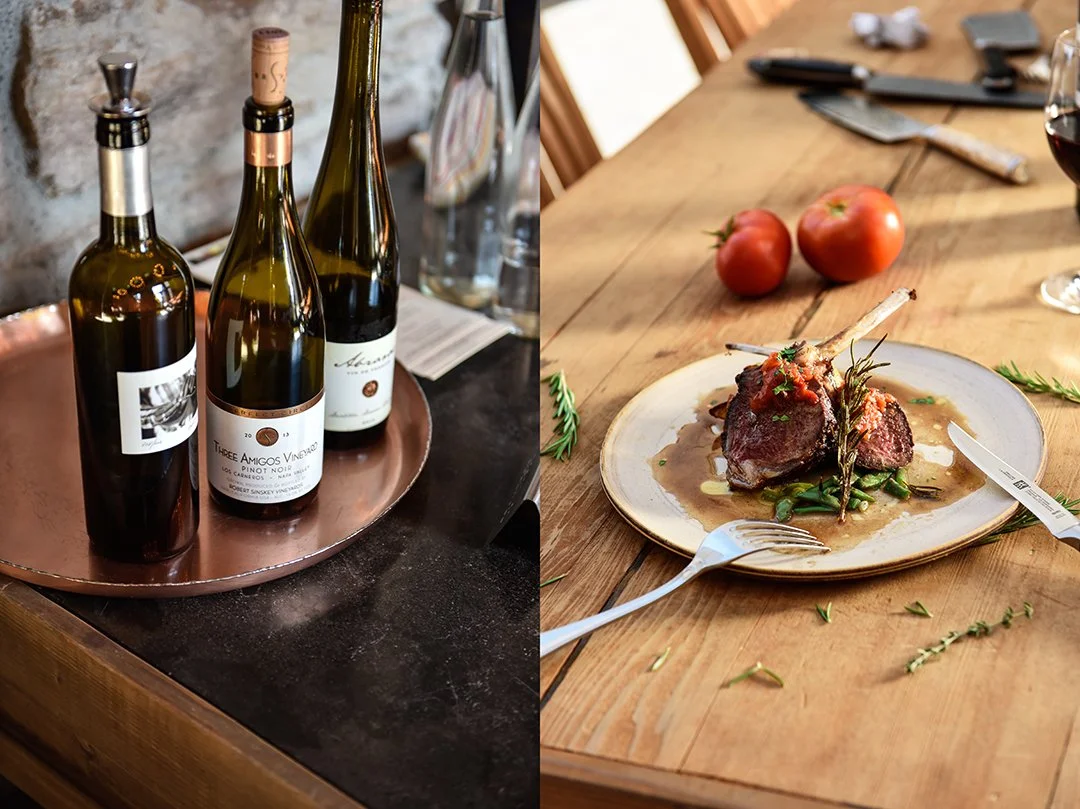


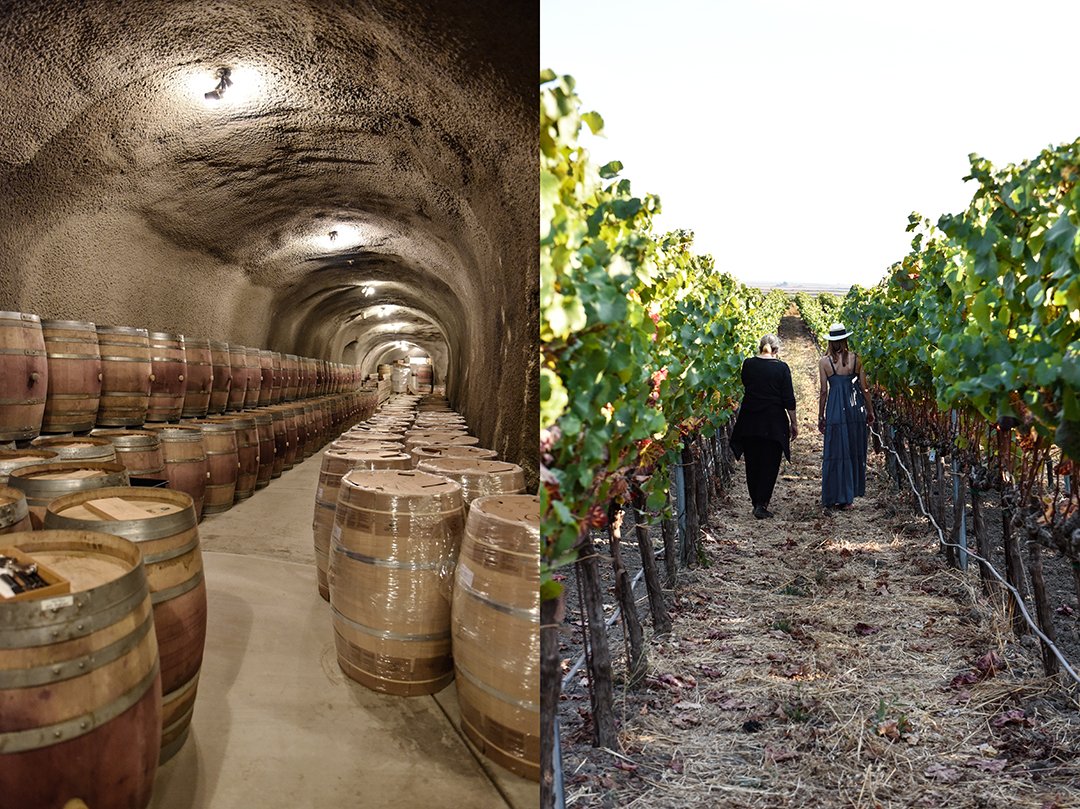

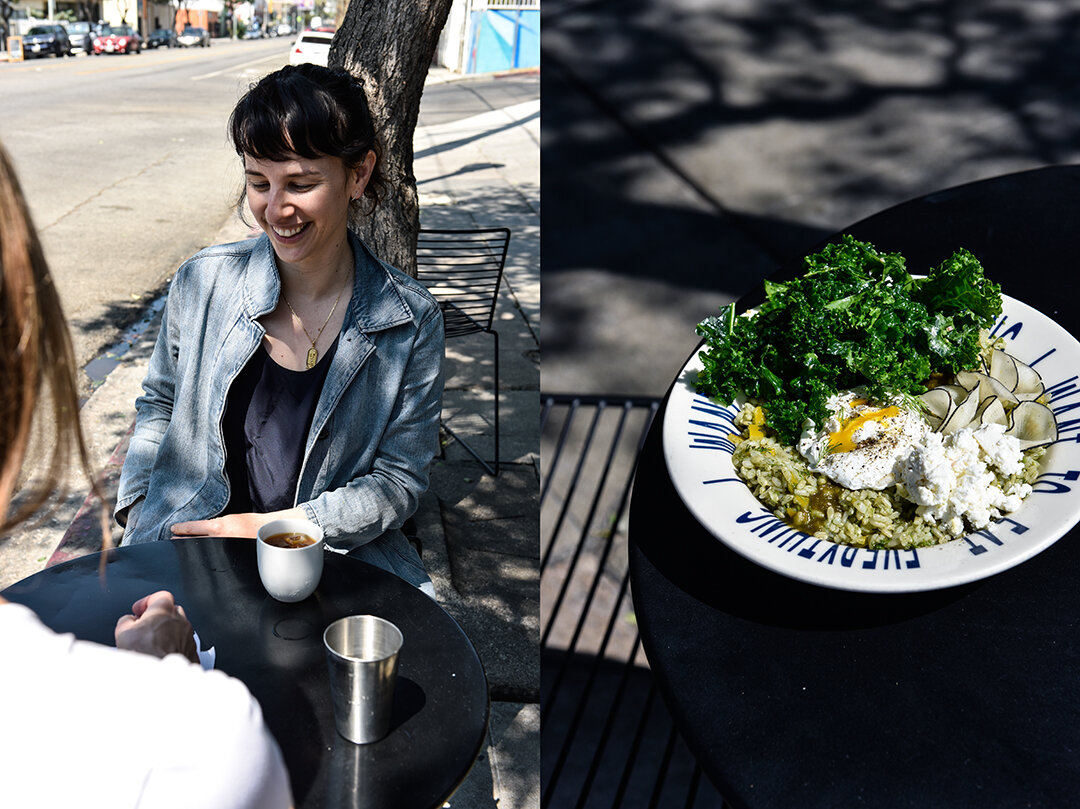
Meet In Your Kitchen | Jessica Koslow's Sqirl in LA & the Magic of Sorrel Pesto Rice

It's captivating to watch a craftswoman concentrating on her material, a carpenter choosing the right piece of wood, a tailor feeling the fabrics, or a chef taking about a new recipe and picking the right ingredients. Jessica Koslow is a craftswoman, but she's equally an artist gifted with a huge sense for freedom and creativity and this shines through every single one of her creations. She's also a scientist who critically re-thinks all the single components of a dish until the final result is complete, until the textures and flavors feel aligned, until it looks deliciously tempting. This woman is so much, which makes her one of the leading figures of a new powerful movement of female chefs in California, but also in the rest of the world.
Sqirl is located just around the corner from Vermont Avenue that leads straight to Griffith Park, the restaurant is almost unspectacular, pleasantly unpretentious and casual, but the dishes that come out of the kitchen can easily compete with Michelin starred restaurants. The open kitchen works smoothly, peacefully, every chef seems to deeply enjoy the part they have in the Sqirl universe, it's a bit like friends cooking, just more precise. Like the Sorrel Pesto Rice, inspired by Pierre Troisgros, the father of the nouvelle cuisine movement, that blew my mind: Kokuho rose brown rice, sorrel pesto, preserved meyer lemon, lacto-fermented hot sauce, watermelon radish, French sheep feta, and a perfectly poached egg spreading its shiny liquid yolk all over this vibrant composition. And the Sqirl Chicken Salad with Marin Sun chicken, bok choy, dehydrated citrus and root vegetables, grated carrots, and black garlic vinaigrette balances crunch and tenderness, sweetness and bitterness, it's a dish that excites and satisfies.
Jessica comes across as very relaxed, she laughs a lot, but when you ask her a question she pauses and takes her time to think, to answer with the same precision you can find in her dishes, in the same way that she designed her restaurant, and how she put her first cookbook together, Everything I Want to Eat: Sqirl and the New California Cooking. There is a vision that only she can see that seems to guide her in the right direction. She used to be a competitive figure skater which explains her discipline and dedication, and when she stopped at 19, she channeled her obsession into something new: food.
From then on it was all about cooking, eating, and tasting. She was fascinated by the moment when you put the first bite into your mouth and you're overwhelmed. That's the experience she wants to create at her restaurant and she knows that she only has this first second to reach and convince her guests' taste buds. She and her team are gifted with outstanding produce, which she honors in her creations and that she receives from farmers who are friends and part of her community. This is the foundation of her work: "Raw produce defines a season, it's the passing of times and in California, thankfully, it's such a delicious marker of time. Our produce is an exciting time stamp and a building block from there." The Sqirl world is about dishes that feel familiar and unfamiliar at the same time, they create comfort and inquisitiveness, it's about different layers and textures, using the raw natural produce, but also playing with it, fermenting, pickling, or dehydrating it. As exciting as it is to eat this woman's food, it's a pure pleasure listing to her words.
Sqirl is a breakfast and lunch spot only, but in 2018 Jessica will open a dinner place for all her begging, hungry fans, called Tel - keep your eyes and ears open!
In the next months, I’ll share many new Meet In Your Kitchen features with you that took me to California, Italy, France, and Japan. Thanks to Zwilling for sponsoring these features for our culinary trip around the world!


Jessica Koslow's Sorrel Pesto Rice
Serves 6
3 cups (600 g) medium-grain brown rice, preferably Kokuho Rose
Fine sea salt
½ cup plus 2 teaspoons (130 ml) extra-virgin olive oil
1 cup (25 g) lightly packed kale leaves (stems removed)
2 cups (50 g) lightly packed chopped sorrel leaves
3 tablespoons fresh lemon juice
2 tablespoons chopped fresh dill, plus more for serving
1 Preserved Meyer Lemon, flesh removed, peel finely chopped
2-4 small watermelon radishes, very thinly sliced
¼ cup (60 ml) Fermented Jalapeño Hot Sauce
¾ cup (85 g) crumbled sheep’s-milk feta
6 poached eggs
Fleur de sel
Freshly ground black pepper
Boil the rice in plenty of salted water until it’s tender, 30 to 45 minutes. Drain and let cool.
Meanwhile, make the sorrel pesto: In a blender or food processor, combine ½ cup (120 ml) of the oil, kale, sorrel, and 1 tablespoon of the lemon juice. Blend until smooth, stopping and scraping down the sides as needed. Season with salt to taste.
In a large bowl, toss the rice with the dill, preserved lemon peel, 1 tablespoon of the lemon juice, and the pesto. Taste and add a bit more salt, if needed.
In a small bowl, toss the radish with the remaining 1 tablespoon lemon juice, the remaining 2 teaspoons oil, and a pinch of salt. Set aside to marinate for a few minutes, until the radish is pliable and tender.
To serve, divide the rice among six bowls. Spoon a line of hot sauce across the rice. Arrange a little clump of feta on one side and a rosette of radish slices on the other side. Set a poached egg in the middle of each bowl and season it with fleur de sel and black pepper. Garnish with a tiny sprig or two of dill.


Watch my interview with Jessica in LA in September 2017:
Thank you, Jessica!





Jessica Koslow
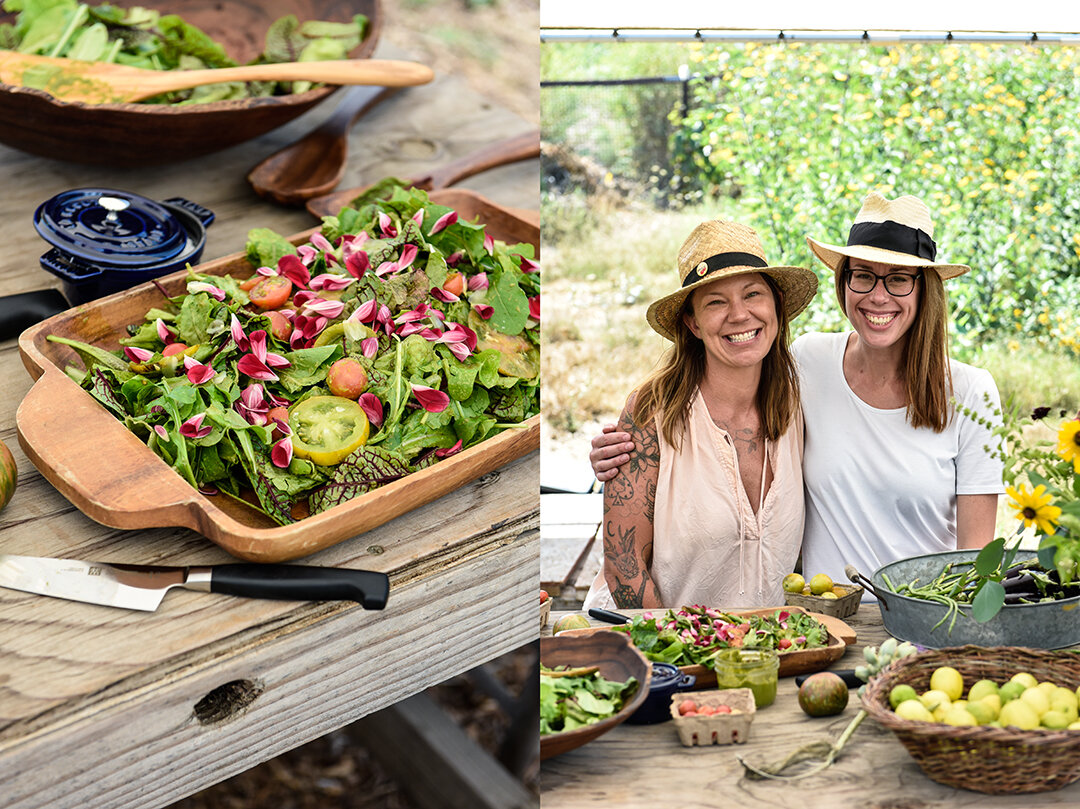
Meet In Your Kitchen | Urban Farming and a Garden Salad at LA's Farm Lot 59

A 1-hour drive, leaving the skyline and the buzz of Downtown LA behind, and you're in Long Beach, still LA county, yet a totally different scene. As we left California Avenue in the south and drove our bulky van down a dusty road for a new Meet In Your Kitchen feature together with Zwilling, the inspiring urban farmer Sasha Kanno welcomed us with a big smile in front of the gate of her green oasis, Farm Lot 59.
Sasha is a woman with a strong vision and principles, she believes in honest food, available not only for herself, but also for the community that she lives in. She took over the land surrounded by urban industrial buildings in 2010 and turned it into a non-profit organic farm, practicing biodynamics and following the Waldorf School philosophy. The farmer who's fascinated by rare and heirloom varieties and who gets many of her seeds from a 100-year old seed company in Honolulu, is famous and loved by locals and chefs for her outstanding lettuce and herb mixtures. All year round, she puts an exciting seasonal bouquet together, of arugula, lemony blood sorrel, giant red-leaf mustard lettuce, basil (with a rough surface), huacatay (black mint), cilantro, fennel, tarragon, thyme, chocolate mint, and many more. Her edible flowers, such as pensi, dahlia, dianthus, calendula, lavender chamomile flowers, are a feast for the eye and an explosion of flavors for the palate.
However, as much as she loves to share the produce from her garden with other passionate lovers of natural, healthy fruits and vegetables, Sasha felt that there was more for her to do. She started an educational program of cooking and gardening classes, she wanted to bring the basics back to the table of our children: her tomatoes, beans, eggplants, pumpkins, squash (I learnt that you can even eat its leaves cooked like a vegetable), peppers, snake melon, and artichokes. She wanted them to smell again and listen to the sounds of the woods and fields, and taste pure unprocessed food. She saw city kids who were totally overwhelmed by this experience, being confronted by nature, even stressed some of them. Some of the most common fruits and vegetables had never been in the hands of these children before. It's an essential experience, if not a right to have access to food in its original form. Sasha takes responsibility to teach them about our fragile ecosystem, so that future generations adjust the way that we deal with ourselves, our food, and our environment.
The doors of Farm Lot 59 are open almost every day and it's worth visiting this green paradise framed by apple, stone fruit, and guava trees. You can buy the handpicked produce and humanely sourced meats, dairy products, and eggs from friends and other farmers at the farm's market stand at the street, the Farmstand 59. And then you go home and prepare the beautiful salad that Sasha made for us in her outdoor farm kitchen: a colorful tomato salad with the farmer's delicious basil vinaigrette featuring the pure taste and beauty of this sweet fruit and fragrant herb!
In the next months, I’ll share many new Meet In Your Kitchen features with you that took me to California, Italy, France, and Japan. Thanks to Zwilling for sponsoring these features for our culinary trip around the world!

Sasha Kanno's Tomato Salad with Basil Vinaigrette
Serves 4
For the dressing
1 cup (240ml) olive oil
2 tablespoons red wine vinegar
1 red onion, roughly chopped
2 cups fresh Tuscan basil
1 clove garlic
½ teaspoon haberno salt (haberno peppers mixed with sea salt)
For the salad
8-12 green, red and yellow ripe tomatoes (of various sizes), sliced
2 large handfuls mixed young lettuce greens
1 small handful edible flower petals
For the dressing, purée the ingredients in a blender until smooth and season to taste with salt. Add more oil if the dressing is too thick.
Spread the lettuce greens and tomatoes in a large bowl, sprinkle with the dressing and flower petals and serve immediately.

Watch my interview with Alana in LA in September 2017:
Thank you, Sasha!


Meet In Your Kitchen | Heather and Emily celebrate LA's vegetables at Botanica
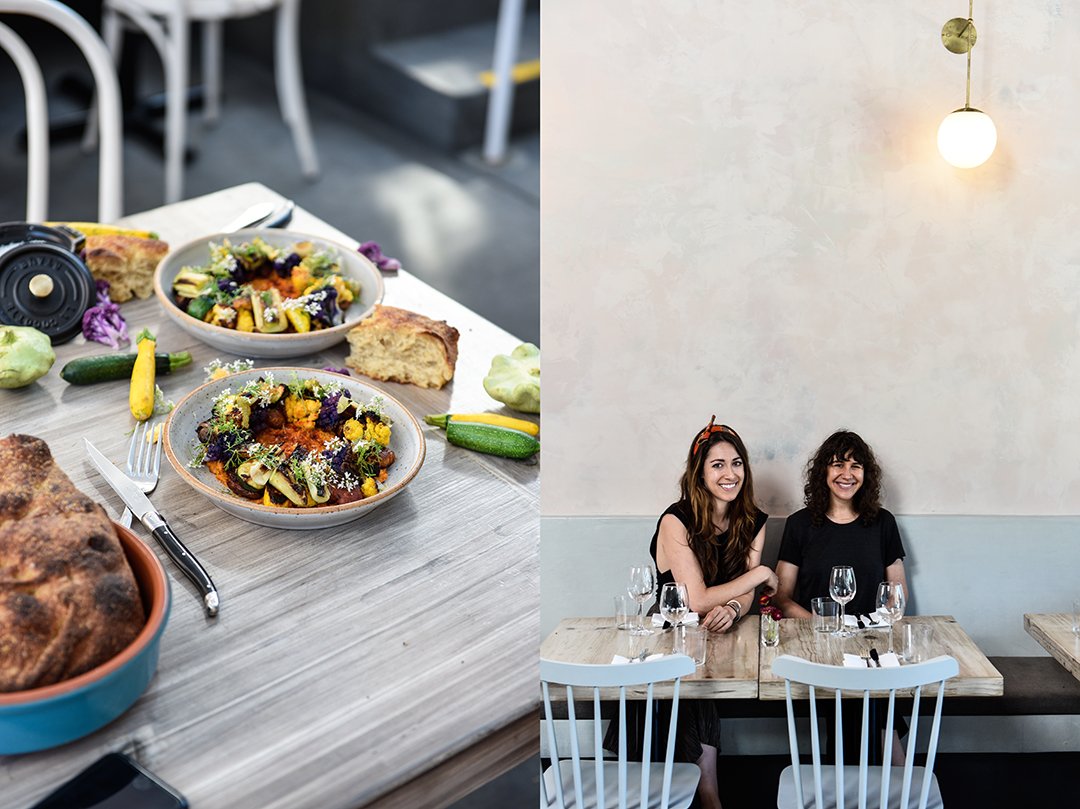
One of the kitchens that I visited on my trip to LA - the first stop of my new adventure together with Zwilling - was at Botanica, a stunningly beautiful restaurant founded by the wonderful Heather Sperling and Emily Fiffer. Both women had been working in the food industry as editors on the East coast for more than a decade, but they were hungry for more. They chose LA to bring a project to life, giving it all their love, passion, and honest determination. An old run-down liquor store in Silverlake looked less than promising when they first saw it, but Heather and Emily knew from the start that this would be the right place to give their vision a home. They gutted it and after a year of sweat and work you can't even imagine how this gorgeous bright and airy space looked before the renovations. A tall wall touched up in a soft Tuscan pink holds the old wooden beams above the restaurant's rustic wooden tables and the little market where you can buy the products and produce used in Botanica's kitchen.
The two ladies also started an online magazine, a collection of the recipes used at their restaurant to complete their customers hungry needs: you can eat a dish at Botanica, fall in love with it so much that you want to cook it at home, buy the ingredients right away, grab the recipe from the magazine, and go straight to your own kitchen and cook it again.
Sitting at this restaurant feels a bit like being in Heather and Emily's home and this was an important aspect for them when they first started thinking about their restaurant baby. The design, the menu they put together, the way they work together with their employees, this all shows a philosophy of working and living together in a community. They have strong connections with the other restaurants in their neighborhood, many of which are also run by women, and together they put the spotlight back onto LA's culinary scene (like "Kismet" that I wrote about last week and Jessica Koslow's "Sqirl", which will be featured here on the blog in 2 weeks). They not only share the same work ethics, but also their farmers and suppliers.
And they all have one more thing in common, all these restaurants celebrate vegetables. Heather and Emily manage to turn a potato, cauliflower, squash, or carrot into a vibrant feast. They shift the traditional focus from meat and seafood centric dishes to roots, cabbages, and legumes. Botanica is not a vegetarian restaurant, but ribs, steaks, or fillets aren't the star of the meal anymore, they can be a part of a greater composition, add flavor, be a luxurious treat of outstanding quality, but they aren't essential anymore. And the two women's recipes are so fantastic that you won't even miss it, you just indulge in a dish like their seared vegetables with romesco (recipe below), which is so rich, balanced, and exciting that you don't ever think of anything but tasty vegetables. And apart from this more than satisfying pleasure for the taste buds, you can be sure that you just enjoyed food that is good for your body, locally sourced in a strong community that works with and not against nature and our environment.
In the next months, I’ll share many new Meet In Your Kitchen features with you that took me to California, Italy, France, and Japan. Thanks to Zwilling for sponsoring these features for our culinary trip around the world!


Heather Sperling and Emily Fiffer's Seared Vegetables with Romesco
Serves 4
For the romesco
4 red bell peppers
1 jalapeño, seeds removed
2 medium cloves garlic
¼ cup (60ml) olive oil
1 tablespoon sherry vinegar
1 small lemon, zest and juice
2 teaspoons Spanish smoked paprika
1 cup (140g) toasted almonds
1 large handful fresh cilantro leaves (about ¼ cup chopped)
Sea salt
For the vegetables
20 tiny potatoes (preferably purple), boiled in salted water until just tender, drained and cooled
Olive oil
Sea salt
Black pepper
Spanish smoked paprika
Broccolini, summer squash, romanesco, Brussels sprouts or cauliflower (or a mix)
3 leeks, white and light green part only, cut in half lengthwise
For the topping
About ½ lemon, zest and juice
1 small handful fresh cilantro flowers (or cilantro leaves)
Preheat the oven to 450°F (230°C).
To make the romesco: Roast the bell peppers until blistered and fully soft. Transfer to a large bowl and let them cool for a few minutes. Remove and discard the seeds and stems, collect the thick juices that run off the peppers. Peel the skin and set aside.
In a food processor, combine the roasted peppers and their skin, the jalapeño, garlic, olive oil, vinegar, lemon zest and juice, smoked paprika, almonds, cilantro, and a splash of the liquid from the peppers. Blend until fully incorporated, but not fully uniform; some texture is ideal here. Add more sherry vinegar, salt, olive oil, and cilantro to taste.
For the vegetables: Lightly crush each potato with the side of a knife. Heat a splash of olive oil in a pan over medium heat and sauté the potatoes on one side until just starting to crisp, then flip and crisp up the other side. Remove from oil and season well with salt, pepper, and a sprinkle of smoked paprika.
While the potatoes are crisping, prepare the remaining vegetables: Cut the vegetables into bite size pieces (except the leeks) and toss with olive oil, salt and pepper, then grill or sear until al dente, with nice char in spots. In a large pan, cook the leeks, cut-side down, until they get a touch of caramelized char, then flip and cook for a few minutes on the other side, until soft through. Cut in two-inch lengths, season, and set aside.
Mound the romesco in the center of a large plate and arrange the potatoes, leeks and vegetables in a ring around the purée. Garnish with a good drizzle of olive oil, a squeeze of lemon juice, lemon zest, a sprinkle of salt, and the cilantro flowers and serve immediately.


Watch my interview with Heather and Emily in LA in September 2017:
"I think that for many women in the industry, they are very aware that this is a moment in time when they can be actively involved in changing the culture of the restaurant world."
Thank you, Heather and Emily!
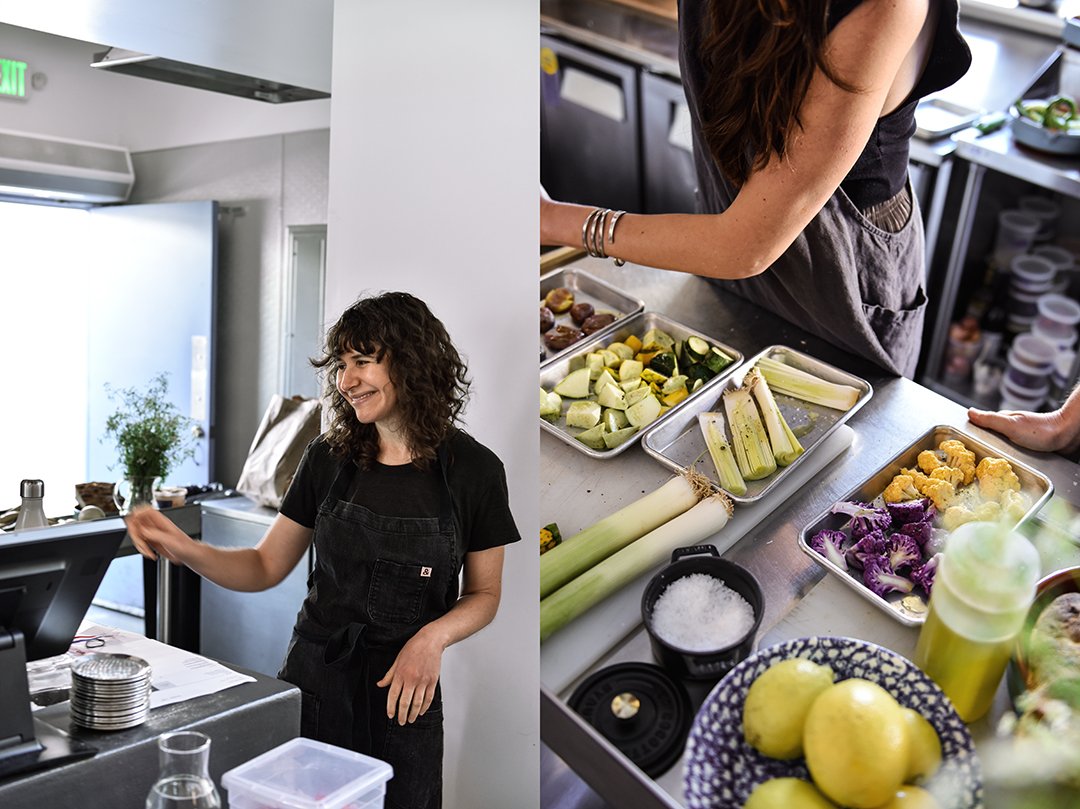


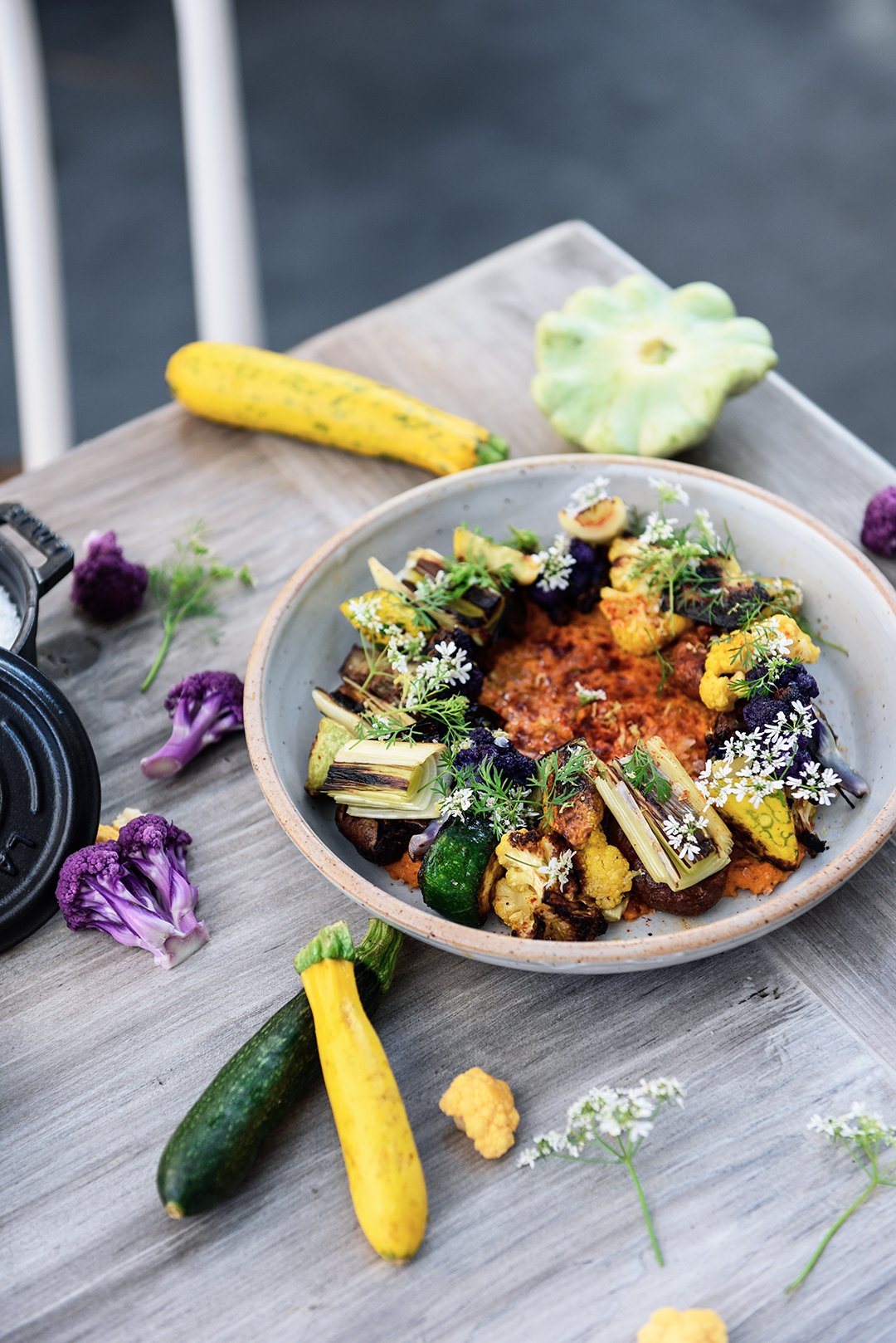
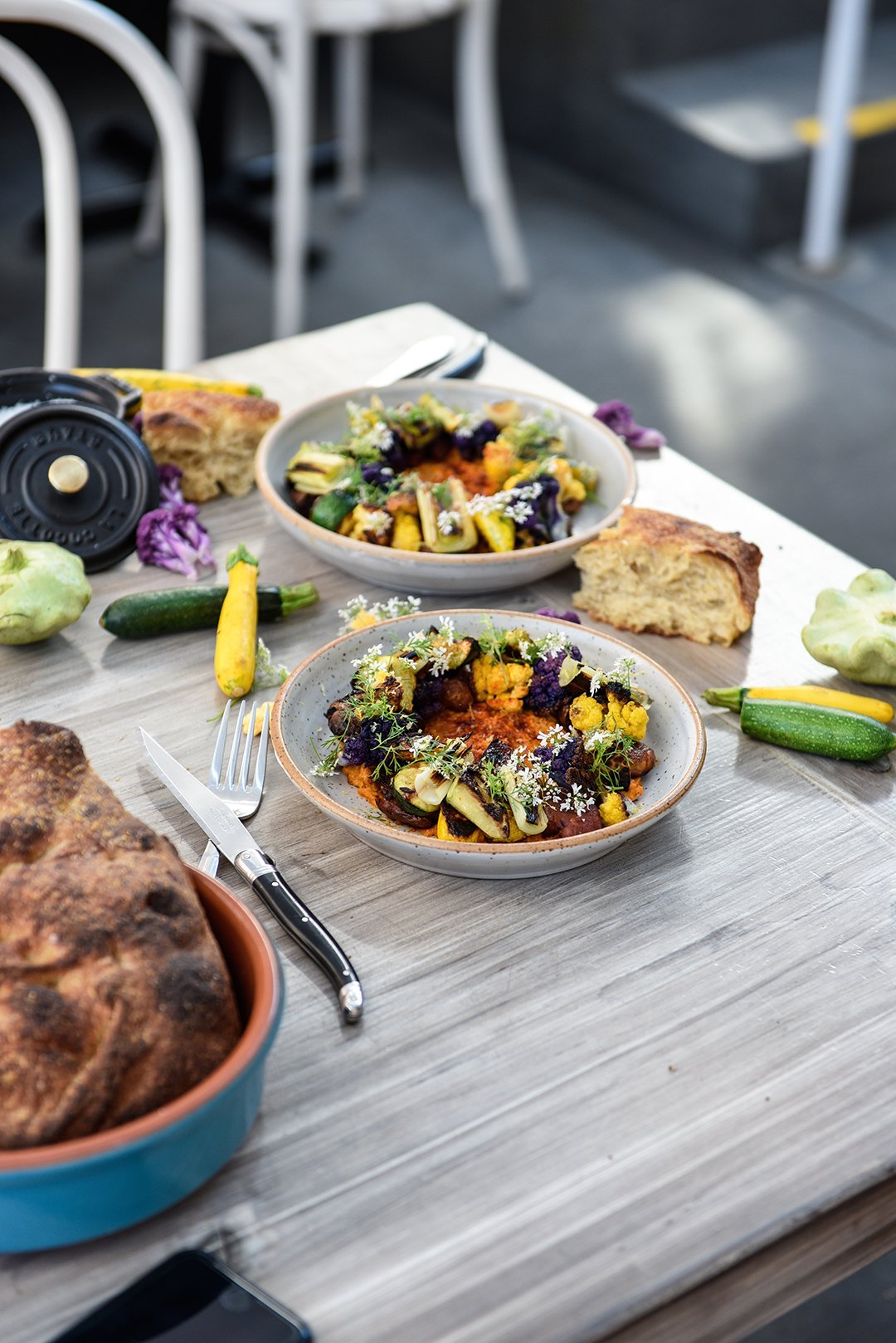
Meet In Your Kitchen | Kismet LA's Persian Cucumbers, Melon & Rosewater Labneh
White brushed walls, pale wood, and strong geometric lines turn Kismet into a minimalist spot of casual elegance right on LA's sunny Hollywood Boulevard. Sitting on the wooden bench at the wide window, the fleshy leaves of a tall banyan tree playing with the light, I felt immediately captured by the restaurant's laid-back vibe and exciting Middle Eastern and Mediterranean-style menu.
Sarah Hymanson and her partner Sara Kramer created a beautiful place to enjoy breakfast, lunch, or dinner with a group of friends - following their philosophy that food tastes best when you share it. Kismet is a neighborhood hub where you can fill your table with plates full of colorful vegetable focused delicacies and indulge in the pleasures of wonderful treats such as Little Gem Lettuce with Plums, Sprouted Lentils and Tarragon, Freekeh Polenta with Lamb, Green Chili, Greens and Poached Egg, or the wonderful Persian Cucumbers with Melon, Rosewater Labneh and Parsley Seed Za'atar – this recipe is a feast for the taste buds thankfully shared with us by the two chefs. You just dig in and feel happy, inspired by new flavor combinations focusing on taste and freshness. Or celebrate some precious time just for yourself and a book, have a coffee, and nibble on a Scone with Lemon Cream or Brioche Toast with Date Butter.
"LA is an exciting place to be right now, there's a lot of young creative energy", Sarah says. She doesn't hide that she loves the East coast, she's from Chicago and worked in New York for years, moving west wasn't an obvious step for her. In 2015, she met NY native Sara Kramer at Glasserie in New York, Kramer was the opening chef at the acclaimed restaurant and won Eater's NYC Chef of the Year award for her celebrated way of cooking. Yet the two strong willed chefs and highly creative minds who developed the vision of opening their own place, had to find out that it wasn't in the East but West, in California, where their first "baby" would open its doors. An organic falafel shop at the lively Grand Central Market in Downtown LA called Madcapra was their testing ground. It became a huge success and so Kismet came next.
Rooted in California through the produce that the Kismet chefs get from their beloved farmers and friends who are such an important part of their community of chefs – "their produce is what makes our food" - yet their style of cooking is very much based on their experiences in the kitchen and their upbringing. Thanks to the similar climate, they can use a lot of fruits and vegetables that are prominent in Middle Eastern cooking, such as pomegranate, dates, olives, and fresh herbs. This is the kind of food that both of them loved all their life, what they grew up with – Sara's mother is Israeli – it's the food that fascinates both of them and constantly feeds their inspiration.
LA has always offered a great platform and an excitable open-minded audience to female chefs, like Nancy Silverton, Suzanne Goin, Marie Sue Milliken, and Susan Feniger to name just a few. There's a history of inspiring women in this city and also in California in general who try alternative ways of producing food, cooking, but also working together. Over the past few years, there have been changes in restaurants all over the US that touch the roots of this industry. Work ethics change, the tone in the kitchen that was very male for decades, changes. "The women today try to challenge these norms by treating people as people. It's not an easy process, but it's a responsibility to the industry and the people working in this industry." Sarah and her partner introduced a 20% service charge on top to improve payments and also even out the gap between front and back of house at their restaurant. It's not easy, but it's an important part of the place that they want to create, where it's about good food, but also about a healthy community, in and outside Kismet.
In the next months, I’ll share many new Meet In Your Kitchen features with you that took me to California, Italy, France, and Japan. Thanks to Zwilling for sponsoring these features for our culinary trip around the world!


Persian Cucumbers with Melon, Rosewater Labneh and Parsley Seed Za'atar
By Kimset / Sarah Hymanson and Sara Kramer
Serves 6
For the Za'atar
2 tablespoons untoasted sesame seed, ground
1 tablespoon whole toasted sesame seeds
¾ cup (about 12g) dried rose petals, broken up
1 ½ teaspoons sumac
1 teaspoon parsley seeds, ground
¼ teaspoon salt
For the rosewater labneh
2 cups (470g) labneh
1 teaspoon salt
Zest of 2 lemons
2 cloves garlic, grated on a microplane
2 teaspoons honey
¼-1 tablespoon rose water, to taste
Black pepper, finely ground, to taste
For the salad
9-12 Persian cucumbers, rinsed, shaved lengthwise on a mandoline
1 cup (about 160g) melon, cut into oblique pieces
Juice of 2 lemons
Olive oil
Salt, to taste
Fresh chervil, leaves only
For the Za'atar, in a small bowl, combine the untoasted and toasted sesame seeds, rose petals, sumac, parsley seeds, and salt. You can keep the Za'atar in an airtight container for up to 1 week.
For the labneh, in a large bowl, combine the labneh, salt, lemon zest, garlic, honey, and ¼ tablespoon of the rose water and season to taste with pepper and additional rosewater. You can prepare the rose water labneh in advance and keep it in the fridge for 1 day.
For the salad, mix together the cucumbers, melon, lemon juice, olive oil, and a pinch of salt. Toss to coat and set aside.
Divide the rose water labneh between bowls, arrange the cucumbers and melon on top, and sprinkle each portion with about 1 teaspoon of the Za'atar and a little chervil. Serve immediately.


Watch my interview with Sarah in LA in September 2017:
Thank you, Sarah!


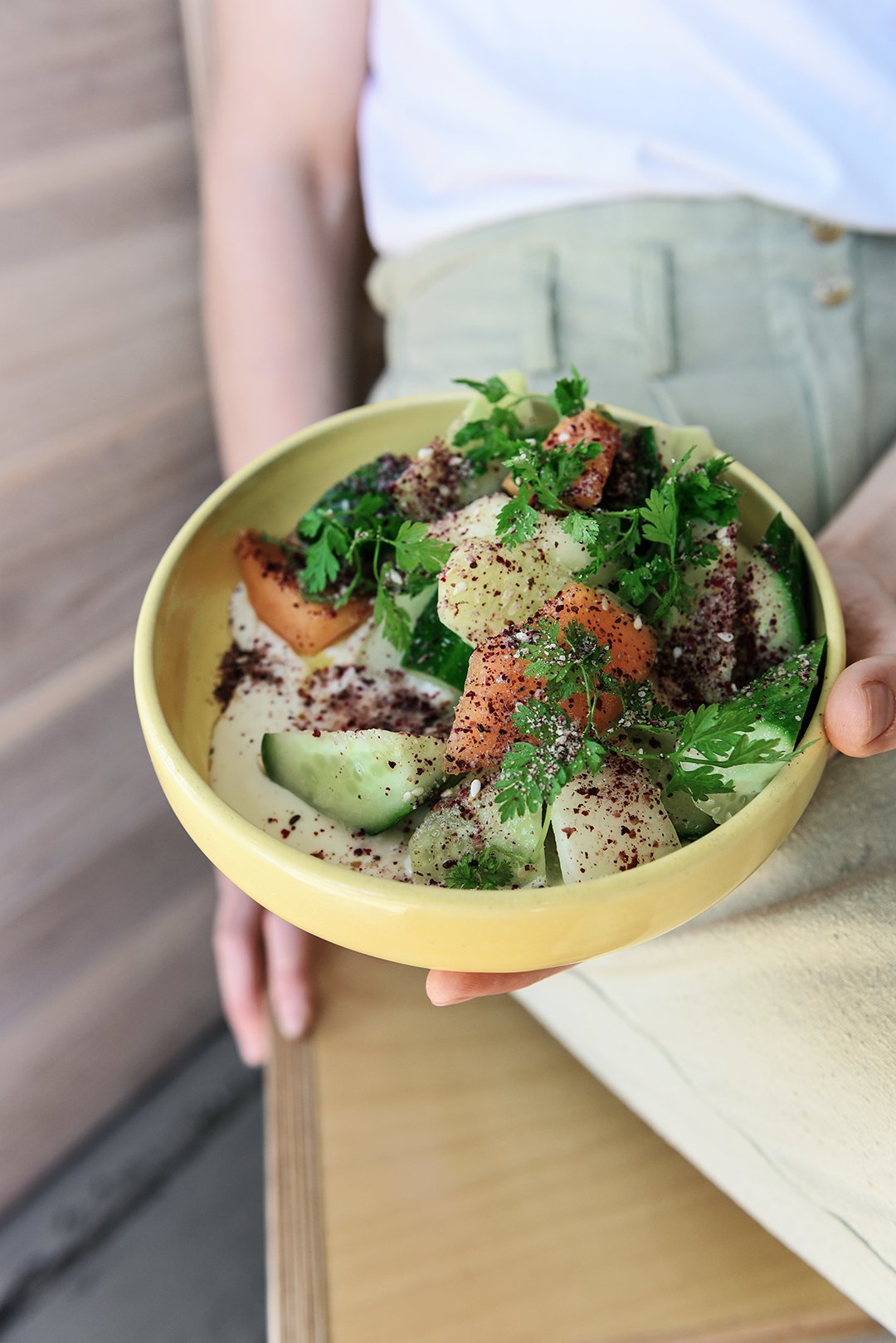

Meet In Your Kitchen | Alana Kysar's Hawaiian Poke & her sunny life in LA

Driving up and down Hollywood's soft hills is like swinging in a cradle in one of those dreams that you never want to end. Seduced by the sweet city cocktail of warm asphalt and colorful blossoms popping up behind the iron gates of the elegant Spanish-style mansions along the endless streets and boulevards cutting through the city, I had to pinch myself to believe that I finally arrived at the first stop of my culinary trip around the world, an adventure I started together with Zwilling.
These trips will take me to different continents to meet the locals and dive into the secrets and excitements of their cuisines. The cooking of each country, region, or even village is unique, but despite the differences, we have one thing in common wherever we live: we meet in the kitchen, at the table, to eat, drink, and feast together with the ones we love. This has never changed and I don't believe that this will ever change.
LA wins me over in an instant, always, whenever I go there. There seems to be freedom in the air, no boundaries, but opportunities. Palm trees gracefully grow into the endless blue sky, and even the Pacific hitting the long beaches of Venice and Malibu with its wild waves seem to mellow down as it touches the city's golden sand. LA just puts a smile on your face, you can't help it, it makes you focus on what's possible rather than the obstacles. It's magical and this might be the reason why so many people from all over the country working in the food scene come together in this beautiful spot in California, to work together, to create, and to let their visions become alive.
This, and the fact that the state's unbelievably pleasing weather lets the produce grow so lusciously that it turns the land into a Garden of Eden. Whoever I met in LA, praised the gift of having the best fruits and vegetables at hand almost all year round. All the chefs, home cooks, and farmers who I met in California, who often came from far-flung places and left their home town or country behind, were pulled and inspired by the ingredients that California brings to their kitchens.

This woman has the sweetest smile and the cutest sausage dog and I don't remember what hit me first when I met Alana Kysar in the hall of her elegant home in LA. The blogger and soon to be cookbook author lights up a room with her positive attitude and aura and makes you want to just sit in her kitchen and chat – and that's what I did.
I had been following Alana's work on her food blog, Fix Feast Flair, and on Instagram for years and she successfully made me curious to learn more about the cuisine of her roots. Born and raised in Hawaii, she has an inspiring cooking heritage that shines through most of the creations that come out of the kitchen in her new hometown LA. Her poke recipe in particular roused my appetite just by the look of the pictures on her blog and to finally cook this dish together with her in her minimalist kitchen perfectly equipped with a knife collection that would make every chef jealous, felt just right. We stood at the long counter, attentively watched by her sausage dog, LA's skyline sparkling right behind us, cutting tender tuna fillets that felt like butter. I can honestly say that I considered moving to California in that moment and becoming my host's sous-chef.
According to Alana, it's best to enjoy a bowl of poke on the beach, with a six pack of beer and a bunch of friends after work. It's a Hawaiian classic, slightly similar to Peruvian ceviche, however, the fish stays raw, it's not cured in citrus juices as in the South-American version. It's a very minimal dish that impresses with its simplicity and ingredients of outstanding quality. The spotlight is on the ahi (yellowfin tuna), cut into cubes and tossed in sesame oil, soy sauce, and Hawaiian salt, then you add some onions, nuts, and seaweed, the result is unbelievably tender and tasty. It's usually served with rice, which points to the fact that the roots of Hawaiian cooking are versatile but strongly connected to Asia. Japan, Korea, the Philippines, all these countries left a mark on the cooking of America's 50th state, but the Hawaiians adapted it to the produce that their islands offer: mainly fish, fruit, and vegetables – and lots of sugar.
Alana was born in Kona and raised in Kula on the island of Maui, surrounded by a family of true food lovers who also brought a great portion of humor into her life. Her father often cooked with young Alana and established a judging system for her creations: she'd get points for ingredients, creativity, and presentation. Her mother introduced her to the local cuisine, laid back dishes, she's a master in the kitchen who Alana admiringly describes with the words: she's all that I want to be in the kitchen. One of her chicken recipes must be so good, that the daughter is still trying to beat it.
However, you shouldn't be deceived by a beautiful woman's smile, the soon to be author describes herself as a dictator at the cooker. She knows how she wants everything chopped and done and doesn't accept compromises, even when it comes to her mom who had the honor - and pleasure - to test all the recipes in Alana's new book. The feedback was content from both sides, so I guess Alana Kysar isn't that far away from fitting in her kitchen idol's footsteps.
In the next months, I'll share many new Meet In Your Kitchen features with you that took me to California, Italy, France, and Japan. Thanks to Zwilling for sponsoring these features for our culinary trip around the world!


Alana Kysar's Ahi Poke Bowl
Serves 2
1 pound fresh ahi steak (yellowfin tuna), sashimi grade, cut into cubed, bite size pieces
1 tablespoon sesame oil
1 tablespoon soy sauce, plus more to taste
¼ cup thinly sliced sweet Maui onion (or sweet yellow onion)
¼ cup chopped green onions
½ teaspoon Hawaiian salt, plus more to taste
¼ teaspoon shichimi togarashi (Japanese seven spice) or chili pepper flakes
2 teaspoons finely chopped toasted macadamia nuts
1 teaspoon toasted white or black sesame seeds
1 handful fresh chopped ogo/ limu/ edible sea moss (optional)
Shredded nori (dried seaweed) or furikake (dried seaweed seasoning), for the topping
Cooked white rice (optional)
Place the ahi in a bowl.
Start by adding one tablespoon of sesame oil, soy sauce, the sweet onions, green onions, Hawaiian salt, shichimi togarashi or chili flakes, toasted macadamia nuts, sesame seeds, and the ogo/ limu (if using). Using your hands or wooden spoons, gently toss together and adjust the seasoning to your liking.
Divide the rice between 2 bowls. Arrange the poke on top of the rice and sprinkle with shredded nori or furikake, serve immediately.


Watch my interview with Alana in LA in September 2017:
Thank you, Alana!


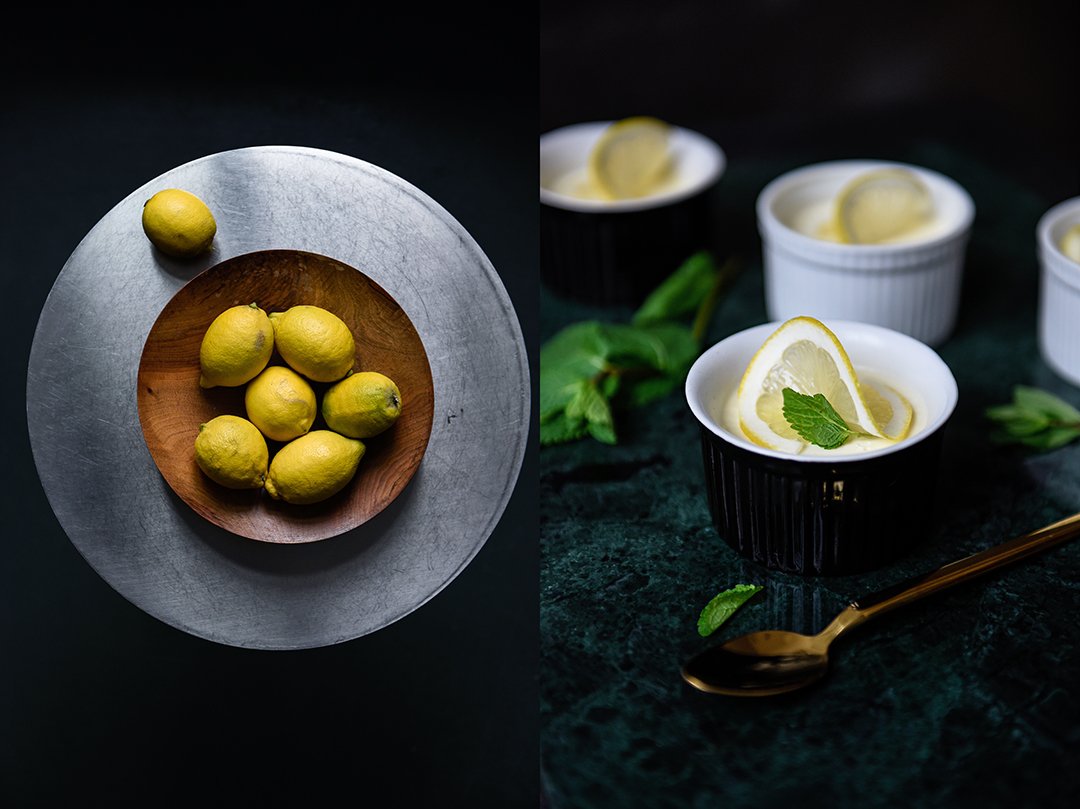
Limoncello Panna Cotta
Some years have the pace and mood of a little stream in the woods, burbling along quietly, without anyone really taking any notice of it. And then there are years that are more like a hungry wave, rolling like thunder and hitting the shore with a crash, ready to pull you off your feet and make you tumble in the most unexpected moments. 2017 had quite a few of these moments, whirling and twirling, they shook the world politically, socially, and environmentally, and also my own world on so many levels. It's exhausting when the ups and downs wear out the mind and squeeze it like a sponge, but it's also a challenge that forces us to question and grow in our own existence and that's its gift. I believe that our human mind needs to leave the known path once in a while, our comfort zone, that can easily become too comfortable and that makes us lazy. The irritating state of mess and confusion can be a great starting point to be brave and dive into the unknown, as much as I hate these moments as it's scary, I'm thankful, afterwards, when they force me to unfold the old, familiar pleats.
Just over 12 months ago, the Eat In My Kitchen book was sent out into the world and little did I know how much it would change my life and the way it used to be. In April 2017, Andrew Zimmern hung the medal for the James Beard Award for Best Cookbook in the General Cooking category around my neck, the state of bursting happiness, surprise, and thankfulness that I felt on that magical night in New York lasts until today. The world also revealed some of its culinary tricks and secrets to me as I travelled in America, Asia, and Europe during autumn. I was on the road for a new project and, for once, I let other people cook for me. I was introduced to the wonders of food in some parts of the world where I had never been before. It was pure bliss to experience new tastes and smells, to listen to unknown languages and learn about traditions and rituals that grew over centuries. And to see so many inspiring women in their kitchens, wherever I was, women who strongly believe in a gastronomic concept of respect and togetherness, women who create praised and highly celebrated restaurants, that made me happy and confident that the future will bring more and more of these fantastic female chefs into the spotlight.
In 2017, we all lost and gained, we gave and took, and as long as the exchange feels balanced, it was a good year. Before I pull the plug and go offline for a week, finally after 4 years of constant buzzing, I have one more thing to give to you: the recipe for this joy-bringing limoncello panna cotta. Now you have a sweet recipe at hand, for the moments when life gives you lemons.Enjoy food, wine, and especially time with the ones you love, have a happy Christmas and a joyful start to an exciting 2018!
Meike xxx

Limoncello Panna Cotta
Serves 2 to 4
gelatin sheets 2 1/2 (7 x 11-cm / 3 x 4-inch)
heavy cream 240 ml / 1 cup
whole milk 120 ml / 1/2 cup
Limoncello 60ml / 1/4 cup
lemon peel 2 long strips
granulated sugar 2 tablespoons
fine sea salt 1/8 teaspoon
lemon slices, very thinly cut for decoration (optional)
fresh mint leaves for decoration (optional)
Soak the gelatin sheets in cold water for about 5 minutes.
In a small saucepan, bring the cream, milk, Limoncello, lemon peel, sugar, and salt to the boil. As soon as the mixture is bubbling, take the pan off the heat. Squeeze the excess water from the soaked gelatin sheets, crumble into the warm cream mixture, and whisk thoroughly. Let the mixture cool in the pan, whisking occasionally.
Once the cream mixture is at room temperature—it will still be liquid—divide it between 4 120-ml /4-ounce ramekins. Cover them with plastic wrap and refrigerate for 1 hour. Transfer the ramekins to the freezer and chill for about 35-45 minutes or until set but not frozen. Alternatively, leave the ramekins in the refrigerator for about 3 hours or overnight.
Decorate the panna cotta with lemon slices and mint just before serving.



23 Recipes for Cozy Christmas Baking

Berlin, December 2017:
I'm sitting at my dining table, listening to Jingle Bells, wrapping Christmas presents, and waiting for the snow to fall. It's the last weekend before Christmas, the last chance to fill the kitchen with the tempting smell of cinnamon, cloves, and citrus fruits, cardamom, chocolate, and candied nuts, so what am I going to bake? I picked 23 recipes from the last four years of cozy Christmas feasting on Eat In My Kitchen and I love each one of them. Just a look at the pictures and my taste buds get excited. I can remember the woody notes of my Rosemary and Lemon Heidesand Cookies, the citrusy-buttery sweetness of my Mediterranean family's Maltese Lemon Christmas Cookies, the elegance of my mother's classic, her Linzer Cookies, and of course, my annual highlight, the best Vanilla Kipferl in the world. You can find a variation of this famous German cookie in my Eat In My Kitchen book, wonderfully fragrant Cardamom Kipferl. So, happy baking, treat yourself to a cozy weekend with the ones you love and indulge in the pleasures of Christmas baking!
Click on the titles for the recipes:




Chocolate, Orange and Cardamom Stollen
My granny Lisa was loved and adored for many of her baked goods. She truly mastered the German Sunday coffee table, filling the house with the sweetest smell of butter, sugar, and eggs every weekend. To please her six children's cravings, and later a growing pack of grandchildren, she sometimes baked seven different cakes in one day. Sponge and fruit cakes, cream tarts and crumbles were often lined up on her kitchen counter and doubtlessly influenced my own baking habits. Her Donauwelle - a marbled cake with cherries and buttercream - will always be my favourite. It's the taste of my childhood - and the beginning of my ever hungry sweet tooth.
Six to eight weeks before Christmas, Lisa used to take orders from friends and family for another one of her celebrated classics: stollen. It's a German staple that you can find at every bakery, in every household as soon as the Christmas lights leave the boxes to twinkle behind wintery windows. The original stollen is quite a dense treat, it's a heavy yeast dough, the texture is crumbly like a fruit bread, but it has richness and depth. Raisins, candied orange and lemon peel infuse the cake for weeks while it sits wrapped in parchment paper in the darkness of the pantry. The top brushed with warm fat and then generously dusted with icing sugar, preventing it from drying out and giving it its snowy white Christmas look.
You can find various interpretations of the basic formula and fill the cake with marzipan, hazelnut or poppy seed paste to add taste and moistness. This is the first stollen recipe I ever created and I wanted it to be an aromatic firework of flavours without distracting from the classic's qualities. I went for bittersweet chocolate chunks, candied orange peel, and a touch of christmassy cardamom and aniseed. I'm more impatient than my granny, so we ate the stollen immediately. There's only one treat that I manage to wait for and that's English Christmas pudding.
Thanks to Kærgården for sponsoring this post, thanks for reminding me of my granny's kitchen and inspiring me to create my first stollen recipe!


Chocolate, Orange and Cardamom Stollen
For the stollen
plain flour 450g / 3 1/2 cups (divided)
granulated sugar 70g / 1/3 cup
ground cardamom 5 teaspoons
aniseed, finely ground in a mortar, 1/4 teaspoon
zest of 1 large orange
fast-acting yeast 2 sachets (7g / 1/4 ounce each)
water, lukewarm, 150ml / 2/3 cup
fine sea salt 1/8 teaspoon
soft butter, unsalted, 250g / 9 ounces
candied orange peel (preferably organic) 100g / 4 ounces
almonds, roughly chopped, 150g / 5 ounces
bittersweet chocolate (50%), roughly chopped, 170g / 6 ounces
For the topping
butter, unsalted, melted 50g / 2 ounces
icing sugar, sifted, about 4-6 tablespoons (to taste)
ground cardamom (optional, to taste)
In the large bowl of a stand mixer, combine 260g /2 cups of the flour, the sugar, cardamom, aniseed, orange zest, and yeast. Add the water and, using the hooks, mix for about 2-3 minutes or until well combined. If the dough is too sticky, add a little more flour. Cover the bowl with a tea towel and let the dough rise in a warm place, or preferably in a 35°C (100°F) warm oven, for 45 minutes or until almost doubled in size.
If the dough has almost doubled in size, add the remaining 190g / 1 1/2 cups of flour, the salt, butter, and orange peel and, using the hooks of the stand mixer, mix for about 3 minutes until smooth. Add the almonds and chocolate and continue mixing until well combined. The dough should be soft and shiny, but not sticky. Take the dough out of the bowl and, using your hands, knead for about 1 minute.
Line a baking sheet with parchment paper.
Transfer the dough to the lined baking sheet and form a short-ish loaf-shape. Flatten the dough a little, flip one long side over until it reaches the middle, then flip over the other long side (see 6th picture), pushing the layers softly together, but don't flatten the loaf, it will expand when it's in the oven! Cover with a tea towel and let rise for about 20 minutes.
Preheat the oven to 175°C / 350°F.
Bake the stollen for about 45-50 minutes or until the loaf is just baked through.
For the topping, brush the top of the warm stollen with the melted butter and dust immediately with icing sugar. If you'd prefer the cardamom to be more present (I recommend to try the stollen first), combine some icing sugar with additional cardamom (to taste) and dust the top of the stollen.
You can serve the stollen immediately, yet I prefer to eat it when it's cool and the chocolate isn't soft anymore. Keep it wrapped in parchment paper and aluminium foil.



Molly Yeh's Chocolate Tahini Cake with Tahini Frosting
Time can feel like a race, it drags you back, you try to keep up, but there's no way to stop. My summer flew by and then there was autumn, as quick as a storm that sweeps all the leaves off the trees, within one night they are all gone.
My last post was on August 27th. Since I started these pages, my Eat In My Kitchen blog, I have never 'abandoned' it for such a long time. It used to feel weird if I didn't come back here every day, like in the first year, or at least every few days like I did in the past 3 years. It was my routine that I loved and hated. Sometimes I did feel pressured, just by myself, and the best thing to escape pressure, at least for me, is another project that sucks me in with such intensity that all my brain cells are too busy to think about anything else. I'm involved in a new project at the moment that I'll only be able to share with you at the beginning of 2018, and this project took me around the world within just a few weeks. I met the most amazing people, I felt hungry and inspired every day, I pushed my borders, which I need to keep my creativity flowing and which I could only do because I had an amazing team around me. So far we went to California, Italy, France, and Japan, and there will be more countries to come. It's quite a journey.
These trips in the past 2 months were one of the reasons why I stayed away from my kitchen, why I didn't go to the farmers market as often, why I didn't experiment, fail and succeed at my cooker, but I discovered new worlds and culinary universes that I can't wait to include in my own cooking - once I'm fully back home and ready to cook.
The second reason I stopped writing, is one that hit me deeper, right into my head, my heart, and my bones. On October 16th, Daphne Caruana Galizia was brutally killed in Malta. She was the most wonderful woman, the bravest I know, she was a mother of three young men, and she was a friend. Daphne fought for freedom and justice, for all of us, she was a well known investigative journalist and blogger. It was late in the evening and I was in Tokyo when I found out, I could only scream and run outside into the dark. Since then, I've been angry, too angry, which never helps anybody. I tried to find words for what happened, but I didn't manage. A few days after I found out, I started writing a post to share here, but it was just anger screamed out into the world. You can say that this is a food blog, and you're right, but this is a food blog written out of my perspective, so whatever influences me as a person will find its way into my kitchen, onto my table, and onto this blog. I can't really say more, my words aren't really back yet, I still feel numbed, but I wanted to put what happened in words, that Daphne Caruana Galizia was killed for saying the honest, painful truth, for being critical, for fighting for our freedom. I will never forget her and my thoughts are with her and her family every day. One of her sons, Matthew Caruana Galizia, continues her work, he just won the Pulitzer prize as a part of a group of investigative journalists who disclosed the Panama Papers first and then the Paradise Papers just recently. We have to support the ones who are brave enough to open their mouth and talk, maybe louder than we'd dare to do, and we have to show that they are not alone and that we are with them.
My mother taught me that life can be beautiful and brutal and that we have to deal with both sides. Sometimes they lay so close to each other that we don't even know how to deal with it. We enjoy the heights to the fullest and then, in the next second, we seem to drown. The place where I often go to when I feel battered by life, is my kitchen, I cook and I bake. And although I've neglected this space so much recently, I have long lists of kitchen projects that I want to dive into during Berlin's long lasting winter.
To cook - and bake - from my friend Molly's Molly On The Range cookbook was on the top of my list, her book came out at the same time as mine, a year ago. Molly and I just met again while I was in California, her compelling, charming way to talk about food and life in general never ceases to amaze me. Molly also knows how to make cakes look so pretty that you wouldn't dare to cut them, like her famous Funfetti Cake or her Gingerbread Farm, a replica of the actual farm where she lives with her husband (you can read her interview for our Meet In Your Kitchen feature in 2015 here). Molly is the kind of person who somehow manages to combine the talents of a perfectionist with the casual laid back attitude of a person who doesn't care about perfectionism at all. Molly's German book was only recently published and when I got the book and spotted the recipe for today's chocolate tahini cake, I was hooked as soon as I read the title.
This was the first cake that I baked in months, and I didn't even notice how much I missed baking until I turned on the oven and thumbed through the pages of Molly's beautiful book. Sometimes, the best thing I can do is to take some time for myself in my kitchen, with eggs, butter, and sugar (and some tahini), and listen to Molly and bake this cake that tastes so unbelievably perfect. It's chocolate, it's tahini, it's sweet, and it's all I needed at the moment to feel ready to face the world again, with all its beauty and its brutality. Thank you, Molly!


Chocolate Tahini Cake with Tahini Frosting
from Molly Yeh's 'Molly On The Range - Recipes and Stories from an Unlikely Life on a Farm'
I only made half of this recipe and decorated the cake with dates and sesame seeds.
Makes one 2-layer 8-inch (20cm) cake or 24 cupcakes
For the cake
1 3/4 cups / 350g sugar
1 3/4 cups / 220g flour
1 cup / 100g unsweetened cocoa powder
1 1/2 teaspoons kosher salt
1 1/2 teaspoons baking powder
1 1/2 teaspoons baking soda
2 eggs
1 cup / 240ml whole milk
1 tablespoon vanilla extract
1/4 cup / 4 tablespoons flavorless oil
1/2 cup / 120g tahini
3/4 cup / 180ml boiling water
For the frosting
1 cup / 240g unsalted butter, softened
1/2 cup / 120g tahini
2 cups / 200g confectioners’ sugar
1/8 teaspoon salt1/4 teaspoon cinnamon
1 1/2 teaspoons vanilla
To make the cake, preheat oven to 350ºF (175°C). Grease and line the bottoms of two 8-inch (20cm) cake pans or line 24 cupcake tins and set aside.
In a large bowl, whisk together the sugar, flour, cocoa powder, salt, baking powder, and baking soda. In a separate, medium bowl, whisk together the eggs, milk, vanilla, oil, and tahini. Add the wet ingredients to the dry ingredients and stir to combine. Whisk in the boiling water.
Pour the batter into the cake or cupcake pans and bake until a toothpick inserted into the center comes out clean. Begin checking for doneness at 28 minutes for cakes and 18 minutes for cupcakes. Let cool in the pans on a rack for 10 minutes and then remove to the rack and cool completely.
To make the frosting, in the bowl of a stand mixer fitted with a paddle attachment, mix together the butter and tahini until creamy. Gradually add the powdered sugar and mix to combine. Mix in the salt, cinnamon, and vanilla.
To assemble, you can either go the traditional route, or crumble up the cake layers with your hands, layer about a 1/3 of them in the bottom of a larger bowl, top it with 1/2 the frosting, another 1/3 of the cake, the remainder of the frosting, and then the remainder of the cake.




Peach, Chèvre and Rosemary Tart
I allowed myself a few treats during our Mediterranean summer in Malta. I went snorkeling far more often than in the past few years, when my cookbook determined my schedule, I had a few girly shopping moments, and my man and I relaxed at the stunning - and newly renovated - Phoenicia Hotel in Valletta. We enjoyed stunning views from their infinity pool with a glass of crisp Maltese wine close at hand and indulged in lush breakfast buffets and fine French inspired cuisine on their gorgeous terrace overlooking the gardens.
Malta treated us well, the Mediterranean pace and hot climate force me to slow and calm down, something I only truly manage there. Nothing feels as heavy, as worrying or threatening as it might feel anywhere else, everything feels manageable and enjoyable. It's not so much about duties, but about collecting and treasuring the good moments in life. This also reflects in my cooking. If I spent a couple more hours at the beach, we just cooked dinner a bit later, or kept it simple by throwing a fish on the grill and drizzling some fresh lemon juice over it. It's pure, it's good, and it allows me to have more time to chill and chat with a friend, to sit on the rocks a little longer and see the sun disappear into the sea's faded evening-blue.
Another one of my lazy summer recipes is this lovely little sweet and savoury tart: ripe peaches, soft chèvre and Mediterranean rosemary spread on top of (store-bought!) puff pastry. You could also make your own, or use short crust pastry, but my lazy self just went to the supermarket and bought frozen Maltese puff pastry - the best I know.
The tart turned out even better than expected, offer it to your friends who don't have a sweet tooth at teatime, or slice it up for a relaxed late summer dinner in the garden or on the balcony and pop open a bottle of wine. Heaven.
This recipe also works with grapes!

Peach, Chèvre and Rosemary Tart
Makes 1 (28cm / 11″) tart, serves 4-6
frozen puff pastry, defrosted, 320g / 11 ounces (you can also use short crust pastry)
large ripe peaches, cut into wedges, 4-5
mild soft chèvre, crumbled, about 150g / 5 ounces
fresh rosemary, finely chopped, 1 generous tablespoon
liquid honey 2 1/2 tablespoons
Preheat the oven to 200°C / 400°F and butter a 28cm / 11″ tart pan.
Line the tart pan with the puff pastry, pushing the pastry into the pan, and put in the freezer for 5 minutes.
Spread the peaches in a circle on top of the pastry, sprinkle with the chèvre and rosemary, and drizzle with the honey. Bake for about 35 minutes or until the pastry is golden brown and crisp at the edges (mind the heat, I use a gas oven in Malta, which is not as precise as my oven in Berlin).
Let it sit for about 10 minutes before serving and enjoy!


